Local SEO for Personal Trainers on Squarespace: Rank for Your City
Introduction
When someone searches "personal trainer near me" or "weight loss trainer in city," do they find you? Most personal trainers and fitness studios don't rank for their own city. Instead, they watch competitors who actually optimised their local SEO grab clients from search results, maps, and Google recommendations.
Local SEO is the practice of optimising your online presence so fitness clients in your geographic area find you easily through Google search, Google Maps, and local recommendations. For personal trainers and fitness studios, local SEO is often more valuable than national ranking because most clients prefer trainers they can meet in person. A personal trainer in Manchester ranking for "personal trainer near me" in Manchester generates far more qualified leads than ranking for "best personal trainers UK" nationally.
This guide walks you through local SEO specifically for personal trainers and fitness studios on Squarespace — from Google Business Profile setup and location pages to review generation and local link building. Whether you operate in-person, online, or both, you'll learn how to rank for your city and attract local clients searching for fitness coaching.
Key Takeaways
Google Business Profile is non-negotiable: Optimise your GBP completely — photos, categories, posts, reviews. This is where most local searches start.
Rank for city-specific keywords: "Personal trainer in [city]," "PT near me," "weight loss training [city]" — these convert better than generic terms because intent is local.
Client reviews are ranking factors: Google prioritises listings with recent reviews and high ratings. Ask satisfied clients for reviews ethically and consistently.
Location pages on Squarespace drive local search: Create dedicated pages for each location you serve (if multi-location), optimised for city-specific keywords.
Local link building matters: Partner with local physiotherapists, nutritionists, health practitioners — these relationships generate referrals and local link signals.
Understanding Local SEO for Fitness
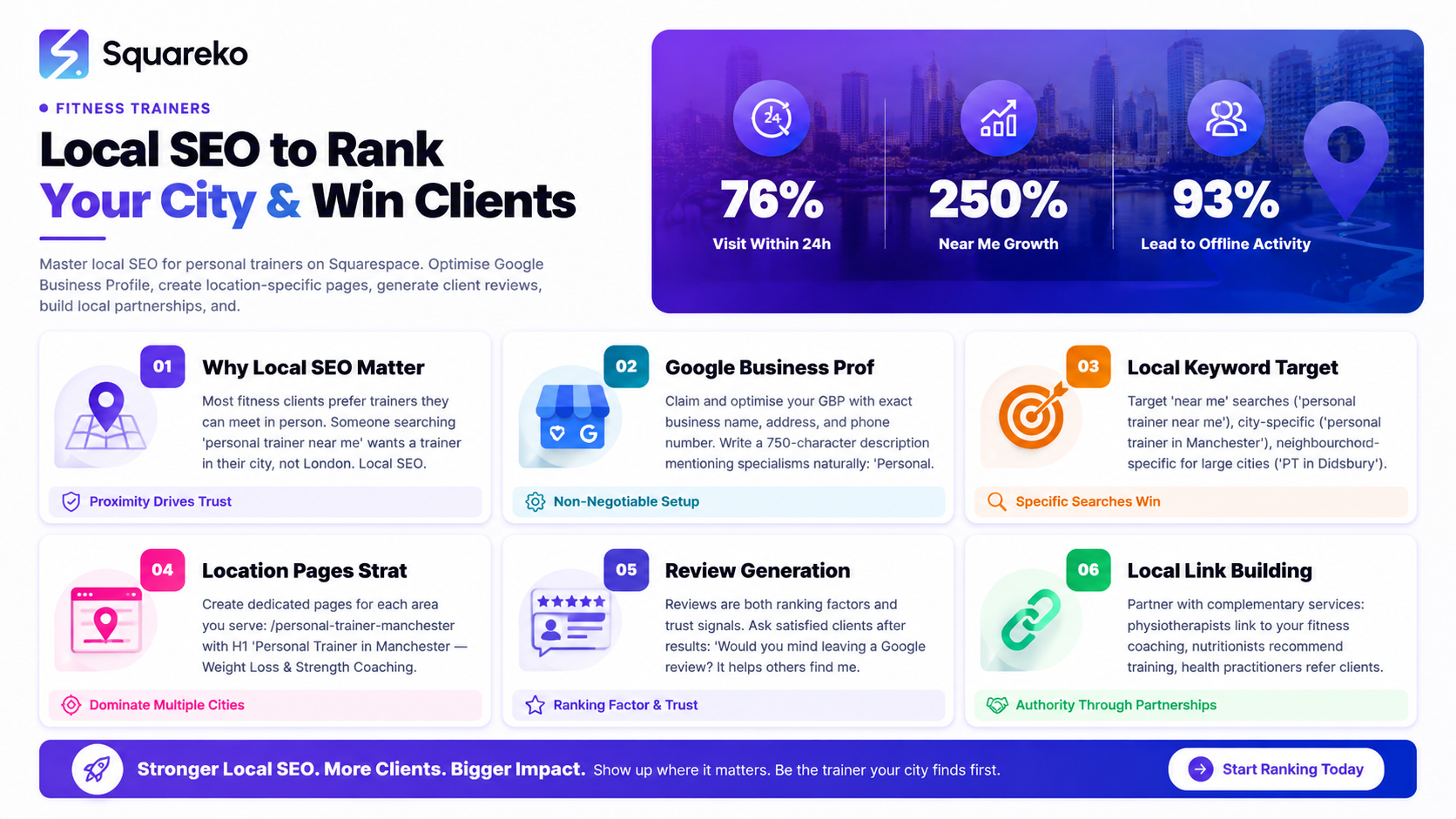
Local SEO is how you dominate search results in your city or region. For fitness professionals, it's gold.
Why Local SEO Matters for Trainers
Most fitness clients prefer local trainers. Someone in Leeds searching "personal trainer near me" wants a trainer in Leeds, not London. Local SEO ensures you appear when that search happens.
Local search behaviour:
76% of people who search for a local business on mobile visit the location within 24 hours
"Near me" searches have grown 250% in 5 years
Google Maps gets more traffic than Google organic search for fitness and health businesses
93% of local searches lead to offline (in-person) activity or sales
For fitness specifically:
Clients trust trainers within their city more than faceless online programmes
Local recommendations (referrals, reviews) drive bookings
Showing up in Google Maps when someone searches "gym near me" or "personal trainer" = instant credibility
Local vs Organic SEO
Organic SEO: Ranking for "how to lose weight," "best strength training," "fitness tips" — national or broad searches.
Local SEO: Ranking for "personal trainer in Manchester," "weight loss coach near me," "fitness studio in my area" — location-specific searches.
For personal trainers and fitness studios, local SEO is often more important because:
Most clients search locally
Less competition in local results than national
Easier to rank locally (you don't need thousands of backlinks)
Local rankings convert faster (high intent)
Google Business Profile Setup and Optimisation
Google Business Profile (GBP) is your command centre for local search. It appears in Google search results, Google Maps, and Google recommendations. Optimising it is non-negotiable.
Creating and Claiming Your GBP
If you don't have a GBP:
Go to Google Business Profile (google.com/business)
Click "Create Account"
Enter your business name, address, and phone number
Verify ownership (Google sends a postcard to your address, or verify by phone/email)
Complete your profile
If you already have a GBP:
Claim it (if you haven't already) by verifying ownership
Optimising Your GBP
1. Business Information — Complete and Accurate
Business name: Exact legal name. Don't keyword-stuff ("Manchester Personal Training Specialist Trainer PT"). Google penalises this.
Address: Your actual business address (if you have a studio). If you're mobile/home-based, leave blank or use a local address.
Phone: A dedicated business number (not personal mobile, if possible).
Website: Link to your Squarespace website.
Hours: Accurate business hours. Update during holidays/closures.
2. Business Categories — Choose Correctly
Categories are crucial for local ranking. Choose all that apply:
Personal Trainer (primary category if you do 1-to-1 training)
Fitness Center (if you have a studio)
Health & Fitness (general)
Sports Activity Location (if you host group classes)
Nutritionists (only if you provide professional nutrition services)
Don't overcrowd; choose 3–5 relevant categories maximum.
3. Business Description — Keyword-Optimised
Write a 750-character description that:
Mentions your specialisms (weight loss, strength, postnatal, athletic performance)
Includes local keywords naturally ("personal training in Manchester," "weight loss coaching for Leeds professionals")
Highlights what differentiates you ("specialising in sustainable strength training," "REPs accredited," "10+ years experience")
Example: "Personal training in Manchester specialising in weight loss and strength coaching for busy professionals. REPS Level 4 accredited with 8+ years experience. We offer 1-to-1 sessions, group classes, and online coaching. Results-focused. Free consultation available."
4. Photos — Professional and Varied
Upload 10+ high-quality photos showing:
Your studio/location (if applicable)
You training clients (with consent)
Equipment and facilities
Client transformations (before/after with consent)
Team members (if multi-trainer)
Testimonial cards or results displays
Pro tip: Rotate photos monthly. Fresh content signals activity to Google and keeps your listing looking current.
5. Business Hours and Openings
Accurate hours for each day
Mark holidays/closures as unavailable
Specify hours for different services (1-to-1 training 7am–7pm, group classes 6pm–7pm)
6. Google Posts
Post updates and promotions to your GBP (like social media, but on Google). Examples:
"New 12-week weight loss programme launching Jan 15. Book your free trial session"
"Client spotlight: Jamie lost 12kg in 12 weeks. Transformation story in link"
"Summer special: 3 sessions per week package, £50 off for first month"
"Now offering postnatal fitness coaching. Safe, effective training after pregnancy"
Post 2–4 times monthly. Posts live for 7 days, then archive.
7. Questions & Answers
Monitor and respond to questions customers ask about your business:
"Do you offer online training?" → "Yes, we offer 1-to-1 online sessions and digital programmes"
"What qualifications do you have?" → "REPS Level 4 Personal Trainer, 8 years experience, insured"
"Do you work with beginners?" → "Absolutely, we specialise in beginners and busy professionals"
Respond professionally and thoroughly within 24 hours.
Review Management
Reviews are crucial for local ranking and client trust.
Generating reviews (ethically):
Ask satisfied clients in person: "Would you mind leaving a Google review? It helps other people find us"
Send a follow-up email after successful sessions: "If you've enjoyed your training, a Google review would mean a lot"
Include a link to your GBP review section
Incentivise ethically: "If you leave a review, I'll give you a free nutrition consultation" (disclosure: don't directly pay for reviews)
Responding to reviews:
Respond to all reviews — positive and negative — within 48 hours
Thank positive reviewers: "Thanks Sarah! Your dedication is inspiring. Looking forward to your next session"
Address negative reviews professionally: "We're sorry your experience wasn't great. Let's chat about how we can improve. Please call us at number"
Target: 4.5+ rating average, 20+ reviews within first year.
Choosing and Targeting Local Keywords
Local keywords are the foundation of local SEO. Choose the right ones and you'll attract qualified leads.
Types of Local Keywords
1. "Near me" searches:
"Personal trainer near me"
"Gym near me"
"Weight loss coach near me"
2. City-specific searches:
"Personal trainer in Manchester"
"PT in Leeds"
"Fitness coaching Manchester"
3. Neighbourhood-specific (if you're in a large city):
"Personal trainer in Didsbury" (Manchester suburb)
"Fitness studio in Shoreditch" (London area)
4. Service + location:
"Weight loss training Manchester"
"Postnatal fitness coaching Leeds"
"Strength training for women in [city]"
5. Intent-based + location:
"How to lose weight in Manchester" (informational, but leads to local coaching)
"Fitness for busy professionals [city]"
Keyword Research for Local
Tools:
Google Search: Type your keyword in Google, see what autocompletes. "Personal trainer in [city]" — Google will auto-suggest variations.
Google Trends: See search volume trends for your keywords locally
Google Maps: Search your keywords; see who ranks, what categories appear
Semrush local tool: Paid tool showing local keyword difficulty and volume
Research workflow:
Start with "personal trainer in city"
Add modifiers: "weight loss," "strength," "postnatal," "for beginners"
Add intent: "how to," "best," "near me"
Target 5–10 primary keywords for your Squarespace site
Creating Location Pages on Squarespace
If you serve multiple areas or want to dominate multiple cities, create dedicated location pages.
Location Page Structure
For each city/area you serve, create a page:
URL: /personal-trainer-manchester (or /pt-manchester)
Content:
H1 with location keyword: "Personal Trainer in Manchester | Weight Loss & Strength Coaching"
Local image: Photo of you in a Manchester setting or your studio
Local opening: "Looking for a personal trainer in Manchester? I offer 1-to-1 training, online coaching, and group fitness for busy professionals across Manchester and surrounding areas."
Service description: Customised for the location if relevant
Testimonials from local clients: If you have clients from that area
Local credentials: Mention if you're based there, community involvement, etc.
Local CTAs: "Book your free trial session" with location-specific context
Local map: Embed Google Map of your location or the city
Schema markup: LocalBusiness schema with address, phone, coordinates
Example for Manchester location page:
# Personal Trainer in Manchester — Weight Loss & Strength Coaching
Looking for a qualified personal trainer in Manchester who understands your goals and fits your schedule? I'm a REPS-accredited Level 4 Personal Trainer based in Didsbury, Manchester, specialising in weight loss and strength training for busy professionals.
## What I Offer in Manchester
**1-to-1 Personal Training** — In-person sessions at your home, my studio, or your gym. Customised programmes, real-time coaching.
**Online Coaching** — Can't meet in person? 1-to-1 online sessions via Zoom with full programming and accountability.
**Group Classes** — Weekly strength and fitness classes for beginners and intermediate clients in Manchester.
## Why Clients in Manchester Choose Me
- **REPs accredited and insured** — Professional standards
- **8+ years experience** — Proven track record
- **Specialisation in weight loss** — Sustainable, strength-based approach
- **Flexible scheduling** — Early mornings, evenings, weekends
## Client Transformations from Manchester
[Client testimonials from Manchester-based clients]
[Before/after photos from local clients]
## Book Your Free Trial Session in Manchester
[Booking button linked to Squarespace Scheduling]
## Map of Manchester Studio
[Embedded Google Map]
Multi-Location Strategy
If you serve multiple cities, create a location page for each:
/personal-trainer-manchester
/personal-trainer-leeds
/personal-trainer-birmingham
This approach:
Targets each city's local keywords
Builds relevance for "personal trainer in [city]" searches
Generates more local landing pages for Google to crawl
Client Review Generation Strategy
Reviews are both a ranking factor and a trust signal. More reviews = higher rankings + more conversions.
Ethical Review Generation
During sessions:
Deliver excellent service
Ask clients about progress, satisfaction, experience
Build rapport
After results:
When a client achieves results, that's your best moment to ask for a review
Personal request: "I'd love a Google review. It helps other people find me and means the world"
Follow-up email template:
"Hi [Client],
Thanks for working with me these past [weeks/months]. I'm thrilled with your progress [specific result: weight loss, strength gain, confidence].
If you've enjoyed your training, I'd really appreciate a Google review. It helps other people in [city] find me and choose great fitness coaching.
Here's the link: [Google Business Profile review link]
Thanks for your support! [Your name]"
Making Review Requests Easy
Share the direct link: Use Google Business Profile's "Share" function to get a shareable review link. Email or text this link to clients.
Instructions: Briefly explain where to write the review (Google, Google Maps)
Timing: Ask after a visible result (week 4 of a programme, after a major achievement)
Review Targets
First 3 months: 5–10 reviews (small client base)
First year: 15–20 reviews (establish credibility)
Ongoing: 2–3 reviews monthly (maintain momentum)
Local Link Building for Fitness
Local links (websites linking to you from your city) are ranking factors for local search. They also generate referrals.
Local Link Building Opportunities
1. Partnerships with complementary services:
Local physiotherapists → link to you for fitness/strength coaching
Nutritionists → link to you for training (they recommend training + nutrition together)
Health practices → link to you for fitness referrals
Chiropractors → link to you for posture/strength work
2. Local directories:
ukfitness.co.uk
Local business directories (Better Business Bureau, etc.)
Local chamber of commerce websites
Fitness specialist directories
3. Media and local press:
Local news (radio, online papers) feature on "local fitness professionals"
Contributes fitness tips to local lifestyle publications
Quoted in local health articles
4. Local events and sponsorships:
Sponsor local charity runs or fitness events
Exhibit at local health expos
Write for local community blogs or publications
5. Google My Business link placement:
Ensure your Squarespace website links back to your GBP
Include your GBP link in your email signature
Simple Local Link Building Process
Identify 10 local complementary services (physios, nutritionists, health practitioners)
Reach out: "Hi [name], I work with clients in [city] on strength and fitness. Many of my clients also see [physiotherapist/nutritionist]. Would you be open to a reciprocal link? I'd link to your practice, and you link to my training."
Create a referral relationship: Not just links, but actual referrals. Send physio clients who need fitness coaching to each other.
NAP Consistency Across the Web
NAP = Name, Address, Phone. Consistency across Google Business Profile, your Squarespace site, local directories, and anywhere else you list your business is crucial for local ranking.
NAP Audit
Check that your NAP is consistent everywhere:
Google Business Profile: Your Name, Address, Phone
Squarespace website: Contact page, footer, all location pages
Local directories: Any directories you're listed on
Social media: Instagram, Facebook, TikTok bios
Example of consistency:
Google Business Profile: "Walid Hassan Personal Training, 123 Didsbury Road, Manchester M20 2XX, 0161 XXX XXXX"
Squarespace website: Same name, address, phone
Local directories: Same format
Social media: Mention city/location consistently
Don't inconsistently use:
Different phone numbers for different listings
Abbreviated vs full address (e.g., "Manchester" vs "M20 2XX")
Business name variations
Schema Markup for Local Fitness
Schema markup helps Google understand your business is local and fitness-related. Add this to your Squarespace website (via Code Injection).
LocalBusiness Schema
<!-- Please remove the commented script wrapper and add this schema inside a proper <script type="application/ld+json"> tag. -->
{
  "@context": "https://schema.org",
  "@type": "LocalBusiness",
  "@id": "https://yourwebsite.com",
  "name": "Your Name Personal Training",
  "image": "https://yourwebsite.com/image.jpg",
  "description": "Professional personal training in [City]. Specialising in weight loss, strength training, and fitness coaching.",
  "address": {
    "@type": "PostalAddress",
    "streetAddress": "123 Main Street",
    "addressLocality": "Manchester",
    "addressRegion": "Greater Manchester",
    "postalCode": "M20 2XX",
    "addressCountry": "GB"
  },
  "telephone": "+44161XXXXXXX",
  "url": "https://yourwebsite.com",
  "sameAs": [
    "https://www.facebook.com/yourpage",
    "https://www.instagram.com/yourprofile"
  ],
  "priceRange": "££",
  "ratingValue": 4.8,
  "reviewCount": 25,
  "openingHoursSpecification": {
    "@type": "OpeningHoursSpecification",
    "dayOfWeek": "Monday",
    "opens": "07:00",
    "closes": "19:00"
  }
}
ExerciseGym Schema
<!-- Please remove the commented script wrapper and add this schema inside a proper <script type="application/ld+json"> tag. -->
{
  "@context": "https://schema.org",
  "@type": "ExerciseGym",
  "name": "Your Name Personal Training",
  "address": {
    "@type": "PostalAddress",
    "streetAddress": "123 Main Street",
    "addressLocality": "Manchester",
    "postalCode": "M20 2XX",
    "addressCountry": "GB"
  },
  "telephone": "+44161XXXXXXX",
  "url": "https://yourwebsite.com",
  "amenityFeature": [
    {
      "@type": "LocationFeatureSpecification",
      "name": "Personal Training"
    },
    {
      "@type": "LocationFeatureSpecification",
      "name": "1-to-1 Coaching"
    },
    {
      "@type": "LocationFeatureSpecification",
      "name": "Group Classes"
    }
  ]
}
Mobile Optimisation for Local Search
Most local searches happen on mobile. Your site must be mobile-optimised.
Mobile Essentials for Local SEO
Click-to-call button: One tap calls your business. Essential on mobile.
Map integration: Easy access to your location, directions, hours
Fast loading: Mobile pages load quickly (Squarespace compresses images automatically)
Local information above fold: Address, hours, phone, booking button visible immediately
Touch-friendly buttons: Large, easy to tap
Measuring Local SEO Success
Track metrics that matter for local SEO.
Key Metrics
Local ranking positions: Where do you rank for "personal trainer in [city]" on Google and Google Maps? Target top 3.
Google Business Profile views: Monthly views (Google shows this in GBP analytics)
Website traffic from local searches: Google Search Console shows keywords; filter for local variations
Phone calls from Google Business Profile: GBP analytics tracks calls to your business from your listing
Google Maps direction clicks: Directions requests show strong local intent
Reviews (quantity and rating): 4.5+ rating with 20+ reviews in first year is strong
Bookings from local search: Track clients who mention "found you on Google" or "saw you in Google Maps"
Monitoring Tools
Google Search Console: Free; shows local search keywords driving traffic
Google Business Profile: Built-in analytics show views, calls, directions
Google Analytics: Track traffic sources; segment by local/organic
Local rank tracking tools: Semrush, Ahrefs, SEMrush have local rank trackers (£20–100+/month)
Mid-Post CTA: Ready to Dominate Local Search for Your City?
Local SEO is one of the highest-ROI investments for personal trainers and fitness studios. Ranking for "personal trainer in city generates consistent, qualified leads of people actively searching for your services right now.
At Squareko, we specialise in local SEO for fitness professionals. We'll optimise your Google Business Profile, create location-specific pages on your Squarespace website, build your local authority through links and partnerships, and help you generate reviews that build credibility. We understand the fitness industry's unique local SEO challenges — from showcasing transformation results to building local partnerships to converting local search visitors into booked sessions.
Frequently Asked Questions
-
Local SEO results typically appear in 4–12 weeks for competitive markets, faster for less competitive cities. A well-optimised Google Business Profile with fresh reviews and regular posts can see results in 2–4 weeks. Squarespace location pages with good content and local links take 8–12 weeks to establish ranking authority. Consistency and patience are key.
-
Yes, absolutely. Google Business Profile is the primary tool for local search. Without it, you're essentially invisible in Google Maps, local search results, and Google recommendations. It's free to set up and takes 30 minutes to optimise properly. Any personal trainer or fitness studio without a GBP is missing a huge opportunity.
-
If you're mobile (train clients at their homes or gyms), you don't need a specific address. Leave the address field empty on your Google Business Profile. In your Squarespace website, mention you're mobile or service specific areas: "I train clients across Manchester and surrounding areas." This avoids confusing Google with a false address and still lets local clients find you.
-
Ask satisfied clients directly, in person or via email, after they achieve results. Include a direct link to your Google Business Profile review section. Make it easy: "Click here to leave a review." Timing matters — ask after a visible result (week 4 of a programme, after a major achievement). Aim for 2–3 reviews monthly through consistent, ethical asking. Avoid paying for reviews directly.
-
Google search results show web pages (your Squarespace website, blog posts). Google Maps shows your location, hours, reviews, and photos. Both are important for local fitness. A client might search "personal trainer near me" in Google Maps (maps results) or "personal trainer in Manchester" in Google search (web results + maps snippet). Optimise both: Google Business Profile for Maps, Squarespace website for search results.
-
One website with multiple location pages works well. Create a dedicated page for each city you serve (/personal-trainer-manchester, /personal-trainer-leeds). This consolidates your domain authority while targeting each city's keywords. You don't need separate websites unless you have completely separate businesses in different cities.
-
Very important. Reviews are both a ranking factor (more reviews = higher ranking) and a trust signal (clients read reviews before booking). Google prioritises listings with recent, positive reviews. Aim for 4.5+ rating with consistent reviews (at least 1–2 monthly). Reviews also generate more clicks to your website and booking page.
-
Yes. Include city keywords naturally in your page titles, descriptions, and H1 headings. Example: "Personal Trainer in Manchester — Weight Loss & Strength Coaching" as your page title for a Manchester-specific page. But don't keyword-stuff. Google penalises unnatural keyword repetition. Write for humans first, keywords naturally.
Ready to Dominate Local Search for Your City?
You now understand local SEO strategy and tactics for personal trainers and fitness studios. But execution matters — optimising your Google Business Profile, building local links, generating reviews, and creating location pages takes time and expertise.
At Squareko, we help fitness professionals dominate local search on Squarespace. From GBP optimisation and location page creation to local link building and review generation strategy, we handle it all. You focus on training; we ensure local clients find you through Google.

From custom website design to SEO strategy, we help businesses launch a site that looks professional and performs better.

About the Author
Walid | squareko
I'm Walid Hasan, a Certified Squarespace Expert and Squarespace Circle Platinum Partner with over 12 years of hands-on experience designing and optimizing high-performing websites. Over the years, I've had the privilege of building more than 2,000 Squarespace websites for clients around the world, always focusing on clean design, strong user experience, and conversion-driven results.