Squarespace SEO for Personal Trainers and Fitness Professionals: Rank in 2026
Introduction
Fitness professionals live or die by visibility. A personal trainer with a beautiful website but zero organic search traffic is invisible. A personal trainer showing up in Google search results when someone searches "how to lose weight," "personal trainer in city," or "strength training for beginners" attracts clients every single day with zero ad spend.
SEO search engine optimisation is how you make your Squarespace fitness website visible in Google search results. In 2026, fitness clients expect expert advice, transformation proof, and credentials. Google rewards websites that deliver all three. This guide walks you through SEO for personal trainers and fitness professionals on Squarespace — from keyword research and on-page optimisation to E-E-A-T signals (Expertise, Experience, Authoritativeness, Trustworthiness) and AI search recommendations. You'll learn how to rank for competitive terms, attract organic search traffic, and build a sustainable pipeline of clients found through Google.
Key Takeaways
Fitness clients search for solutions, not services: "How to lose weight," "strength training for beginners," "fix lower back pain" rank easier and convert better than "personal trainer" or "hire a PT."
E-E-A-T is non-negotiable for fitness: Google prioritises fitness content from qualified professionals. Display credentials (REPs, CIMSPA), client results, and experience prominently.
Squarespace SEO limitations are real but manageable: Squarespace doesn't offer advanced SEO features, but modern Squarespace sites are fast and indexable. Focus on content quality and technical basics.
Blog content attracts and converts: A fitness blog answering common client questions (free content) brings organic traffic and builds authority. You're competing with health writers, not just trainers.
AI search (GEO/AEO) is the future: Google AI recommendations like "recommend a personal trainer in [city]" and ChatGPT plugin integration change ranking priorities. Optimize for both traditional search and AI.
Fitness Keyword Research: What Clients Actually Search
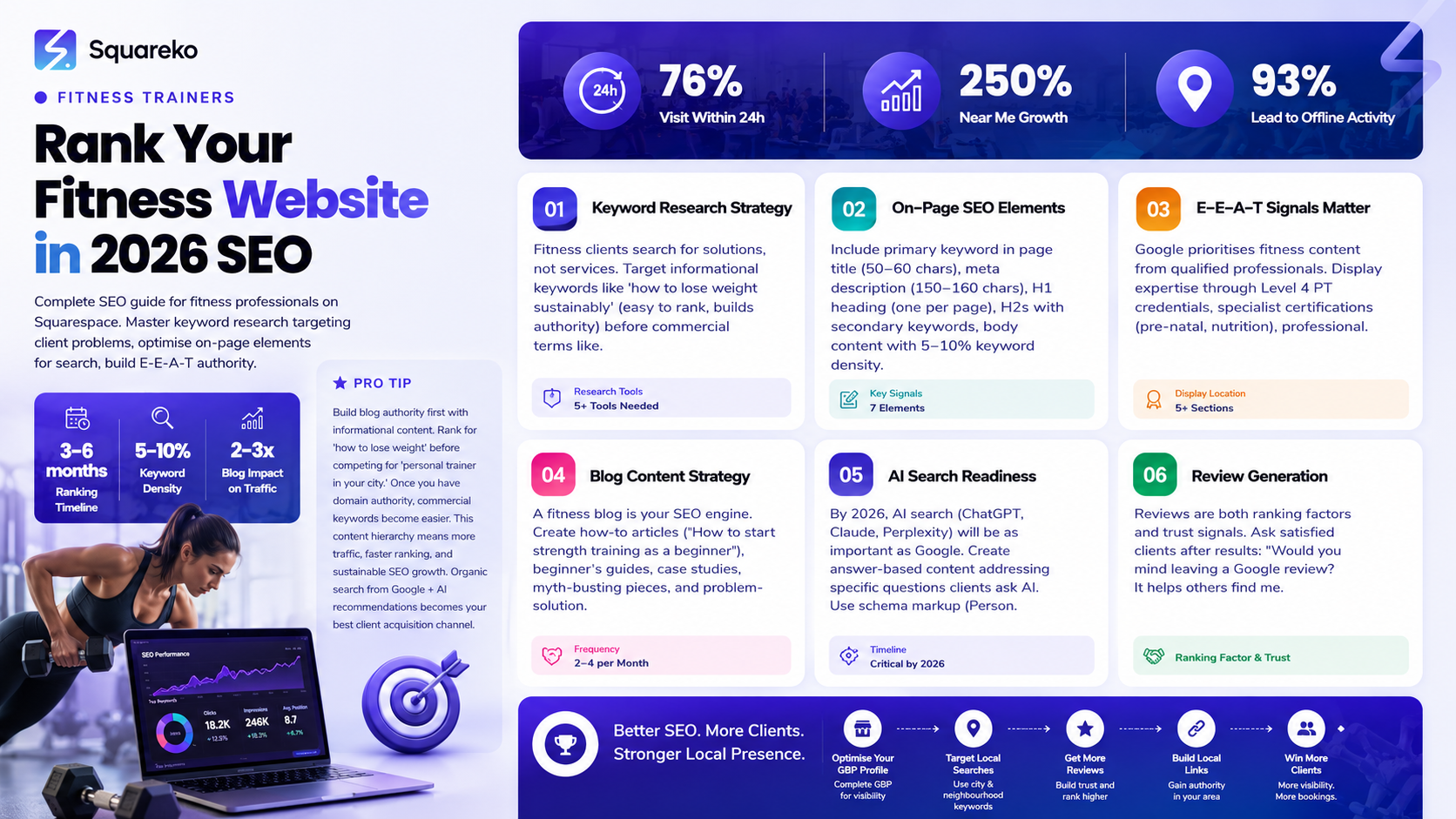
SEO starts with keywords. But fitness professionals often target the wrong ones.
Three Types of Fitness Keywords
1. Informational keywords: "How to," "why," "best way to" — searches for advice and information.
"How to lose weight fast"
"Strength training for beginners"
"Best exercises for bad knees"
"Can you build muscle without weights?"
Commercial intent: Low (person is learning, not buying) Conversion: Slow (but high volume, builds authority) Difficulty: Medium (many competitors, but not all are quality)
2. Commercial keywords: "Hire," "buy," "book," "price" — searches for services or products.
"Hire a personal trainer in [city]"
"Best personal training studio"
"Online fitness coach reviews"
"How much does personal training cost?"
Commercial intent: High (person is considering purchase) Conversion: Fast (fewer searches, but qualified leads) Difficulty: High (direct competition from other trainers)
3. Local keywords: "[Service] + [city]" — location-specific searches.
"Personal trainer in Manchester"
"Fitness coaching Leeds"
"Weight loss PT in [city]"
Commercial intent: Very high (local buyer is most likely to convert) Conversion: Very fast (high intent, low competition in small markets) Difficulty: Low to medium (less competition than national)
Fitness Keyword Research Workflow
Step 1: Start with seed keyword
Your services: "personal training," "weight loss coaching," "strength training"
Your specialisms: "postnatal fitness," "fitness for busy professionals," "athletic performance"
Your location (if applicable): "[Your city]"
Step 2: Use Google autocomplete to expand Type into Google: "how to lose weight" — autocomplete shows what people actually search:
"how to lose weight fast"
"how to lose weight at home"
"how to lose weight naturally"
"how to lose weight for women"
Step 3: Research search volume and difficulty Tools:
Google Trends: Free; shows relative popularity of keywords over time
Keyword Planner (Google Ads): Free with Google account; shows monthly search volume
Semrush, Ahrefs: Paid (£70–200+/month); detailed keyword metrics, competitor analysis, ranking difficulty
Step 4: Prioritise keywords by opportunity Target keywords with:
Commercial intent (buyer is looking for a trainer, not just information)
Local specificity (adds local intent, reduces competition)
Medium-low difficulty (you can actually rank)
20–500 monthly searches (enough volume to matter, not impossibly competitive)
Example Fitness Keyword Portfolio
High-priority (commercial + local):
"Personal trainer in [your city]" — 50–200 searches/month, high intent
"Weight loss coaching [city]" — 20–100 searches/month, commercial
"Fitness trainer for busy professionals [city]" — 10–50 searches/month, niche
Medium-priority (informational + personal brand):
"How to lose weight sustainably" — 500–2k searches/month, low difficulty, build authority
"Strength training for beginners" — 1k–5k searches/month, medium difficulty, attract leads
"How to stick to a fitness routine" — 100–500 searches/month, habit-focused
Build authority first (informational):
Answer common fitness questions your target clients ask
Rank for these easier informational terms
Build domain authority and credibility
Then target commercial terms with higher authority
On-Page SEO for Fitness Websites
On-page SEO is optimising your website content and structure for search engines and humans.
Keyword Placement Strategy
For each target keyword, include it naturally in:
Page title (SEO title): 50–60 chars, include primary keyword early
Good: "Weight Loss Personal Training in Manchester | Results-Driven"
Bad: "Personal Training and Fitness Services | Manchester Studio"
Meta description: 150–160 chars, compelling CTA
"Sustainable weight loss coaching in Manchester. Strength-based training + nutrition guidance. Results in 12 weeks. Book your free trial session."
H1 heading: One per page, primary keyword naturally
"Weight Loss Personal Training in Manchester That Works"
H2 headings: Secondary keywords, natural language
"How Strength Training Supports Weight Loss"
"Personal Training for Busy Professionals in Manchester"
Body content: 5–10% keyword density (not keyword stuffing). Keyword appears naturally throughout first 100 words, then several times in body.
Alt text on images: Describe images; include keywords where relevant
"Weight loss transformation before/after photos showing 15kg loss over 12 weeks"
URL slug: Include primary keyword if possible
/weight-loss-personal-training (good)
/services/coaching (bad)
Content Structure for SEO
Google rewards clear, well-structured content:
Opening hook (100–150 words): Introduce the problem, include primary keyword in first sentence.
"Weight loss is hard. Most people start with the wrong approach — extreme dieting and hours in the gym. Neither is sustainable. At your name Personal Training, we help clients in Manchester lose weight sustainably through strength training and realistic nutrition coaching."
Key points or outline: Bullet points or short section, show what readers will learn.
"In this guide: What actually works for weight loss, why most diets fail, how strength training accelerates results, nutrition without obsession, 12-week transformation case study"
Detailed sections (H2s with H3 subsections): Break content into digestible chunks.
H2: "Why Strength Training Accelerates Weight Loss"
H3: "Muscle Burns More Calories at Rest"
H3: "Strength Training Preserves Muscle During Calorie Deficit"
Real examples and case studies: Specific, concrete examples rank better than theory.
"Sarah, a 42-year-old project manager, lost 15kg in 12 weeks combining 2x weekly strength sessions with flexible nutrition tracking. Here's her transformation story."
Internal links: Link to related pages and blog posts naturally.
"If you want to understand nutrition basics, check out [our nutrition guide]. To start strength training safely, read [beginner strength guide]."
Calls-to-action: Place CTAs naturally, not aggressively.
"Ready to start your weight loss transformation? [Book a free trial session]"
E-E-A-T Signals for Fitness Professionals
Google prioritises fitness content from qualified, trustworthy sources. E-E-A-T stands for Expertise, Experience, Authoritativeness, Trustworthiness.
Expertise Signals
Display your fitness qualifications prominently:
Primary credential: "Level 4 Personal Trainer (REPs Accredited)" — largest, most visible
Supporting qualifications: Strength & Conditioning, Nutrition, Postnatal, etc.
Professional memberships: REPs, CIMSPA, NASM, ACE, or other industry body
Insurance: Professional indemnity and public liability
Years of experience: "8+ years personal training experience"
Specialisms: "Specialising in weight loss, strength training, and fitness for busy professionals"
Where to display:
Home page (About section or trust badges)
About page (prominent credential section)
Blog author bio (credentials listed)
Author schema (structured data with credentials)
Experience Signals
Google wants to know you've actually helped real people achieve fitness goals:
Client testimonials: Names, photos (with consent), specific results ("Lost 12kg in 12 weeks")
Before/after transformation photos: Real client transformations, not stock photos
Case studies: Detailed transformation stories with timeline, challenges, and results
Blog posts based on real training experience: Write about what you actually see with clients
Years of experience: The longer you've been coaching, the more experience authority you have
Authoritativeness Signals
Being a recognised expert in fitness:
Articles and press mentions: If local media or fitness publications mention you, that's authority
Speaking engagements: Fitness expos, podcasts, webinars — visible expertise
Professional affiliations: REPs registration, CIMSPA membership — formal recognition
Unique methodology or approach: If you have a signature programme or approach, document and promote it
Backlinks from authoritative sites: Links from fitness publications, health websites, professional bodies signal authority
Trustworthiness Signals
Why should clients trust you?
Transparent pricing: Clear pricing or "contact for rates" — no hidden fees or vagueness
Clear refund/guarantee policy: "30-day money-back guarantee" reduces risk for clients
Privacy and security: Clear privacy policy, secure site (HTTPS), professional appearance
Client reviews and ratings: Real client reviews on Google, trustworthy third parties
Disclaimer and legal language: Fitness professionals should include disclaimers ("This is fitness coaching, not medical advice")
Contact information and responsiveness: Easy to reach, professional communication
Technical SEO on Squarespace
Squarespace is relatively SEO-friendly, but understand its limitations and strengths.
Squarespace Technical SEO Strengths
Mobile-friendly by default: All Squarespace sites are responsive
Fast hosting: Squarespace servers are fast; pages load quickly
HTTPS standard: All Squarespace sites use HTTPS (secure)
Sitemaps auto-generated: Squarespace creates XML sitemaps automatically
Image compression: Squarespace optimises images automatically
Built-in Schema markup: Squarespace supports basic schema types
Squarespace SEO Limitations
Limited URL customisation: You can't fully control URL structures; some pages auto-generated
No advanced internal linking control: You can link naturally, but can't control anchor text extensively
Limited header/H-tag control: Some templates auto-generate headers; harder to optimise precisely
No robots.txt or advanced server config: Limited control over crawl directives
Redirects are cumbersome: Changing page URLs creates redirects; not ideal for URL migrations
Workarounds and Best Practices
Optimise within Squarespace's constraints:
Use custom page titles and meta descriptions (Settings → SEO)
Write compelling header tags (within template constraints)
Add alt text to all images
Use Code Injection for schema markup
Focus on content quality:
Squarespace sites rank well when content is high-quality
Long-form, comprehensive articles rank despite Squarespace limitations
Regular blog publishing signals freshness
Use Code Injection for advanced SEO:
Add schema markup (LocalBusiness, FAQPage, Author, etc.)
Add Google Analytics and Google Search Console verification
Add custom tracking pixels if needed
Monitor Core Web Vitals:
Use Google PageSpeed Insights to check speed
Squarespace's modern templates score well
Optimise images and avoid embedding too many videos on single pages
Content Strategy for Fitness Blogs
A fitness blog is your SEO engine. Blog content attracts organic search traffic, demonstrates expertise, and builds authority.
Blog Content Types That Rank and Convert
1. How-To Articles (High intent, medium competition)
"How to start strength training as a beginner"
"How to maintain weight loss after dieting"
"How to fix poor posture through exercise"
Why they rank: High user intent (people want actionable advice), opportunity to show expertise
2. Beginner's Guides (Build authority, low competition)
"Complete beginner's guide to weight loss"
"Strength training for people over 40"
"Fitness for busy professionals: The realistic approach"
Why they rank: Comprehensive content signals expertise; less competition than narrow "how-to" articles
3. Case Studies (Build trust, high conversion)
"How Sarah lost 15kg and kept it off for 2 years"
"From couch to running 5k: Alex's 12-week transformation"
"Postnatal fitness: How Emma returned to strength safely"
Why they rank: Specific, unique content; builds trust through real examples
4. Myth-Busting Articles (Engage and position)
"5 weight loss myths that are wrong"
"Can you really lose weight without exercise?"
"Do you need to go to the gym to get fit?"
Why they rank: People search for debunked myths; positions you as an expert debunker
5. Problem-Solution Articles (Answer common questions)
"Why your weight loss has stalled and what to do"
"Lower back pain during workouts: Causes and fixes"
"Motivation falling? How to stick to fitness"
Why they rank: Addresses specific problems clients face; builds trust through solutions
Blog Publishing Frequency
Ideal: 2–4 posts per month (high-frequency signal to Google)
Realistic: 1 post per month minimum (shows freshness and activity)
Consistency matters: Regular publishing (even 1/month) ranks better than sporadic (3 posts, then silence for 6 months)
Blog Post Structure for SEO
Each blog post should include:
Compelling headline: Include primary keyword naturally, benefit-driven
Meta description: 150–160 chars, hooks reader in search results
Opening hook: Why this topic matters to the reader (150–200 words)
Table of contents: Shows structure, helps with site architecture
Detailed sections: H2s with H3s, short paragraphs (2–4 sentences)
Real examples: Case studies, client transformations, concrete examples
Actionable takeaways: Readers should leave with specific action steps
Internal links: 3–5 relevant links to other blog posts or service pages
Call-to-action: "Ready to start your transformation? [Book a free trial]"
Author bio: Credentials, link to your main website
Squarespace SEO Limitations and Workarounds
Squarespace isn't WordPress (which has unlimited SEO plugins), but it's more than adequate for fitness professionals.
Key Limitations
No advanced plugin ecosystem: WordPress has Yoast SEO, Rank Math, etc. Squarespace has none.
Workaround: Use external tools (SEMrush, Ahrefs) to audit and track rankings
Limited internal linking control: Can't force exact anchor text.
Workaround: Link naturally; Google understands natural linking patterns
URL structure constraints: Some auto-generated URLs are suboptimal.
Workaround: Use clean custom URLs for important pages; avoid long, parameter-heavy URLs
Redirect limitations: Complex redirects are harder to manage.
Workaround: Plan URL structure carefully upfront; avoid frequent changes
Squarespace SEO Advantages
Modern templates:Squarespace templates are clean, fast, and search-friendly
Automatic responsive design: Mobile-friendly out of the box
Built-in blogging: Easy publishing, automatic sitemaps
No maintenance: Squarespace handles updates, security, hosting
Integrated analytics: See traffic sources, keywords, behavior in Squarespace dashboard
Schema markup support: Can add structured data via Code Injection
Building Backlinks and Domain Authority
Backlinks (other websites linking to yours) are a ranking factor. More and higher-quality backlinks = higher domain authority = better rankings.
Getting Backlinks for Fitness Websites
1. Press and media mentions:
Local news features you: "Meet the Manchester Personal Trainer Transforming Bodies"
Fitness publications quote you: "The best way to start strength training, according to fitness expert Walid Hassan"
Reach out to journalists covering fitness topics; offer expertise/quotes
2. Guest posting:
Write articles for fitness blogs, health publications, industry magazines
Include a bio with a link back to your website
Focus on publications your target clients read
3. Directory listings:
Join fitness professional directories (REPs, CIMSPA, local directories)
These listings include links back to your site
4. Local partnerships:
Partner with complementary businesses (nutritionists, physiotherapists, health practitioners)
Link to each other; create referral relationships
Guest post on each other's blogs
5. Content worth linking to:
Create original research or data: "I surveyed 500 fitness clients about weight loss barriers"
Original case studies or unique insights
Tools (calculators, guides, templates) people link to
6. Community and social signals:
Active social media presence (not a direct ranking factor, but increases visibility)
Engage in fitness communities (Reddit, Facebook groups) — share your knowledge, link back to relevant articles
Comment on other fitness blogs; some allow author links
AI Search Optimisation (GEO/AEO) for Fitness
In 2026, Google AI recommendations and ChatGPT integration are changing how people find fitness coaches. Optimise for both traditional search and AI.
What is GEO/AEO?
GEO (Google Experience Optimization): Google AI recommendations like "recommend a personal trainer in Manchester" that surface relevant businesses based on AI ranking, not just traditional SEO.
AEO (Answer Engine Optimization): Optimising for AI search engines (ChatGPT, Claude, Perplexity) that answer questions with AI-generated responses + sources.
Optimising for Google AI Recommendations
Google increasingly recommends fitness professionals based on:
Relevance: Does your website content match the person's specific needs?
Ratings and reviews: Google favours highly-rated, well-reviewed businesses
Freshness: Recent client testimonials, blog posts, and activity signal current service
Local authority: Strong Google Business Profile with photos, hours, reviews
Optimization tactics:
Google Business Profile: Continuously optimise (add photos monthly, encourage reviews)
Local authority: Rank in local search; Google AI factors this into recommendations
Client testimonials: More recent, more specific testimonials help AI identify you as a good match
Specialisation signals: "I specialise in weight loss for busy professionals" helps AI match your expertise to specific searchers
Content freshness: Regular blog posts and updates signal active, current service
Optimising for ChatGPT and AI Chatbots
When someone asks ChatGPT "recommend a personal trainer in Manchester" or "how do I find a strength coach?", you want your website to appear in the sources.
Factors AI chatbots consider:
Authoritative sources: Are you cited on authoritative fitness sites?
Clear expertise: Do you display credentials clearly?
Structured data: Schema markup helps AI understand your business
Content quality: High-quality, factual content gets cited more
Optimization tactics:
Authoritative content: Write comprehensive, well-researched articles
Credentials display: Make qualifications unmissable
Schema markup: Use LocalBusiness, Person, ExerciseGym schema
Press mentions and citations: Be quoted on authoritative fitness sites
Link from authoritative sources: Fitness publications, professional bodies linking to you
Mobile SEO for Fitness
Most fitness clients search on mobile. Mobile SEO is non-optional.
Mobile-First Ranking
Google prioritises mobile version of your site for ranking. If your mobile site is poor, your rankings suffer.
Mobile essentials:
Fast load time: Core Web Vitals — LCP <2.5s, FID <100ms, CLS <0.1
Responsive design: Content readable on small screens without horizontal scrolling
Touch-friendly buttons: Tap targets 44px+ for easy clicking
Readable text: Base font 16px+, sufficient contrast
Squarespace advantage: Squarespace templates are mobile-first; you don't have to worry about technical mobile setup.
Mobile-Specific Content
Click-to-call button: One tap calls your business
Map with directions: Shows your location, makes navigation easy
Mobile-friendly CTAs: "Book Now" button prominent and tappable
Fast image loading: Squarespace auto-optimises, but avoid oversized images
Measuring SEO Success and Iterating
SEO takes 3–6 months to show results. Track metrics that matter.
Key SEO Metrics
Organic search traffic: Sessions from Google search in Google Analytics
Keyword rankings: Where you rank for target keywords (track with Semrush, Ahrefs, or rank tracking tools)
Clicks from search results: Google Search Console shows impressions and clicks
Conversion rate: What % of organic visitors book a session or contact you?
Pages ranking: How many pages rank on page 1, page 2, page 3 of Google?
Tools to Monitor SEO
Google Search Console (free): Google's official tool; shows keyword rankings, click data, indexing status
Google Analytics (free): Traffic sources, user behavior, conversions
Google PageSpeed Insights (free): Mobile and desktop speed metrics
Semrush, Ahrefs, Moz (paid, £70–300+/month): Competitive analysis, rank tracking, backlink monitoring
Optimisation Cycle
Month 1–2: Publish content, build links, optimise key pages. Measure baseline metrics.
Month 2–3: Monitor rankings for target keywords. Identify which content is gaining traction.
Month 3–6: Double down on winning content. Update underperforming pages. Add more blog content.
Month 6+: Iteratively improve. Rank higher for high-performing keywords. Expand to new keywords.
Mid-Post CTA: Ready to Dominate Fitness Search in 2026?
You now understand fitness SEO strategy — from keyword research to E-E-A-T signals to AI search optimisation. But execution is where most trainers get stuck. Building authority, publishing consistent content, optimising for search and AI, tracking rankings — this takes expertise and time.
At Squareko, we specialise in SEO for fitness professionals on Squarespace. We'll develop your keyword strategy, optimise your website for search intent, create blog content that ranks and converts, build your E-E-A-T authority, and ensure you rank for AI recommendations in your city. Whether you're a solo personal trainer competing for local visibility or a fitness studio building national reach, we know how to make Squarespace websites rank
Frequently Asked Questions
-
SEO results typically appear in 3–6 months. Local keywords (e.g., "personal trainer in [city]") show results faster (4–8 weeks), while national or broader terms ("how to lose weight") take longer (6–12 months). Consistency matters more than speed; regular blog publishing and ongoing optimisation beat sporadic effort.
-
Blog content isn't required, but it's highly effective. A blog answers common client questions, attracts organic search traffic, and demonstrates expertise. Most fitness websites that rank well have active blogs. Without a blog, you rely on service pages ranking — harder and slower.
-
Write for humans first, keywords second. Your keyword should appear naturally 5–10 times in a 1,000-word article — not forced. Read your content aloud; if it sounds awkward, remove the keyword or rephrase. Example: "Weight loss in Manchester" might naturally appear in headings and topic sentences, but forcing it into every sentence sounds fake.
-
Display credentials prominently in an About section, trainer bio, and schema markup (structured data). Example: "Level 4 Personal Trainer (REPs Accredited), 8+ years experience, specialising in weight loss." Include credentials on your home page, About page, blog author bio, and in Author schema markup. This signals expertise to Google and builds trust with readers.
-
Yes. Squarespace sites rank well in competitive fitness markets. The key is content quality, domain authority, and consistent publishing. Squarespace's fast hosting, mobile design, and indexing are excellent. The main limitation is lack of SEO plugins, but that's not essential for ranking.
-
Focus on: (1) Authoritative content and citations (2) Clear credentials and expertise display (3) Schema markup (structured data) (4) Fresh content and client testimonials (5) Backlinks from authority sites (6) Client reviews and ratings. AI recommendations consider similar factors as traditional search, plus social proof and specialisation.
-
Focus on local SEO first if you serve in-person clients; national SEO if you sell online programmes or serve clients globally. Local SEO is easier to win (less competition) and converts faster (high intent). Once you dominate local search, then expand nationally if desired.
-
Social media is not a direct SEO ranking factor, but it supports SEO indirectly: (1) Social sharing increases visibility and potential backlinks (2) Active social presence signals you're a current, active business (3) Social followers may link to your website or mention you (4) Social content can become ranking blog content.
Ready to Rank Your Fitness Website in 2026?
You now understand fitness SEO strategy for Squarespace. But implementation — keyword research, content planning, ongoing optimisation, tracking metrics — requires expertise and dedication.
At Squareko, we help fitness professionals dominate search in 2026. From keyword research and content strategy to technical SEO optimisation and AI search readiness, we build Squarespace websites that rank and convert. Whether you're a solo trainer building local authority or a fitness studio expanding national reach, we know how to make Squarespace websites rank.

From custom website design to SEO strategy, we help businesses launch a site that looks professional and performs better.

About the Author
Walid | squareko
I'm Walid Hasan, a Certified Squarespace Expert and Squarespace Circle Platinum Partner with over 12 years of hands-on experience designing and optimizing high-performing websites. Over the years, I've had the privilege of building more than 2,000 Squarespace websites for clients around the world, always focusing on clean design, strong user experience, and conversion-driven results.