How to Build a Chiropractic Clinic Website on Squarespace That Books More Patients
Introduction
Your chiropractic clinic website isn't just an online brochure. It's a patient acquisition and booking machine. Every design decision, every word choice, every button placement directly impacts whether a potential patient books an appointment or clicks to your competitor. Building a high-converting chiropractic website on Squarespace requires understanding the patient journey—from initial pain-driven search, through evaluation of your credibility and location, to the moment they click "Book Now." This guide walks you through every essential component of a chiropractic clinic website and exactly how to optimize each section for patient conversion within GCC compliance requirements.
Key Takeaways
A high-converting chiropractic website guides visitors through a specific journey: recognize pain → evaluate credentials and location → book appointment
Your homepage must prominently display GCC registration, clinic location, and an unmissable booking CTA
Clear service pages describing what you treat (within ASA/CAP guidelines) directly impact conversion rates
The "New Patient" page is critical—tell patients exactly what to expect at their first appointment to reduce booking anxiety
Squarespace Scheduling integration eliminates friction and allows real-time appointment availability
Understanding the Chiropractic Patient Journey
Before you build a single page, understand how people actually become your patients.
Most chiropractic patients arrive at your website in one of two states: acute pain (they woke up with back pain and need help) or chronic pain (they've been managing it and are actively seeking better solutions). They're not researching chiropractic philosophy—they're searching for relief and assurance that you can help them.
Their mental journey looks like this:
Recognize Problem: "I have back pain / neck pain / headaches"
Initial Search: "Chiropractor near me" or "Back pain treatment [city]"
Land on Your Site: Seconds to decide if you're worth reading
Evaluate Credentials: GCC registration, qualifications, years of experience
Assess Location and Accessibility: Is your clinic convenient? Easy parking? Disabled access?
Read Patient Reassurance: What happens at a first appointment? Will it hurt? What should I bring?
Trust Decision: Do I trust this chiropractor with my health?
Action: Book an appointment or leave and try another clinic
Your website must address each stage of this journey with zero friction.
Homepage: The Conversion Foundation
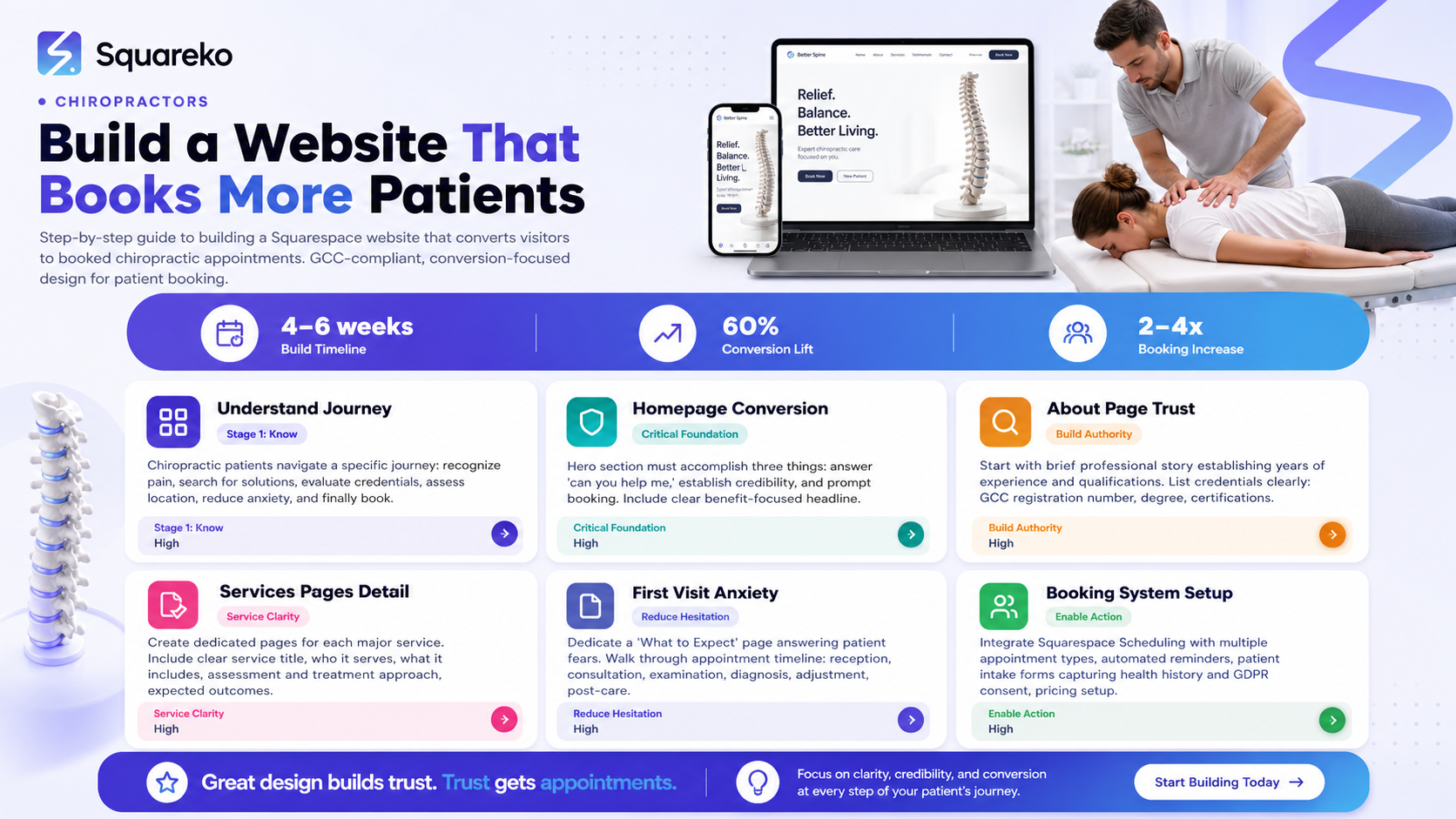
Your homepage has seconds to accomplish three things: answer "can you help me?", establish credibility, and prompt an appointment booking.
Hero Section
The hero section is critical. Use a clear headline that mirrors what patients are searching for:
Strong headline examples:
"Back Pain Relief from Experienced GCC-Registered Chiropractors"
"Sports Injury Treatment and Performance Optimization for Manchester Athletes"
"Family Chiropractic Care for All Ages in Bristol"
Weak headline examples:
"Welcome to Our Chiropractic Clinic"
"Wellness Solutions for Your Health"
"Chiropractic Excellence"
Notice the difference? Strong headlines describe the problem you solve and demonstrate credentials. Weak ones say nothing actionable.
Your hero should include:
Clear, benefit-focused headline
Subheading that clarifies your scope (location, specialty, or primary patient demographic)
GCC registration number and clinic address displayed prominently (compliance + trust)
Large booking CTA button (color contrast, readable font, clear call to action: "Book First Appointment" not just "Contact")
Hero image: professional clinic photo or team photo (not generic health stock imagery)
Service Preview Section
Below the hero, briefly showcase your key services. This isn't the place for full descriptions—those go on dedicated service pages. Instead, show 3-5 core services with one-line descriptions:
Spinal Assessment and Manipulation
Sports Injury Treatment and Recovery
Postural Assessment and Correction
Headache Management
Workplace Ergonomics Consultation
Use icons or simple visuals, but keep text minimal. The goal is to signal to a potential patient with knee pain that yes, you do treat knees (or to a headache sufferer that you treat headaches).
Testimonials Section
Place a testimonials section prominently on the homepage. Show 3-4 recent, specific patient reviews. Keep testimonials focused on patient experience and results rather than making clinical claims:
Strong testimonial: "After six months of managing my back pain with regular appointments, I'm now pain-free for the first time in years. Walid was knowledgeable, professional, and made me feel completely at ease. Highly recommend."
Weak/Problematic testimonial: "This chiropractor cured my herniated disc! He's amazing!"
The second example makes a specific medical claim that violates ASA/CAP standards and creates liability. The first example speaks to patient experience and outcomes without overstated claims.
Contact and Location Info
Your homepage footer should include:
Full clinic address (legal requirement)
Phone number
Email
Business hours
GCC registration number
Emergency contact if applicable (e.g., for acute conditions)
Map embed showing clinic location
About Page: Building Trust Through Credentials
Many potential patients will click to the About page before booking. This is where credentials matter enormously.
Your Professional Story
Start with a brief personal/professional story that humanizes you without being overly casual. Patients want competence and warmth.
Good about opening: "I qualified as a chiropractor in 2008 and have spent 16 years helping patients recover from injury, manage chronic pain, and improve performance. I'm GCC-registered (number: GCC123456) and hold additional qualifications in sports chiropractic and postural assessment."
Poor about opening: "I'm passionate about wellness and chiropractic."
The first example establishes years of experience, specific qualifications, and regulatory standing in one paragraph. The second says nothing concrete.
Full Credentials Section
List your credentials clearly:
GCC Registration Number (prominently display this)
Qualifications (e.g., "MSc Chiropractic, University of [X]")
Additional certifications (sports chiropractic, pediatric, etc.)
Professional memberships (BCA, McTimoney Chiropractic Association, etc.)
Years in practice
Special interests or areas of focus
For multi-chiropractor clinics, create individual practitioner pages with each clinician's full credential statement.
Treatment Philosophy (Within Scope)
Briefly describe your approach to chiropractic care. Focus on:
Your assessment process (how you diagnose)
Your treatment modalities (spinal manipulation, mobilization, soft tissue therapy, etc.)
Your patient outcomes focus (helping patients return to normal function)
Avoid making broad health claims. Use language aligned with GCC Code of Practice and evidence-based musculoskeletal care.
Professional Photo
Include a professional headshot of each practitioner. Patients want to see who they'll be meeting. Professional photos matter—they communicate competence and approachability.
Services Pages: Describing What You Treat
Your services pages are where you describe what you treat and why. This is critical for SEO, conversion, and compliance.
Create Dedicated Service Pages
Don't list all services on one page. Create individual pages for each major service or condition group:
Spinal Adjustment
Sports Injuries
Postural and Ergonomic Assessment
Headache Management
Pediatric Chiropractic (if applicable)
Workplace Wellness Programs
Each service page should:
1. Clear Service Title "Sports Injury Treatment for Runners and Cyclists"
2. Who This Service Is For "This service is ideal for active individuals who have sustained a sports-related injury or want to prevent injury through performance optimization."
3. What the Service Includes
Initial biomechanical assessment
Sport-specific movement analysis
Treatment planning (manipulation, mobilization, soft tissue therapy)
Rehabilitation exercise prescription
Return-to-sport timeline discussion
4. What You Treat (Language Matters) Use language aligned with evidence and your scope. For example:
Strong language: "We assess and treat runners with patellofemoral pain syndrome, IT band syndrome, and plantar fasciitis through biomechanical analysis and targeted soft tissue therapy."
Weak language: "We can fix any running injury."
Problematic language: "We cure knee pain."
The difference: strong language identifies specific conditions within your scope and describes your approach. Weak language overstates. Problematic language makes medical claims.
5. Expected Outcomes "Most patients experience pain reduction within 4-6 appointments and return to full running within 8-12 weeks depending on injury severity."
This sets expectations and manages the patient's mental timeline before they book.
6. CTA End with a clear booking button: "Book a Sports Injury Assessment"
New Patient Page: Reducing Booking Anxiety
The "New Patient" or "What to Expect" page is a psychological conversion tool. Patients hesitate to book new appointments because they're uncertain and anxious. Removing that uncertainty dramatically improves conversion.
Your new patient page should answer:
What Happens at My First Appointment?
Walk through the appointment timeline:
"Your first appointment lasts 45-60 minutes. Here's what happens:
Reception and Paperwork (5 minutes): You'll check in, complete a health history form, and discuss any insurance coverage.
Clinical Interview (10 minutes): Your chiropractor will ask detailed questions about your condition, pain history, previous injuries, and health goals.
Physical Examination (15 minutes): You'll undergo a thorough orthopedic and chiropractic examination including range of motion testing, palpation, and if needed, postural assessment.
Diagnostic Imaging Discussion (5 minutes): Your chiropractor will explain any imaging findings (X-rays, MRI) and what they mean for your condition.
Treatment Plan Explanation (10 minutes): Your chiropractor will explain their findings, proposed treatment plan, and expected timeline to improvement.
Initial Treatment (optional): Depending on your condition, treatment may begin during your first visit.
Home Care Instructions: You'll receive specific advice on posture, ergonomics, stretches, or activity modification."
Will It Hurt?
Address the fear directly:
"Spinal manipulation should not be painful. You may feel pressure or hear a 'popping' sound (which is normal joint movement), but this should be comfortable. If anything causes pain, tell your chiropractor immediately—they'll adjust their technique. Many patients find their first visit reduces pain significantly."
What Should I Bring?
"Please bring:
Photo ID and proof of address
Insurance card (if applicable)
Prescription medications list
Any recent medical imaging (X-rays, MRI scans, CT scans)
Details of previous injuries or health conditions"
What Should I Wear?
"Wear comfortable, loose clothing. You may be asked to remove outer layers for the examination. Comfortable shoes are fine."
What's the Cost?
Be transparent about pricing:
"Our initial consultation and examination is £75. Subsequent treatment sessions are £55-65 depending on treatment complexity. Most insurance plans provide coverage. We'll discuss payment options during your first appointment and provide an estimate of treatment cost based on your condition."
Transparency about cost before booking removes a major source of booking hesitation.
Patient Resources and Education Content
A resources/education section builds trust and improves SEO. Include content that answers common patient questions:
"How does spinal manipulation work?"
"Is chiropractic safe?"
"How many appointments will I need?"
"Can chiropractic help with [specific condition]?"
"What's the difference between a chiropractor and a physiotherapist?"
"Should I see a chiropractor for maintenance care?"
This content serves dual purposes:
Helps patients understand chiropractic care
Targets informational keywords that drive organic traffic
Positions you as an expert and trusted resource
Keep education content aligned with evidence. Avoid overstating chiropractic's scope. Reference NICE guidelines, Cochrane reviews, or published clinical evidence when discussing condition-specific treatment.
Testimonials and Reviews: Social Proof Strategy
Social proof dramatically impacts conversion. Patients trust other patients' experiences more than any marketing message you write.
Collecting Patient Reviews Ethically
Under GDPR, you must have explicit written consent to publish patient testimonials. Here's the compliant approach:
After successful treatment, ask: "Would you be willing to share a brief review of your experience?"
Provide a simple consent form explaining how the review will be used (website, Google, marketing materials)
Offer patients options: name and photo, name only, anonymous
Ask specific questions:
"How did this condition impact your life?"
"What was your experience with our clinic like?"
"Would you recommend us to friends?"
"Any improvement since starting treatment?"
Best Practices for Testimonials
Specificity: "I'm now running 5K three times a week without pain" is more powerful than "I feel better"
Authenticity: Real patient names and optional photos are more trustworthy than anonymous reviews
Diversity: Show testimonials from different patient demographics (athletes, desk workers, elderly patients) if applicable
Recency: Update testimonials regularly—older reviews lose impact
Compliance: Never allow health claims in testimonials ("cured my herniated disc"). Guide patients toward experience-focused feedback
Google Reviews
Encourage Google reviews by:
Following up with patients post-treatment with a "Review Us on Google" request
Making it easy: send a direct link to your Google Business Profile
Responding professionally to all reviews (positive and negative)
Focusing requests on genuinely satisfied patients
Google reviews significantly impact local search visibility and patient decision-making.
Booking Page Setup with Squarespace Scheduling
Squarespace Scheduling is your conversion tool. It eliminates back-and-forth email exchanges and allows real-time booking.
Setting Up Squarespace Scheduling
Appointment Types: Create appointment types for your key services:
Initial Consultation & Examination (60 minutes)
Follow-up Treatment (30-45 minutes)
Postural Assessment (45 minutes)
Sports Injury Evaluation (60 minutes)
Appointment Availability: Set your availability for the next 8-12 weeks. Patients won't book beyond that window.
Pricing: Set prices for each appointment type. Display pricing clearly.
Patient Intake Form: Use Squarespace's form builder to collect:
Full name and contact details
Emergency contact
Brief description of condition/pain
Insurance information
Any health history relevant to treatment
Confirmation and Reminders: Set automatic email confirmations and reminder emails (24 hours before appointment) to reduce no-shows.
Payment Collection: Squarespace can collect payment upfront or require it at appointment. Decide based on your practice model.
Prominent Booking Integration
Don't bury the booking page. Link to it:
Hero section CTA button
Every service page
About page
Contact page
Navigation menu
Trust Signals: GCC Registration, Credentials, and Professional Affiliations
Trust is everything. Use every legitimate trust signal available.
GCC Registration Display
Display your GCC registration number:
On your homepage (footer or credentials section)
On the About page
On every practitioner's individual bio page
In the booking confirmation email
This isn't optional—it's a legal requirement under GCC Code of Practice.
Professional Memberships
Display badges for:
BCA (British Chiropractic Association): Shows professional commitment and ethical standards
McTimoney Chiropractic Association: If applicable
Specialized credentials: Sports chiropractic, pediatric chiropractic, etc.
Professional Indemnity Insurance
Mention that you carry professional indemnity insurance. This is both a legal requirement and a trust signal.
Patient Testimonials
Patient testimonials are your strongest trust signal after credentials. Prioritize real, detailed testimonials over generic praise.
GDPR, Privacy, and Data Protection for Patient Information
Handling patient data requires compliance with UK GDPR and your legal obligations as a healthcare provider.
Privacy Policy
Your privacy policy must cover:
What data you collect (appointment history, health information, insurance details)
How you use it (treatment, clinic management, improvement)
How long you store it (guidance: minimum 6 years for medical records)
Patient rights (access, correction, deletion rights)
Third parties you share data with (insurance companies, NHS referrals)
Your data security measures
Cookie Policy
Your Squarespace site automatically uses cookies for:
Analytics (Google Analytics)
Functional cookies (appointment reminders, user preferences)
Advertising cookies (if you use retargeting)
Disclose this clearly and allow users to opt out of non-essential cookies.
Patient Consent
Collecting health information requires explicit consent. Your intake form should include consent language:
"By providing health information, you consent to its use for your treatment and clinic management in accordance with our Privacy Policy."
Data Security
Don't store sensitive data in unencrypted emails
Use secure appointment scheduling (Squarespace Scheduling handles this)
Don't include health details in SMS appointment reminders or voicemails
Ensure your Squarespace site uses HTTPS (Squarespace does this by default)
Right to Access and Correction
Patients have the right to access their health records and request corrections. Have a process for handling these requests.
Frequently Asked Questions
-
Building core pages (homepage, about, services, new patient, booking) takes 2-4 weeks depending on content preparation. Most of the time is spent writing copy and gathering photos, not platform setup. Squarespace's intuitive interface means the actual design/building is relatively fast.
-
Strongly recommended. Professional clinic photos, team headshots, and treatment room images significantly improve perceived professionalism and conversion. Budget £500-1,500 for a professional clinic photoshoot. Stock photos feel generic and reduce trust.
-
Before-and-after photos are tricky under ASA/CAP advertising standards. They're acceptable if they show functional improvement (e.g., increased range of motion) rather than medical outcome claims. Get explicit written consent from patients for any photos. Many chiropractors avoid this entirely to sidestep compliance complexity.
-
Focus on patient experience and functional outcomes rather than disease claims. Use language like "We assess and treat patients with patellofemoral pain syndrome" instead of "We cure knee pain." Reference your scope (musculoskeletal assessment and treatment) and avoid claims about treating systemic conditions. When in doubt, consult GCC guidance or a compliance advisor.
-
Update testimonials quarterly. Aim for at least 3-5 recent testimonials on your site and actively encourage Google reviews. Stale testimonials lose impact and can appear inauthentic.
-
Respond professionally and factually. For Google reviews, respond in writing: acknowledge the feedback, offer to discuss concerns privately, and avoid defensive language. For legal or GDPR issues with reviews containing health details, contact Google directly for removal.
-
Not necessarily. Many chiropractors collect contact information and health history during booking, then collect payment at the appointment. However, some practices charge a consultation fee upfront to reduce no-shows. Decide based on your patient demographic and practice model. Disclose your payment policy clearly.
-
Squarespace templates are built with accessibility in mind, but you should:
Ensure sufficient color contrast in text
Use alt text on all images
Include captions on any video content
Make forms keyboard-navigable
Test your site with a screen reader
This also improves SEO and demonstrates professional care.
Ready to Build Your Patient-Booking Website?
Building a chiropractic website that actually books patients requires more than picking a template. It requires understanding your patient journey, structuring your content for conversion, and ensuring compliance with GCC and ASA/CAP standards.
At Squareko, we help UK chiropractors build Squarespace websites that convert. We handle template selection, compliance setup, patient journey optimization, and integration with Squarespace Scheduling so your website becomes your most reliable patient acquisition channel.
Whether you're launching your first website or redesigning an existing site that isn't converting, we'll guide you through every step. Our goal is your goal: more booked appointments and better-served patients.

From custom website design to SEO strategy, we help businesses launch a site that looks professional and performs better.

About the Author
Walid is the founder of Squareko
I'm Walid Hasan, a Certified Squarespace Expert and Squarespace Circle Platinum Partner with over 12 years of hands-on experience designing and optimizing high-performing websites. Over the years, I've had the privilege of building more than 2,000 Squarespace websites for clients around the world, always focusing on clean design, strong user experience, and conversion-driven results.