GCC Compliance and Chiropractic Website Regulations on Squarespace
Introduction
As a UK chiropractor, your website isn't just a marketing tool—it's a legal compliance document. The General Chiropractic Council (GCC) is the statutory regulator of chiropractic in the UK, and registration is not optional. Your website must reflect your legal status, display your credentials accurately, and comply with advertising standards set by the ASA/CAP. Make a mistake here and you risk not just patient trust but potential regulatory action from the GCC and advertising standards authorities. This guide covers every compliance requirement you need to understand when building your chiropractic website on Squarespace, with specific implementation guidance and templates you can use immediately.
Key Takeaways
GCC registration is a legal requirement to call yourself a chiropractor in the UK—displaying your registration number on your website is mandatory
Your website must include your clinic address, professional indemnity insurance confirmation, and GCC registration number prominently
ASA/CAP advertising standards restrict condition claims; you must avoid disease treatment claims unless supported by strong clinical evidence
Patient testimonials, before-and-after photos, and health claims require careful compliance language
GDPR compliance for patient data, cookie policies, and privacy statements is non-negotiable
Disclaimer: This guide is educational information, not legal advice; consult GCC guidance, BCA resources, or your legal advisor for specific compliance questions
GCC Registration: The Foundational Requirement
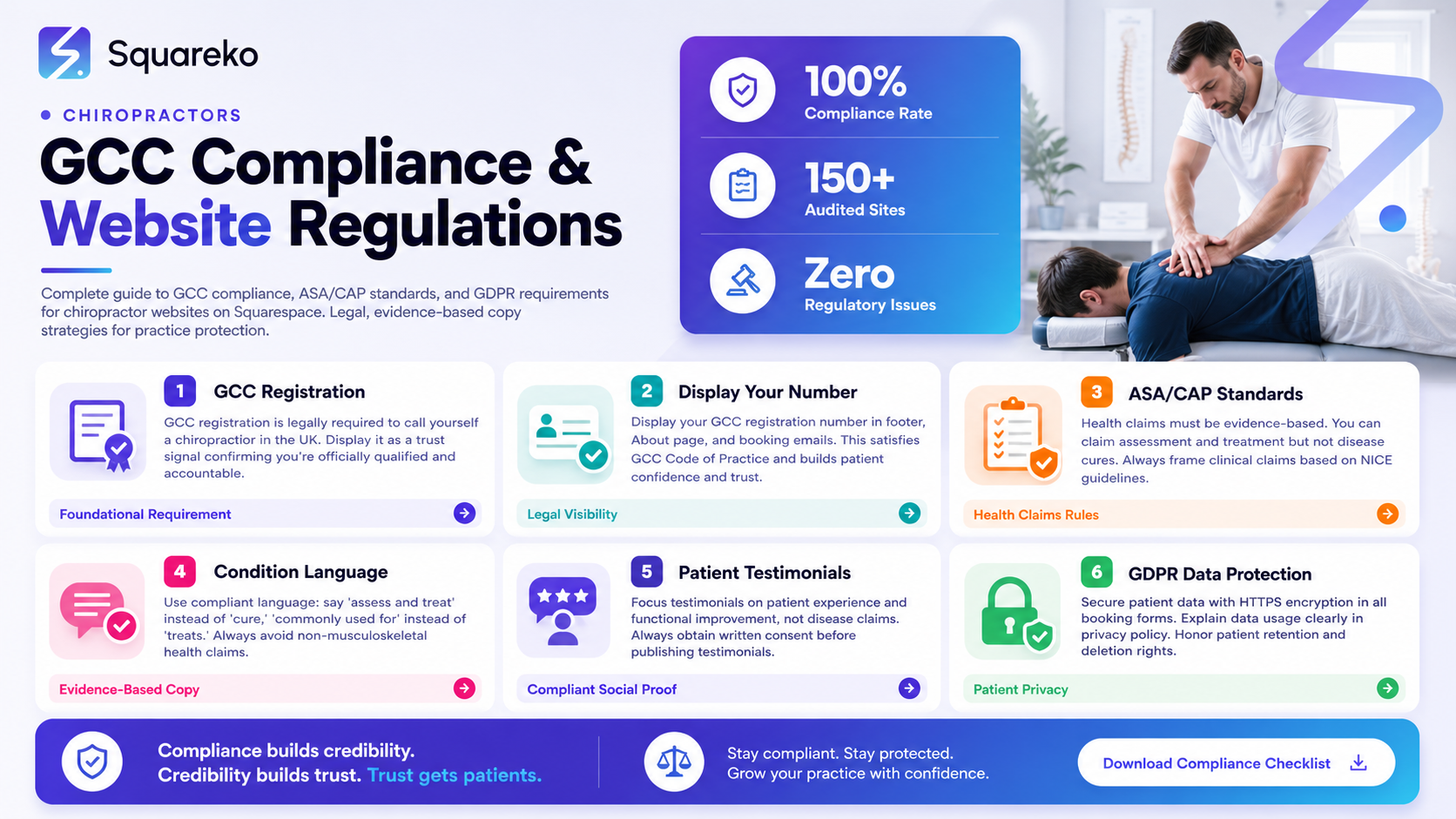
GCC registration is not optional. In the UK, it is illegal to describe yourself as a chiropractor unless you are registered with the GCC. This is a fundamental legal requirement, not a professional credential like BCA membership. Many chiropractors don't fully appreciate the distinction.
If you are not registered with the GCC, you cannot legally call yourself a chiropractor, describe your practice as "chiropractic," or advertise chiropractic services. Period. This is a criminal offense under the Chiropractors Act 1994.
If you are GCC-registered, you must display this status on your website. This isn't optional for compliance purposes—it's a direct requirement under GCC Code of Practice, which states that chiropractors must inform the public of their registration status.
GCC Registration Verification
Your GCC registration status is publicly searchable. Patients can verify your registration on the GCC website (the Find a Chiropractor directory). You should encourage patients to do this and display your registration number so verification is easy.
Your registration includes:
Your GCC registration number (a unique identifier)
Your name as registered with GCC
Your qualifications
Your registration status (currently registered, suspended, etc.)
Your practice address (addresses if you practice in multiple locations)
All of this information on the GCC Find a Chiropractor directory creates your "official" online presence from a regulatory perspective. Your website should be consistent with this registration information.
What GCC Registration Means and Why It Matters
GCC registration means:
You meet educational standards: You've completed GCC-approved chiropractic education (4+ years typically)
You meet professional standards: You've demonstrated clinical competence and ethical judgment
You maintain continuing education: You must complete Continuing Professional Development (CPD) hours annually to maintain registration
You carry professional indemnity insurance: Required as part of registration maintenance
You adhere to GCC Code of Practice: This is legally binding and covers patient care, professional conduct, confidentiality, and information to the public
This is fundamentally different from someone calling themselves a wellness practitioner or spinal therapist without GCC registration. GCC registration means legal accountability, regulatory oversight, and patient protection.
From a patient perspective, GCC registration is a powerful trust signal. When you display your GCC number prominently, patients know you're not just calling yourself a chiropractor—you're legally accountable to a statutory regulator.
Displaying Your GCC Registration Number on Your Website
Your GCC registration number must be displayed prominently. "Prominently" means it should be easily visible without scrolling or searching.
Best Practices for Display
Option 1: Footer Display (Recommended) Include your GCC registration number in your website footer on every page:
"[Your Name] is registered with the General Chiropractic Council (GCC Registration: GCC12345). We carry professional indemnity insurance."
Option 2: Credentials Section Include it prominently in your About page credentials section:
"Professional Registration:
GCC Registration: GCC12345
BCA Member
Diploma in Chiropractic, [University]"
Option 3: Booking Confirmation Include it in automated booking confirmation emails so patients see it before their first appointment:
"Thank you for booking. Your appointment with Your Name (GCC Registration: GCC12345) is confirmed for [Date/Time]."
Option 4: Contact/Legal Page Include it in a dedicated "Contact and Credentials" or "Legal Information" page.
Multiple Practitioners
If you run a multi-chiropractor clinic, each practitioner must have their own GCC registration number displayed. Create individual practitioner profile pages with each person's:
Full name as registered with GCC
GCC registration number
Qualifications
Photo
Brief bio
Treatment specializations
Never display one GCC registration number for a clinic with multiple practitioners. This violates GCC regulations and creates legal liability.
Domain Name and Naming Conventions
Your website domain should reflect your legal trading name and location ideally. If your domain is unclear, include your full legal practice name and location prominently on your homepage. This ensures consistency with GCC registration information.
Professional Indemnity Insurance and Website Display
Professional indemnity insurance is a legal requirement for GCC registration. You must have it. On your website, disclose that you carry professional indemnity insurance.
Wording Examples
"We carry comprehensive professional indemnity insurance"
"[Your Name] is GCC-registered and insured"
"Backed by professional indemnity insurance"
You don't need to display policy numbers or insurance provider names publicly, but you should have documentation readily available if patients ask. Some chiropractors display their insurance provider name to increase trust:
"We are insured with Insurance Provider Name, providing Amount coverage for professional indemnity."
ASA/CAP Advertising Standards for Chiropractors
ASA (Advertising Standards Authority) and CAP (Committee of Advertising Practice) set rules for healthcare advertising. For chiropractors, the key rule is: health claims must be substantiated with evidence.
This doesn't mean you can't advertise. It means your claims must be accurate and evidence-based. The challenge is that clinical evidence for chiropractic is mixed. NICE (National Institute for Health and Care Excellence) and Cochrane reviews have found evidence for spinal manipulation in specific musculoskeletal conditions (mainly acute low back pain) but limited evidence for other claims.
The Evidence Hierarchy for CAP Compliance
Strong evidence (Safe to claim):
"Spinal adjustment for acute low back pain"
"Spinal manipulation for neck pain"
"Musculoskeletal assessment and treatment"
Moderate evidence (Claim carefully):
"Posture and ergonomic assessment to reduce work-related pain"
"Treatment for work-related neck and shoulder tension"
"Sports injury assessment and rehabilitation"
Weak evidence (Avoid claiming without specific disclaimers):
"Improved immune function"
"Better sleep"
"Headache treatment" (evidence is limited; say "assessment and management" instead)
"Pregnancy-related back pain treatment" (limited evidence and safety concerns during pregnancy)
No evidence (Do not claim):
"Treatment for asthma," "treatment for ear infections," "treatment for digestive disorders," "improved athletic performance" (without specific context like injury prevention)
Organ function claims or systemic health claims
Prevention of specific diseases
What This Means for Your Website Copy
Avoid:
"Chiropractic can cure back pain"
"We treat sciatica"
"Chiropractic care improves immune function"
"Spinal adjustment helps with headaches, asthma, and digestive issues"
"We specialize in healing sports injuries"
Use instead:
"We assess and treat patients with acute and chronic low back pain"
"We manage sciatica symptoms through spinal assessment and targeted treatment"
"We assess postural and structural factors that may contribute to headaches"
"Our sports injury assessment and rehabilitation program helps athletes return to performance"
"GCC-registered chiropractors providing musculoskeletal assessment and treatment"
The difference is subtle but critical. The first set makes disease treatment claims. The second set describes your clinical assessment and treatment process while being honest about outcomes.
Compliant Condition Claims and Evidence-Based Language
Creating compliant copy is about being specific without overstating evidence.
Service Page Template
Here's a compliant structure for service page copy:
Title: "Low Back Pain Assessment and Treatment"
Opening: "Low back pain is one of the most common musculoskeletal complaints. We provide comprehensive assessment and evidence-based treatment to help you return to normal function."
What We Assess:
Spine structure and movement
Muscle strength and flexibility
Postural and movement patterns
Any referred symptoms or nerve involvement
Treatment Approach:
Spinal manipulation and mobilization
Soft tissue therapy
Postural and ergonomic advice
Home exercise prescription
Activity modification guidance
Expected Outcomes: "Most patients experience pain reduction within 4-6 sessions. Full recovery depends on severity and adherence to treatment and home care recommendations. Average treatment course is 8-12 weeks."
Avoid claiming:
"We cure low back pain"
"Guaranteed relief"
"Permanent elimination of symptoms"
"Treatment prevents future back pain"
"Chiropractic is better than [other treatment]"
Notice the structure: description of the condition, assessment process, treatment modalities, and realistic outcomes. This is all compliant with ASA/CAP while being honest and informative.
Patient Testimonials Under Advertising Standards
Patient testimonials are powerful for conversion but create compliance risk if not handled carefully.
Testimonial Compliance Rules
Compliant testimonials:
Focus on patient experience and functional improvement
Use patient names and optional photos (with explicit consent)
Avoid medical/disease treatment claims
Avoid exaggeration or unrealistic outcomes
Non-compliant testimonials:
"This chiropractor cured my herniated disc"
"My sciatica is completely gone after one session"
"Best treatment for my condition anywhere"
"Completely healed my chronic pain" (implies permanent cure, which is unrealistic)
Testimonial Review Template
Before publishing any patient testimonial, ask yourself:
Is this a claim about disease treatment or cure? (If yes, remove it)
Does this claim a permanent or guaranteed outcome? (If yes, modify to realistic claim)
Does this compare us to other providers inappropriately? (If yes, remove comparison)
Is this exaggerated or overly promotional? (If yes, request revision)
Example testimonial revisions:
Original: "You cured my herniated disc! I'm completely healed!" Revised: "After 10 sessions of treatment, my back pain reduced significantly and I was able to return to my normal work. I'm very satisfied with the care I received."
Original: "Best chiropractor in the city! Nobody else comes close!" Revised: "I was impressed with the thorough assessment and friendly approach. The treatment helped my back pain, and I'd recommend this clinic to others."
Original: "My sciatica is gone forever." Revised: "My sciatica symptoms have improved dramatically with treatment and home exercises. It's made a huge difference in my daily life."
Testimonial Consent Requirements
Get written consent before publishing any testimonial. Your consent form should state:
How the testimonial will be used (website, Google reviews, marketing materials)
That the patient has permission to see their testimonial before publication
That falsifying information in testimonials is not permitted
That patient data in testimonials will be handled according to GDPR
Before-and-After Photos: Compliance and Best Practices
Before-and-after photos are tricky for chiropractors and best avoided unless carefully executed.
Why They're Problematic
Medical claim risk: Before-and-after photos imply medical/health improvement, which is a health claim requiring evidence
Patient identification: Many before-and-after photos are identifiable, creating GDPR and privacy concerns
Unrealistic expectations: Photos of dramatic improvements can create unrealistic patient expectations
If You Use Before-and-After Photos
If you choose to use before-and-after photos, follow these rules:
Functional improvement only: Show postural improvement or range of motion improvement—not disease disappearance
Non-identifiable: Use photos where the patient cannot be identified (avoid faces, use image editing to obscure identity)
Explicit written consent: Get detailed written consent explaining how photos will be used
Clear context: Explain what's being shown: "Before and after postural assessment and treatment"
No medical claims: Don't claim medical improvement; describe postural or movement improvement
Include disclaimer: "Results vary by individual. These photos show assessment and postural improvement, not disease treatment outcomes."
Better alternative: Use video testimonials or written patient stories rather than before-and-after photos. These are easier to keep compliant.
Privacy Policy and GDPR Compliance for Patient Data
Your website collects patient data through appointment booking forms and contact forms. GDPR requires you to handle this data responsibly.
Required Privacy Policy Elements
Your privacy policy must cover
What Data You Collect:
Contact information (name, phone, email, address)
Health information (pain description, medical history, medications)
Insurance information (if applicable)
Payment information (credit card, if collected)
Why You Collect It:
Treatment provision (the main legal basis)
Clinic administration and appointment management
Communication about treatment and follow-up
Billing and insurance claims
Improvement of services
Who Has Access:
Your staff (must sign confidentiality agreements)
Third parties: insurance companies, NHS referrals, other healthcare providers (only with patient consent or necessity)
Squarespace (the platform hosting your data—mention this)
Payment processors (if you collect cards)
How Long You Keep It:
Health records: minimum 6 years after last treatment (legal requirement for healthcare providers)
Contact/marketing data: as long as patient consents; they can request deletion
Backup data: retained for reasonable period to recover from system failure
Patient Rights:
Right to access their data
Right to correct inaccurate data
Right to deletion (subject to legal requirements)
Right to data portability
Right to object to processing
Right to lodge complaints with the Information Commissioner's Office (ICO)
Data Security Measures:
HTTPS/SSL encryption (Squarespace provides this)
Secure password practices
Regular backups
Limited staff access to patient data
No sharing of patient data for marketing or third-party purposes without consent
International Data Transfers:
If you use any services outside the UK/EU, clarify how data is protected
Squarespace stores data in secured servers; specify location in your policy
Sample Privacy Policy Opening
"[Your Practice Name] is committed to protecting your privacy. We collect and process personal data, including health information, to provide chiropractic treatment and clinic management. This privacy policy explains how we handle your data in accordance with UK GDPR and Data Protection Act 2018."
Consent Language for Booking Forms
Include consent language in your appointment booking form:
"By submitting this form, you consent to Practice Name collecting, processing, and storing your personal and health information for the purpose of providing chiropractic treatment, clinic administration, and communication about your care. Your data will be handled in accordance with our Privacy Policy."
Cookie Policy and Website Tracking
Your Squarespace website uses cookies. You're legally required to disclose this and allow users to consent.
What Cookies Your Site Uses
Essential/Functional
Session cookies (remember you're logged in)
Form data cookies (remember what you typed)
Appointment scheduling cookies
Analytical:
Google Analytics (if you have it enabled)
Squarespace analytics These track visitor behavior to help you understand your audience.
Marketing/Advertising:
Facebook Pixel (if you run retargeting ads)
Google Ads tracking These track visitors to show them targeted ads elsewhere.
Cookie Policy Template
"This website uses cookies to improve your experience. Some cookies are essential for the site to function. Others help us understand how you use the site and allow us to show you targeted content.
Essential Cookies: These cookies are necessary for the website to function and cannot be disabled.
Analytical Cookies: These cookies help us understand how visitors use our website. If you disable these, we cannot understand site usage patterns.
Marketing Cookies: These cookies allow us to show you targeted ads on other platforms. You can disable these without affecting website function.
You can manage cookie preferences in your browser settings. By continuing to use this site, you accept our use of cookies as described in this policy."
Legal Requirement
Squarespace should have a default cookie notice, but you should review it and customize if needed. Don't rely on Squarespace's default alone take responsibility for your specific tracking practices.
Specific Restricted Claims and Language to Avoid
Here's a quick reference of claims to avoid without evidence:
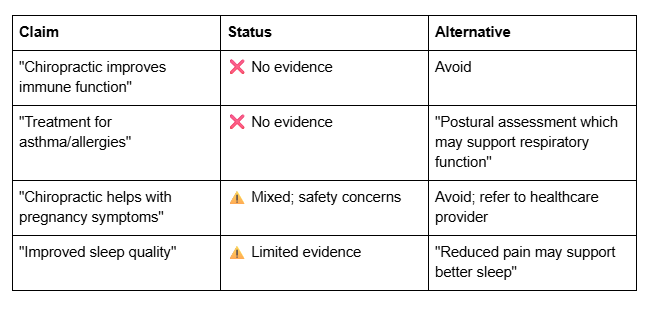
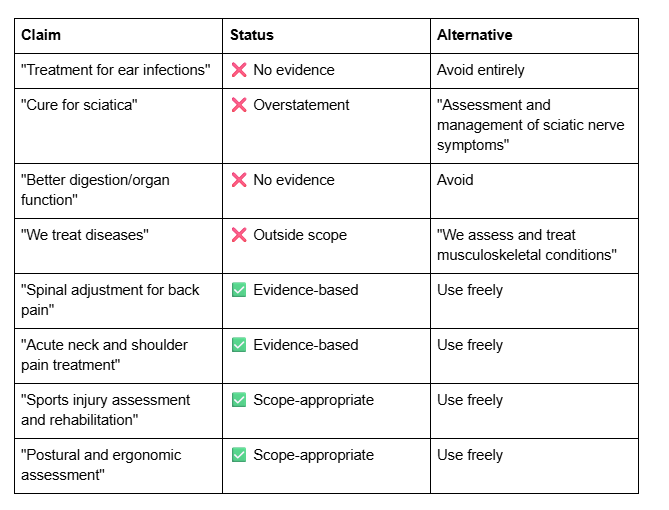
Frequently Asked Questions
-
Is it really illegal to call myself a chiropractor without GCC registration?
-
It's a breach of GCC Code of Practice. While not immediately catastrophic, if a patient complaint or regulatory review occurs, not displaying your GCC registration will be noted as a compliance issue. More importantly, you miss the opportunity to build trust through transparency. Always display it.
-
Citing research doesn't automatically make a claim compliant. Your claim must be substantiated by the evidence you cite. If you cite a Cochrane review or NICE guideline, make sure your claim aligns with what that evidence actually says. Don't cherry-pick research or overstate findings. When in doubt, use more cautious language ("may help," "is associated with reduction of") rather than absolute claims ("treats," "cures").
-
Only if you have explicit written consent. A Facebook comment saying "Great clinic!" is not sufficient permission to republish elsewhere. Reach out to the patient, explain how you want to use their testimonial, and get written consent. This is both a GDPR requirement and an advertising standards requirement.
-
Use this test: Could a patient reasonably interpret your claim as a medical treatment guarantee? If yes, it's probably too strong. Use evidence-based language focused on assessment and management rather than disease treatment or guaranteed outcomes. If you're uncertain, contact the BCA for guidance or consult with your legal advisor.
-
Take it seriously. If the ASA contacts you, respond promptly and provide evidence for your claims. If you cannot substantiate a claim, remove it immediately. Document everything. If you have professional liability insurance, notify your insurer. Don't be defensive—advertising compliance is evolving and many chiropractors learn through experience.
-
Only with explicit patient consent and clear context. Frame them as showing structural changes in alignment, not disease treatment. Avoid any language suggesting the X-rays show "before and after cure" or medical improvement. The safer approach is to avoid before-and-after imagery altogether and use written testimonials instead.
-
At least annually. Review all marketing claims, testimonials, and service descriptions. If GCC Code of Practice changes (check the GCC website regularly), update your policy and privacy statements. When you change services or add new treatment offerings, review the compliance implications immediately.
Compliance-First Web Design for UK Chiropractors
Building a compliant chiropractic website isn't about being overly cautious—it's about protecting your practice, building patient trust, and operating with integrity. GCC registration, advertising standards, and GDPR requirements aren't obstacles; they're frameworks that separate professional, trustworthy practices from unregulated operators.
At Squareko, we build Squarespace websites for UK chiropractors with compliance at the foundation. We ensure your GCC registration is displayed prominently, your marketing claims are evidence-based, your patient data is protected, and your site meets every regulatory requirement. Whether you're launching your first website or ensuring an existing site is compliant, we'll guide you through every requirement.

From custom website design to SEO strategy, we help businesses launch a site that looks professional and performs better.

About the Author
Walid is the founder of Squareko,
I'm Walid Hasan, a Certified Squarespace Expert and Squarespace Circle Platinum Partner with over 12 years of hands-on experience designing and optimizing high-performing websites. Over the years, I've had the privilege of building more than 2,000 Squarespace websites for clients around the world, always focusing on clean design, strong user experience, and conversion-driven results.