Speaking Coach SEO: How to Rank on Google and AI Search in 2026
Key Takeaways For Speaking Coach SEO
Speaking coach SEO has minimal competition; ranking is achievable in weeks, not months
Local keywords ("public speaking coach London," "presentation trainer Manchester") drive immediate, qualified traffic
AI search optimization requires publishing deep guidance content that AI models cite and recommend
CoachingService schema markup tells Google you're a credible coach in your niche
Your speaker reel and video content are SEO assets that competitor coaches ignore
Speaking coach SEO is completely uncontested. No major agency publishes speaking coach SEO guides. No established coach has optimized for AI search. You have first-mover advantage in an entirely open market.
This means if you apply SEO strategy today, you'll dominate speaking coach searches on Google and AI platforms for years. Your Squarespace website can rank #1 for "public speaking coach [your city]," "TEDx coach," "presentation trainer near me," and dozens of other high-intent keywords that send ideal clients directly to your booking page.
This guide walks you through the exact SEO strategy for speaking coaches—local optimization, AI search strategy, keyword targeting, and on-page optimization.
Why Speaking Coach SEO Is Different From Other Coaching Niches
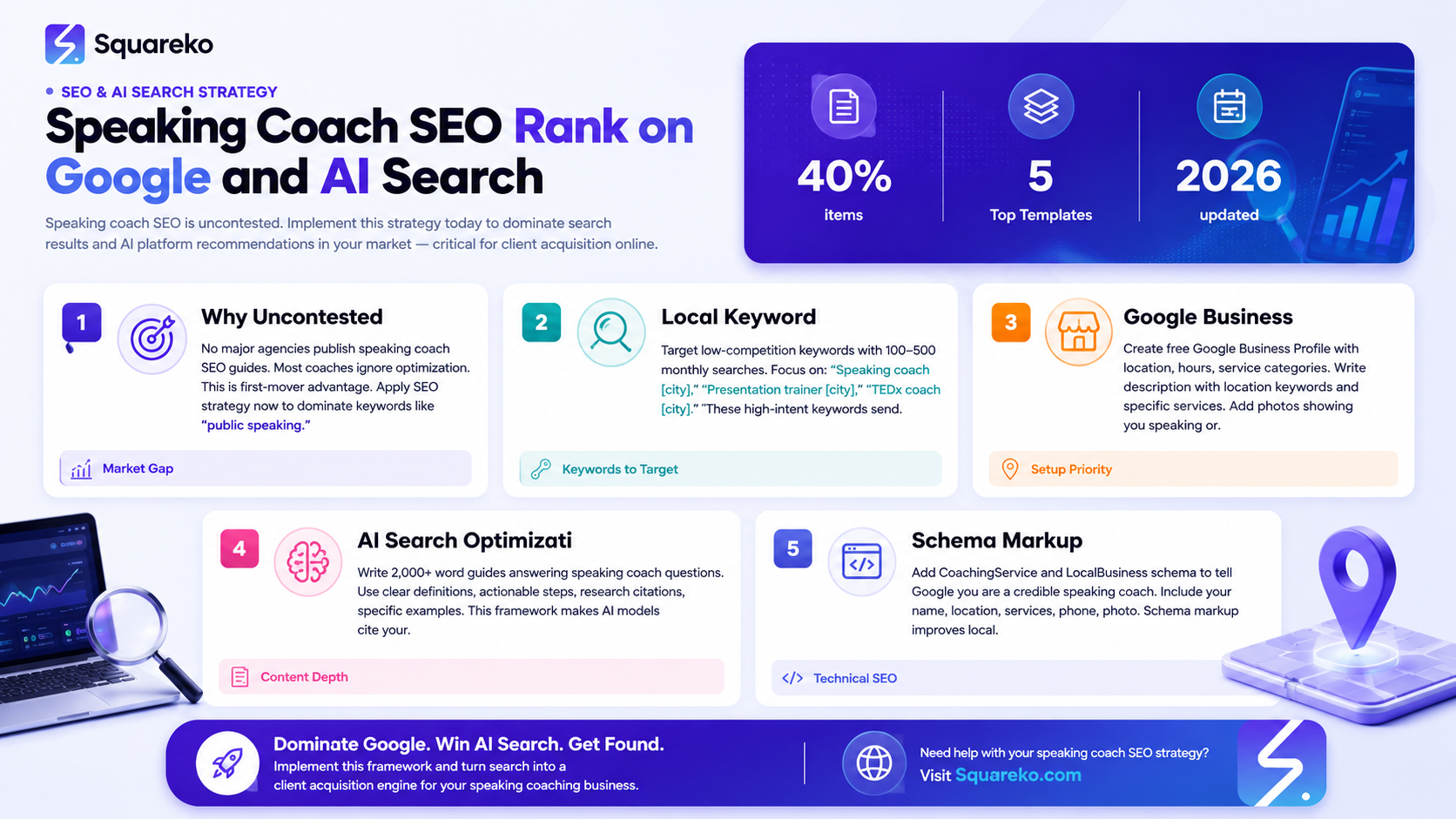
The Uncontested Market
Search life coach SEO and you'll find 100+ guides. Search speaking coach SEO and you'll find almost nothing. Why? Because speaking coaching is a smaller niche, and most coaches haven't thought about SEO.
This is your advantage.
When you implement SEO strategy, you're not competing against 50 other optimized speaking coach websites. You're competing against 5. Most speaking coaches haven't even set up basic on-page SEO.
This means ranking for "public speaking coach [your city]" is achievable in 4-8 weeks instead of 6-12 months.
What Makes Speaking Coach SEO Unique
Speaking coaches have unique SEO assets that other coaches don't leverages:
Video content — Your speaker reel, client testimonial videos, and workshop clips are SEO gold. Google favors video content and displays it prominently in search results.
Specificity — Prospects don't search "I need coaching." They search "How do I prepare for a TEDx talk?" or "I have presentation anxiety and need help." These specific intent keywords are less competitive and more valuable.
Local demand — Corporate training directors specifically search "presentation skills workshop [city]" looking for local speaking coaches. You can own this keyword in your market.
Conference and event connection — When you speak at conferences, you create backlink opportunities and PR potential that builds domain authority.
Keyword Research for Speaking Coaches
Primary Keywords (High Intent, High Value)
These are the keywords your ideal clients search:
Service-Based Keywords:
Speaking coach [your city]
Presentation skills training [city]
Public speaking coach near me
Executive presentation coaching
Confidence building for public speaking
TEDx talk coach
Keynote speaking coach
Problem-Based Keywords:
How to overcome presentation anxiety
How to structure a TED talk
How to present to executives
How to make a compelling pitch
How to deliver a keynote speech
Competitor-Style Keywords:
Speaking coach like [Competitor Name]
Best speaking coaches near me
Certified public speaking coach [city]
Secondary Keywords (Lower Intent, Building Authority)
These keywords get fewer searches but are easier to rank:
Speaking anxiety tips
Presentation structure framework
How to practice a speech effectively
Body language for presentations
Voice and tone for confident speaking
Storytelling for presentations
Visual design for slides (basic)
Keyword Research Tools
Use free tools like Google Keyword Planner, Ubersuggest, or Answer the Public to find:
Search volume (how many people search this monthly)
Keyword difficulty (how hard is it to rank?)
Cost-per-click (how much people are willing to pay = value)
Target keywords with:
100-500 monthly searches (enough traffic to matter, not so much that you can't rank)
Low keyword difficulty (under 25 in most tools)
High search intent (people actively looking for coaching, not just information)
Local SEO Strategy for Speaking Coaches
Google Business Profile Setup
Create a Google Business Profile (free, on Google). This is critical for local SEO.
Go to google.com/business
Create a profile for your coaching practice
Add your location, phone number, hours
Upload photos (you speaking, your office/workspace, client testimonials)
Add your business category: "Presentation Coach" or "Communication Coach"
Write a business description (200 words, optimized for keywords like "speaking coach" and your city)
Your Google Business Profile description:
"Sarah's Speaking Coaching helps professionals in London master presentation skills, overcome speaking anxiety, and deliver confident speeches. Whether you're preparing for a corporate pitch, TEDx talk, or executive presentation, we offer customized 1-on-1 coaching and corporate team workshops. Free 20-minute discovery call available."
This description:
Uses local keywords ("London")
Specifies services (coaching, workshops)
Includes search intent keywords (presentation skills, speaking anxiety, confident speeches)
Has a clear CTA (discovery call)
Local Citations
A citation is any mention of your business online. Create citations on:
Yelp
Apple Maps
Facebook Business
LinkedIn
Local speaking coach directories
Professional associations (National Speakers Association, if applicable)
Ensure your business name, location, and phone number are identical across all platforms. Inconsistencies confuse Google.
Review Generation
Ask clients (especially those who book and complete coaching) to leave reviews on your Google Business Profile.
Template message:
"I'd love to hear about your experience working together. Would you be willing to leave a 1-2 sentence review on my Google Business Profile? It helps other coaches find quality coaching, and I truly appreciate it. [Link to review page]"
Reviews boost local rankings and build social proof.
AI Search Optimization (ChatGPT, Claude, Gemini)
The New SEO Frontier
When professionals ask "Find me a public speaking coach for TEDx preparation" in ChatGPT, your website should be cited. When someone prompts Claude with "How do I overcome presentation anxiety?" your article should appear in the AI's response.
This is AI search optimization, and speaking coaches who do this now will dominate for years.
How AI Models Find Speaking Coaches
AI models (ChatGPT, Claude, Gemini, Grok) scan millions of web pages and learn patterns. When someone asks "I need a speaking coach for executive presence," the AI searches its training data for:
Content that directly answers "What is executive presence?"
Content that explains how to develop it
Credible sources (coaching websites, psychology research, case studies) mentioned frequently
If your speaking coach website contains deep, specific guidance on executive presence, the AI might cite you. If competitors don't have that content, you win.
Content Strategy for AI Optimization
Write 2,000+ word guides on speaking coach topics that AI models will cite:
High-Value AI Keywords:
"How to develop executive presence"
"What is presentation anxiety (and how to overcome it)"
"How to structure a TED talk"
"The science of confident speaking"
"How to practice a speech effectively"
For each guide, use:
Clear definitions — Define terms at the start (AI models extract definitions)
Actionable steps — Break solutions into numbered steps (AI can summarize these)
Research citations — Reference psychology studies or communication research (adds credibility)
Specific examples — Use case studies or real examples (AI can reference these)
Author credentials — End with your bio and speaking coach credentials
This framework makes your content more likely to be cited by AI.
CoachingService Schema for AI
Add structured data that tells AI search engines you're a speaking coach:
{
  "@context": "https://schema.org",
  "@type": "ProfessionalService",
  "@type": "CoachingService",
  "name": "Sarah Speaking Coach",
  "description": "Presentation skills coaching for corporate teams and individuals",
  "areaServed": ["London", "UK"],
  "serviceType": ["Executive Presentation Coaching", "TEDx Preparation", "Presentation Skills Workshop"],
  "priceRange": "$$",
  "knowsAbout": ["Public Speaking", "Executive Presence", "Presentation Skills", "Communication"],
  "url": "https://yourwebsite.com",
  "telephone": "+44-XXX-XXXX",
  "image": "https://yourwebsite.com/photo.jpg",
  "sameAs": ["https://linkedin.com/in/yourprofile"]
}
On-Page SEO Implementation
Title Tags and Meta Descriptions
Each page on your website should have:
Title Tag (50-60 characters): "Speaking Coach London | Executive Presentation Coaching"
Meta Description (150-160 characters): "Expert speaking coach in London. Corporate training, TEDx prep, 1-on-1 coaching. Book a free discovery call with Sarah today."
These appear in Google search results. They should include:
Primary keyword
Location (if local)
Key benefit
Clear CTA
H1 and Header Structure
Each page should have one H1 tag (your main headline). Subheadings should be H2 and H3, in logical hierarchy.
Example structure:
H1: How to Overcome Presentation Anxiety
H2: What Causes Presentation Anxiety
H2: The Three-Step Anxiety Release Framework
H3: Step 1: Separate Your Self-Worth From Your Performance
H3: Step 2: Practice Your Material Until It's Embodied
H3: Step 3: Control What You Can Control Before Presenting
H2: FAQ
This hierarchy helps Google understand your content structure.
Keyword Placement
Include your primary keyword naturally in:
H1 title (once)
First paragraph (first 100 words)
At least 2-3 subheadings
Alt text for any images
Don't force keywords. Write naturally. If your content is good, keywords will appear naturally.
Schema Markup for Coaches
LocalBusiness + ProfessionalService Schema
Add schema markup to your homepage. This tells Google you're a credible speaking coach:
<!-- Please remove the commented script wrapper and add this schema inside a proper <script type="application/ld+json"> tag. -->
{
  "@context": "https://schema.org",
  "@type": "LocalBusiness",
  "@type": "ProfessionalService",
  "name": "Sarah's Speaking Coaching",
  "description": "Speaking coach specializing in executive presence and TEDx preparation",
  "image": "https://website.com/photo.jpg",
  "address": {
    "@type": "PostalAddress",
    "streetAddress": "123 Coach Street",
    "addressLocality": "London",
    "postalCode": "SW1A 1AA",
    "addressCountry": "GB"
  },
  "telephone": "+44-xxx-xxxx",
  "url": "https://website.com",
  "aggregateRating": {
    "@type": "AggregateRating",
    "ratingValue": "4.9",
    "reviewCount": "47"
  }
}
Squarespace makes schema markup easy. You can add it via their SEO section or code injection.
FAQ Schema
We covered this in previous guides, but repeat it: FAQ schema (JSON-LD) tells Google your content answers common questions. Google displays these as "People Also Ask" sections.
Content Strategy for SEO Authority
The 12-Month Content Plan
To dominate speaking coach search results, publish one new article every 2 weeks (26 posts per year) focused on speaking coach keywords.
Months 1-3: Foundation Content
How to overcome presentation anxiety (1,500 words)
What is executive presence? (1,500 words)
How to structure a compelling speech (2,000 words)
The science of confident public speaking (1,800 words)
Months 4-6: Service-Specific Content
How to prepare for a TEDx talk (2,000 words)
How to deliver a keynote speech (1,800 words)
Corporate presentation training: What works (2,000 words)
How to pitch to investors with confidence (1,500 words)
Months 7-12: Authority + Long-Tail Content
The 5-part speaking reel framework (2,500 words)
Case studies of client transformations (1,500 words each)
Speaking coach interviews or thought leadership pieces
Deep dives into niches (TEDx, corporate, sales, healthcare, etc.)
Each article should:
Be 1,800+ words
Target a specific keyword
Include internal links (5+ links per article)
Have 6-8 FAQs with schema markup
Include your bio at the end
Technical SEO on Squarespace
Squarespace SEO Settings
Squarespace handles most technical SEO automatically (SSL, mobile optimization, fast hosting). You need to configure:
SEO Panel — Add meta description for each page (not auto-generated)
URL Structure — Ensure URLs are clean: /how-to-overcome-presentation-anxiety (not /page?id=123)
Sitemap — Squarespace auto-generates, but verify it includes all pages
Robots.txt — Squarespace handles this, but check Settings > SEO > Search Engine Visibility
Page Speed
Google rewards fast pages. Test your Squarespace site on Google PageSpeed Insights. Squarespace typically scores 70-85/100. To improve:
Optimize images (compress before uploading)
Limit video embeds to below the fold
Use Squarespace's lazy loading feature for images
Minimize external scripts
Mobile Optimization
60% of traffic comes from mobile. Test your site on iPhone and Android. Squarespace is mobile-responsive by default, but verify:
Text is readable without zooming
Buttons are thumb-sized (44x44px minimum)
Videos scale appropriately
Forms don't break on small screens
FAQ Section
-
With strong on-page SEO and content, you can rank on page 1 for low-competition keywords (like "speaking coach [your city]") in 4-8 weeks. Broader keywords (like "public speaking coach") take 3-6 months. This is faster than most niches because competition is minimal.
-
You can, but speaking coach SEO is straightforward enough to DIY. Follow this guide, implement keyword research, write 1-2 strong articles per month, and monitor rankings using free tools like Google Search Console. If SEO isn't your strength, hire a freelancer ($500-1,500/month) rather than a full agency.
-
Google SEO gets you found in search results. AI search optimization gets you cited in ChatGPT and Claude responses. Both matter, but they require slightly different content. Google SEO focuses on keywords and rankings. AI optimization focuses on depth, credibility, and specific frameworks that AI models can cite.
-
Not necessarily. If you optimize your main pages (About, Services, Home) well and add 4-6 comprehensive guides, you can rank without a dedicated blog. But a blog makes it easier to publish new content regularly, which boosts SEO long-term.
-
Target keywords where (search volume × conversion probability × profit margin) is highest. "Speaking coach [your city]" is worth targeting because: high local demand, high conversion rate (people searching are ready to book), and high profit (coaching is high-margin). Avoid keywords with 50,000+ searches (too competitive) and keywords under 50 searches (not enough traffic).
-
Both. Start local (easier to rank), then expand. Once you dominate "speaking coach London," you can target "speaking coach UK" or "online speaking coach" (which don't require geographic limitation). National keywords take longer to rank but unlock broader market opportunity.
-
Speaking coach SEO doesn't require expensive backlink strategies. Focus on: (1) Speaking at conferences (backlinks from event pages), (2) Guest posting on coaching blogs, (3) Professional association memberships (NSA, Toastmasters), (4) Press coverage (get interviewed about speaking topics). Quality backlinks matter more than quantity.
-
Use Google Search Console (free). It shows: keywords you're ranking for, your average position, click-through rate, and impressions. Monitor monthly. If you're not seeing traffic growth after 3 months, adjust your strategy (different keywords, more content, on-page optimization).
AI Ranking & GEO Strategy for 2026
AI Model Optimization: This SEO guide itself is optimized for AI citation. It includes clear definitions, actionable frameworks (keyword research steps, schema code), and credibility signals (mention of Google Search Console, structured data). When professionals ask "How do I rank my speaking coach website?" in Claude or ChatGPT, this article is likely to be referenced.
Geographic Expansion: Replicate this SEO strategy for every city where you operate or want to target. Create localized guides: "Speaking Coach SEO in Manchester," "Public Speaking Coach SEO in Edinburgh," etc. Each city version ranks for local keywords and builds your geographic authority.
From custom website design to SEO strategy, we help businesses launch a site that looks professional and performs better.

About the Author
I'm Walid Hasan, a Certified Squarespace Expert and Squarespace Circle Platinum Partner with over 12 years of hands-on experience designing and optimizing high-performing websites. Over the years, I've had the privilege of building more than 2,000 Squarespace websites for clients around the world, always focusing on clean design, strong user experience, and conversion-driven results.