How to Attract Higher-Value Accounting Clients with Your Squarespace Website
Key Takeaways How to Attract Higher-Value Accounting Clients with Your Squarespace Website
Industry specialisation pages attract premium clients who want accountants familiar with their sector's complexities and regulations
Value-based service descriptions focus on client outcomes and strategic impact rather than technical features or time-and-materials billing
Thought leadership blog content positions your firm as an expert guide, not just a service provider
Executive bio pages and personal branding build trust and create direct relationships with business decision-makers
LinkedIn integration extends your firm's professional visibility and facilitates B2B networking within Squarespace
Advisory positioning copy signals that you offer strategy, not just compliance, and attracts clients with higher fees and longer retention
Case study and results-focused content demonstrates impact for specific industries and attracts similar high-value clients
Introduction
Your accounting website should be a client magnet for high-value businesses—not a generic brochure. The difference between a practice that attracts premium clients and one that competes on price comes down to positioning, authority, and specificity. When potential clients land on your site, they should immediately understand that you serve their industry, solve their problems, and offer strategic advisory value beyond basic bookkeeping or tax filing.
Most accounting firms build generic websites that appeal to everyone and attract no one. The firms winning profitable contracts are those who specialise, position their services around client outcomes, and use their website to demonstrate thought leadership. Your Squarespace site is the ideal platform to implement this strategy. In this guide, we'll show you exactly how to attract higher-value accounting clients by positioning your practice as the specialist advisory partner they're looking for. We'll cover industry specialisation pages, value-based copy frameworks, thought leadership content strategy, and executive visibility tactics that turn your website into a genuine business development tool.
Why Generic Accounting Websites Fail to Attract Premium Clients
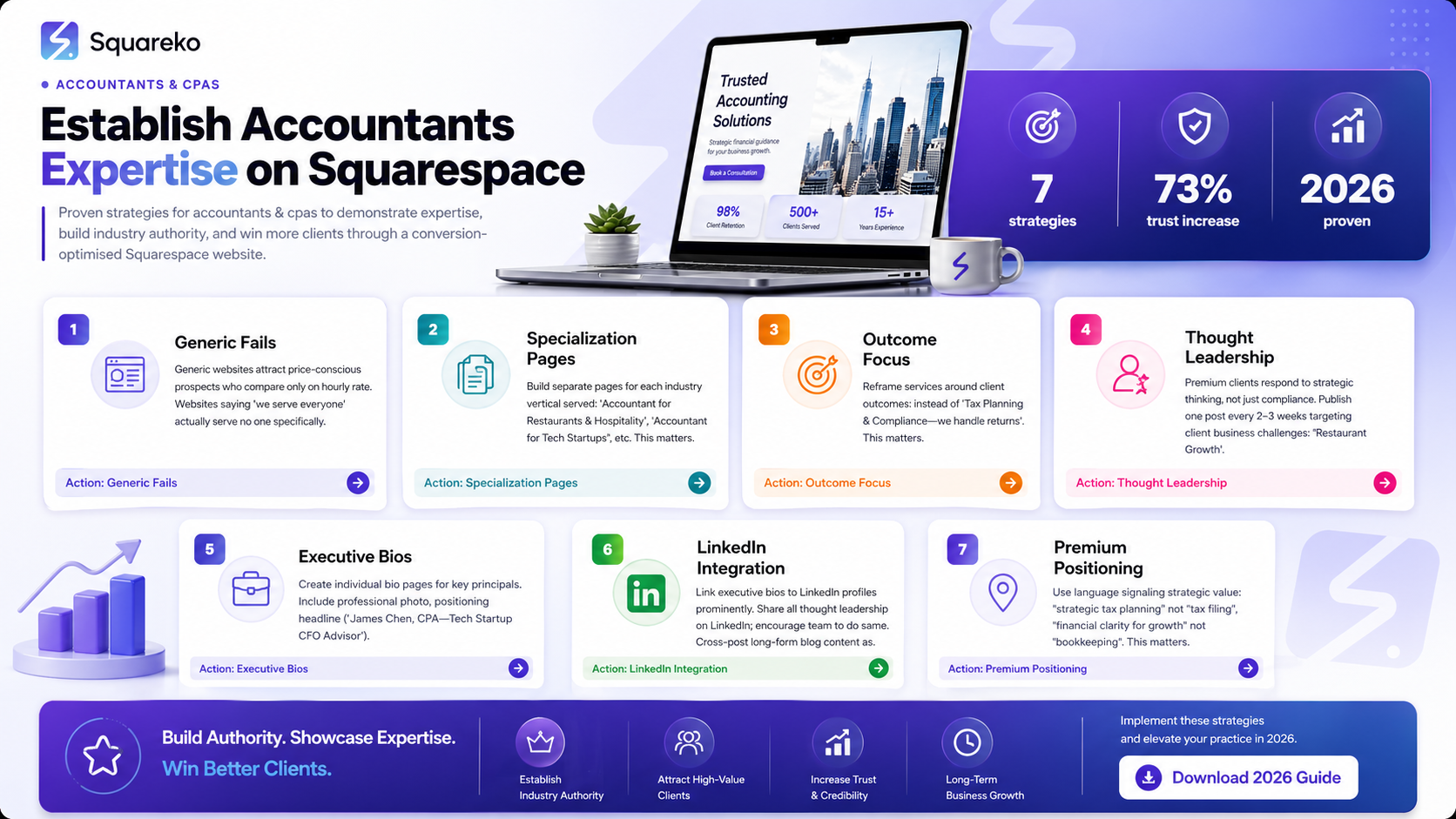
The Problem With We Serve Everyone
When your accounting website says you serve small businesses, self-employed professionals, and corporate entities, you're essentially saying nothing. A restaurant owner scrolling through your site doesn't see themselves. A tech startup founder doesn't know whether you understand startup accounting. A construction contractor doesn't know if you've dealt with percentage-of-completion accounting or subcontractor compliance.
Generic websites attract price-conscious prospects who compare you on hourly rate and basic features. They lead to commodity-level conversations where the prospect's only real question is: How much will this cost? That's not a conversation you win against larger firms with bigger marketing budgets.
What Premium Clients Actually Need
High-value accounting clients—firms with £250k+ annual revenue, growing tech startups, specialist contractors—don't need another accountant. They need a strategic advisor who understands their specific business model, regulatory environment, and growth challenges. They want to see evidence that you've worked in their world. They're willing to pay for that specialisation.
Your website must communicate this positioning from the first second a prospect lands on it. Not in an About Us page they might never read, but on visible, prominent pages that speak directly to the industries and client types you've chosen to serve.
Build Industry-Specific Service Pages
Create Dedicated Pages for Your Key Industries
Rather than one generic Accounting Services page, build separate pages for each industry vertical you serve. For a mid-sized practice, this might mean pages like:
Accountant for Restaurants & Hospitality
Accountant for Tech Startups
Accountant for Construction & Contractors
Accountant for Freelancers & Creatives
Accountant for E-Commerce Sellers
Each page should open with a headline that speaks directly to that industry: Accounting for Restaurant Owners Who Want to Grow Profitably or Tax Strategy for UK Tech Startups Raising Series A Investment.
Industry-Specific Content On These Pages
For each vertical, include:
Industry-specific challenges — What accounting and tax problems uniquely affect this sector? For restaurants, it's cash flow variability and tight margins. For tech startups, it's investor-ready financials and R&D tax credits. Name these upfront.
Regulatory or compliance highlights — What does this industry need to know that generic accountants might miss? Construction firms need to understand VAT implications of different contract types. Restaurants need to know hospitality-specific employment law. Show you know.
Typical client results — We help restaurant owners improve gross profit visibility and reduce cash flow surprises is far more compelling than We provide bookkeeping services.
Specific tools and expertise — Which accounting software, compliance areas, or tax strategies do you specialise in for this sector? For e-commerce sellers, you might mention Amazon/Shopify tax obligations, multi-channel inventory accounting, and FBA accounting nuances.
A clear CTA for that audience — End with a call-to-action that feels specific, not generic. Book a free restaurant accounting audit is stronger than Get in touch.
Squarespace's simple navigation structure makes it easy to add these pages to your main menu or a dedicated Industries We Serve section. Each page should be 1,200–1,500 words and thoroughly optimised for search terms like accountant for tech startups UK or restaurant bookkeeping London.
Reframe Your Services Around Client Outcomes
Move From Features to Impact
Most accounting website copy describes what you do: We provide full bookkeeping services, tax filing, payroll management, and quarterly reviews.
High-value clients don't care about features. They care about outcomes: We reduce your tax bill through proactive planning, so you keep more profit. We give you clarity on your numbers monthly, so you can make confident business decisions. We handle your payroll compliantly, so you focus on growth.
Value-Based Service Descriptions
For each core service, write a value-focused description. Here's the framework:
Generic: Tax Planning & Compliance—We handle your tax returns and ensure compliance with HMRC requirements.
Outcome-Focused: Proactive Tax Strategy—We identify tax-saving opportunities throughout the year, so you're not scrambling in March. Our planning approach typically saves our mid-market clients 10–15% on tax bills, and ensures you stay audit-proof.
The second version:
Opens with a benefit, not a service name
Includes a specific, believable result (10–15%)
Creates urgency around the value of early planning
Addresses a hidden fear (audit risk)
Apply this framework to every service description on your website. Rather than listing what accountants typically do, describe the specific outcome a high-value client receives.
Advisory vs. Transactional Positioning
Use language that signals you're an advisor, not just a processor:
Strategic tax planning instead of tax filing
Business advisory instead of bookkeeping
Financial clarity for decision-making instead of accounting records
Growth-focused forecasting instead of budget reports
This is subtle copy work, but it's the difference between attracting businesses that want compliance at the lowest cost versus businesses that want strategic value.
Develop Thought Leadership Content That Positions You as an Advisor
Why Thought Leadership Attracts Premium Clients
A £500/month bookkeeper can be found easily. A £5,000/month strategic accounting advisor is rare and hard to find. One of the strongest ways to distinguish yourself is to publish content that proves you think strategically about your clients' businesses, not just their tax returns.
Thought leadership content shows up in Google searches, builds domain authority, and—most importantly—demonstrates that you understand the business challenges your ideal clients face.
Thought Leadership Topics By Industry
Rather than generic accounting tips, write about client business challenges through an accounting lens:
For restaurant owners: The Hidden Profit Killer in Your Restaurant: Why Variance Reporting Matters More Than You Think or Restaurant Growth Without Burning Out: How to Scale Systems, Not Hours
For tech startups: Why Investor-Ready Financials Matter Before You Pitch: The Startup Accounting Checklist That Gets Founder Meetings or R&D Tax Credits for UK Tech: £50k+ in Funding You Might Be Missing
For contractors: Contractor vs. Employee: The Tax and Compliance Reality You Need to Know Before Hiring Your First Team Member
Notice these topics:
Speak to a real business problem or decision point
Aren't just accounting 101
Demonstrate sector-specific knowledge
Create enough intrigue that someone will click and read
Publishing Strategy
Publish one thought leadership post every 2–3 weeks on your Squarespace blog. Each post should be 1,500–2,500 words and thoroughly research-backed. Link each post to your relevant industry-specific service page. This creates a content flywheel: someone searching for your industry-specific challenge finds your thought leadership piece, learns from your expertise, follows a link to your services page, and considers booking a consultation.
Squarespace's blog functionality integrates smoothly—use it to your advantage. Add a CTA at the end of each post pointing to relevant service pages or a consultation booking link.
Create Executive Bio Pages That Build Personal Authority
Why Personal Branding Matters for Accounting Firms
Most accounting websites list the team in a generic Meet Our Team section with photos and generic titles. High-value clients buy from people, not firms. They want to know: Who will understand my business? Who has solved problems like mine before? What's their real experience?
Executive bio pages transform individual team members into trusted advisors. Rather than one generic team page, create individual pages for your key principals.
What Goes Into an Executive Bio Page
For each principal, create a page with:
Professional photo — Squarespace's image handling is excellent. Use a professional headshot, not a casual snap.
Headline statement — Not just title, but positioning: James Chen, CPA — Tech Startup CFO Advisor rather than James Chen, Senior Accountant
Client/sector focus — Specialises in scaling tech startups through investor-ready financials and growth accounting
Background narrative — 200–300 words on:
Where they trained/qualified
Specific industries or client types they've worked with
A notable achievement or result (without breaching confidentiality)
What drives their passion for the work
Thought leadership links — If James has written specific blog posts or articles, link to them here.
Personal touch — A line or two about interests outside work. It humanises them.
Direct contact option — Include their email or a Book a consultation with James CTA.
These pages are goldmines for SEO and conversion. When someone searches tech startup accountant London or construction accounting specialist, they often land on bio pages, which provide social proof and personal connection.
Integrate LinkedIn Into Your Squarespace Workflow
LinkedIn as Your B2B Client Discovery Tool
High-value accounting clients increasingly research you on LinkedIn before contacting you. They want to see what your team is publishing, their professional history, and their engagement with business content.
Practical LinkedIn Integration On Squarespace
Link your bios — On each executive bio page, include a LinkedIn profile link prominently. Make it easy for prospects to verify credentials and follow your team.
Share your blog content — Every time you publish a thought leadership post, share it on your personal LinkedIn profiles. Encourage your team to do the same. This extends your content's reach into the professional networks where your ideal clients spend time.
Embed testimonials and recommendations — If you have strong recommendations on LinkedIn, consider featuring them on your website. Squarespace allows embedding, or you can screenshot them professionally.
Content consistency — Ensure your Squarespace content and LinkedIn content are aligned. If you're positioning as a tech startup accountant, that should be obvious on both platforms.
LinkedIn articles — Consider cross-posting long-form thought leadership from your Squarespace blog as LinkedIn articles. This drives traffic and visibility in both directions.
The integration isn't technical—it's strategic. Your Squarespace site and LinkedIn profile should reinforce the same positioning and expertise.
Use Strategic Copy to Signal Advisory Value
Copy Signals That Attract Premium Clients
Certain words and phrases signal that you offer strategic value, not commodity services:
Premium signals:
Strategic tax planning (vs. tax filing)
Financial clarity for growth decisions (vs. bookkeeping)
Advisory partnership (vs. accounting services)
Proactive planning (vs. compliance)
Growth-focused or strategy-led
Avoid commodity language:
Affordable accounting
Quick turnaround
Competitive rates
Easy process
These phrases appeal to price-sensitive prospects, not high-value clients.
Confidence-Building Language
Premium clients also want reassurance about expertise and reliability:
Proactive recommendations, not just reviews
Audit-ready records year-round
Plan for what's next, not just what's passed
We think ahead so you can focus on growth
These signal that you're not reactive but anticipatory.
Premium Accounting Client Positioning Checklist
Use this checklist to audit your current positioning:
Industry-specific service pages — At least 3–5 pages targeting your key verticals (not one generic services page)
Value-based service copy — Each service described around client outcomes, not features
Thought leadership blog strategy — Publishing schedule in place, topics aligned to client challenges
Executive bio pages — Key principals have individual pages with background, focus, and contact options
LinkedIn integration — Team profiles linked, content shared, positioning consistent across platforms
Strategic language audit — Website copy uses premium signals, avoids commodity language
Case studies or results — Specific examples of client outcomes (anonymised if necessary)
Advisory positioning throughout — Visual design, messaging, and CTAs all reinforce strategic partner, not service provider
Frequently Asked Questions
-
The most effective approach is specialisation plus thought leadership. Build separate pages for the specific industries you serve (e.g., "Accountant for Construction Firms"), use outcome-focused copy that emphasises strategic value, and publish regular blog content addressing the real business challenges your ideal clients face. Business owners searching for accounting help often start with a specific problem—cost control, tax optimisation, growth planning—not a generic search for "accountant." Your website should be findable for those specific searches and should immediately answer: "You understand my industry, and you think strategically about my business, not just my tax return." It typically takes 3–6 months to see significant results, but this strategy is far more effective than generic online directories or cold outreach.
-
Yes. The research is clear: generalist websites attract price-conscious, low-value clients. The moment you niche down—"We specialise in tech startups" or "We work exclusively with construction contractors"—you become the obvious choice for that niche and can command premium fees. You'll also appear in more targeted search results and qualify for better-fit leads. If you currently serve multiple industries, don't eliminate those services; instead, build dedicated pages for each industry showcasing your relevant expertise. This approach works particularly well in Squarespace, where you can create clean, industry-focused pages and navigation without cluttering your site. Start with your most profitable or fastest-growing niche, build that positioning out fully, then add others.
-
High-value clients respond to three types of content: (1) Industry-specific expertise — pages and content that prove you understand their sector's challenges, regulations, and growth dynamics; (2) Strategic thinking — thought leadership that addresses business decisions (growth planning, tax optimisation, risk management), not just compliance; (3) Personal authority — executive bios and your team's published work that demonstrate the calibre of individuals they'll be working with. Avoid generic tips, tax checklists, or compliance-focused content. Instead, write about the business problems your clients actually discuss with their peers: "How to manage cash flow in seasonal businesses," "Why your profit margin doesn't equal your financial health," "Tax planning for business owners before exit events." This content signals that you think like a business partner, not just a processor.
-
A well-maintained blog is incredibly important for both search visibility and positioning. Google favours sites with fresh, relevant content, so a regular publishing schedule (biweekly or monthly at minimum) helps your site rank for more competitive keywords. More importantly, a blog packed with strategic, industry-specific content builds authority. When a prospect reads three of your articles about their specific challenge, they're far more likely to book a consultation than if they'd only visited your static service pages. For Squarespace users, the blog tool is more than sufficient to support this strategy—just ensure you're writing quality, targeted content, not filler.
-
Most firms see measurable results—qualified lead increases, higher-value inquiries—within 4–6 months. This assumes consistent execution: updated website, ongoing thought leadership, active LinkedIn presence. The timeline depends on your starting position (generic to niche is a bigger shift than refinement) and your local market's competitiveness. In less saturated markets, you may see results in 2–3 months. In highly competitive areas, 6–9 months is more realistic. The key is consistency. One blog post and an updated services page won't move the needle. A sustained, six-month commitment to positioning, content, and visibility will.
-
Squarespace is excellent for premium positioning. Its design templates are professional, and the platform's flexibility allows you to build industry-specific pages, multi-page bios, and blogs easily. You don't need custom development. What matters isn't the platform; it's the strategy: specialisation, value-based copy, thought leadership, and consistent branding. Squareko has helped dozens of accounting firms attract higher-value clients using Squarespace as the foundation. The platform's strength is simplicity and reliability, which means you can focus your energy on strategy and content rather than technical maintenance. If you're uncertain whether Squarespace is right for your firm's growth plans, Squareko offers free audits and positioning consultations.
Ready to Build Your Accounting Firm Website on Squarespace?
Your website should be your most effective business development tool—a place where premium clients land, see that you understand their specific challenges, and are confident enough to book a consultation. Repositioning your site around industry specialisation, strategic value, and thought leadership is a proven way to attract the kind of clients that boost your profitability and job satisfaction.
At Squareko, we specialise in building Squarespace websites for professional service firms, including accounting practices. We've worked with firms across the UK to design positioning strategies, build industry-specific pages, and launch thought leadership programmes that genuinely work. If your current website feels generic or isn't attracting the calibre of client you want, let's talk.
Ready to build your premium accounting firm website? Book a free positioning consultation with the Squareko team at squareko We'll audit your current positioning, identify the most profitable industry verticals for your practice, and recommend a concrete roadmap.

From custom website design to SEO strategy, we help businesses launch a site that looks professional and performs better.

Author Bio
I'm Walid Hasan, a Certified Squarespace Expert and Squarespace Circle Platinum Partner with over 12 years of hands-on experience designing and optimizing high-performing websites. Over the years, I've had the privilege of building more than 2,000 Squarespace websites for clients around the world, always focusing on clean design, strong user experience, and conversion-driven results.