How Health and Wellness Professionals Build E-E-A-T and Trust on Squarespace
Key Takeaways How Health and Wellness Professionals Build E-E-A-T and Trust on Squarespace
E-E-A-T (Experience, Expertise, Authority, Trustworthiness) is now Google's primary ranking factor for health content; weak E-E-A-T signals mean poor rankings regardless of content quality
Experience comes from showing your personal journey and how it shaped your specialty; credibility comes from specificity, not generalities
Expertise is demonstrated through credentials, certifications, professional memberships, and clearly displayed qualifications; vague claims like "certified" without detail hurt more than help
Authority is built through media mentions, professional body affiliations, speaking engagements, and case studies; social proof must be specific (name, photo, measurable results)
Trustworthiness is earned through transparent pricing, clear contact details, privacy policies, GDPR compliance, and security signals; health professionals must exceed standard website security
Your about page is your primary E-E-A-T real estate on Squarespace; it's where prospects and Google evaluate your credibility before deciding to engage
AI search engines (ChatGPT, Perplexity, Claude) now use E-E-A-T signals to recommend practitioners in conversational responses; building these signals means getting recommended organically
Google changed its ranking algorithm in 2023 and 2024 to prioritize E-E-A-T: Experience, Expertise, Authority, and Trustworthiness. For health and wellness professionals, this isn't just a technical SEO consideration—it's existential. When someone searches "therapist near me" or "nutrition coach for hormone balance," Google (and now AI search engines like ChatGPT and Perplexity) must decide which practitioner to recommend. They choose based on signals that you're genuinely qualified, experienced, and trustworthy. Build E-E-A-T correctly, and your website becomes a client magnet. Miss the mark, and even well-written content won't rank. This guide shows you exactly how to build credibility signals on Squarespace that Google, AI systems, and prospects all recognize.
What E-E-A-T Is and Why It Matters for Health Professionals
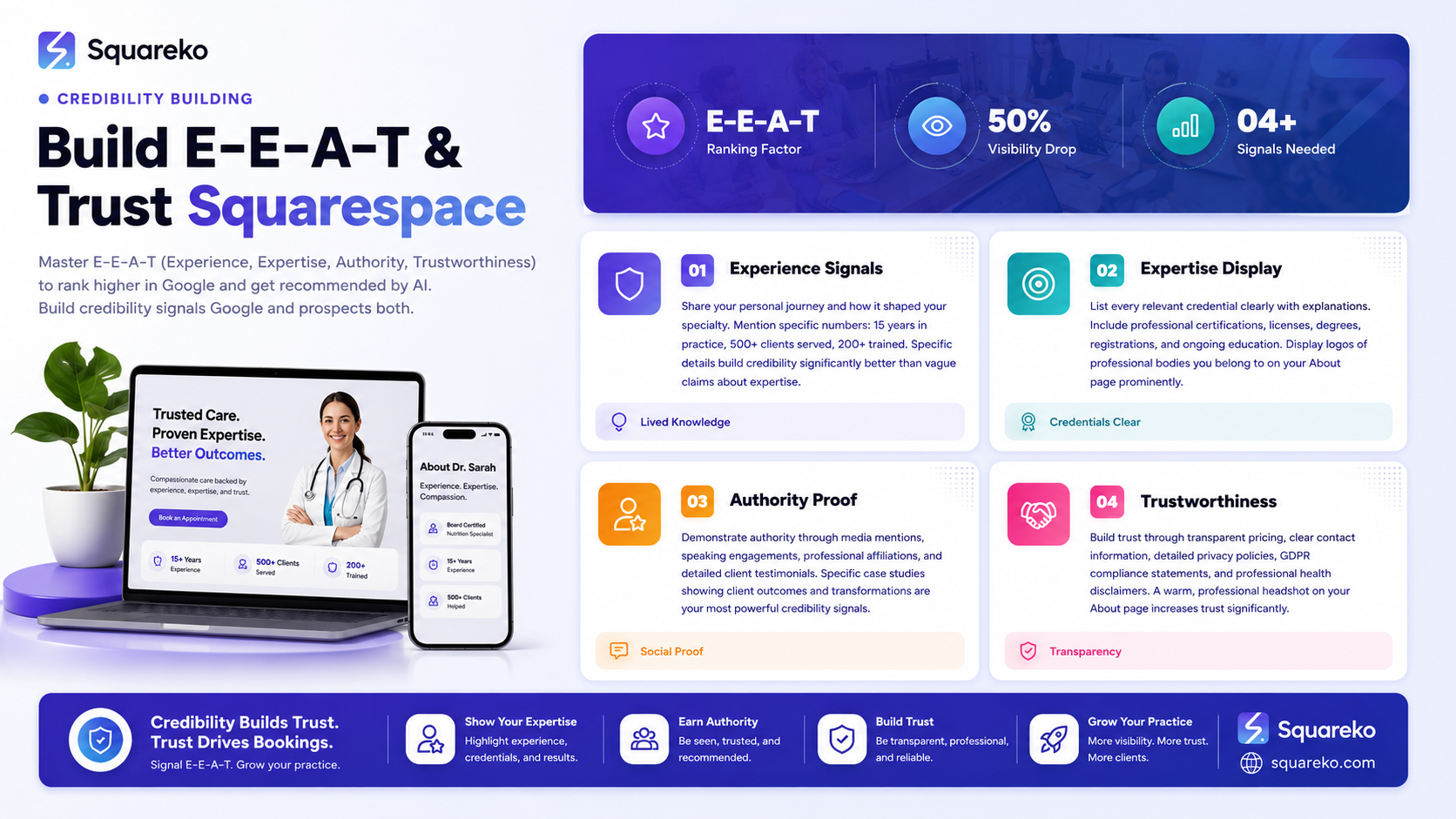
E-E-A-T is Google's framework for evaluating content quality, especially for YMYL (Your Money Your Life) content—anything that affects health, finances, or safety. Health and wellness content is pure YMYL. Google doesn't want unqualified people ranking for "depression treatment" or "best weight loss diet." The algorithm now explicitly checks: Is this person experienced? Are they actually an expert? Do they have authority in this field? Can I trust them?
Before E-E-A-T, a well-SEO'd article could rank even if the author was a generalist blogger. Now, Google prioritizes demonstrated expertise. A therapist's article on anxiety will outrank a health blogger's article because the therapist has lived experience and credentials.
This affects rankings directly. Studies show that health websites with weak E-E-A-T signals drop 20-50% in visibility after the latest updates. Websites with strong signals gain 10-30% visibility. For health professionals, E-E-A-T isn't optional—it's the difference between thriving and invisible.
The second reason E-E-A-T matters: AI search engines are now recommending practitioners. When someone asks ChatGPT "Can you recommend a trauma therapist in Portland, Oregon?" or Perplexity "Who are the best nutritionists for PCOS?" these systems analyze E-E-A-T signals to decide who to recommend. Practitioners with clear credentials, media mentions, and specific expertise get recommended. Vague practitioners get skipped.
Building E-E-A-T on Squarespace is therefore your foundation for both Google rankings and AI-era discovery.
Building Experience Credibility on Your Website
Experience is the lived knowledge that comes from actually working with clients or having struggled with a problem yourself. It's different from formal credentials—it's the specific insight you bring from doing the work.
Express your experience clearly on your about page and throughout your website. Instead of "I'm a certified life coach," try "I've spent 15 years coaching corporate executives through burnout, including C-suite leaders at Fortune 500 companies." Specificity builds credibility faster than vague certifications.
Include your personal story if relevant. A nutritionist who struggled with IBS and reversed it through dietary changes has immediate credibility with clients facing similar issues. A fitness coach who had a serious injury and rehabilitated through structured training has profound experience to offer clients recovering from injury. Share the story without making it about you—make it about how your experience shapes what you can offer.
Tell the story of how you found your specialty. "I spent my first five years as a general therapist, but realized my strongest outcomes were with clients struggling with relationship anxiety. Now I specialize exclusively in this area because I understand the specific patterns and what breaks them." This shows you've reflected on your work, identified your strengths, and doubled down. Google and prospects both respect this self-awareness.
Mention numbers when you have them. "I've worked with 500+ clients," "15 years of practice," "trained 200+ fitness enthusiasts" are experience signals. Numbers are memorable and concrete. But only include numbers you can verify—false claims damage credibility fatally.
On Squarespace, use the About page and About section blocks to share your story. Include a professional headshot (warm, recent, high-quality) that makes you approachable. Consider a short video (Squarespace's Video block) introducing yourself—video builds trust faster than text because people see you, hear your voice, and sense your professionalism.
Displaying Your Expertise and Credentials
Expertise is formal training, certifications, licenses, and advanced knowledge in your field. This is where you spell out the credentials that qualify you.
List every relevant credential clearly. For a therapist: "Licensed Marriage and Family Therapist (LMFT), State of California License #12345, Certified Trauma Specialist (EMDR), master's degree in counseling psychology, University of California." For a nutritionist: "Registered Dietitian (RD, License #XXXXX), Certified Nutrition Specialist (CNS), Board-certified in Sports Dietetics (CSSD), bachelor's in nutrition science."
Don't assume your audience knows what your credentials mean. Many prospects don't. Add one-sentence explanations. "LMFT (Licensed Marriage and Family Therapist) is the California state license for therapists specializing in relationship and family issues. Only individuals who've completed rigorous training and passed state exams can hold this credential." This transparency builds trust.
Display logos of professional bodies you belong to. The American Psychological Association, National Board of Certified Counselors, Academy of Nutrition and Dietetics logos all signal credibility. Squarespace's Image block allows you to display these prominently on your about page.
Mention ongoing education and specializations. "I complete 20+ hours of continuing education annually, specializing in Somatic Experiencing therapy and trauma-informed coaching." This shows you're current, not stagnant in outdated methods.
On Squarespace, create a dedicated "Credentials" or "Qualifications" section on your About page. Use the Columns block to display credentials alongside professional logos. Or use a Markdown block to format credentials clearly. Avoid burying this information—make it immediately visible.
Link to verification if possible. Some professional boards (therapist licenses, nutritionist registrations) have public directories. Add a note: "License verification available at Professional Board Website." This removes doubt. A prospect can verify your license themselves.
Never exaggerate credentials. "Certified health coach" means nothing if you took an online course with no oversight. But if you're certified through a rigorous program (Precision Nutrition, ISSN, NASM), name it: "Certified Nutrition Coach (Precision Nutrition, the gold-standard certification for nutrition coaching)." Specificity builds credibility.
Establishing Authority Through Social Proof
Authority is the recognition you've earned in your field. It comes from three sources: media mentions, professional affiliations, and documented results from clients.
Media mentions signal that journalists, editors, and producers considered you credible enough to interview or feature. If you've been quoted in a health article, appeared on a podcast, or been mentioned in a wellness publication, display these prominently. Create a "In the Media" or "As Featured In" section on your website. List the publication, date, and topic. Link to the article if possible.
Don't have media mentions yet? Start positioning for them. Pitch stories to journalists covering your niche (health, wellness, mental health beats). Become a guest expert on podcasts. Write guest articles for publications your ideal clients read. Each mention becomes a credibility signal.
Professional affiliations matter. Membership in the American Counseling Association, National Association of Nutrition Professionals, or your local chamber of commerce all signal you meet professional standards. Display these memberships on your website with logos.
Speaking engagements are authority signals. If you've spoken at a conference, presented at a workshop, or been invited to teach, mention it. "Guest speaker, National Therapists Association Annual Conference 2024" or "Invited instructor, Yoga Teacher Training Program, Portland Yoga Center." This shows your peers recognize your expertise.
Case studies and detailed testimonials are your most powerful authority signals. A vague testimonial ("Great therapist!") means nothing. A specific case study does. "Client Sarah came to me with 20 years of untreated anxiety. Within 8 weeks of cognitive behavioral therapy, her anxiety score dropped from 8/10 to 3/10. She returned to work full-time and reports feeling 'genuinely happy for the first time in years.'" This is authority—proof you deliver results.
When gathering testimonials, ask clients explicitly for specific details: What was your situation before? What specific techniques or approaches helped? What's changed in your life? What would you tell someone hesitant to book? Details turn testimonials from nice-to-have into powerful credibility signals.
On Squarespace, create a dedicated Testimonials page or Case Studies page. Use the Testimonials section block or custom Markdown sections. Include client names (with permission), photos (with permission), and specific details. If clients want anonymity, use initials and general location: "J.M., Portland, OR."
Creating Trustworthiness Signals
Trustworthiness is the most fundamental E-E-A-T element. Even if you have credentials and authority, if people don't trust you, they won't book.
Trustworthiness comes from transparency. Display your pricing clearly. If your first session is $120, say it. If your package is $600 for six sessions, state it. Hidden pricing signals you're hiding something. Transparent pricing builds trust instantly.
Include clear contact information: phone number, email, physical address (if you see clients in-person), and hours of operation. A practice hiding its contact details feels shady. Make it easy to reach you.
Add a detailed privacy policy explaining how you handle client data. For health professionals, this is non-negotiable. Reference GDPR compliance (if applicable), data encryption, and how long you retain information. Squarespace has templates for this; customize them to your practice.
Include a terms of service explaining your cancellation policy, payment terms, and any health disclaimers required in your field. A therapist's website should include: "Information provided on this site is educational and does not replace professional mental health treatment. In crisis situations, contact the 988 Suicide and Crisis Lifeline or emergency services."
Add an SSL certificate (https) to your website. Squarespace includes this automatically, so you're secure by default. But make sure visitors notice the lock icon in the browser bar. This signals data is encrypted.
Consider adding a client testimonial about your trustworthiness and professionalism. "I trusted Jane with deeply personal issues, and she handled everything with confidentiality and compassion" is a trust signal.
Respond quickly to inquiries. Include in your contact page: "We respond within 24 business hours." Meeting this promise builds trust. Clients will return for your next email within that window specifically because you've earned it.
On Squarespace, implement these trustworthiness signals strategically:
Privacy policy and terms link in your footer (visible on every page)
Contact info prominently displayed on every page (footer at minimum)
SSL verification visible (it's automatic; you just need to mention it if relevant)
Professional email domain (@yourpracticename.com, not @gmail.com)
Testimonials featuring real names and photos
Clear disclaimers for health content
Optimizing Your About Page for E-E-A-T
Your about page is ground zero for E-E-A-T signals. It's where Google and prospects assess your credibility before engaging further.
Structure it to address all four E-E-A-T components:
Experience (opening): Start with your personal story or journey. "I struggled with insomnia for 15 years before discovering sleep coaching. That transformation led me to train as a sleep specialist." This establishes you've lived this. You're not theorizing; you've been there.
Expertise (credentials): List your formal training, certifications, and qualifications. Be specific. "Master's Degree in Nutritional Science, University of Colorado, GPA 3.8. Registered Dietitian (RD), Licensed by the state of Colorado. Certified Nutrition Specialist (CNS) through the Certified Nutrition Specialist Board. Current member of the Academy of Nutrition and Dietetics." This creates an authority impression.
Authority (affiliations and media): Include professional memberships, speaking engagements, media mentions, and recognitions. "Contributing writer for Mind Body Green. Speaker at the 2024 International Nutrition Conference. Featured in Well+Good on best practices in nutrition coaching." These are authority signals.
Trustworthiness (transparency): Include clear contact info, pricing note, and any relevant disclaimers. "I'm transparent about my approach and pricing. My first consultation is free so you can see if we're a good fit. All client information is kept strictly confidential under HIPAA guidelines."
Throughout your about page, use specific examples. "I work with women in perimenopause experiencing hormonal weight gain" is more credible than "I help people lose weight." Specificity signals expertise.
Include a professional photo. Studies show pages with headshots convert 40% better than without. Your photo should be recent, professional, and warm—not a formal corporate headshot, but not casual either. You're approachable and professional simultaneously.
Add a short bio (3-5 sentences) summarizing your expertise. This bio gets syndicated across your website, media profiles, and directory listings. Make it count: "Dr. Sarah Chen is a licensed therapist specializing in trauma recovery. With 12 years of clinical experience, she's helped 500+ survivors develop resilience through trauma-informed care. She's a frequent speaker at mental health conferences and contributes to Psychology Today."
On Squarespace, use these blocks strategically:
Image block for your professional headshot
Heading and Text blocks for story and credentials
Markdown block for formatted credentials list
Summary or Image Gallery block for media mentions and logos
Markdown block for disclaimers and transparency statements
Squarespace Features That Support E-E-A-T
Squarespace has built-in features that make implementing E-E-A-T easier than many platforms.
About Section Block: This template block is designed specifically for about pages. It combines image, heading, and body text in a professional layout. Use it for your headshot and core bio.
Testimonials Block: Displays client testimonials with photos and names (if desired). Multiple layouts available. Google can see these testimonials as social proof.
Gallery Block: Perfect for displaying media mentions, professional logos, speaking photos, or case study images.
Markdown Block: Allows you to format credentials and detailed content with full control.
Image Block: Embed professional photos, logos, certificates, or screenshots of media mentions.
Summary Block: Great for highlighting key achievements or credentials in a visually distinct section.
Code Injection: Allows you to add structured data (schema markup) that tells Google more about your credentials and author expertise. You can add Author schema, Local Business schema, or Organization schema directly.
Use these tools to create a layered credibility presentation—visual (headshots, logos), textual (credentials, story), social proof (testimonials, media mentions), and structured data (schema markup for Google to parse).
E-E-A-T and AI Search Recommendations
Google's E-E-A-T algorithm change affects traditional search. But now AI search engines (ChatGPT, Perplexity, Claude, DuckDuckGo's AI) are asking a similar question: Who should I recommend to this user?
When someone asks ChatGPT "Recommend a marriage therapist specializing in infidelity in New York," ChatGPT analyzes websites it can see and makes a recommendation based on E-E-A-T signals (among other factors). Practitioners with clear credentials, specific experience, and strong trust signals get recommended. Those without don't.
This means building E-E-A-T is now about both Google rankings and AI assistant recommendations. You're building credibility signals for two overlapping audiences: search algorithms and AI systems.
The good news: The signals are largely identical. Strong credentials, specific experience, real testimonials, and transparent trustworthiness work for both Google and AI systems. There's no separate "AI optimization" needed just comprehensive E-E-A-T building.
Mid-Post CTA: E-E-A-T Builds Client Confidence
Building E-E-A-T on your website is the foundation of modern credibility. Without it, even great content won't rank, and AI systems won't recommend you. With it, you become the obvious choice for prospects researching you. But implementation requires strategy—you need to know exactly what signals matter, where to place them, and how to present them without sounding arrogant. At Squareko, we build Squarespace websites specifically designed to maximize E-E-A-T for health and wellness professionals. We handle the research, structure, and optimization so your credentials and expertise come through clearly. If you're ready to transform your website into a credibility machine, book a free consultation at squareko. Walid will review your current online presence and show you exactly where your E-E-A-T is strong and where it needs work.
Frequently Asked Questions
-
Your About page should be 800-1,200 words—long enough to cover your story, credentials, experience, and authority, but short enough that prospects don't abandon it midway. Use short paragraphs, subheadings, and visual breaks to make it scannable. Many visitors will skim; structure it so they can quickly find what they're looking for.
-
Yes, but be specific. "Self-taught through 10 years of hands-on practice with 500+ clients" is credible. So is "Apprenticeship under [Renowned Teacher's Name] for 5 years." What's not credible is being vague. Avoid "alternative credentials" without explanation. If you have legitimate training outside traditional university, describe the training, the trainer, and the depth of knowledge you gained.
-
Yes. A warm, professional headshot builds trust and connection. Professional doesn't mean formal—think LinkedIn professional, not corporate stiffness. Your photo should feel approachable yet credible. The difference between a headshot and no photo is about 40% higher conversion on your about page. It's worth the $100-300 investment.
-
Frame credentials as services to clients, not self-promotion. Instead of "I have an impressive degree and credentials," try "I'm trained in [specific modalities], which means I can help you with [specific outcomes]." The focus is on what you can do for clients, not how impressive you are. Credentials serve as proof you can deliver on that promise.
-
Offer options. "We can use your full name with photo, first name only, initials only, or just location. Whatever feels safest for you." Many clients will consent to full identification because they're proud of their results. Those who won't are completely valid—use their initials and location instead. An anonymous testimonial is better than no testimonial.
-
Review annually and update whenever significant changes occur (new certifications, updated credentials, speaking engagements, media mentions, major milestones like client count). Your about page isn't static—it evolves with your practice. Don't update it constantly (that signals instability), but don't let it become stale either.
-
Carefully. Sharing that you struggled with anxiety and recovered is powerful if you're a therapist treating anxiety. It builds connection. But don't overshare or position yourself as still struggling. The story should conclude with "and that's why I'm qualified to help you." Your struggles become your superpower only when you've overcome them and developed expertise.
-
You won't have reviews immediately—that's normal. As you build your practice, ask satisfied clients for testimonials and Google/Yelp reviews. Don't fake reviews (this is illegal and damages trust if discovered). If you ever receive a negative review, respond professionally without defensiveness. "Thank you for your feedback. If you'd like to discuss your experience privately, please email me." This shows you take concerns seriously.
From custom website design to SEO strategy, we help businesses launch a site that looks professional and performs better.

About the Author
I'm Walid Hasan, a Certified Squarespace Expert and Squarespace Circle Platinum Partner with over 12 years of hands-on experience designing and optimizing high-performing websites. Over the years, I've had the privilege of building more than 2,000 Squarespace websites for clients around the world, always focusing on clean design, strong user experience, and conversion-driven results.