How Health and Wellness Professionals Use Squarespace to Grow Their Practice in 2026
Key Takeaways How Health and Wellness Professionals Use Squarespace to Grow Their Practice in 2026
Your Squarespace website is a 24/7 client acquisition machine; it should generate qualified leads, not just exist as a digital business card
Content marketing (blog articles, resources, guides) builds organic visibility and establishes authority while generating 3x more leads than companies without blogs
Email list building through newsletter signups and lead magnets creates a warm audience you own; email subscribers convert to clients at 5-8x higher rates than cold prospects
Social proof strategy (testimonials, case studies, media mentions, reviews) reduces booking friction and increases conversion by 40%+ for new prospects
Online programs and digital products add revenue streams independent of your hourly rate; they also build your reputation as an authority
Local SEO (Google Business Profile, location keywords, local links) helps nearby prospects find you first; practices without local SEO lose 30% of searchable local demand
AI search visibility (being recommended by ChatGPT, Perplexity, Claude) is now essential; building E-E-A-T signals in your website content increases AI recommendations
Analytics and conversion optimization (measuring what works, testing CTAs, removing friction) multiplies the impact of every other growth strategy
Your website shouldn't just exist it should work for you. A therapist's website generating 5 phone calls per week is fundamentally different from a therapist's website generating 1 call per month, even if both are equally beautiful. The difference isn't design quality; it's strategy. Your Squarespace website is your most cost-effective marketing tool, available 24/7, reaching clients while you sleep, qualifying prospects before they contact you, and building your reputation continuously. But only if you set it up to drive growth. This guide shows you exactly how health and wellness professionals use Squarespace strategically in 2026 to attract more ideal clients, fill their schedules, and grow revenue. You'll get a growth roadmap: what to focus on in months 1-3, 3-6, and 6-12.
Your Website as a Growth Engine
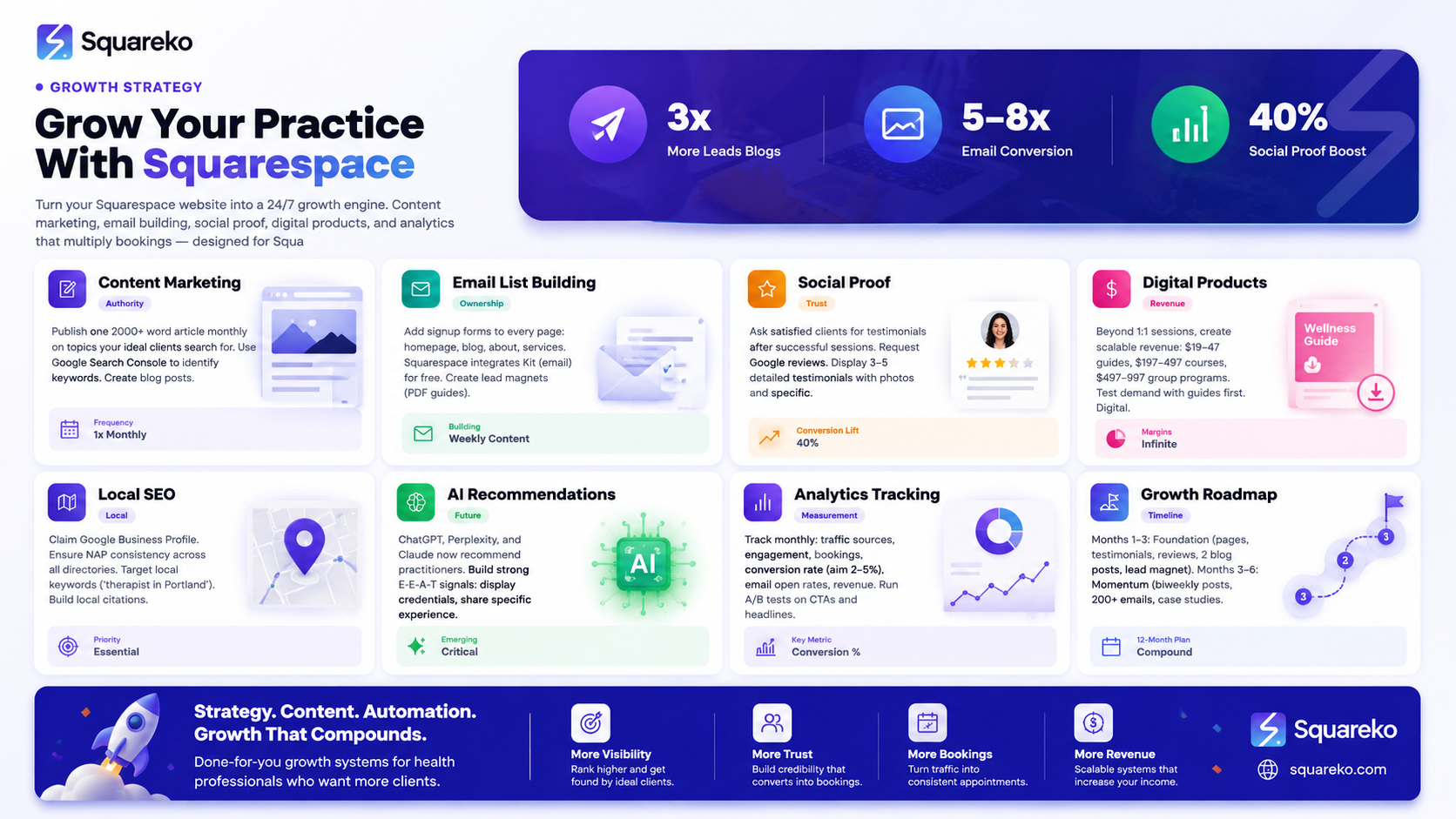
A growth engine website has three functions. First, it attracts prospects (through search, social, referrals, or AI recommendations). Second, it qualifies them (making it obvious whether you're the right fit). Third, it converts them (turning interested prospects into booked clients).
Most health professionals build websites for function one only—they want to be findable. Then they wonder why being findable doesn't fill their schedule. The missing pieces are qualification and conversion.
Qualification happens through clarity. Your services page clearly states what you do, who it's for, and what it costs. A prospect reading this knows instantly whether you're a fit. They either book or they don't. If they don't, you've saved both of you time.
Conversion happens through friction reduction. A prospect ready to book shouldn't have to fill a 20-field form, email you, wait days for a response, then jump through more hoops. Squarespace's integrated booking system gets them booked in 60 seconds. They get instant confirmation. Your calendar updates automatically. The conversion path is frictionless.
Then there's growth beyond one-to-one services. You can sell digital products (guides, courses, meditations, meal plans). You can build an email list and nurture it with valuable content. You can offer group programs. Each of these diversifies your revenue and establishes you as an authority.
The shift from "website as business card" to "website as growth engine" is where most health professionals’ plateau. It requires thinking about your website not as a static thing, but as a living, growing business asset.
Content Marketing Strategy for Organic Growth
Content marketing is the practice of publishing valuable information (blog posts, guides, videos) that attract and educate your ideal clients. It does three things simultaneously: establishes authority, builds trust, and drives organic search visibility.
Health professionals who publish one blog post per week get 3x more leads than those who don't publish at all, according to HubSpot data. That's not a small effect. And the effect compounds—each post you publish continues attracting leads for months and years after publishing.
Start with a content calendar. Pick one day per month (e.g., first Monday) and commit to publishing a 2,000+ word post on a topic your ideal clients search for. A therapist might publish "Signs You Need Anxiety Treatment" or "How to Choose the Right Therapist." A fitness coach might publish "Strength Training for Women Over 40" or "Why You're Not Seeing Results and How to Fix It."
Choose topics based on search volume and relevance to your ideal client. Use Google Search Console (free, connects to your Squarespace) to see what terms people search that land on your site. Then write deeper articles around those terms.
On Squarespace, create a Blog section. Connect it to your email campaigns (Kit, which Squarespace includes for free, automatically syndicates blog posts to email subscribers). Every blog post is a lead generation opportunity—prospects read, subscribe to your newsletter, and you now have their email.
Monetize content indirectly. Don't put paywalls on blog posts. Instead, at the end of each post, offer a lead magnet: "Download our Free 30-Day Anxiety Recovery Checklist" or "Get the Complete Guide to Choosing Your Next Therapist." These magnets sit behind an email signup form. You're exchanging valuable content for email addresses.
Quality matters more than quantity. One deeply researched, genuinely helpful post per month will drive more growth than four rushed posts. Each post should answer a real question prospects have and provide actionable advice.
Track blog performance. Squarespace's analytics show which posts get traffic. Double down on topics that resonate. Over 12 months, your content hub becomes your most valuable asset—self-sustaining visibility you own.
Email List Building and Nurture
Your email list is the audience you own. Social media followers, Instagram followers, and Google rankings can disappear tomorrow. Email subscribers are in your direct control.
Build your list aggressively. Every page on your website should have at least one email signup opportunity. Your homepage: "Join our wellness newsletter for weekly tips" with a signup form. Your blog: "Subscribe to get new articles in your inbox." Your about page: "Get my free resource guide by email." Your services page: "Get a free consultation planning worksheet."
Squarespace integrates with Kit (formerly Squarespace email) for free. Every email you collect can be added to your list automatically. As your email list grows, you own a direct communication channel to prospects and past clients.
Create lead magnets specifically designed for your ideal clients. A therapist might offer a "How to Find the Right Therapist Checklist" or "Anxiety Management Quick-Start Guide" (PDF, downloadable). A nutritionist might offer "30-Day Clean Eating Meal Plan" or "Food Label Reading Guide." A fitness coach might offer "Beginner Workout Plan for Home" or "Progressive Training Roadmap."
Lead magnets should be genuinely valuable—something you'd normally charge for. Your goal is getting permission to email the prospect, which increases booking likelihood by 5-8x. You're playing a long game: attract, educate, earn trust, convert.
Once you have email addresses, send regular content. Weekly is ideal; at minimum, monthly. Share tips, resources, client success stories, special offers. The goal is staying top-of-mind. When they're ready to book, they think of you first.
Segment your email list as it grows. Prospects who downloaded "Anxiety Treatment Guide" are different from those who downloaded "Fitness for Over 40." Send them relevant emails, not generic blasts. Squarespace/Kit allows basic segmentation; more sophisticated segmentation requires tools like Mailchimp or Active Campaign.
Track email metrics: open rate (industry average: 20-25%), click rate (2-5%), conversion rate (how many click through to book). Optimize subject lines and content based on what works.
Social Proof Accumulation Strategy
Social proof is the principle that people trust others' decisions more than their own judgment. A prospect seeing 50 5-star reviews and detailed testimonials thinks "This person is legitimate." A prospect seeing no reviews thinks "I'm nervous."
Start accumulating social proof immediately. Ask your first clients for testimonials. After their second or third session, email: "Would you be willing to share a brief testimonial about your experience? It helps other people decide if I'm the right fit." Include a template to make writing easier.
Request Google reviews. After a successful session, text or email: "I'd appreciate a Google review. Here's the link: [your Google Business Profile link]." Google reviews carry weight in rankings and influence local prospects.
Display testimonials prominently. Create a Testimonials page on your website. Use the Testimonials block in Squarespace—it's designed specifically for this. Include client name, photo (with permission), and specific details. "Sarah came to me with 15 years of untreated anxiety. Within 8 weeks, her anxiety score dropped from 8/10 to 3/10. She's now sleeping through the night and handling stress without panic attacks."
Create case studies for bigger transformations. A 2,000-word case study follows a client through their transformation: situation before, approach taken, specific techniques used, timeline, and results. Case studies are powerful because they show methodology and realistic timelines.
Build a reviews strategy. Every health professional should be on Google Business Profile (free, vital for local visibility), Yelp, Psychology Today (if therapist), or relevant directories. Ask satisfied clients to leave reviews on each platform.
Plan media mentions. Send your expertise to journalists. When a local news outlet does a story on mental health, offer yourself as a source. When wellness publications run roundups ("Top 10 Anxiety Coaches"), pitch your story. Each media mention is a credibility signal.
The compound effect of social proof is profound. A practice with 10 testimonials, 30 Google reviews, 2 media mentions, and 5 case studies is trusted in ways a practice with none of these isn't. Accumulate relentlessly.
Online Programs and Digital Products
Beyond one-to-one sessions, health professionals can create scalable revenue streams through digital products.
A therapist might create a video course "30-Day Anxiety Recovery Program" ($97-297) teaching techniques clients can apply independently. A nutritionist might offer a meal-planning software or course. A fitness coach might sell customized workout plans. A wellness practitioner might sell guided meditations or workshops.
Digital products have incredible margins. You create once, sell infinitely. After 10 sales, you've paid for your time. Sales 11-infinity are profit.
Start with something simple: a downloadable guide. Create a PDF ("The Complete Guide to Finding Your Ideal Therapist"), price it $19-47, and sell through Squarespace's built-in e-commerce. Test demand. If 5+ people buy, you've found interest. Build from there.
Courses are more complex but higher-value. A 6-week email course delivering video lessons, worksheets, and accountability is often priced $197-497. Squarespace integrates with Teachable or Kajabi for course hosting if you scale up.
Group programs create scarcity and community. "8-Week Anxiety Intensive" run quarterly at $497-997 caps enrollment, creates urgency, and builds a cohort of clients supporting each other.
Digital products also build authority. "I created a guide 500+ people have used" is a credibility signal. "I teach workshops to executives nationwide" is authority.
Start building your digital product business alongside your one-to-one practice. It diversifies revenue and opens new client channels.
Local SEO for In-Person Practices
If you see clients in-person, local SEO is essential. A prospect searching "therapist in Portland" will find you only if your website and Google Business Profile are properly optimized for local keywords.
Claim and optimize your Google Business Profile (free). Ensure your business name, address, phone number, and hours are correct and consistent across all platforms. Add 3-5 high-quality photos of your office. Write a compelling business description: "Trauma-informed therapy in Portland helping professionals manage anxiety and stress."
Build local citations. Add your business to relevant directories (Healthgrades, Psychology Today, Yelp, local chamber of commerce). Each citation is a local SEO signal.
Target local keywords. Instead of just "therapist," target "trauma therapist in Portland" or "anxiety therapy downtown Portland." Your website content should naturally include these terms.
Create location-specific pages if you have multiple locations. "Therapy in Portland" page, "Therapy in Vancouver" page, etc. Google rewards location specificity.
Earn local links. Partner with local businesses, get mentioned in local press, sponsorize local community events. Local links build authority for local searches.
Implement local schema markup. Squarespace supports this natively through the Business Information settings. This tells Google your business location, phone, hours, and contact details.
The payoff: A therapist ranking #1 for "trauma therapist in Portland" gets consistent local client inbound, without paid advertising. It's one of the highest-ROI marketing efforts you can make.
AI Search Visibility and Recommendations
AI search (ChatGPT, Perplexity, Claude, DuckDuckGo AI) is now recommending health professionals to users. When someone asks "Can you recommend a nutritionist in NYC who specializes in fertility," AI systems search the web and make recommendations based on your website and E-E-A-T signals.
To get recommended by AI systems, ensure your website has strong E-E-A-T signals (as covered in our E-E-A-T article). Display credentials clearly, share specific experience, include testimonials and case studies, and build authority through media mentions and specialization.
Also ensure your website is crawlable. AI systems use web crawling to understand your content. Make sure:
You have a sitemap (Squarespace generates this automatically)
Your content is text-based (not hidden in images)
Key information (credentials, services, about) is easily accessible
Your site loads quickly (Squarespace handles this)
Write blog content answering common questions your ideal clients ask. "How to choose a therapist," "What to expect in your first session," "How long does therapy take to work?" When AI systems search for practitioner recommendations, they cite articles answering these questions. Your articles = your visibility.
Optimize for AI search just like you optimize for Google: provide accurate information, cite sources, be specific, and demonstrate expertise. The tactics overlap significantly.
Measuring What Matters: Analytics and Optimization
Growth comes from measurement and iterative improvement. Squarespace's built-in analytics show traffic, where it comes from, and which pages convert.
Track these metrics monthly:
Traffic: Total visitors, traffic sources (organic search, direct, referral). Organic growth means your content is working.
Engagement: Average time on site, pages per session. Higher engagement means people are actually reading, not bouncing.
Conversions: Emails collected, bookings made, products sold. This is your business outcome.
Booking rate: Visitors to bookings percentage. Aim for 2-5%. (If you get 100 visitors and 3 book, that's 3% conversion—good.)
Run A/B tests. Test your CTA button text: "Book Now" vs. "Schedule Consultation" vs. "Start Your Journey." Change one variable, measure for 2-4 weeks, see what works better. Compound these improvements.
Test landing page headlines. "Professional Therapy" converts worse than "Anxiety Therapy for Busy Professionals." Test specificity.
Reduce friction. Count how many form fields you require. Remove anything you can live without. Each field you eliminate increases completion rate.
Track email metrics. See which blog topics drive the most email signups. Write more on those topics.
Track which testimonials/case studies drive the most bookings. If case studies drive bookings, create more. If they don't, deprioritize.
Look at your Google Analytics and Squarespace analytics together. Understand your full funnel: where visitors come from, what they read, when they book. This intelligence drives strategy.
Mid-Post CTA: Strategy Turns Traffic Into Growth
Understanding the mechanics of growth—content attracts, email builds relationships, social proof reduces friction, digital products diversify revenue—is foundational. But implementing it requires strategy. Many health professionals publish content that gets no traffic because they're optimizing for the wrong keywords. Others build email lists but send generic broadcasts instead of segmented, valuable content. The difference between stagnation and growth is usually not effort—it's strategy and execution. At Squareko, we work with health professionals to implement these exact growth strategies on Squarespace. We handle content planning, email strategy, social proof accumulation, and analytics implementation so you can focus on clients. If you're ready to turn your website into a true growth engine, book a free consultation at squareko. Walid will review your current setup and show you exactly where your growth leaks are and how to fix them.
Frequently Asked Questions
-
Email list building shows results immediately—you'll have 10-20 subscribers after your first month if you have traffic. Content marketing takes longer: expect 3-4 months before a blog post ranks in Google and drives meaningful traffic. Paid ads show results in days. The compound effect happens at the 6-12 month mark when multiple strategies reinforce each other. Don't judge your strategy after one month; judge it at 6-12 months.
-
Outsource it. Hire a freelance health writer ($50-150 per post) or use a content agency ($500-2,000/month). But write the outline yourself—the writer needs your specific insights and voice. Alternatively, batch your writing. Write four posts in a single day monthly. You control the pacing.
-
Social media is a traffic driver, not a business foundation. Use it to share blog posts and drive people to your website (where you control the experience and own the audience). Don't try to book clients from social—it's friction. Social drives traffic; your website converts. Most health professionals find Instagram or LinkedIn effective for visibility, but always funnel people back to your website.
-
Start with a $500-2,000 investment in your first digital product (course hosting software, design, copywriting). If it sells 10+ copies, you've ROI'd. Scale from there. Many health professionals generate $10,000-50,000/year in digital product revenue with minimal time investment once created.
-
Ranges wildly: 100 to 10,000+. A 1-year-old practice might have 200 email subscribers. A 5-year practice might have 2,000. Growing 10-50 new subscribers monthly is realistic for most practices. The power is in nurturing them, not size.
-
Your website does client acquisition while you serve clients. You don't have to choose. Once set up, your blog, email, and booking system run without your involvement. You publish monthly content (6-8 hours/month), email clients weekly (2-3 hours/month), and your system works. The leverage increases as you scale.
-
Rarely. Discounts train clients to expect discounts, devaluing your work. Instead, offer value-adds: "Book a 6-session package and get a free follow-up workout plan" or "Refer a friend and get a free hour." These build loyalty without devaluing your core offering.
-
Yes, but they need to understand your practice and clients. A VA (virtual assistant) can send campaigns you write, segment your list, and monitor metrics. You keep the strategy. Alternatively, use automation: Squarespace/Kit has automated sequences (e-mail prospects after they download a guide, email clients monthly, etc.). Automation costs $0-50/month depending on sophistication.

From custom website design to SEO strategy, we help businesses launch a site that looks professional and performs better.

About the Author
I'm Walid Hasan, a Certified Squarespace Expert and Squarespace Circle Platinum Partner with over 12 years of hands-on experience designing and optimizing high-performing websites. Over the years, I've had the privilege of building more than 2,000 Squarespace websites for clients around the world, always focusing on clean design, strong user experience, and conversion-driven results.