How Financial Advisors Use Squarespace to Demonstrate Expertise and Win More Clients
Introduction
Your website is your first impression potential clients form of your practice. It communicates trustworthiness and expertise. Many financial advisors overlook strategic website potential, creating basic service lists instead of communicating depth of knowledge, experience, and results. The difference between generic websites and authority-building platforms determines whether prospects contact you or competitors.
This guide covers using Squarespace to build credibility, demonstrate expertise, and win clients through key expertise signals, thought leadership content, and practical implementation that turns your website into a client-acquisition engine.
Key Takeaways How Financial Advisors Use Squarespace to Demonstrate Expertise and Win More Clients
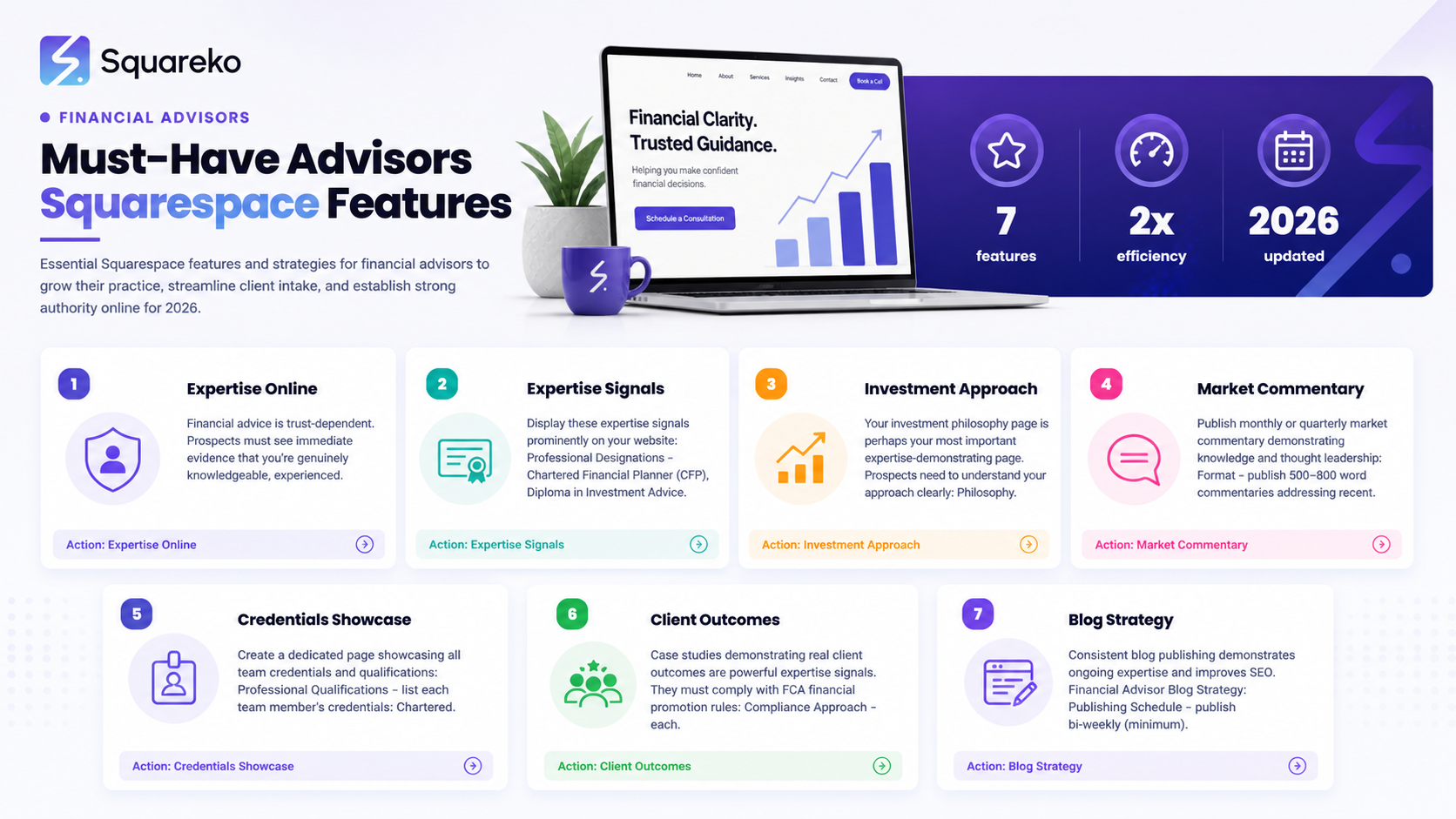
Expertise signals matter: Credentials, qualifications, speaking history, investment philosophy—visible on your Squarespace website
Content establishes authority: Strategic blog (market commentary, retirement planning, investment FAQs) makes you a thought leader
FCA compliance is crucial: Financial promotion guidance must inform all content for regulatory compliance
Client stories build confidence: FCA-compliant case studies provide social proof without breaching confidentiality
Investment philosophy wins business: Transparent approach explanation differentiates you and attracts aligned clients
Regular content drives visibility: Published content keeps your practice visible in search engines
Squarespace implementation: Well-designed, properly structured website makes expertise discoverable
Why Financial Advisors Need to Demonstrate Expertise Online
The advisory industry has transformed. Clients no longer rely solely on referrals or local reputation. They research advisors online, compare credentials, read reviews, and evaluate websites before contacting.
Prospects look for: relevant credentials, evidence of deep knowledge, track records/outcomes, distinct investment philosophy, regulatory transparency. Your Squarespace website is the hub where all this information converges.
Your website functions in three client journey phases:
Awareness: Prospects searching for investment strategy guidance discover your content in search results. Your blog and resources capture attention and build trust.
Consideration: Prospects evaluate whether you're worth contacting. Your credentials, philosophy, and outcomes demonstrate qualifications and trustworthiness. Prospects assess if your approach aligns with their values.
Decision: Your website removes engagement barriers. Clear process, fee, and contact information makes it easy for prospects to take the next step. Strong expertise presentation makes you the obvious choice.
Each phase requires specific content and presentation strategies Squarespace enables.
Understanding Expertise Signals in Wealth Management
Financial services prospects evaluate expertise signals—visible indicators you have knowledge, experience, and credibility to manage wealth.
The eight key expertise signals:
Professional credentials (Chartered Financial Planner, CFA, CAIA) — prominently displayed with verification links
Investment philosophy statement — clear explanation of your approach to asset allocation, risk management, and market cycles
Published thought leadership — blog posts, articles, and insights demonstrating current knowledge
Speaking/media presence — conference appearances and expert commentary signal third-party recognition
Client outcomes — FCA-compliant case studies showing concrete results
Experience summary — professional background, years in industry, specialisations, career progression
Awards/recognition — industry awards and peer recommendations
Regulatory transparency — FCA registration, compliance approach, conflict of interest disclosures
Together, these signals create comprehensive authority. A website lacking these elements struggles to convert prospects regardless of design attractiveness.
Building Your Investment Philosophy Page
Your investment philosophy page is your most important expertise page—a detailed, honest explanation of how you invest and why.
What to cover:
Core principles: Your beliefs about market efficiency, active vs. passive management, diversification
Asset allocation: How you allocate portfolios across asset classes, geographic diversification, alternative assets
Risk management: How you identify and manage risk, downside protection, hedging strategies, discipline during volatility
Research process: Proprietary or external research, key team members, review frequency
Fee transparency: How you're compensated and why your fee structure aligns with client interests
Historical context: Past performance with appropriate FCA disclaimers
Structure hierarchically with clear headings for readability and SEO. Include keywords related to your investment approach (e.g., ESG-focused investment philosophy, growth-oriented wealth management).
Market Commentary Strategy for Thought Leadership
Market commentary establishes thought leadership and attracts prospects. Regular market commentary:
Keeps your website fresh (search engine reward)
Demonstrates active market engagement
Provides valuable content building trust
Gives clients reasons to revisit your website
Provides confidence during volatility
Effective topics: Quarterly market reviews, economic outlook updates, sector-specific commentary, market cycle perspective, policy impact analysis, valuation analysis.
Structure: Create a publishing calendar committing to realistic frequency (monthly + quarterly reviews). Each piece should include your analysis, historical context, implications for different profiles, relevant links, and FCA-compliant disclaimer that this is commentary, not personalised advice.
Credential and Qualification Showcase
Your qualifications are trust signals deserving prominent presentation. Explain what each credential means. List regulatory registrations clearly; highlight continuing education commitment; explain specialist designations; showcase team credentials; display professional memberships. Link to verification sources (FCA registration, professional bodies) to strengthen credibility.
Speaking and Media Record as Authority
Speaking engagements and media appearances signal external recognition, more credible than self-promotion.
Showcase speaking history: Create a dedicated section listing conferences, events, topics addressed, audience profiles, and links to slides/videos. Speaking to peer audiences is more impressive than consumer audiences.
Media portfolio: Document expert commentary, publication appearances, podcast features, quotes, dates, and links to articles/recordings. Media recognition significantly enhances credibility.
Building speaking opportunities: Join professional associations, speak at continuing education seminars, industry conferences, webinars, chamber of commerce events, and university lectures. Each engagement provides website content and credibility references.
Client Outcome Stories: FCA-Compliant Case Studies
Client success stories prove expertise and results, but FCA rules govern client communications.
FCA requirements: Communications must be fair, clear, not misleading; no selective evidence of success (must balance winners and losses); client consent for any identifying information; hypothetical case studies clearly marked; performance claims require disclaimers; past performance cannot indicate future results.
Creating effective case studies:
Anonymised profiles: Describe clients generically
Specific challenge: Explain the financial problem
Your process: Describe your analysis, recommendations, and philosophy
Results: Describe the plan and measurable outcomes with appropriate disclaimers
Client perspective: Include brief quotes with permission
Disclaimer example: This case study is anonymised to protect privacy. Results were specific to this client's circumstances. Past performance doesn't indicate future results. Different clients experience different outcomes. All investments carry risk. This isn't personalised advice.
Financial Advisor Blog Content Strategy
Organise your blog around four core pillars:
(1) Market Commentary and Economic Insight, (2) Retirement and Lifestyle Planning, (3) Wealth and Investment Education, (4) Life Events and Transition Planning.
Proven topics: Interest rate impacts, inflation perspectives, market corrections, pension planning, retirement income strategies, asset allocation, active vs. passive investing, tax-efficient investing, inheritance planning, business sale strategies, redundancy/career transitions, divorce planning, education planning.
Publishing: Commit to one detailed article monthly (1,500-2,000 words) rather than sporadic longer pieces. Balance seasonal/timely content with evergreen pieces. Address questions you encounter repeatedly and topics prospects actually search for.
SEO optimisation: Conduct keyword research before writing; include target keywords naturally in headlines and opening paragraphs; use clear headings for structure; link relevant posts to each other and key pages; write compelling 150-160 character meta descriptions.
FCA Compliance for Financial Promotion Content
Every website piece is potentially a financial promotion under FCA rules.
Key requirements:
Fair, clear, not misleading: Avoid exaggerating capability or financial outcomes
Materiality: Don't hide disclaimers, risk warnings, conflicts of interest in fine print
Evidence: Substantiate all performance, capability, expertise claims
Balance: Include context and warnings about future results with past performance
Conflict disclosure: Transparently disclose product recommendations, affiliations, interests
Consumer restrictions: Ensure consumer-facing content meets stricter compliance rules
Content compliance checklist:
Performance claims: Include past performance disclaimers; never cherry-pick results; explain measurement basis; warn about future results
Commentary: Label as opinion (not advice); include risk warnings; avoid predictions; base on evidence
Recommendations: Explain basis; disclose conflicts; highlight risks; include disclaimers
Testimonials: Obtain client consent; present balanced perspectives; disclaim variable results; document basis
Compliance workflow: (1) Draft focusing on quality, (2) Review against FCA rules, (3) Legal review if needed, (4) Add disclaimers, (5) Maintain records.
Financial Advisor Expertise Signals Checklist
Credentials: Clear qualifications (CFA, CFP, CAIA); FCA registration links; specialist designations; continuing education; team credentials; professional memberships.
Investment Philosophy: Clear statement (500+ words); asset allocation approach; risk management framework; research process; fee transparency; historical context with disclaimers.
Content: Established blog with regular posts; market commentary; retirement guides; investment education; life event articles; SEO optimisation.
Speaking/Media: Speaking engagements documented; media appearances listed; publications linked; video/presentation materials available.
Social Proof: FCA-compliant case studies (3-5); client testimonials with permission; anonymised outcomes; before-and-after scenarios; results with disclaimers.
Experience: Professional background; years in advisory; specialisations; career progression; previous roles; relevant experience.
Trust/Transparency: FCA registration displayed; permissions explained; conflicts disclosed; complaints procedure accessible; fee structure transparent; compliance approach explained.
Technical: Mobile-responsive design; fast page speeds; clear navigation; professional design; high-quality imagery; accessibility standards; testimonials displayed.
-
Through integrated signals: credentials, thought leadership, investment philosophy, speaking/media appearances, client stories, transparent experience. Combine all elements within a professional website. Squarespace's flexibility allows cohesive presentation without extensive technical knowledge.
-
Investment philosophy page; regular blog content (market commentary, retirement planning, investment education, life events); FCA-compliant case studies; credentials; speaking history; market insights. This demonstrates expertise, improves search visibility, provides client resources, establishes thought leadership.
-
Commit to consistent publishing (ideally monthly); focus on four pillars (market commentary, retirement planning, investment education, life transitions); conduct keyword research; optimise for search; link content together; maintain FCA compliance. Goal: demonstrate genuine expertise, not promotion.
-
Yes, with appropriate disclaimers. Market commentary is protected opinion when clearly labelled (not personalised advice) with risk warnings. Include language: "Not personalised advice; past performance unreliable; consult advisor." Review all commentary before publication.
-
Case studies answer: "Can this advisor help me?" FCA-compliant case studies (anonymised clients, documented process, disclaimers) demonstrate real expertise and results, more persuasive than testimonials. Multiple studies covering different client types help prospects see themselves in your practice.
-
Conduct of business rules (COBS) apply to all financial promotions. Requirements: fair, clear, not misleading; substantiable claims; no predictive past performance claims; disclose conflicts; include risk warnings; no material misleading content. Rules differ for consumer vs. professional communications. Consult compliance specialist.
-
Professional templates conveying credibility; flexible page structures for credentials/philosophy/outcomes; integrated blogging for thought leadership; SEO tools; mobile responsiveness; technical reliability. Work with compliance-aware agencies (like Squareko) for design and regulatory standards.

From custom website design to SEO strategy, we help businesses launch a site that looks professional and performs better.

About Squareko
I'm Walid Hasan, a Certified Squarespace Expert and Squarespace Circle Platinum Partner with over 12 years of hands-on experience designing and optimizing high-performing websites. Over the years, I've had the privilege of building more than 2,000 Squarespace websites for clients around the world, always focusing on clean design, strong user experience, and conversion-driven results.