Squarespace SEO for Financial Advisors: Rank on Google, Bing and AI Search in 2026
Introduction
Search engine optimisation is essential for financial advisors, IFAs, and planners seeking high-intent clients through organic search. In 2026, the SEO landscape has shifted significantly: AI-powered search engines are mainstream, and traditional ranking factors have been refined through years of financial content updates.
Squarespace provides solid technical SEO foundations for financial services sites, though you'll need a deliberate strategy to rank for competitive keywords like financial advisor, independent financial planner, and investment management in your local market.
This guide covers optimising your Squarespace site for both traditional search engines and AI search platforms, addressing compliance landscape around financial promotion, content structuring for AI investment queries, and an essential SEO checklist for financial advisors in 2026.
Key Takeaways Squarespace SEO for Financial Advisors: Rank on Google, Bing and AI Search in 2026
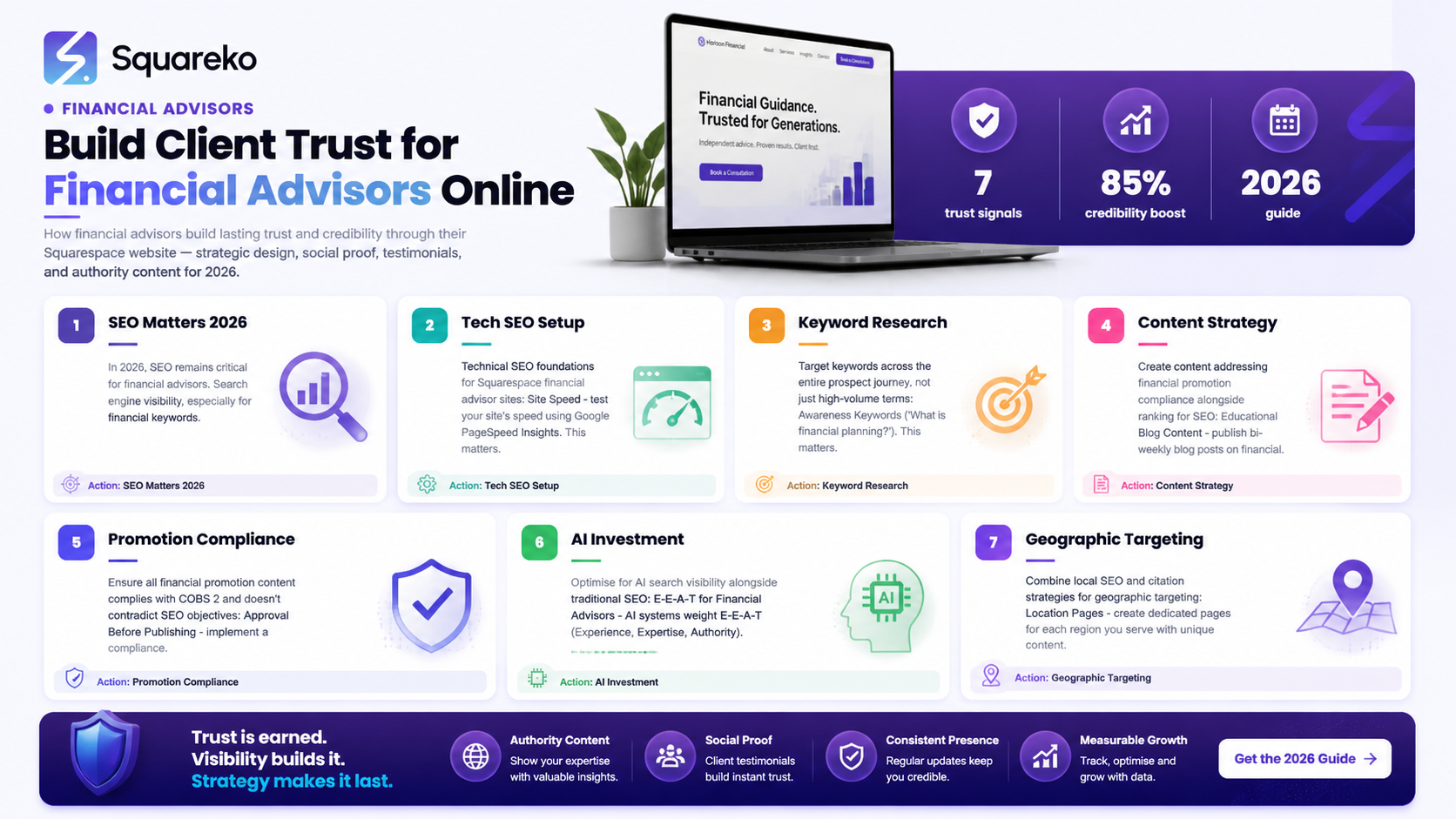
Squarespace is viable for financial advisor SEO with deliberate optimisation of structure, content, and schema
Local + niche keywords are higher-priority targets than broad national keywords
AI visibility requires Financial Service schema, Local Business schema, and clear, factual content
FCA/SEC compliance must inform all promotional content; work with your compliance officer and document approvals
Schema markup improves both AI and traditional search visibility
Educational content addressing client pain points (How do I retire?) builds authority more effectively than transactional keywords alone
Technical SEO, content quality, and compliance form the three pillars of successful financial advisor SEO
Why Squarespace SEO Matters for Financial Advisors in 2026
Over 75% of people seeking financial guidance start with a search engine query. For financial advisors, visibility in Google, Bing, and AI search systems directly affects client acquisition.
Squarespace strengths for financial advisor SEO:
Built-in SEO controls
Mobile-responsive templates by default
HTTPS security included
Clean, readable URL structure
Fast CDN and good Core Web Vitals scores
Squarespace limitations:
Limited custom schema flexibility
No native advanced content hierarchies
Advanced analytics tracking requires manual setup
Understanding these strengths and constraints is essential for building a realistic SEO strategy.
Technical SEO Foundations for Squarespace Financial Services Sites
Before addressing keywords and content, ensure your Squarespace site meets technical SEO requirements.
Site structure: Organise your website clearly with a homepage, separate service pages, About/Team pages, blog/resources, and contact page. Keep your site to 4–6 levels deep maximum; use clear navigation rather than deeply nested URLs.
Page speed: Squarespace performs well on page speed but optimise further by compressing images, limiting third-party scripts to essentials (cookie consent, analytics), and verifying lazy loading is enabled. Check Core Web Vitals in Google Search Console; aim for LCP < 2.5s, CLS < 0.1, INP < 100ms.
Technical foundations: Squarespace automatically generates XML sitemaps and robots.txt; verify these include all public pages and exclude confidential areas (client portals, draft pages). All Squarespace sites use HTTPS by default. Confirm your site is not serving mixed content (HTTP and HTTPS together) by checking Google Search Console.
Keyword Strategy for Financial Advisors
Focus on four keyword types:
1. Local + Service: Financial advisor London, IFA Manchester, Retirement planner near me — your priority targets combining geographic and service intent.
2. Niche Specialisation: Tax-efficient investing, High-net-worth planning, Pension transfer advice.
3. Informational: How much do I need to retire?, What is financial planning?, Understanding ISAs.
4. Branded: Monitor searches for your firm name and competitor terms.
Keyword research: Use Ahrefs, SEMrush, or Moz to find keywords with 100–500 monthly searches, clear intent, and local relevance. Prioritise less competitive, specific keywords your firm can realistically rank for.
Content Strategy That Ranks and Meets Financial Promotion Standards
Financial advisor content must both rank in search engines and comply with FCA/SEC standards. Use a two-layer approach:
Layer 1 — Educational Content: Blog posts answering client questions (How to Diversify a Portfolio, Understanding Pension Options) rank for informational keywords and establish authority. Educational content is easier to keep compliant than promotional content.
Layer 2 — Promotional Content: Service pages and case studies directly describing your offerings. These pages should be reviewed by your compliance officer before publication.
Content structure best practices:
Intro (150–200 words): Introduce topic, include focus keyword naturally
Middle sections (400–800 words): Detailed, practical advice with subheadings
Conclusion (100–150 words): Summarise key points; suggest when professional advice is needed
CTA (50–100 words): Invite readers to book consultation or contact you
Tone guidelines: Use UK English; be precise and avoid exaggeration; use plain language; include appropriate disclaimers (This is general guidance; consult your advisor); avoid guaranteed outcome claims.
Financial Promotion Compliance in SEO Content
The FCA's ICOBS rules require all financial promotions be clear and fair, not misleading, balanced, and accompanied by appropriate risk warnings.
What constitutes a financial promotion: Service pages, blog posts recommending strategies, case studies, and product comparison content all qualify. Educational content (factual explanations like What is an ISA?, general planning principles, disclaimers stating no personal advice) typically doesn't qualify.
FCA compliance checklist: Before publishing, verify all claims are factually accurate and verifiable; include balanced risk warnings, not just potential rewards; avoid guaranteed outcome claims; clearly state your regulated status and FCA registration; include past performance disclaimers; note advice is tailored to individual circumstances; don't promote unsuitable products; ensure any comparisons are fair; cite sources clearly; have a compliance officer review all financial content before publication.
Working with compliance: Share your keyword list, content plan, and content templates with your compliance officer at the start. Establish a review process before publication. Document all approvals. This protects your firm and builds regulator trust.
How Financial Advisors Appear in AI Investment Queries in 2026
AI search systems (ChatGPT, Gemini, etc.) increasingly influence how clients discover advisors. Unlike traditional search, AI systems provide natural language answers to queries like Find me an independent financial advisor in London specialising in pension planning.
AI systems source information from:
Web content: Your website pages and content
Knowledge graphs: Structured data (schema markup)
Citation patterns: How often your firm is mentioned across the web
Credibility signals: Reviews, regulatory status, backlinks
To appear in AI-generated answers:
Implement structured data: Add Financial Service, Local Business, and Organisation schema to your website
Build credibility signals: Collect reviews on Google Business Profile; earn mentions in industry publications; build backlinks
Ensure consistency: Your firm's information must match across your website, Google Business Profile, and all directory listings
Create clear, factual content: Your website pages should directly answer What services do you offer? and Where are you located?
Optimising for AI search in 4 steps:
Complete your Google Business Profile: Add address, phone, service categories, business description, photos, and encourage client reviews
Implement schema markup: Add Financial Service and Local Business schema to your website
Create clear service pages: Each service should clearly describe what it is, who it's for, your credentials, and how clients engage
Ensure consistency across platforms: Verify your firm's name, address, and phone number are identical across your website, Google Business Profile, local directories, LinkedIn, and industry association sites
Schema Markup for Financial Advisors
Schema markup helps search engines and AI systems understand your content. The most relevant types for financial advisors are:
FinancialService: Describes a financial service you offer
LocalBusiness: Identifies your physical location
Organisation: Describes your firm as an organisation
Implementing FinancialService Schema
Add this JSON-LD schema to your service pages :
{
  "@context": "https://schema.org",
  "@type": "FinancialService",
  "name": "Retirement Planning Service",
  "description": "Personalised retirement planning for professionals.",
  "provider": {
    "@type": "Organization",
    "name": "[Your Firm Name]",
    "url": "https://yourwebsite.com",
    "areaServed": [{"@type": "City", "name": "London"}],
    "contactPoint": {
      "@type": "ContactPoint",
      "telephone": "+44-xxx-xxxx",
      "contactType": "Customer Service"
    }
  },
  "serviceType": "Pension Planning"
}
Implementing LocalBusiness Schema
Add to your homepage or contact page:
{
  "@context": "https://schema.org",
  "@type": "LocalBusiness",
  "name": "[Your Firm Name]",
  "address": {
    "@type": "PostalAddress",
    "streetAddress": "[Address]",
    "addressLocality": "[City]",
    "postalCode": "[Postcode]",
    "addressCountry": "UK"
  },
  "telephone": "+44-xxx-xxxx",
  "url": "https://yourwebsite.com"
}
Implementing schema on Squarespace:
Go to Settings > Advanced > Code Injection and paste your JSON-LD schema code in the Header section. Verify your schema is valid using Google's Rich Result Test.
Building Authority and Trust Signals for Financial Services SEO
Financial services SEO depends on Google's E-E-A-T framework (Experience, Expertise, Authority, Trustworthiness). Establish authority through:
Expertise signals: Display credentials prominently; publish team bios with qualifications; join professional associations; create educational content.
Authority signals: Earn backlinks from industry directories, local business listings, and news publications. Build citations across the web. Structure internal links strategically.
Trustworthiness signals: Display FCA registration and regulatory information transparently; collect client reviews on Google Business Profile; maintain a privacy policy; ensure professional website design; keep content current.
Building backlinks: Register with industry directories, local directories (Yell, Thomson Local, chamber of commerce), and offer expert commentary to local press. Contribute guest articles to financial planning blogs and build relationships with complementary professionals.
Local SEO for Financial Advisors: Geographic Targeting and Citations
For most financial advisors, local SEO is more important than national ranking. Clients search for advisors in their area.
Local keyword targets: Financial advisor [City],IFA [Area],Pension planning [Location], and service + location keywords like Tax-efficient investing Manchester.
Google Business Profile is essential:
Complete all required fields (business name, address, phone, hours, website)
Write a description including your location and key services
Add 3+ high-quality photos of your office and team
Post regular updates (blog articles, news, events)
Respond professionally to all client reviews
Encourage satisfied clients to leave reviews
Local citations: Register your firm in key directories. Ensure your business name, address, and phone number are identical across all sources. Inconsistencies confuse search engines and harm rankings.
Citation consistency: Audit your business information across all platforms quarterly. Any discrepancies should be corrected immediately.
Financial Advisor Squarespace SEO Checklist 2026
Use this essential checklist to audit and improve your financial advisor SEO on Squarespace. Focus on items 1–20 for foundational improvements.
Technical SEO (8 items)
1. HTTPS/SSL: Site uses HTTPS; padlock visible in browser address bar
2. Mobile responsiveness: Site is fully functional on mobile devices; text is readable without zooming
3. Page speed: Core Web Vitals are acceptable (LCP < 2.5s, CLS < 0.1); images are optimised
4. Meta titles/descriptions: All pages have unique, descriptive tags
5. Internal linking: Key pages link to each other with descriptive anchor text
6. XML sitemap: Sitemap exists and includes all public pages
7. Robots.txt: Correctly configured to allow crawling of public pages
8. Search Console: Google Search Console is set up and monitoring for errors
Content and Compliance (8 items)
9. Focus keywords: Each major page has 1–2 target keywords identified
10. Keyword placement: Keywords appear in H1 title, first 100 words, and naturally throughout content
11. Content length: Service pages 800+ words; blog posts 1,200+ words
12. Compliance review: All financial content reviewed by compliance officer before publication
13. Disclaimer language: Financial content includes appropriate disclaimers and risk warnings
14. FCA registration: FCA registration number prominently displayed on site
15. No guaranteed claims: Content avoids claiming specific returns or guaranteed results
16. Educational focus: Content answers client questions rather than being purely promotional
Authority and Local SEO (8 items)
17. Google Business Profile: Fully completed with address, phone, hours, description, and recent photos
18. Local keywords: Targeting keywords like financial advisor [city] relevant to your location
19. Local citations: Listed in key directories
20. Team credentials: Team bios include qualifications, experience, and areas of expertise
21. Client reviews: Actively encouraging and responding to Google Business Profile reviews
22. Schema markup: Financial Service and Local Business schema implemented and validated
23. Media presence: Displaying any media mentions, speaking engagements, or industry features
24. Backlink strategy: Identified relevant industry directories and news sources for backlink opportunities
This checklist covers 24 essential items. Starting with items 1–15 will address your foundational SEO and compliance requirements.
-
Ranking requires three components: technical SEO (mobile-responsive, fast pages, unique meta tags), content quality (in-depth content answering client questions), and authority building (client reviews, backlinks). Start with technical fixes, identify local + niche keywords, create in-depth content, then build authority through reviews and backlinks. Ranking typically takes 3–6 months for new pages, 6–12 months for competitive keywords.
-
Target local + service keywords ("IFA London," "pension adviser near me"), niche specialisation keywords ("tax-efficient investing," "pension transfer advice"), and informational keywords ("How much do I need to retire?"). Use keyword research tools to find keywords with 100–500 monthly searches and clear intent. Avoid broad, generic keywords.
-
Squarespace lacks native schema support, but you can add FinancialService, LocalBusiness, and Organisation schema manually via Code Injection (Settings > Advanced > Code Injection). For most financial advisors, basic FinancialService and LocalBusiness schema is sufficient for AI visibility.
-
Consistency matters more than volume. Aim for 2–4 blog posts monthly. Quality is more important than quantity; one detailed 1,500-word post that ranks is more valuable than four shallow posts. Update existing content quarterly to improve rankings.
-
Involve your compliance officer from the start. Share your keyword list and content plan. Establish a review process before publication. Document approvals. Use appropriate disclaimers and avoid guaranteed outcome claims.
-
Three key differences: (1) regulatory complexity (FCA/SEC compliance required), (2) trust importance (E-E-A-T signals weighted heavily), (3) schema complexity (FinancialService schema required). Otherwise, principles are similar.
-
Weeks 1–4: indexing. Months 2–3: ranking/traffic. Months 4–6: measurable increases. Months 6–12: competitive keywords rank higher.

From custom website design to SEO strategy, we help businesses launch a site that looks professional and performs better.

Author Bio
I'm Walid Hasan, a Certified Squarespace Expert and Squarespace Circle Platinum Partner with over 12 years of hands-on experience designing and optimizing high-performing websites. Over the years, I've had the privilege of building more than 2,000 Squarespace websites for clients around the world, always focusing on clean design, strong user experience, and conversion-driven results.