How Digital Product Creators Build an Audience and Drive Organic Traffic with Squarespace
Why Audience Building Matters for Digital Products
The difference between a digital product creator earning $1K/month and $50K/month isn't better products. It's audience size.
The Audience Revenue Multiplier
Revenue depends on three factors:
Audience size (email list, followers, visitors)
Product quality (affects conversion rate)
Product price (how much you charge)
Most creators focus on product quality and price. They neglect audience size.
Example:
Creator A:
200 email subscribers
2% conversion rate
$29 average product price
Monthly revenue: 200 × 0.02 × $29 = $116
Creator B:
5,000 email subscribers
2% conversion rate
$29 average product price
Monthly revenue: 5,000 × 0.02 × $29 = $2,900
Same conversion rate, same product price. The difference is entirely audience size—25x more revenue.
Key Takeaways How Digital Product Creators Build an Audience and Drive Organic Traffic with Squarespace
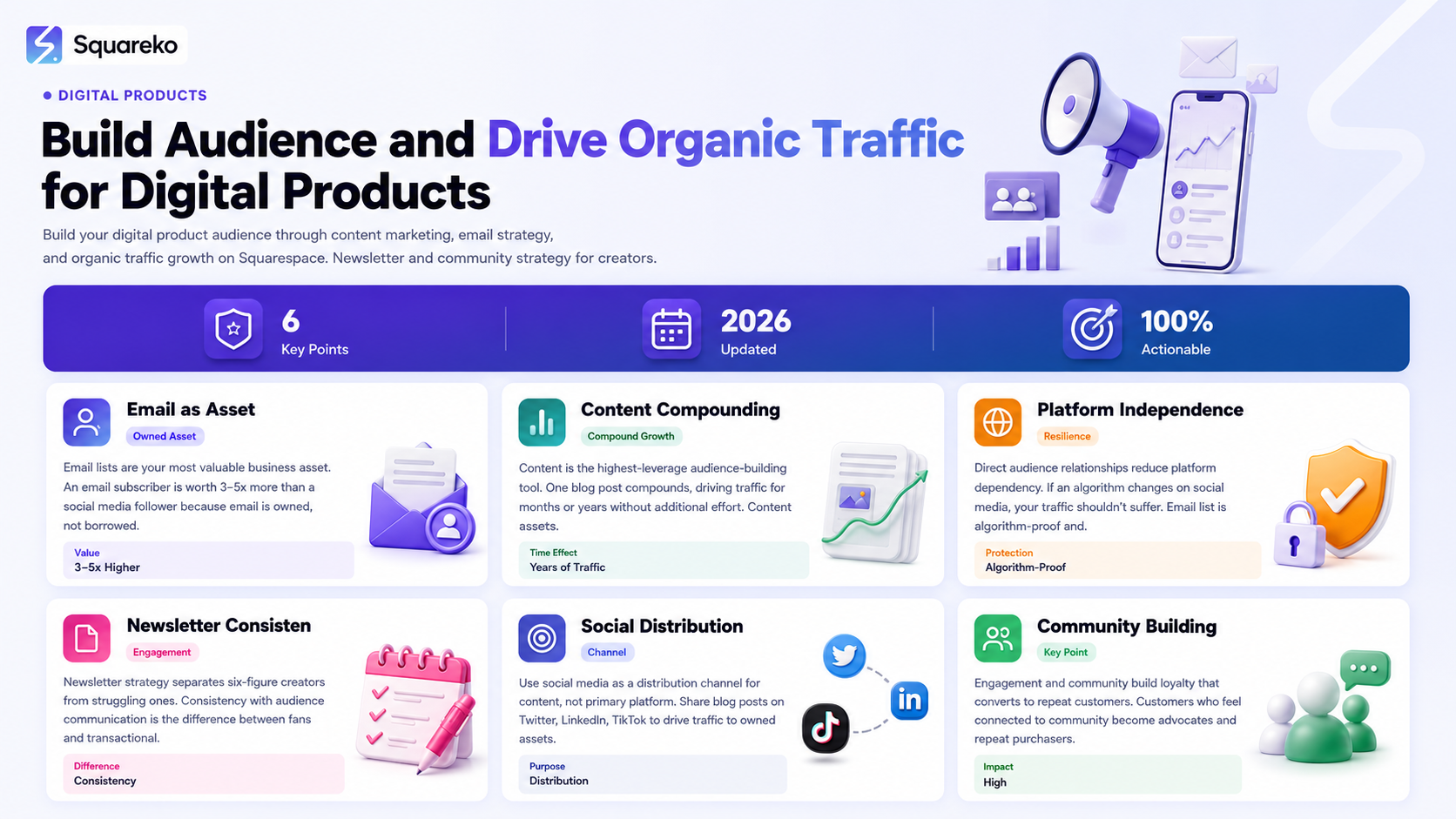
Email lists are your most valuable asset — an email subscriber is worth 3-5x more than a social media follower because email is owned, not borrowed
Content is the highest-leverage audience building tool — one blog post compounds, driving traffic for months or years without additional effort
Direct audience relationships reduce platform dependency — if an algorithm changes on social media, it shouldn't kill your traffic; your email list is algorithm-proof
Newsletter strategy separates six-figure creators from struggling ones — consistency with audience communication is the difference between fans and transactional customers
Community engagement builds loyalty that converts to repeat customers — customers who feel connected to your community become advocates and repeat purchasers
Building an Audience Creates Options
With a larger audience, you can:
Test new products safely (you have existing customers willing to try)
Raise prices confidently (demand from large audience supports it)
Diversify income (multiple product options)
Be selective about partnerships
Achieve financial stability through predictable revenue
A small audience is fragile. One algorithm change, one platform policy shift, and your business suffers.
A large audience is resilient. If traffic drops on one platform, other channels compensate.
Audience Building Is Underrated
Many creators underestimate how long audience building takes. They want to launch products immediately. But the creators earning $10K+ monthly almost always spent 6-12 months building audience before launching.
This feels like wasted time to impatient creators. But it's the highest-leverage time investment.
Email List as Your Core Asset
Your email list is your single most valuable business asset. Build it relentlessly.
Why Email Is Superior to Social Media
Social media:
Platform owns the relationship
Algorithm decides if your followers see your content
Account could be suspended (you lose access)
No direct contact information
Engagement declining (lower open rates on all platforms)
Email:
You own the relationship
Recipients see your message (no algorithm)
Only you control the list
Direct contact for each subscriber
Engagement stable and predictable
A follower on social media is rented. An email subscriber is owned.
Email List Quality vs. Quantity
A list of 500 engaged subscribers converts better than 5,000 disengaged subscribers. This matters.
Focus on building a genuinely interested list:
Attract people interested in your specific niche
Remove unengaged subscribers periodically
Maintain high engagement through relevant content
Email regularly (consistency builds engagement)
A 500-subscriber list emailing weekly with relevant content generates more revenue than a 5,000-subscriber list emailing sporadically with generic content.
Email Growth Targets
Set realistic email growth goals:
Months 1-3 (starting out):
Goal: 50-100 subscribers
Methods: Lead magnets, social sharing, website signups
Months 3-6 (building momentum):
Goal: 100-300 subscribers
Methods: Content marketing, podcast appearances, guest blogs
Months 6-12 (established):
Goal: 300-1,000 subscribers
Methods: Consistent content, word-of-mouth, strategic partnerships
Year 2+ (scaling):
Goal: 1,000-5,000+ subscribers
Growth rate: 10-20% monthly
These are achievable targets for digital product creators with consistent effort.
Email Platform Selection
On Squarespace, integrate email marketing through:
Option 1: Klaviyo (recommended for e-commerce)
Powerful automation
Better product recommendations
Superior analytics
Integrates tightly with Squarespace Commerce
Cost: Starts free, scales with subscriber count
Option 2: ConvertKit (recommended for creators)
Creator-focused features
Simple, clean interface
Strong audience monetization
Good free tier
Cost: Starts free, scales with subscriber count
Option 3: MailerLite (recommended for small budgets)
Very affordable
Good automation
Underrated quality
Generous free tier (1,000 subscribers)
Cost: Stays free longer than competitors
Option 4: Squarespace Email Campaigns
Built into Squarespace
Basic but functional
No additional cost
Limited automation and segmentation
Use if: Getting started, want simplicity
For serious digital product businesses, use Klaviyo or ConvertKit. The automation and analytics are worth the cost.
Content Marketing to Drive Organic Discovery
Content is the best audience-building tool. It compounds over time.
Content as Lead Generation
Every piece of content you publish should serve your audience and funnel them toward your email list and products.
Blog post structure for audience growth:
Introduction — Hook the reader with a specific problem
Valuable content — Provide legitimate value (most of the post)
Takeaway — Summarize what they learned
Lead magnet offer — Offer a related resource in exchange for email
Call-to-action — Link to relevant product
This structure delivers value while converting readers into email subscribers and customers.
Content Topics for Your Niche
Identify topics that your audience searches for:
If you sell design templates:
How to Create Professional Presentations Without Design Skills
Design Templates vs. Hiring a Designer: Cost Comparison
How to Customize Templates Without Breaking Them
If you sell courses:
How to [achieve goal] Without Expensive [alternative]
Common Mistakes [audience] Make With [topic]
Step-by-Step Guide to [topic]
If you sell tools/assets:
How [tool] Saves [audience] [X hours] Per Month
Best Practices for Using [tool type] in Your Business
Why [tool] Is Better Than [alternative]
Each content topic should:
Address a specific problem your audience has
Demonstrate your expertise
Build trust and credibility
Naturally lead to your products
Content Distribution for Reach
Publish content to:
Primary: Your blog on Squarespace
This is your owned platform
Ranks in search engines
Builds your domain authority
Secondary: Medium, LinkedIn, or relevant platforms
Reach different audiences
Drive traffic back to your Squarespace site
Build additional authority
Sharing: Email list, social media
Email first (highest engagement)
Then social media (secondary reach)
This distribution strategy builds audience on multiple platforms while funneling back to your core asset (email list).
Newsletter Strategy and Consistency
An email newsletter is your direct line to your audience. Use it strategically.
Newsletter Purpose and Frequency
Your newsletter should balance:
Providing value (helpful information, tips, insights)
Building relationship (your personality, behind-the-scenes)
Selling (products, offers, courses)
Ideal mix for digital product creators:
60% value — Genuinely helpful content
30% relationship — Stories, opinions, personality
10% sales — Product promotions and offers
Frequency: Email 1-2 times per week
Consistency beats frequency
More than 2x weekly usually triggers unsubscribes
Less than 1x weekly causes list to forget about you
Weekly (every Thursday) is sweet spot for most creators
Newsletter Content Ideas
For a weekly newsletter, rotate through:
Week 1: Educational content
How-to, tips, frameworks
Solves a specific problem
400-600 words
Week 2: Behind-the-scenes
What you're working on
Lessons learned
Personal story
300-400 words
Week 3: Audience questions
Answer a subscriber question
Provide specific, actionable answer
400-500 words
Week 4: Product/offer
Spotlight a product
Share customer results
Limited-time offer
300-400 words
This rotation keeps newsletters fresh while providing consistent value.
Newsletter Writing Best Practices
Subject lines that get opens:
Curiosity: I've been doing this wrong for years.
Utility: How to [achieve specific result] in [timeframe]
Personal: I'm shutting down my [product]—here's why
Direct: Here's what worked (and what didn't)
Email copy that keeps readers:
Short paragraphs (2-3 sentences max)
Short sentences (less than 15 words)
Conversational tone (like talking to a friend)
Clear benefits (why should they care?)
One clear call-to-action
Calls-to-action for digital products:
Clear and specific: Buy this template (not learn more)
Benefit-focused: Get 50 templates to save 20+ hours
Urgent when appropriate: 50% off—offer ends Friday
Segmentation Strategy
As your list grows, segment by behavior:
Purchased customers: Different content, upsell opportunities
Free content consumers: Education and relationship building
Inactive subscribers: Re-engagement campaigns
By interest: If you have multiple products, segment by product interest
Segmentation increases engagement and revenue because emails are more relevant.
Social Media as Distribution Channel
Social media is where your audience hangs out. Use it to distribute content and build relationships.
Social Media Role
Don't think of social media as your primary audience-building channel. Think of it as a secondary distribution channel for content created elsewhere.
Your primary channel is your website + email list.
Social media's role:
Distribute blog content to wider audience
Build personal brand and authority
Engage with audience and build relationships
Drive traffic to your website and email signup
Ultimately convert to email subscribers and customers
Platform Selection
Choose 1-2 platforms where your audience spends time:
If your audience is: Designers, visual creators
Primary: Instagram, Pinterest, TikTok
Strategy: Visual portfolio, trending designs, tutorials
If your audience is: Entrepreneurs, business owners
Primary: LinkedIn, Twitter
Strategy: Thought leadership, trends, business tips
If your audience is: Educators, coaches, course creators
Primary: TikTok, Instagram, YouTube
Strategy: Short tips, transformations, problem-solving
If your audience is: Software and tools users
Primary: Twitter, GitHub, LinkedIn
Strategy: Updates, features, technical content
Pick one platform and master it before adding a second. Consistency on one platform beats mediocrity on five.
Social Media Content Strategy
For each piece of published content:
Blog post: Publish to Squarespace with newsletter signup
Email: Send to list (highest priority audience)
Social media: Repurpose into 3-5 social posts
Quote from article
Key tip or takeaway
Behind-the-scenes creation
Reader question and answer
Call-to-action link to full article
This leverages one piece of content across multiple channels without requiring unique content for each.
Lead Magnets That Actually Convert
A lead magnet is a free resource you offer in exchange for an email address.
Effective Lead Magnets
Effective lead magnets:
Address a specific problem
Provide immediate value
Take 5-15 minutes to use/consume
Position as gateway to your paid products
Examples by product type:
If you sell templates:
Free template (1 sample from your collection)
Template checklist or guide
Template customization tutorial
If you sell courses:
First lesson or module (free access)
Workbook or checklist
Resource list (tools, apps, templates)
If you sell tools:
Free limited-use trial
Beginner's guide
Setup template or framework
If you sell digital assets:
Smaller version of your asset pack
Example project showing asset use
Design guidelines or specifications
Lead Magnet Presentation
On Squarespace, add lead magnet signup forms to:
Blog posts (end of relevant posts)
Sidebar (on blog pages)
Homepage (above the fold)
Product pages (complementary resources)
Exit intent popup (if visitor leaving, last chance)
Lead Magnet Strategy
Don't offer the same lead magnet for every blog post. Instead:
Blog post about templates: Offer template sample
Blog post about design: Offer design checklist
Blog post about pricing: Offer pricing calculator
Match lead magnet to content topic. Readers interested in your post are already warm—give them the most relevant next step.
Building and Nurturing Community
Community separates transactional customers from loyal fans.
Community Definition
Community is people who share common interests, values, or goals and engage with each other around those topics.
For digital product creators, community can be:
Email list community — Engaged newsletter subscribers with shared interest
Social media community — Followers who interact with your content
Discord/Slack community — Dedicated space for members and customers
Facebook group community — Structured community around a topic
Course community — Students helping each other and connecting
Building Community on Squarespace
Squarespace isn't designed for community building, but you can:
Option 1: Community through email
Regular newsletter
Reply-to-conversation (ask questions, encourage replies)
Spotlight subscriber stories and questions
Create sense of connection
Option 2: Community through blog comments
Enable comments on blog posts
Respond to every comment
Encourage discussion
This builds relationships
Option 3: Community through external platform
Create Facebook group (free)
Create Discord server (free)
Invite email subscribers to join
Moderate and engage regularly
Recommended: Combine email newsletter + external community platform
Email is your direct channel. External platform (like Facebook group) is where community happens.
Community Engagement Strategy
To build engaged community:
Ask questions — Get audience input, opinions, stories
Respond to every message — Shows you care and are present
Spotlight community members — Feature customer stories
Create inside jokes and language — Build shared identity
Exclusive access — Give community early access to products
Community members become your best marketers. They refer friends, leave positive reviews, and become repeat customers.
Customer Relationship Management
Manage your growing audience systematically.
CRM on Squarespace
Squarespace integrates with several CRM platforms:
Built-in: Squarespace tracks customers through Commerce
View customer history
See all purchases
Manage addresses and contact info
Send automated emails
Integration: Klaviyo
Customer segmentation
Detailed customer profiles
Automation based on behavior
Analytics and ROI tracking
Integration: Zapier/Integromat
Connect multiple tools
Create automation workflows
Log customer interactions
Customer Data to Track
Track for each customer:
Email address
Purchase history
Purchase amount and frequency
Product interests
Customer quality (high-value vs. occasional)
Engagement level (emails opened, links clicked)
This data informs:
Who to focus on retaining (high-value customers)
What to offer (based on past purchases)
Who might be at risk of churning (disengaged customers)
Retention Strategy
Acquiring a new customer costs 5-25x more than retaining an existing customer.
Retention strategy:
Email engaged customers regularly (weekly newsletter)
Offer complementary products (cross-sell)
Create upgrade paths (upsell)
Recognize and reward loyalty (exclusive offers, early access)
Provide exceptional support (fast, helpful responses)
A customer who purchases twice is worth 4-5x more than a one-time customer.
Analytics and Understanding Your Audience
Measure your audience-building efforts to optimize and improve.
Metrics to Track
Email metrics:
List size (growing or stagnant?)
Open rate (what % opens emails?)
Click rate (what % clicks links?)
Unsubscribe rate (losing subscribers?)
Conversion rate (subscribers who purchase)
Content metrics:
Blog traffic (visitors to blog posts)
Traffic sources (where visitors come from?)
Bounce rate (do they leave immediately?)
Time on page (do they read?)
Conversion to email signup (blog readers becoming subscribers?)
Product metrics:
Email subscriber to customer conversion
Customer acquisition cost from organic channels
Customer lifetime value
Social media metrics:
Follower growth rate
Engagement rate (comments, shares)
Traffic to website from social
Conversion from social traffic
Tools for Tracking
Email: Your email platform (Klaviyo, ConvertKit, etc.)
Built-in analytics show open rates, clicks, conversions
Blog: Google Analytics
Traffic sources, bounce rate, time on page
Click-through to product pages
Overall: Spreadsheet
Track monthly metrics in a spreadsheet
Visualize trends over time
Inform strategic decisions
Using Data to Optimize
Monthly review process:
Check metrics — What went up, down, stayed same?
Identify patterns — What content type got most engagement?
Identify problems — Where are bottlenecks?
Make one change — Based on patterns, what's one thing to improve?
Implement — Test change for a month
Repeat — Next month, assess change impact and iterate
This systematic approach compounds improvements.
Scaling Your Audience Over Time
Audience building is a long-term play. Scale systematically.
Year 1 Audience-Building Goals
Q1 (Months 1-3):
Publish first 6-8 blog posts
Build email list to 50-100
Start newsletter (weekly or bi-weekly)
Choose and set up one social platform
Q2 (Months 4-6):
Publish 8 more blog posts (14-16 total)
Grow email list to 150-300
Maintain consistent newsletter
Build social following to 500-1,000
Q3 (Months 7-9):
Publish 8 more blog posts (22-24 total)
Grow email list to 300-500
Maintain newsletter, start community (Facebook group or Discord)
Build social following to 1,000-2,000
Q4 (Months 10-12):
Publish 8 more blog posts (30-32 total)
Reach 500+ email subscribers
Established community with 50+ engaged members
2,000+ social followers
These are realistic targets requiring consistent effort.
Year 2+ Scaling
After establishing foundation in Year 1:
Leverage:
Past content continues attracting new readers
Email list grows through blog reader signups
Content ranks better (authority builds)
Community becomes self-sustaining
Social following compounds
Expansion:
Add complementary products
Explore new content formats (video, podcasts)
Develop strategic partnerships
Launch premium community (paid access)
Build personal brand through speaking/media
Scaling becomes easier as your systems mature and compound.
Conclusion
Building an audience for your digital product business is unsexy compared to launching products. But it's the highest-leverage investment.
The difference between struggling digital product businesses and thriving ones isn't product quality. It's audience size.
Success with audience building requires:
Consistency (showing up regularly)
Value delivery (genuinely helping your audience)
Relationship building (personal connection)
Systems (email, content, community infrastructure)
Patience (results compound over time)
Start with an email list. Build it relentlessly. Supplement with content marketing and social media. Create community around your products.
In 12-24 months, you'll have an asset that generates consistent, growing revenue.
CTA Section
Ready to build an audience for your digital products?
Many creators struggle with audience building because they try everything at once. Email, blog, social media, community—it feels overwhelming.
At Squareko, we help digital product creators build systematic, scalable audiences. We specialize in email strategy, content marketing, and community building—the three pillars that drive audience growth.
We offer:
Email marketing and list-building strategy
Content marketing and blog strategy
Community building and engagement
Analytics and optimization coaching
Get a free audience audit. We'll analyze your current audience-building efforts and identify your biggest opportunity for growth.
Frequently Asked Questions
-
Email list first. Social media is a bonus, but social follows change or disappear with algorithm updates. An email list is your owned asset. Build email to 500+ first, then expand to social media for additional reach.
-
With consistent effort (2 blog posts per month + regular social sharing), expect 12-18 months to reach 1,000. If you already have audience (social following, existing network), you can accelerate this. Speed depends on starting advantages and effort level.
-
Average: 20-30% for created audiences. Good: 30-40%. Excellent: 40%+. Open rate depends on subject lines, send time, and list quality. Focus on list quality (subscribers genuinely interested in your content) over size.
-
Weekly (1-2 emails per week) is ideal for most digital product creators. Daily is too frequent (high unsubscribe rate). Monthly is too infrequent (subscribers forget about you). Weekly maintains top-of-mind while respecting their attention.
-
Yes, but tastefully. Most newsletter audiences expect occasional promotions. Balance 90% value with 10% promotions. When you promote, make it clear why you recommend the product (because it solves a problem they have).
-
For engaged digital product lists: 1-3% per promotion. If you email 1,000 people about a product, expect 10-30 sales. This assumes your list is genuinely interested in your products (not spam subscribers).
-
Low conversion (under 10%) suggests your lead magnet isn't compelling enough. High conversion (30%+) suggests it's relevant and valuable. Test different lead magnets for different content pieces. Track which lead magnets convert best and double down on those.
-
You can (social media, paid ads, organic search), but it's much harder. With an email list, you can promote new products to existing customers cheaply. Without it, you pay for customer acquisition repeatedly. Email list is foundational to sustainable digital product business.

From custom website design to SEO strategy, we help businesses launch a site that looks professional and performs better.

Author Bio
I'm Walid Hasan, a Certified Squarespace Expert and Squarespace Circle Platinum Partner with over 12 years of hands-on experience designing and optimizing high-performing websites. Over the years, I've had the privilege of building more than 2,000 Squarespace websites for clients around the world, always focusing on clean design, strong user experience, and conversion-driven results.