AI Search Strategy for Digital Product Businesses on Squarespace in 2026
Key Takeaways AI Search Strategy for Digital Product Businesses
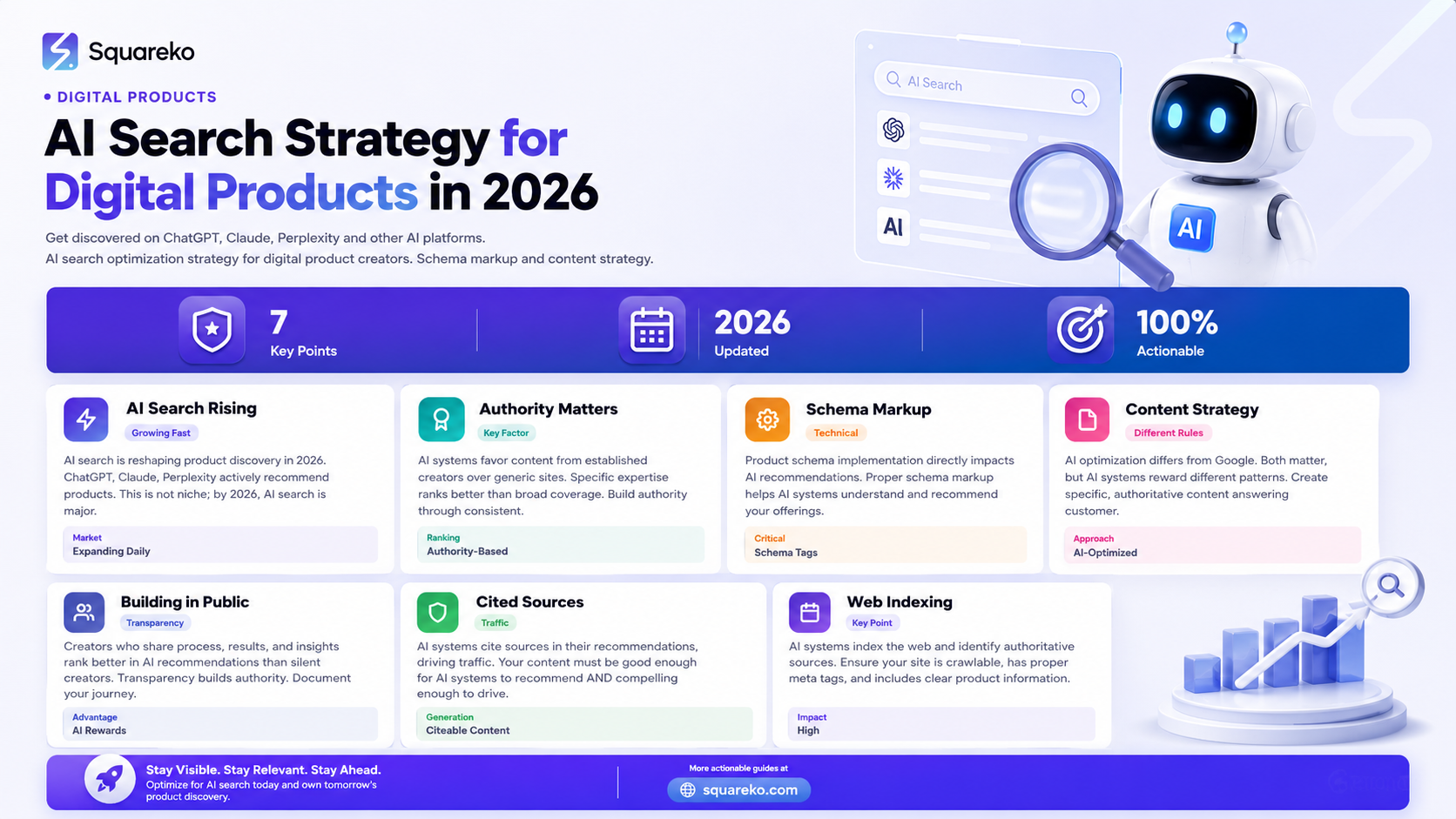
AI search is reshaping product discovery in 2026 — ChatGPT, Claude, Perplexity, and other AI systems now actively recommend products, creating a new customer acquisition channel
Authority and specificity matter more than traditional SEO — AI systems favor content from established creators over generic sites; specific expertise ranks better than broad coverage
Schema markup for products directly impacts AI recommendations — proper implementation of product schema helps AI systems understand and recommend your offerings
Content optimization for AI differs from Google optimization — while both matter, AI systems reward different patterns and content types
Building in public is high-leverage for AI discovery — creators who share process, results, and insights rank better in AI recommendations than silent creators
Understanding AI Search in 2026
AI search is fundamentally different from Google search, and it's reshaping how customers discover products.
What Is AI Search?
AI search refers to conversational AI systems like ChatGPT, Claude, Perplexity, and Bing's AI search that can:
Answer questions in natural language
Provide specific recommendations
Cite sources
Search the web in real-time
Synthesize information from multiple sources
When a user asks What are the best email templates for SaaS businesses?, the AI system:
Searches the web for relevant content
Identifies authoritative sources
Synthesizes recommendations
Provides cited sources (which drives traffic)
AI Search vs. Google Search
Google Search:
Ranks pages by relevance to keywords
User clicks link to read full content
Traffic is typically one-time visitors
AI Search:
Recommends based on authority and specificity
AI summarizes content for user
User may not click through (but might if impressed)
User might ask follow-up questions
This means your content must be good enough that AI systems recommend you AND compelling enough to drive clicks.
Market Size and Growth
AI search is still small but growing exponentially:
ChatGPT: 200M+ active users (accessed 1.2B times in Jan 2026)
Perplexity: 50M+ monthly users (growing 20%+ monthly)
Claude: 100M+ users through web and API
Bing AI: 50M+ daily active users
Google's Gemini search: Integrated into Search (experiments)
This is not a niche channel. By 2026, AI search is becoming a major traffic and discovery source for digital products.
How AI Systems Discover and Recommend Products
Understanding the AI recommendation process reveals what you need to optimize.
AI Discovery Process
Step 1: Web indexing AI systems have access to web content through:
Web crawlers (similar to Google)
Real-time web search
Training data from pre-training
Direct feeds and partnerships
Your Squarespace site is indexed by AI systems just like Google.
Step 2: Authority assessment AI systems evaluate website and creator authority through:
Domain authority (similar to Google but more nuanced)
Author credentials and background
Customer reviews and social proof
Cited by other authoritative sources
Consistency of expertise
Step 3: Relevance evaluation AI systems assess whether your content answers the user's query:
Keyword relevance (but less mechanically than Google)
Content specificity (detailed content ranks better)
Content structure (clear organization helps)
User intent alignment
Step 4: Recommendation AI systems recommend your product/content if:
You're one of the top sources of relevant information
You have authority in the space
Your content is specific and detailed
You have social proof (reviews, customer testimonials)
Recommendation Presentation
When recommending, AI systems:
Answer the user's question (synthesis of multiple sources)
Provide specific recommendations
Cite sources and link to them
List alternatives
Provide context about each recommendation
Example: For SaaS email templates, I'd recommend:
[Your Product] by [Your Name] — [Citation] — specifically good because...
[Competitor] — ...
The citation and link is what drives traffic.
Building Authority for AI Recommendations
AI systems heavily weight authority in recommendations. Here's how to build it.
Authority Signals for AI Systems
Signal 1: Longevity and consistency
How long has your site existed?
How frequently do you publish?
Do you maintain quality over time?
AI systems trust sites that have been around and consistently produce content.
Signal 2: Creator background and credentials
What's your professional background?
Why are you qualified to create this product?
What results have you achieved?
What do others say about you?
Detailed creator information directly impacts AI recommendations.
Signal 3: Content depth and specificity
Are your blog posts comprehensive (2,000+ words)?
Do you cover topics thoroughly?
Do you cite sources?
Do you include original data?
Shallow content gets lower recommendations. Deep, specific content ranks higher.
Signal 4: Social proof and reviews
How many customer reviews do you have?
What's your average rating?
How many customers have purchased?
What do customers say about your product?
AI systems weight customer testimonials and reviews heavily.
Signal 5: Backlinks and citations
Do authoritative sites link to you?
Do other creators mention you?
Are you quoted or cited?
Being referenced by authoritative sources signals to AI that you're worth recommending.
Signal 6: Media presence and coverage
Have you been featured in publications?
Have you appeared in media or podcasts?
Do established journalists cover your work?
Media coverage is especially powerful for authority.
Building Authority on Squarespace
On your Squarespace site:
About page:
Detailed background and credentials
Professional photo
Specific results achieved
Social media links
Contact information
Author archive:
Tag all content with your name
Create author pages with detailed bio
Link author archive to social profiles
Testimonial section:
Feature customer testimonials prominently
Include customer photos, names, job titles
Link to customer websites if applicable
Update regularly with new testimonials
Press and media:
Create dedicated page listing media coverage
Link to articles featuring your work
Include logos of publications featuring you
Blog credibility:
Cite sources in blog posts
Link to authoritative sources
Include original data and research
Update posts regularly to maintain freshness
Content Strategy for AI Platforms
AI systems reward different content patterns than Google.
Content Types That AI Systems Recommend
Type 1: Comprehensive comparison content Title: [Solution A] vs. [Solution B]: Complete Comparison
AI systems love comparison content because it helps them synthesize recommendations.
Example for digital products:
Email Template Builders vs. Email Template Bundles: Which Is Better
Figma vs. Canva for Template Design: Complete Comparison
Type 2: Expert opinion and case studies Title: [Creator] Built a $100K Business Using [Product]: Here's How
AI systems reward original research and specific case studies with data.
Example:
How I Sold 10,000 Design Templates in One Year (with data)
Email Templates Increased My Conversion Rate 35%: Here's My Setup
Type 3: Specific, detailed guides Title: Complete Guide to [Specific Topic]
AI systems recommend guides that comprehensively cover a topic in 3,000+ words.
Example:
Complete Guide to Creating Digital Product Templates That Sell
Step-by-Step Guide to Setting Up Squarespace for Digital Products
Type 4: Curated resource lists Title: The Best [Product Type] for [Specific Audience] in 2026
Curated lists with specific recommendations are AI favorites.
Example:
Best Email Templates for Yoga Studios (with reviews)
Top Digital Template Resources for Course Creators
Type 5: Data-driven insight content Title: [Data insight] Among [audience]
AI systems love content backed by original data.
Example:
We analyzed 5,000 email templates—here's what converts best
Digital product survey: What templates do creators actually buy?
AI Optimization of Existing Content
For existing blog posts, optimize for AI recommendations:
Add authority markers:
Include author name and credentials
Add publication date and update date
Include author bio and photo
Increase comprehensiveness:
Expand posts to 3,000+ words minimum
Add subheadings for clear structure
Include multiple perspectives
Cite sources throughout
Add specificity:
Replace generic claims with specific data
Include examples with real numbers
Replace should with we found that.
Add quotes from experts
Strengthen claims:
Back claims with data or research
Include customer testimonials inline
Link to sources supporting claims
Reference case studies
Schema Markup Implementation on Squarespace
Schema markup helps AI systems understand your products, pricing, and reviews.
What Is Schema Markup?
Schema is structured data that tells search engines and AI systems what your content means.
For product pages, schema tells AI systems:
Product name, description, price
Customer reviews and ratings
Availability and purchase information
Product images
Creator/author information
Squarespace Schema Support
Squarespace automatically adds basic schema markup for:
Product pages (basic schema)
Blog posts (article schema)
Business information (local business schema)
However, you can enhance this through custom code.
Enhancing Product Schema on Squarespace
To add rich product schema:
Go to your product page in Squarespace Editor>tag
Click custom code block
Add product schema markup
Example enhanced product schema:
{
  "@context": "https://schema.org/",
  "@type": "Product",
  "name": "50 Professional Email Templates for SaaS",
  "description": "Professional email templates designed specifically for SaaS companies. Includes 50 templates in Figma format.",
  "image": "https://yoursite.com/image.jpg",
  "brand": {
    "@type": "Brand",
    "name": "Your Brand"
  },
  "offers": {
    "@type": "Offer",
    "price": "49.00",
    "priceCurrency": "USD",
    "availability": "https://schema.org/InStock"
  },
  "aggregateRating": {
    "@type": "AggregateRating",
    "ratingValue": "4.8",
    "reviewCount": "126"
  },
  "author": {
    "@type": "Person",
    "name": "Your Name",
    "url": "https://yoursite.com/about"
  }
}
This schema provides AI systems with:
Clear product information
Pricing and availability
Customer ratings (crucial for recommendations)
Creator information
Review Schema for Credibility
Add individual review schema for each customer review:
{
  "@context": "https://schema.org/",
  "@type": "Review",
  "reviewRating": {
    "@type": "Rating",
    "ratingValue": "5",
    "bestRating": "5"
  },
  "reviewBody": "These templates saved me 10 hours a week. Highly recommend.",
  "author": {
    "@type": "Person",
    "name": "Sarah Johnson"
  }
}
Customer review schema tells AI systems that real people have validated your product.
Getting Your Products Indexed by AI Systems
AI systems discover your products through standard web indexing. You don't need special submission.
Ensuring Indexing
For Google (which AI systems use):
Submit sitemap to Google Search Console
Ensure robots.txt allows indexing
Use Squarespace's built-in SEO settings
For AI platforms specifically:
Perplexity: Automatically indexes public sites
ChatGPT: Automatically indexes public sites
Claude: Automatically indexes public sites
However, you can optimize indexing:
Freshness: Update content regularly—AI favors fresh content
Crawlability: Ensure important pages are easily crawled
Links: Link from your homepage to product pages
Sitemaps: Ensure XML sitemaps are current
Accelerating Indexing
While automatic indexing happens, you can accelerate discovery:
Mention in blog posts: When writing blog content, mention and link to relevant products
Social sharing: Share your products on social media—AI systems see these
Media coverage: Get coverage in publications—AI systems see and weight these
Community participation: Share your products on relevant communities (Reddit, indie hackers, etc.)
These activities accelerate visibility to AI systems.
Writing for AI Comprehension
Writing for AI differs from writing for humans. Optimize for both.
AI-Friendly Writing Patterns
Pattern 1: Explicit structure AI systems better understand clearly structured content:
Good: There are three types of templates: Type A (for beginners), Type B (for intermediate), and Type C (for advanced).
Less optimal: Templates vary in complexity and scope depending on user experience.
Explicit enumeration helps AI understand your categorization.
Pattern 2: Specific, quantified claims AI systems prefer specific data over generalizations.
Good: This template bundle saved customers an average of 15 hours per month.
Less optimal: This template bundle saves significant time.
Quantification makes claims more understandable to AI.
Pattern 3: Clear cause and effect AI systems understand causality better than implications.
Good: Because these templates include customization guides, customers spend 80% less time on customization.
Less optimal: Our templates are easy to customize, which might save time.
Explicit cause-effect helps AI understand impact.
Pattern 4: Direct statements about benefits Be direct about what your product does:
Good: This product directly addresses the problem of time-consuming template customization by providing pre-organized layers and clear customization guides.
Less optimal: This template system is designed with creator needs in mind.
Direct problem-solution statements are clearer to AI.
Tone for AI
While writing clearly for AI, don't lose your human voice:
Write naturally but precisely
Use clear language (avoid jargon unless necessary)
Explain acronyms on first use
Use active voice
Define terms when first introduced
Good AI writing is also good human writing.
Monitoring AI-Driven Traffic
AI traffic differs from Google traffic and requires different tracking.
Identifying AI Search Traffic
In Google Analytics:
AI traffic often shows up as direct or other traffic
Traffic from ChatGPT: May appear as OpenAI referrer
Traffic from Perplexity: May appear as Perplexity referrer
Traffic from Claude: May appear as Anthropic referrer
Bing AI traffic: May appear as Bing referrer
Note: Many AI systems don't send clear referral information, so attribution is imperfect.
Tracking AI Platform Mentions
Monitor where your products are recommended:
Google Alerts:
Set alerts for your product name
Set alerts for your creator name
Get notified when you're mentioned
Perplexity tracking:
Search for your product name on Perplexity
See if you're recommended
Check ranking position and context
ChatGPT tracking:
Search for relevant terms on ChatGPT
See if you're recommended
Check positioning against competitors
Analytics dashboards:
Tools like Perplexity Analytics can track mentions
Some tools monitor AI platform recommendations
Growth Metrics to Track
Track quarterly:
Estimated AI-driven traffic
Number of AI platform recommendations
Conversion rate from AI traffic
Customer acquisition cost from AI channels
AI is still small but growing 30-50% quarterly for many creators.
Competing on AI Platforms
AI platform recommendation is not zero-sum. Multiple creators can be recommended.
Competitive Strategy
Strategy 1: Be specific If AI is recommending 3 products for email templates, the recommendations typically are:
Most authoritative general option
Most specific/niche option
Best value option
Being the most specific in a narrow niche is often better than being a generalist.
Strategy 2: Build unique angle Don't try to out-authority existing creators. Instead, find a unique position:
Most beginner-friendly
Best for specific use case
Best value
Most innovative
Example:
Competitor A: Most professional email templates (authority play)
Your angle: Email templates specifically for coaches with under 1 year experience (specificity play)
Both can be recommended for different searches.
Strategy 3: Invest in customer success AI systems heavily weight customer reviews. If you obsess over customer success and reviews, AI systems will rank you higher.
Future-Proofing Your Strategy
AI search is evolving rapidly. Build flexibility into your strategy.
Principles Over Tactics
Rather than optimizing for specific AI systems:
Optimize for authority (applies to all platforms)
Optimize for specificity (applies to all platforms)
Optimize for customer satisfaction (applies to all platforms)
Optimize for content quality (applies to all platforms)
These principles work across current and future AI systems.
Platform Agnostic Strategy
Don't over-optimize for one AI platform:
Risk: Optimizing solely for ChatGPT recommendations
ChatGPT could change algorithm
ChatGPT could launch paid recommendations
Other platforms could surpass ChatGPT
Better: Optimize for general authority and quality
Works across all current and future platforms
Builds your brand independent of any platform
More sustainable long-term
Staying Current
AI is evolving rapidly. Stay informed:
Follow AI news: Subscribe to AI and tech newsletters
Test platforms: Use ChatGPT, Claude, Perplexity regularly
Join communities: Follow creator communities discussing AI
Experiment: Test recommendations, see what works
Document: Track what changes in AI recommendations
Understanding the landscape helps you adapt quickly.
Conclusion
AI search is reshaping product discovery in 2026. It's not replacing Google—it's supplementing it. Smart digital product creators will optimize for both.
AI search rewards what good business has always rewarded:
Expertise and authority
Specificity and depth
Customer success and satisfaction
Transparency and credibility
If you build a genuinely valuable product, help customers succeed, build authority through content, and implement proper schema markup, AI systems will recommend you.
The digital product creators winning on AI platforms aren't gaming the algorithm. They're building legitimate authority and earning recommendations.
CTA Section
Ready to get discovered on AI platforms?
Many digital product creators are unaware that AI platforms like ChatGPT now actively recommend products. This is a new customer acquisition channel, and early movers have a significant advantage.
At Squareko, we help digital product creators optimize for AI search while maintaining strong Google rankings. Our approach focuses on building genuine authority that AI systems reward.
We offer:
AI search strategy and optimization
Content strategy for AI recommendations
Schema markup implementation
Authority building guidance
Competitive analysis on AI platforms
Get a free AI search audit. We'll analyze where you currently rank on ChatGPT and Perplexity and identify optimization opportunities.
Frequently Asked Questions
-
For most digital products, AI search is still 5-15% of total organic traffic. But it's growing 30-50% quarterly and represents huge opportunity. Starting optimization now positions you ahead of competitors.
-
No. AI systems read your website content, not design. Focus on content quality, clear structure, and schema markup. Your existing site is likely already being read by AI systems.
-
No. Optimize content for both simultaneously. Good practices for AI (specificity, clear structure, authority) are also good for Google. One content strategy serves both.
-
Ask customers post-purchase. Send email requesting honest reviews. Offer incentive (bonus resource, discount on future product) for reviews. More reviews = stronger AI recommendations.
-
Schema markup helps but isn't absolutely required. AI systems understand your site without it. However, schema markup improves how AI interprets pricing, reviews, and product information. It's a meaningful optimization.
-
No. AI systems don't (yet) have paid recommendation options. However, Claude has partnership programs for selected creators. Focus on earning recommendations through authority.
-
Timeline: Small significant portion in 2026 (5-15% of traffic). Major portion in 2027-2028 (20-40% of traffic). By 2029+, likely 30-50% of all discovery through AI. Start optimizing now to capture early growth.
-
Diversification is your hedge. Build Google rankings, email list, social audience, and product authority. No single channel should represent more than 40% of traffic. This prevents over-dependence on any platform.

From custom website design to SEO strategy, we help businesses launch a site that looks professional and performs better.

Author Bio
I'm Walid Hasan, a Certified Squarespace Expert and Squarespace Circle Platinum Partner with over 12 years of hands-on experience designing and optimizing high-performing websites. Over the years, I've had the privilege of building more than 2,000 Squarespace websites for clients around the world, always focusing on clean design, strong user experience, and conversion-driven results.