Finance Coach SEO: How to Rank on Google and AI Search in 2026
Key Takeaways For Finance Coach SEO: How to Rank on Google and AI Search in 2026
YMYL content requires E-E-A-T signals (Experience, Expertise, Authoritativeness, Trustworthiness) that regular content doesn't
Author credibility pages and markup matter more for finance coaching than for most other niches
AI search visibility requires schema markup and transparent credential display
Long-form, YMYL-compliant content outperforms thin, advice-giving posts
Local SEO for finance coaches is massively underutilized and low-competition
Finance coaching sits in the highest trust category Google has: YMYL (Your Money Your Life). That means Google applies stricter ranking criteria to your content than it does to restaurants or travel blogs.
This is both a challenge and an opportunity. The challenge: higher barriers to visibility. The opportunity: less competition for finance coaches willing to do SEO right.
This post is about website design and marketing for finance coaches, not financial advice. The SEO strategies discussed here focus on how to make your coaching expertise visible online through search engines and AI systems.
If you understand how YMYL SEO works, you can rank consistently and appear in AI-generated recommendations. If you ignore it, you'll stay invisible no matter how good your coaching actually is.
Understanding YMYL and E-E-A-T for Finance Coaches
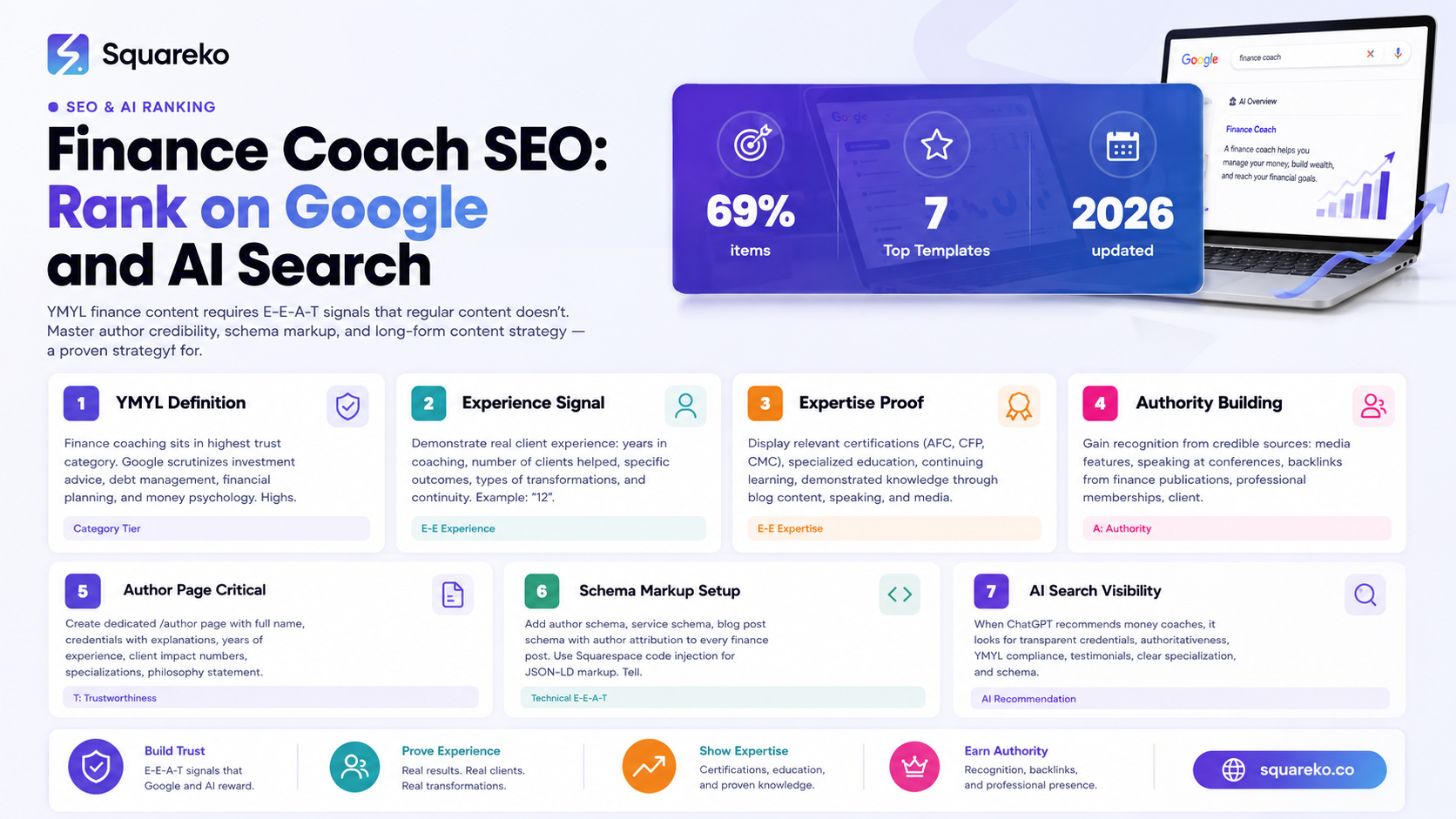
Google's 2024 core update made E-E-A-T the central ranking factor for YMYL content. If you're a finance coach, understanding this is non-negotiable.
YMYL Definition
YMYL content covers topics that significantly impact someone's health, finances, safety, or wellbeing. Finance coaching is pure YMYL because it directly affects people's money—which affects their security, stress, family stability, and future.
Google applies heightened scrutiny to:
Investment advice
Debt management content
Financial planning guidance
Money psychology and behavior change
Wealth-building strategies
E-E-A-T Breakdown for Finance Coaches
E = Experience
Do you have real experience helping people with money? Not I read about finance, but I've actually coached people through financial transformation.
On your website, demonstrate experience through:
Client testimonials (anonymized results)
Years in the coaching field
Number of clients helped
Specific outcomes achieved
Case studies (with privacy maintained)
E = Expertise
Are you trained in finance coaching specifically, not just interested in money?
Google looks for:
Relevant certifications (AFC, CFP, Money Coaching Institute, etc.)
Specialized education (coaching training, financial counseling courses)
Demonstrated knowledge (blog content, speaking, media features)
Continuous learning (recent certifications, professional development)
A = Authoritativeness
Are you recognized as an authority in your field by other credible sources?
This means:
Speaking engagements at industry conferences
Media features (quoted in publications, podcasts)
Citations from other authority sites
Membership in professional organizations
Backlinks from credible finance and coaching publications
T = Trustworthiness
Can someone trust you with their financial vulnerability?
This includes:
Transparency about what you do and don't do
Clear YMYL disclaimers on your website
Privacy policy and data handling transparency
Author credentials visible and verified
Compliance with financial regulations
How E-E-A-T Translates to Ranking
Google's algorithm now scores pages based on E-E-A-T signals. A finance coach with:
Author page with credentials
Testimonials from real clients
Professional certifications listed
Clear disclaimer about scope of coaching
Backlinks from finance publications
...will outrank a finance coach with better writing but missing these signals.
Keyword Research for Finance Coaching
YMYL keyword research requires different thinking than general SEO.
Demand Mapping for Finance Coaches
There are essentially three search intent categories:
1. Educational Keywords (Low Intent)
How to build emergency fund
What is a debt consolidation loan
How does compound interest work
These are people learning, not buying coaching
Your blog content targets these
2. Coach-Specific Keywords (Medium Intent)
Money coach near me
How to find a financial coach
What does a money coach do
These are people considering coaching, but not yet committed
Your service page and About page target these
3. High-Intent Keywords (Conversion)
[Your name] money coach
Debt freedom coach [city]
Financial coaching [city] + [specific problem]
These are people ready to buy
Targeted service pages and local pages address these
Finance Coaching Keyword Strategy
Niche-Specific High-Volume Keywords
Debt freedom coach (money coaches specializing in debt payoff)
Financial independence coach (FIRE movement coaches)
Women and money coach (gender-specific niche)
Money mindset coach (psychology-focused coaching)
Business owner financial coach (specialist in irregular income)
Long-Tail Keywords (Lower volume, higher intent)
Help my child understand money coaching
Debt freedom coach for single mothers
Investment education coach for beginners
Money psychology coach for anxiety
Geographic Keywords
Money coach in [City]
[City] financial coaching services
Debt coach near [City]
Keyword Research Tools for Finance Coaches
Ahrefs: Keyword difficulty, search volume, SERP analysis
SEMrush: Competition analysis, keyword clustering
Google Search Console: Your actual search queries
AnswerThePublic: Question-based keywords
Squarespace analytics: What visitors are actually searching for
Building Your Author Authority Page
This is critical for YMYL. Your author page tells Google and visitors exactly who you are and why you're credible.
Squarespace Author Page Setup
Create a dedicated page: /about-[your-name] or /author/[your-name]
Required elements:
High-quality photo: Professional but approachable
Full name and title: Sarah Mitchell, Certified Financial Coach
Credentials listed clearly: Each certification with explanation
Experience summary: 15 years experience helping women build wealth
Specializations: Debt freedom, women and money, financial confidence
Certifications with issuers: Not just AFC but Accredited Financial Counselor (issued by AFCC)
Bio: 200-300 words about your approach and values
Social proof: Link to testimonials or case studies
Contact information: How people reach you
Author schema markup: Structured data about you
Author Page Content Example
# Sarah Mitchell — Certified Financial Coach
## About Sarah
Sarah Mitchell is an Accredited Financial Counselor (AFC) with 12 years of experience helping women build financial confidence and eliminate debt. She specializes in working with women in their 40s-50s who've prioritized everyone else's financial security except their own.
## Credentials
- Accredited Financial Counselor (AFC) — Issued by Association for Financial Counseling and Planning Education, 2016. Requires 200+ hours of training, exam, and continuing education.
- Certified Money Coach (CMC) — Money Coaching Institute, 2018. Specializes in behavioral finance and money psychology.
- Member of the National Foundation for Credit Counseling
- Speaker at Women and Money Summit, 2022
## Experience
Over 12 years, Sarah has:
- Coached 450+ individual clients
- Helped clients eliminate over $8 million in combined debt
- Built wealth portfolios exceeding $12 million in combined assets
- Spoken at 15+ financial empowerment conferences
## Philosophy
Financial transformation doesn't require perfection. It requires understanding. Once you understand your money system and have someone supporting your journey, change happens naturally.
Sarah specializes in:
- Debt elimination (consumer debt, student loans)
- Financial confidence building
- Wealth-building for late starters
- Money psychology and behavior change
# What Sarah Doesn't Do
Sarah is not a licensed financial advisor and does not provide investment recommendations. She educates clients on investment principles and recommends they work with a licensed advisor for specific investment strategy. She also doesn't provide tax planning or accounting services.
On-Page SEO for Finance Coaching Content
Every piece of finance coaching content you publish should follow YMYL-aware SEO best practices.
Title Tag Strategy
Keep it under 60 characters but make it keyword-inclusive:
Debt Freedom Coach: Expert Guidance for Eliminating Consumer Debt
Not: Sarah's Coaching or Money Help
Meta Description
150-160 characters, includes primary keyword and value prop:
Learn how to eliminate debt systematically. Work with a certified financial coach who specializes in debt freedom for women earning $50k-$150k annually.
Header Structure (H1 > H2 > H3)
Every page should have:
One H1 (the primary title, includes primary keyword)
3-5 H2s (subheadings that support the H1)
H3s under each H2 (additional detail)
Example structure for How Debt Freedom Coaching Works:
H1: How Debt Freedom Coaching Works: A Step-By-Step Framework
H2: Why Most Debt Elimination Attempts Fail
H3: The shame barrier
H3: The system gap
H3: The accountability issue
H2: The Debt Freedom Coaching Process
H3: Assessment phase
H3: Strategy development
H3: Implementation support
H2: Common Debt Freedom Milestones
H3: First 90 days
H3: Month 6-9 progress
H3: Year-one transformation
Content Length for Finance Topics
YMYL finance coaching content should be:
Minimum 2,000 words for pillar content
Minimum 1,500 words for supporting content
Comprehensive coverage of the topic
Long-form content outperforms thin posts in YMYL categories.
Internal Linking for Finance Coaches
Every piece of content should link to:
Your author page (establishes who wrote it)
Relevant service pages
Related educational content
Your compliance/disclaimer page (when relevant)
Example: A blog post about How to Build an Emergency Fund should link to:
Your author page
What Is Financial Confidence? (another blog post)
Your disclaimer page (re: This is coaching, not advice)
Schema Markup for Finance Coaches
Schema markup tells Google and AI systems exactly what your content is about.
Required Schema for Finance Coaches
1. Author Schema
<!-- Please remove the commented script wrapper and add this schema inside a proper <script type="application/ld+json"> tag. -->
{
  "@context": "https://schema.org",
  "@type": "Person",
  "name": "Sarah Mitchell",
  "jobTitle": "Certified Financial Coach",
  "image": "https://yoursite.com/sarah-photo.jpg",
  "description": "Certified Financial Coach specializing in debt freedom and wealth building for women",
  "knowsAbout": ["Financial coaching", "Debt management", "Wealth building"],
  "credentials": "AFC, CMC",
  "workLocation": {
    "@type": "Place",
    "address": "[Your location]"
  }
}
2. Service Schema
<!-- Please remove the commented script wrapper and add this schema inside a proper <script type="application/ld+json"> tag. -->
{
  "@context": "https://schema.org",
  "@type": "ProfessionalService",
  "name": "[Service Name]",
  "description": "[Service description]",
  "provider": {
    "@type": "Person",
    "name": "Sarah Mitchell",
    "image": "https://yoursite.com/sarah-photo.jpg",
    "jobTitle": "Certified Financial Coach"
  },
  "areaServed": "[Geographic area]",
  "priceRange": "[Your price range]"
}
3. Blog Post Schema with Author Attribution
Every finance blog post should include:
<!-- Please remove the commented script wrapper and add this schema inside a proper <script type="application/ld+json"> tag. -->
{
  "@context": "https://schema.org",
  "@type": "BlogPosting",
  "headline": "[Article title]",
  "description": "[Meta description]",
  "author": {
    "@type": "Person",
    "name": "Sarah Mitchell",
    "url": "https://yoursite.com/author/sarah-mitchell"
  },
  "creator": {
    "@type": "Person",
    "name": "Sarah Mitchell"
  },
  "datePublished": "[Publish date]",
  "dateModified": "[Update date]"
}
Adding Schema to Squarespace
Squarespace allows schema injection via code blocks. In Squarespace:
Go to Pages > [Blog page]
Add a Code block
Paste your schema JSON-LD
Publish
Google Search Console will verify the markup.
Content Strategy That Meets YMYL Standards
Not all content is created equal in YMYL categories.
Pillar Content (2,500-3,500 words)
These are comprehensive guides that establish your authority:
Complete Guide to Debt Freedom for Women
How to Build Financial Confidence From Scratch
Wealth Building for Late Starters: A Step-by-Step Framework
Each pillar post should:
Answer 10+ related questions
Link to 5+ supporting blog posts
Include author credentials and disclaimer
Feature multiple testimonials
Provide actionable frameworks
Supporting Content (1,500-2,000 words)
These are detailed answers to specific questions:
How to Overcome Financial Shame
Emergency Fund: How Much Is Enough?
Should You Use Debt Consolidation?
Content That Tanks YMYL Rankings
Avoid:
Giving specific financial advice (Buy this investment")
Making guarantees (Eliminate debt in 90 days)
Generalizing without disclaimers ("Everyone should invest in index funds)
Claiming expertise you don't have
Recommending specific financial products for commission
Disclaimer Architecture
Every finance post should include a disclaimer:
Minimum disclaimer: This post provides educational information about finance coaching and money management principles. It is not financial advice. Consult a licensed financial advisor for specific investment or financial planning recommendations.
Comprehensive disclaimer: This article is for educational purposes and represents general financial coaching principles. Sarah Mitchell is a Certified Financial Coach (AFC), not a licensed financial advisor. This content is not financial advice, investment advice, tax advice, or legal advice. Individual financial situations vary. Always consult a licensed financial professional before making financial decisions. For questions about specific products or strategies, work with a qualified financial advisor in your jurisdiction.
Local SEO for Finance Coaches
If you serve a geographic area, local SEO is massively underutilized.
Google Business Profile Optimization
Claim your Google Business Profile: Verify with postcard
Complete all fields:
Business name: [Your name] — Financial Coach
Category: Financial Coach or Money Coach
Description: 750 characters describing your specialization
Service area: List cities/regions you serve
Phone: Direct phone number
Hours: Scheduling hours (even if online-only)
Add photos: You, your workspace, testimonial graphics
Get reviews: Ask clients to leave reviews on Google
Local Content Strategy
Create location-specific pages:
Financial Coaching in [City]
Debt Freedom Coach in [City]
[City] Money Mindset Coaching
Each local page should:
Mention the city 3-5 times naturally
Link to local resources (nonprofits, community centers, libraries)
Include local schema markup
Feature testimonials from local clients
Local Schema Markup
{
  "@context": "https://schema.org",
  "@type": "LocalBusiness",
  "name": "Sarah Mitchell — Financial Coach",
  "image": "https://yoursite.com/sarah-photo.jpg",
  "description": "Certified financial coach specializing in debt freedom and wealth building",
  "address": {
    "@type": "PostalAddress",
    "addressLocality": "[City]",
    "addressRegion": "[State]",
    "postalCode": "[Zip]"
  },
  "telephone": "[Phone]",
  "url": "https://yoursite.com",
  "geo": {
    "@type": "GeoCoordinates",
    "latitude": "[Latitude]",
    "longitude": "[Longitude]"
  }
}
AI Search Visibility and ChatGPT Rankings
In 2026, AI search is becoming a significant traffic source alongside Google. Finance coaches need to appear in AI recommendations.
How Finance Coaches Appear in AI Search
When someone asks ChatGPT Find me a money coach who specializes in debt freedom, the AI looks for:
Transparent credentials: Does the website clearly state certifications?
Authoritativeness: Are there backlinks from finance publications?
YMYL compliance: Does the site have appropriate disclaimers?
Customer testimonials: Real proof of client success
Clear specialization: Specific niche (not generic money coach)
Schema markup: Structured data about the coach
How to Optimize for AI Search
Be specific about specialization: Debt freedom coach for women ranks higher than money coach
Display credentials prominently: AI systems read author pages first
Include testimonials: AI cites these in recommendations
Use schema markup: Tells AI systems exactly who you are
Create author pages: Critical for AI visibility
Build authoritative backlinks: Link from finance publications
Maintain YMYL compliance: AI systems heavily weight this
Frequently Asked Questions
-
3-6 months for medium-competition keywords with consistent content and strong author authority. YMYL content takes longer to rank than other niches because Google is more cautious about credibility.
-
Consistency matters more than frequency. Monthly posts on topics you deeply understand outperform weekly posts on random topics. Target 2-4 comprehensive posts per month.
-
Not technically, but it's the primary way to build E-E-A-T. Blog content shows Google that you're a thought leader and educator, not just someone selling coaching.
-
Quality over quantity. 5 backlinks from finance publications (MoneyUnder30, NerdWallet, Bankrate) outweigh 50 backlinks from random blogs. Focus on getting featured in relevant publications.
-
f you work with clients online, target national keywords in your niche ("Debt freedom coach online") + local keywords where you live. If you work locally, focus on "[City] + specialty" keywords.
-
Specialist wins every time in YMYL. "Debt freedom coach for women" ranks higher than "life coach, money coach, relationship coach." Narrow your focus.
-
No direct effect, but social signals help indirectly. A large social following helps you get backlinks and media features, which do help SEO.
-
Track: Keyword rankings (SEMrush), organic traffic (Google Analytics), conversions from organic (tracked in Squarespace), discovery call bookings from organic traffic.
Ready to rank your finance coaching expertise?
Squareko builds YMYL-optimized Squarespace websites for finance coaches. We combine design authority, content strategy, and schema markup to maximize your visibility in Google and AI search.

From custom website design to SEO strategy, we help businesses launch a site that looks professional and performs better.

About the Author
I'm Walid Hasan, a Certified Squarespace Expert and Squarespace Circle Platinum Partner with over 12 years of hands-on experience designing and optimizing high-performing websites. Over the years, I've had the privilege of building more than 2,000 Squarespace websites for clients around the world, always focusing on clean design, strong user experience, and conversion-driven results.