Fashion Website SEO on Squarespace: Keywords, Strategy and AI Search for 2026
Introduction
Building a successful fashion brand online means far more than uploading stunning photos of your collections. For independent fashion retailers and designers using Squarespace, ranking your products in Google's search results—and now across emerging AI search platforms—requires a strategic approach to fashion website SEO on Squarespace with targeted keywords and modern search strategy. This guide walks you through the exact tactics that enable clothing brands to capture organic traffic in 2026, from product-level optimisation to structured data implementation.
Whether you're selling luxury handbags, sustainable activewear, or streetwear accessories, Squarespace provides the foundation for strong SEO. However, the platform's default settings and templates alone won't guarantee visibility. Success depends on understanding how fashion searchers use keywords, how Google indexes product content, and how to prepare your store for AI-powered discovery.
This post covers everything: keyword research by fashion niche, on-page and technical SEO specific to Squarespace, Product schema markup implementation, and the emerging landscape of AI search visibility for independent fashion brands.
Key Takeaways
Fashion keyword research requires niche-specific approaches: luxury brands, sustainable fashion, and streetwear each command different search intent and keyword opportunity
Squarespace's native SEO tools are sufficient for fashion SEO, but require proper configuration of meta titles, descriptions, alt text, and URL structures
Product schema markup (JSON-LD) is no longer optional—it's essential for Google Product Listings and new AI search visibility
Independent fashion brands can rank for high-value, long-tail keywords by combining trend-focused content with optimised product pages
AI search platforms in 2026 prioritise structured product data, brand mention signals, and content authority; traditional link-building matters less than data quality
Squarespace's blogging capabilities enable fashion trend content strategy, which supports both SEO and brand positioning
Technical optimisation—mobile performance, Core Web Vitals, and crawlability—directly affects ranking potential across search channels
How Fashion Keyword Research Differs from Other Industries
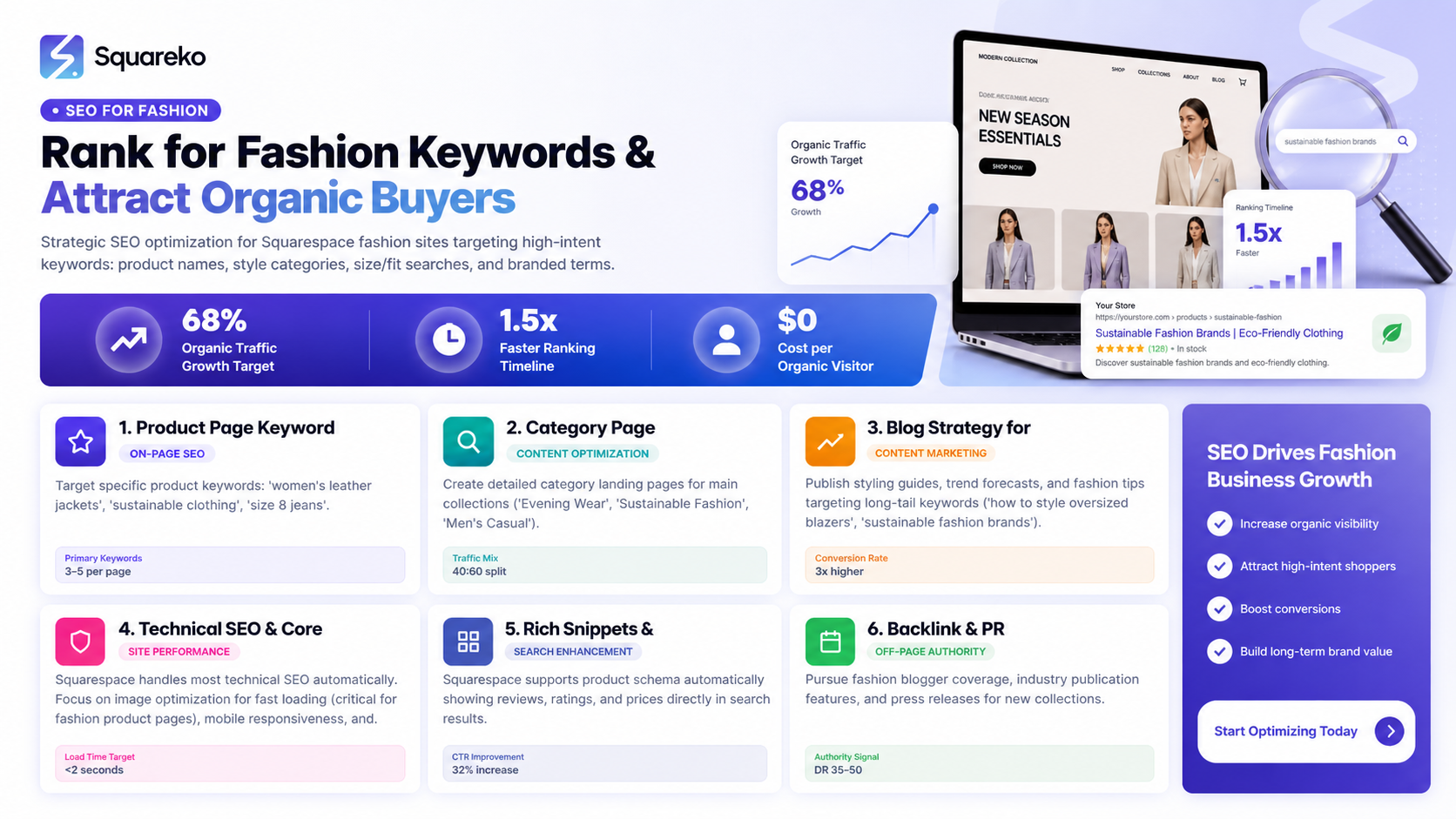
Fashion keyword research operates under different rules than, say, software SaaS or financial services. Fashion searchers exhibit distinct patterns:
Intent variability. A search for "black leather jacket" could represent ten different customer intents: comparison shopping, trend inspiration, size guides, brand research, or price hunting. Your keyword strategy must accommodate this spectrum.
Trend-driven keywords. Fashion keywords have seasonal and cultural lifecycles. "Maxi dress" searches spike in spring; "wool coat" peaks in autumn. Savvy brands prepare content calendars around these cycles.
Visual-first discovery. Fashion relies heavily on visual search—Google Images, Pinterest, and TikTok. Text-only keyword strategies miss significant traffic.
Long-tail and descriptive searches. Fashion customers use highly specific descriptors: "lightweight linen shirt for women under 50 pounds", "vegan leather crossbody bag ethical brand", "oversized blazer streetwear style". These specificity patterns create opportunities for independent brands competing against large retailers.
User-generated content and social proof. Fashion searchers actively seek reviews, styling guides, and influencer recommendations. Keywords like "best sustainable clothing brands" and "[brand name] reviews" are high-intent entries.
Understanding these patterns means your keyword strategy must span product keywords, content keywords, and trend keywords simultaneously.
Fashion Keyword Examples by Niche
Keyword opportunity differs dramatically by fashion segment. Here are real examples organized by niche:
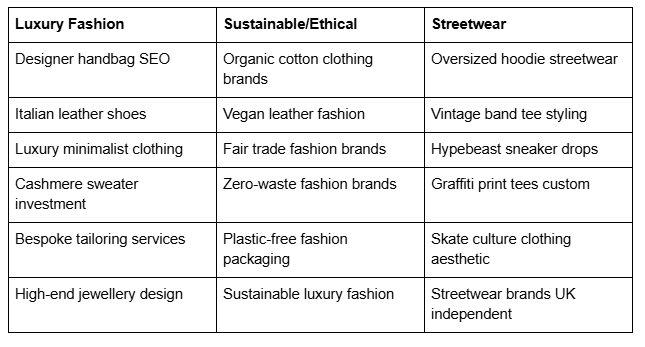
Long-tail opportunities: These niches permit hyper-specific keyword targeting. For example, in sustainable fashion, keywords like affordable organic linen trousers online UK or small business vegan leather bags attract qualified searchers with strong purchase intent who face less competition than broad terms.
Search volume vs. competition trade-off. Luxury fashion often commands high search volume but also attracts enormous competition from retail giants. Independent luxury brands succeed by targeting specific sub-niches: luxury linen resort wear versus "dresses.
Secondary keyword clusters. Within each niche, group related keywords:
Sustainability keywords: organic, ethical, fair-trade, vegan, zero-waste, eco-friendly, plastic-free
Fit keywords: oversized, petite, tall, curvy, slim-fit, relaxed-fit
Material keywords: linen, silk, cotton, wool, recycled, biodegradable
Style keywords: minimalist, bohemian, vintage, contemporary, avant-garde
Squarespace SEO Foundations for Fashion Stores
Squarespace offers several native SEO capabilities that fashion retailers must configure properly:
URL structure. Squarespace generates clean URLs by default, but ensure product URLs include descriptive keywords:
✅ yourstore.com/shop/black-leather-tote-bag
❌ yourstore.com/shop/product-1234
Meta titles and descriptions. These are non-negotiable. Each product page needs a unique meta title (50–60 characters) and description (150–160 characters) that incorporate primary and secondary keywords while compelling clicks from search results.
Alt text for product images. This is where many fashion brands fail. Alt text serves two functions: accessibility and SEO. Write descriptive alt text that includes relevant keywords and describes the product accurately:
✅ Black leather cross-body bag with gold hardware, sustainable vegetable-tanned leather
❌ Product image or leather bag
Internal linking strategy. Link between related products using anchor text with keywords. A blog post about "summer linen dress styling" should link to your best-selling linen dresses. This distributes authority and helps Google understand your content topically.
Page speed and mobile optimisation. Squarespace handles much of this automatically, but monitor Core Web Vitals in Google Search Console. Fashion sites with large product images must optimise image file sizes and use modern formats (WebP).
Collections and category pages. Your product categories (e.g., "Dresses", "Sustainable Collections", "New Arrivals") are landing pages in their own right. Each needs a unique meta title, description, and introductory text that targets category-level keywords.
Structuring Product Pages for Maximum SEO Impact
Your product pages are the foundation of fashion website SEO. Here's the anatomy of an optimised product page:
H1 tag (product name with primary keyword). The H1 should be the product name, and it should naturally incorporate your main keyword. Organic Cotton T-Shirt in Charcoal" works; Amazing Tee! does not.
Product description (300–500 words with keyword variation). Write for humans first, but ensure your description naturally uses keyword variations and addresses customer questions:
What is it made of?
How does it fit?
What's the environmental impact?
Which seasons/occasions suit it?
Who is it for?
Include subheadings (H2, H3) if the description is longer. Materials & Care, Sizing Guide, Sustainability, Styling Tips" are natural subheading categories.
Bullet points. Fashion shoppers scan. Use bullet points for:
Material composition
Size and fit details
Care instructions
Sustainability claims
Available colours and sizes
Product specifications section. Structured data loves specificity. Include:
Brand
Material(s)
Available sizes
Available colours
Weight
Dimensions
Care instructions
Customer reviews section. If Squarespace displays reviews (or you integrate a review app), ensure reviews stay visible. Reviews add keyword-rich user-generated content and increase dwell time.
Related products. Link to complementary items. This increases time on site and provides contextual internal linking opportunities.
Product Schema Markup: The Complete Implementation Guide
Product schema markup (JSON-LD format) is essential for 2026 fashion SEO. It tells Google and AI search engines exactly what your products are, how they're priced, and how customers rate them. Squarespace allows schema implementation via custom code blocks or footer code injection.
Basic Product Schema Example:
{
  "@context": "https://schema.org",
  "@type": "Product",
  "name": "Black Linen Shirt - Women's",
  "description": "Lightweight black linen shirt, perfect for summer and resort wear. Made from 100% organic linen, ethically produced in Portugal. Features long sleeves, mother-of-pearl buttons, and a relaxed fit.",
  "image": "https://yourstore.com/images/black-linen-shirt.jpg",
  "brand": {
    "@type": "Brand",
    "name": "Your Brand Name"
  },
  "offers": {
    "@type": "Offer",
    "url": "https://yourstore.com/shop/black-linen-shirt",
    "priceCurrency": "GBP",
    "price": "85.00",
    "availability": "https://schema.org/InStock",
    "seller": {
      "@type": "Organization",
      "name": "Your Brand Name"
    }
  },
  "aggregateRating": {
    "@type": "AggregateRating",
    "ratingValue": "4.8",
    "reviewCount": "24"
  },
  "review": [
    {
      "@type": "Review",
      "author": {
        "@type": "Person",
        "name": "Sarah M."
      },
      "datePublished": "2026-02-15",
      "reviewRating": {
        "@type": "Rating",
        "ratingValue": "5"
      },
      "reviewBody": "Perfect lightweight shirt for summer. The linen is soft and drapes beautifully."
    }
  ]
}
Enhanced Product Schema with Clothing Specifics:
{
  "@context": "https://schema.org",
  "@type": "Product",
  "name": "Oversized Wool Coat - Charcoal",
  "description": "Oversized wool coat in charcoal grey. Sustainable tailoring from recycled wool blend.",
  "image": [
    "https://yourstore.com/images/coat-front.jpg",
    "https://yourstore.com/images/coat-back.jpg",
    "https://yourstore.com/images/coat-detail.jpg"
  ],
  "brand": {
    "@type": "Brand",
    "name": "Your Brand"
  },
  "url": "https://yourstore.com/shop/oversized-wool-coat-charcoal",
  "offers": {
    "@type": "Offer",
    "url": "https://yourstore.com/shop/oversized-wool-coat-charcoal",
    "priceCurrency": "GBP",
    "price": "220.00",
    "availability": "https://schema.org/InStock",
    "seller": {
      "@type": "Organization",
      "name": "Your Brand"
    }
  },
  "aggregateRating": {
    "@type": "AggregateRating",
    "ratingValue": "4.9",
    "reviewCount": "18"
  },
  "material": "Wool, recycled blend",
  "gtin": "1234567890123",
  "sku": "COAT-CHARCOAL-M",
  "size": [
    "XS",
    "S",
    "M",
    "L",
    "XL",
    "XXL"
  ],
  "color": "Charcoal",
  "weight": {
    "@type": "QuantitativeValue",
    "unitCode": "KGM",
    "value": "0.85"
  }
}
Implementation steps in Squarespace:
Navigate to the product page settings
Scroll to Advanced or Custom Code section
Paste the JSON-LD schema in the code block before the closing </head> tag
Test using Google's Rich Results Test tool
Repeat for all product pages, updating name, price, image URL, and review data
Schema best practices for fashion:
Include multiple product images in the image array
Use availability to reflect stock status
Update aggregateRating when new reviews arrive
Use sku and gtin for inventory tracking
Include material and size fields as shown
Add colour variations as separate products or within the schema
How Independent Fashion Brands Appear in AI Search in 2026
AI search platforms like Perplexity, SearchGPT, and emerging proprietary systems are reshaping how fashion discovery works. These platforms don't rely solely on traditional ranking factors. Here's how independent fashion brands gain visibility:
Structured product data is the foundation.
AI systems prioritise information-rich, structured data over unstructured content. A product page with complete schema markup—brand, material, price, ratings, availability—outperforms a beautifully written page without markup. This inverts the traditional SEO hierarchy slightly: data quality matters more than prose quality.
Ensure your product data covers:
Full material composition
Accurate pricing and currency
Stock status
All available sizes and colours
Care instructions
Sustainability certifications (if applicable)
Brand information
Brand mention authority.
AI systems track brand mentions across the web. If your fashion brand appears in fashion magazines, industry blogs, sustainability certifications, and social media with consistent details (brand name, website URL, founder name), AI systems build a knowledge graph around your brand.
Action: Aim for brand mentions on:
Sustainable fashion directories (Good On You, Ethical Consumer)
Fashion blogger reviews
Industry publication features
Podcast interviews
Verified social media profiles
Trend content strategy.
AI search often answers questions with curated, current content. A fashion brand's blog post "Autumn 2026 Linen Styling: How to Transition Linen Beyond Summer" serves two audiences:
Searchers on Google looking for seasonal styling advice
AI systems compiling "what's trending in autumn fashion 2026"
Independent brands positioned as trend authorities gain inclusion in AI search results more readily than brands with product-only content.
Create trend content around:
Seasonal fabric and colour forecasts
Styling guides that feature your products
Trend analysis tied to your brand aesthetic
Fashion sustainability trend reports
Size and fit conversations
Social proof and review signals.
Customer reviews, ratings, and user-generated content feed AI training data. Brands with:
4.5+ average rating across platforms
Consistent positive sentiment in reviews
User-generated styling photos
Social media engagement
...are perceived as trustworthy by AI systems. These signals influence placement in AI search results.
Google's E-E-A-T framework extended to data quality.
Google's Expertise, Experience, Authoritativeness, and Trustworthiness (E-E-A-T) now includes data completeness. A fashion brand demonstrating expertise through:
Complete product specifications
Transparent sustainability claims with certification
Author credentials (founder/designer bio)
Consistent brand messaging
Accurate, detailed descriptions
...positions itself as an authoritative source.
Implementation checklist:
Complete Product schema on every product page
Consistent brand name and logo usage across web presence
Author bio or founder credentials on blog content
Sustainability certifications and claims documented with evidence
Customer review platform integration (Google Reviews, Trustpilot)
Monthly trend-focused blog content
Social media presence with regular user-generated content
Accurate, detailed product descriptions (300+ words)
Fast page load speeds and mobile optimisation
Technical SEO for Squarespace Fashion Websites
Technical foundations enable all other SEO efforts. A poorly optimised Squarespace site limits ranking potential regardless of keyword strategy or content quality.
Core Web Vitals.
Google prioritises pages that deliver excellent user experience signals. Monitor your Core Web Vitals in Google Search Console:
Largest Contentful Paint (LCP): < 2.5 seconds. For fashion sites with large product images, optimise image delivery. Use modern formats (WebP), lazy loading, and content delivery networks (CDNs).
First Input Delay (FID): < 100 milliseconds. Squarespace handles most JavaScript efficiently, but third-party scripts (analytics, chat widgets, review platforms) can degrade performance.
Cumulative Layout Shift (CLS): < 0.1. Ensure product images, prices, and size selectors don't shift as the page loads. Squarespace themes typically maintain low CLS, but custom code can break this.
Mobile optimisation.
Over 70% of fashion searches occur on mobile. Squarespace's responsive templates are mobile-friendly by default, but verify:
Product images render clearly at all screen sizes
Size and colour selector buttons are easily tappable (48px minimum)
Checkout process is streamlined for mobile
Text is readable without horizontal scrolling
XML sitemaps and robots.txt.
Squarespace automatically generates sitemaps. Verify in Google Search Console:
All product pages are included in the sitemap
Collection pages are included
Blog posts are included
Ensure robots.txt permits Google to crawl all essential pages. Squarespace's default settings work, but check if you've blocked any important sections.
Crawlability and internal linking.
Google should crawl your entire product catalogue without hitting crawl budget limits. Internal linking distribution helps:
Link from your homepage to best-selling products
Link between related products
Link from blog content to relevant product pages
Use descriptive anchor text with keywords
HTTPS and security.
Squarespace forces HTTPS by default—one less concern. Ensure your SSL certificate is valid and no mixed content warnings appear.
Duplicate content management.
Fashion sites often have multiple product views (sort by price, filter by size, etc.). Squarespace manages URL parameters properly, but check:
Filtered product views use URL parameters, not duplicate pages
Product pages don't appear in multiple collections with different URLs
Pagination uses rel="next" and rel="prev" tags (Squarespace handles this)
Image optimisation.
High-resolution product images are essential for fashion, but unoptimised images destroy performance:
Compress images without visible quality loss (use tools like TinyPNG or Squoosh)
Use WebP format where Squarespace supports it
Implement lazy loading (Squarespace does this automatically)
Ensure image alt text is descriptive and includes keywords
Name image files descriptively: black-linen-shirt-front.jpg not image-1.jpg
Content Strategy Beyond Products: Blog and Trend Coverage
Fashion SEO isn't purely product-focused. A comprehensive strategy includes blog content that:
Targets informational keywords that product pages can't address
"How to style oversized clothing"
"Sustainable fabric comparison: linen vs. hemp"
"Summer dress colours 2026"
Builds topical authority around your brand niche
A sustainable fashion brand should own content around sustainability, ethical practices, and transparency
A luxury brand should own content around investment pieces and timeless style
A streetwear brand should own trend analysis and cultural commentary
Drives internal links and product discovery
Blog posts naturally link to relevant product pages
Readers exploring styling guides encounter your actual products
Attracts social shares and brand mentions
Well-researched trend content gets shared and cited
These signals feed into AI search visibility
Blog content calendar structure (monthly themes):
March 2026: Spring wardrobe essentials, fabric lightweight trends
April: Easter styling, pastel colour analysis
May: Holiday resort wear, linen season begins
June: Summer dresses, natural fabric sustainability
July: Sustainable luxury alternatives
August: Back-to-school sustainable fashion
September: Autumn colour forecasts
October: Winter coat investment pieces
November: Sustainable holiday gift guides
December: Capsule wardrobes, post-holiday cleansing
January: New year wardrobe refresh
February: Valentine's styling, lingerie trends
Each blog post should:
Target a specific keyword
Include an H1 with the primary keyword
Span 1,500–2,500 words
Incorporate 3–5 internal links to product pages
Feature original images or user-generated content
Include an author bio with credentials
End with a clear CTA linking to relevant products
FAQs
-
Ranking a clothing brand on Google requires three simultaneous efforts: keyword-targeted product pages, technical optimisation, and authority-building content.
First, identify keywords your target customers use. Use Google Keyword Planner, Semrush, or Ahrefs to find search volume and competition data for terms like "sustainable linen dresses" or "oversized wool coats". Target a mix of high-volume keywords (if competition isn't overwhelming) and long-tail keywords (3–5 words) where you can realistically rank.
Second, optimise each product page with a unique meta title, compelling description (300–500 words), and complete Product schema markup. Ensure your site is fast, mobile-friendly, and passes Core Web Vitals checks.
Third, build authority through consistent, trend-focused blog content. Fashion blogs that analyse seasons, materials, sustainability, and styling become trusted sources Google wants to rank highly. Link internally from blog content to product pages.
Finally, earn mentions on fashion directories, sustainability certifications (if applicable), and fashion blogs. These external signals tell Google your brand is legitimate and authoritative.
-
SEO keywords vary dramatically by fashion niche. A sustainable fashion brand targets entirely different keywords than a luxury designer brand.
Research keywords in three categories:
1. Product keywords (high commercial intent):
"Organic cotton dress"
"Sustainable leather jacket"
"Oversized linen shirt"
Include brand name variations: "minimalist dress under £50", "ethical luxury handbag"
2. Informational keywords (content opportunities):
"How to style oversized clothing"
"Sustainable fabrics compared"
"Capsule wardrobe essentials"
"Best vegan leather brands"
3. Navigational keywords (less important, but track):
"[Your Brand Name]" + reviews, sale, sizing, ethical
"Where to buy [specific product type]"
For luxury brands, emphasise investment value and exclusivity. For sustainable brands, incorporate certifications (organic, fair-trade, vegan) and impact (carbon-neutral shipping, zero waste). For streetwear, include cultural references and trend terminology (hypebeast, vintage, graffiti, aesthetic).
Build keyword clusters—groups of semantically related keywords—and assign each cluster to a specific product page or blog post. This ensures your site comprehensively covers customer search intent.
-
Yes, Squarespace is excellent for fashion SEO. Its native features support nearly everything required: clean URL structures, customisable meta tags, fast hosting, mobile responsiveness, native schema support (through custom code blocks), and built-in blogging.
Squarespace's primary limitations aren't fatal:
No direct control over sitemaps (though they're auto-generated correctly)
Limited customisation of heading hierarchy (but easily manageable)
Fewer third-party plugin integrations compared to WordPress (but Squarespace's native features often obviate the need)
For fashion brands, Squarespace's strengths outweigh limitations:
Beautiful product galleries and image handling
Integrated inventory and variant management
Fast global CDN (important for high-resolution fashion images)
Professional hosting and security (no maintenance burden)
Responsive design out of the box
Strong ecommerce features (checkout, shipping, taxes)
The real SEO advantage comes from implementation discipline, not platform choice. A meticulously optimised Squarespace site outranks a poorly maintained WordPress site every time.
-
AI search visibility depends on three pillars: structured product data, brand authority, and trend content.
Structured data: Implement complete Product schema markup on every product page, as outlined above. Include material, price, availability, brand, ratings, and sizes. AI systems prioritise information-rich pages over text alone.
Brand authority: Build consistent brand presence across the web. Aim for mentions on fashion blogs, sustainability directories (Good On You, Ethical Consumer), fashion magazines, and verified social profiles. Develop a founder or designer biography that appears on your site and is cited elsewhere. This creates a "knowledge graph" around your brand that AI systems reference.
Trend content: Publish regular blog content that positions your brand as a thinking authority within fashion. Don't just sell products—analyse trends, provide styling advice, share sustainability insights, or discuss cultural shifts within your niche. AI systems include trend-focused content in results more readily than product pages alone.
Review and social signals: Maintain a 4.5+ average rating across review platforms. Encourage customer reviews through follow-up emails. Share user-generated content on social media with visible engagement. These trust signals influence AI placement.
Example: A sustainable fashion brand should publish monthly content on:
Emerging eco-friendly materials and their impact
Brand sustainability practices and certifications
Styling tips featuring their sustainable pieces
Industry trend analysis (e.g., "Why Vegan Leather Is Moving Beyond Handbags")
This positions the brand as an authority AI systems want to cite when answering questions about sustainable fashion.
-
Fashion SEO differs from general ecommerce (electronics, home goods, etc.) in three key ways:
1. Visual-first intent. Fashion customers research through images and mood boards before reading descriptions. General ecommerce relies more on specifications (megapixels, processor speed, wattage). This means fashion SEO must optimise for image search and ensure product photos are stunning, consistent, and properly tagged.
2. Trend-driven keywords. Fashion keywords have seasonal and cultural lifecycles. "Summer dresses" peaks in spring; "wool coat" in autumn. Electronics keywords are relatively stable year-round. Fashion brands need agile content calendars; general ecommerce can plan further ahead.
3. Style interpretation. A dress "fits well" subjectively; a smartphone specifications are objective. Fashion SEO must address fit variation (petite, curvy, tall, oversized), personal style preferences (minimalist, bohemian, vintage), and subjective quality (drape, texture, comfort). General ecommerce focuses on objective attributes.
Fashion SEO also emphasises influencer mentions, user-generated content, and social proof more heavily than general ecommerce, because fashion is inherently social and aspirational.
-
If your fashion brand has limited budget and time, focus on fundamentals first: keyword research, on-page optimisation (meta tags, descriptions, alt text), Product schema markup, and consistent blog content. These yield 80% of results and don't require specialist skills.
Hire an SEO specialist if:
Your site isn't ranking for any keywords after 6 months of effort
You need competitive analysis and keyword gap identification
You have a large product catalogue (200+ items) requiring systematic optimisation
You want to rank for high-competition keywords ("designer dresses", "luxury fashion")
You have budget for content creation and link-building strategy
An SEO specialist's value comes from strategic guidance and advanced analysis, not platform knowledge. Squarespace's simplicity means you don't need technical expertise to execute basic SEO.
Closing: Your Next Steps
Fashion website SEO on Squarespace isn't mysterious. It's a systematic combination of:
Keyword research specific to your niche (luxury, sustainable, streetwear, etc.)
Product page optimisation with unique meta tags, detailed descriptions, and complete Product schema
Technical excellence ensuring fast load times, mobile responsiveness, and crawlability
Content authority through regular blog posts that position your brand as a thinking authority
AI-ready data with structured markup that enables visibility across emerging search platforms
Brand mention building that creates a knowledge graph Google and AI systems can reference
Start with a single section: choose either product-page optimisation or blog content strategy, and execute completely before expanding. A thorough optimisation of 10 product pages and one trend blog post will outperform surface-level optimisation of 100 items.
Review your site quarterly. Fashion keywords shift seasonally; ensure your content calendar aligns. Monitor Core Web Vitals and search rankings in Google Search Console. Test new schema formats as Google and AI systems evolve.
The brands winning fashion search in 2026 aren't investing in tricks or shortcuts. They're implementing the fundamentals with discipline, creating genuinely useful content, and building real authority within their niche.

From custom website design to SEO strategy, we help businesses launch a site that looks professional and performs better.

About the Author
Walid | Founder, Squareko
I'm Walid Hasan, a Certified Squarespace Expert and Squarespace Circle Platinum Partner with over 12 years of hands-on experience designing and optimizing high-performing websites. Over the years, I've had the privilege of building more than 2,000 Squarespace websites for clients around the world, always focusing on clean design, strong user experience, and conversion-driven results.