Content Creator SEO How to Rank on Google and AI Search in 2026
Key Takeaways For Content Creator SEO: How to Rank on Google and AI Search in 2026
Creator-specific keyword research — Target keywords people search for when looking for creators like you (best fashion YouTuber, comedy podcast recommendations, TikTok creator about personal finance)
Blog content as SEO asset — Repurpose video and podcast content into blog posts that rank on Google and capture organic search traffic
YouTube SEO integration — Optimize titles, descriptions, and transcripts so your videos rank in both YouTube search and Google
AI search visibility — Use schema markup and authoritative content to appear in ChatGPT, Claude, and other AI recommendation results
Niche authority building — Establish yourself as the expert in your specific niche so search engines and AI systems recommend you to relevant audiences
E-E-A-T signals — Demonstrate Experience, Expertise, Authoritativeness, and Trustworthiness to rank well in 2026's competitive search landscape
Most creators think SEO is irrelevant to them. They build audiences on YouTube, Instagram, and TikTok where algorithms matter more than search rankings. They skip the blog, ignore keyword research, and wonder why their website gets no organic traffic.
But here's what forward-thinking creators understand: Google and AI search are massive distribution channels you're leaving on the table.
A creator who publishes YouTube content without repurposing it into SEO-optimized blog posts is wasting 50% of the content's value. A podcaster who doesn't convert episodes into searchable, indexed content is invisible to the millions of people searching for podcast recommendations. A TikTok creator without a website can't be found by anyone searching for their niche expertise.
In 2026, content creator SEO isn't optional. It's the difference between being discoverable and invisible. It's the difference between relying entirely on platform algorithms and building diversified, owned traffic. It's the difference between a $50k and $500k annual creator income.
This guide walks you through the complete SEO strategy for content creators in 2026—from keyword research to schema markup, from YouTube optimization to AI search visibility. By the end, you'll have a framework to rank on Google and AI systems that drive consistent, high-intent traffic to your website and boost your creator authority.
Understanding Creator SEO in 2026
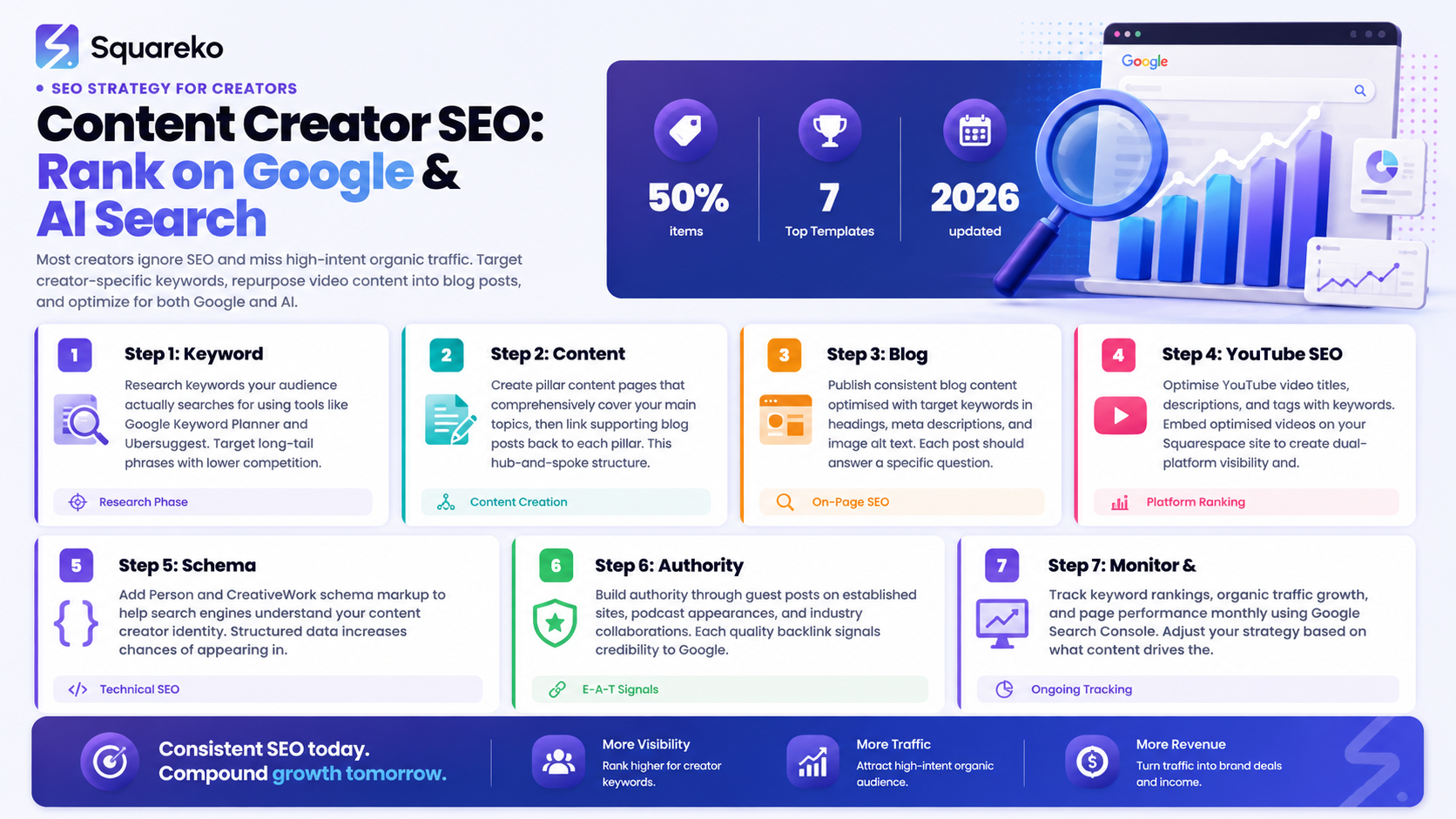
The Creator SEO Shift
Five years ago, creator SEO meant put your name in the description. Today, it's sophisticated, multi-platform, and integrated across Google search, AI systems, and social platforms.
Search algorithms changed significantly in 2024-2026. Google prioritized content from real humans (creators, experts) over corporate SEO farms. AI systems now cite creators as authorities. Publishers like YouTube actively promote creator expertise.
This is good news for creators. If you optimize for SEO properly, you can compete for high-value keywords in your niche.
Why Creators Need SEO
Platform dependency risk: Your YouTube channel could be demonetized. Instagram's algorithm could prioritize Reels over your content. TikTok could be regulated out of existence. SEO traffic is yours to own.
High-intent traffic: Someone searching best YouTube video editor is actively looking for someone to follow. They're pre-sold. High conversion rate.
Authority building: Ranking on Google and being cited by AI systems adds third-party credibility that algorithms can't give you.
Diversified revenue: A creator with 1M YouTube subscribers but no SEO traffic is vulnerable. A creator with 100k YouTube subscribers plus strong organic search has multiple revenue paths.
Long-term compounding: A YouTube video's visibility decays over weeks. A blog post's SEO value compounds over years.
The Creator SEO Opportunity
Most creators ignore SEO. This means less competition. A creator optimizing properly for best podcast about [niche] or "[niche] YouTuber recommendations can dominate search results because 90% of competitors aren't trying.
Keyword Research for Content Creators
Creator-Specific Keywords
Traditional SEO targets keywords like best video editor or YouTube growth tips. Creator SEO targets keywords people use to find specific creators.
Examples:
Best finance YouTubers (audience: people searching for finance creators)
Podcast about entrepreneurship (audience: people looking for entrepreneur-focused podcasts)
TikTok creators who teach fashion styling (audience: people seeking fashion advice creators)
Podcast host interviews on [topic] (audience: niche-specific podcast listeners)
[Your name] YouTube channel (audience: people already interested, looking to find you)
Creators like [similar creator] (audience: fans seeking similar content)
Research Tools
Google Search Console (free):
Shows search queries people use to find your site
Reveals impressions (queries you rank for) vs. clicks (queries that convert)
Shows your average ranking position
Answer the Public (free tier available):
Visualizes questions people ask about your niche
Reveals search patterns and gaps
Semrush or Ahrefs (paid, but worth it):
Competitive keyword research
Volume estimates
Difficulty assessment
Keyword opportunities
Google Trends (free):
Identifies trending topics in your niche
Seasonal patterns
Regional interest
Keyword Categories for Creators
Category 1: Branded keywords
Your Name YouTube
Your Name podcast
Your Name TikTok
Search volume: Medium-high
Conversion: Very high
These are people actively looking for you
Category 2: Creator category keywords
Best productivity YouTubers
Finance podcast recommendations
Fashion TikTok creators to follow
Search volume: Medium
Conversion: High
These are people looking for creators like you
Category 3: Niche expertise keywords
How to film YouTube videos
Podcast microphone under $200
TikTok editing software free
Search volume: High
Conversion: Medium
These position you as an expert, drive traffic, build authority
Category 4: Long-tail comparison keywords
YouTube vs. TikTok for starting creators
Podcast hosting platforms compared
Video editing software for beginners ranked
Search volume: Medium
Conversion: High
These are informational queries where you can showcase expertise
Building Your Target Keyword List
Create a spreadsheet with:
Keyword (the exact search query)
Volume (monthly searches)
Difficulty (how hard to rank 1-10)
Intent (information, navigation, commercial)
Your ranking position (if you're already ranking)
Content plan (blog post, video, podcast episode, etc.)
Target keywords with:
High relevance to your niche
Medium volume (50-1,000 searches/month)
Low-medium difficulty (you can realistically rank)
Strong intent match (searcher wants what you offer)
Blog Content as Your SEO Engine
Why Blogs Matter for Creators
A YouTube video has a shelf life. It trends for days, then decays. A blog post compounds. It can rank for years, driving consistent traffic.
Your blog is where you:
Rank for keywords you can't address in short video/audio content
Provide long-form expertise that impresses both search engines and audiences
Build E-A-T signals (credibility) that AI systems value
Create internal linking opportunities that distribute authority
Capture email subscribers at the end of each post
Repurpose video/podcast content into searchable, indexable text
Blog Content Strategy
Repurposing your existing content:
YouTube to blog: Transcribe your video, expand into a 2,000-word guide, optimize for keywords you rank for in YouTube
Podcast to blog: Transcribe podcast episodes, add timestamps, expand into structured article with sections and subheadings
Social clips to blog: Create longer-form blog posts around the topics you discuss in TikToks/Reels, position as deep dives
Creating new SEO-focused content:
For each target keyword, create a blog post:
Keyword in headline — Include your primary keyword naturally in the H1 title
Semantic keyword coverage — Address related keywords throughout the post (LSI keywords)
Length — 2,000+ words for competitive keywords (shows depth, allows keyword variations)
Structure — H1 title, H2 sections (4-6), H3 subsections. Clear hierarchy helps search engines understand structure.
Internal links — Link to 3-5 other posts on your site (distributes authority, improves SEO)
External links — Link to 2-3 authoritative sources (Google values posts that cite credible sources)
Media — Include images, videos, infographics (multi-media content ranks better)
Publishing Schedule
Consistency matters. Publish 2-4 blog posts monthly for visible organic growth. This is enough to:
Build domain authority over time
Dominate multiple keywords in your niche
Provide fresh content signal to Google
Create sufficient internal linking opportunities
With a 6-month timeline and consistent publishing, you'll see meaningful organic traffic.
Content Repurposing Workflow
Monday: Publish YouTube video or podcast episode Tuesday: Transcribe the content Wednesday-Thursday: Expand transcript into blog post with keyword optimization, internal links, and sections Friday: Publish blog post
This workflow turns one piece of content into two discovery paths: YouTube/podcast + Google search.
YouTube SEO: Ranking in YouTube and Google
YouTube SEO Fundamentals
YouTube is the second-largest search engine after Google. Optimizing for YouTube SEO gets you discovered within YouTube's algorithm and sometimes in Google Search results as well.
YouTube ranking factors (in order of importance):
Watch time — How long people watch your video
Click-through rate — How often your thumbnail/title gets clicked
Engagement — Comments, likes, shares, subscribers gained
Title — Does it match search intent?
Description — Does it include keywords and context?
Tags — Do they reflect video topic?
Transcript — YouTube auto-transcribes, but manual transcripts improve ranking
Closed captions — Improves accessibility and ranking
Optimization Checklist
Title optimization:
Include primary keyword naturally (How to Edit YouTube Videos: Complete Beginner's Guide for the keyword how to edit YouTube videos)
Be specific (The Complete Guide ranks better than Video Editing Tips)
Avoid clickbait (hurts CTR and audience trust)
50-60 characters (longer titles get cut off in search results)
Description optimization:
First 150 characters are visible before Show More — include keyword and value prop here
Include timestamps for long videos (helps YouTube understand structure)
Add links to your blog, website, email signup
Include transcript or chapter marks
2,000+ characters (give YouTube plenty of content to understand)
Tags:
Add 5-10 relevant tags
Include primary keyword + semantic keywords
Use creator tags (tag yourself as the content creator)
Playlist organization:
Organize videos by topic into playlists
Helps YouTube understand content category
Keeps viewers on your channel longer
Boosts watch time
Community posts:
Post updates, behind-the-scenes, polls, links
Increases engagement and keeps audience active
Can drive traffic to blog/website
Podcast SEO Strategy
Podcast Discovery Channels
Most listeners find podcasts through:
Apple Podcasts algorithm
Spotify algorithm
Google Search (podcast episodes + recommendations)
Direct search (best podcasts about X)
Creator social media
Word of mouth
Podcasters typically ignore search optimization, focusing only on platform algorithms. Big mistake.
Podcast SEO Implementation
Show title optimization:
Include niche keyword where possible (The Marketing Momentum Podcast instead of Momentum)
Be specific about what you cover
Avoid numbers or dates that need updating
Episode title optimization:
Include guest name or main topic
Use searchable keywords
Be compelling (title drives subscription)
Examples: How to Build a Sustainable Podcast with [Guest Name] vs. Episode 47
Show description:
Include 2-3 sentences about show topic, frequency, host background
Natural keyword inclusion
Links to your website
Episode descriptions:
Include full transcript or summary
Timestamps for key topics
Guest name and credentials
Links to resources mentioned
Call-to-action to your website or email list
Podcast hosting platform:
Use RSS feeds that Google can crawl (Buzzsprout, Podbean, Transistor all work)
Ensure your podcast is submitted to Google Podcasts
Submit to Apple, Spotify, YouTube Music, etc.
Blog posts from episodes:
Transcribe each episode
Create blog post with episode title as H1
Add structured content with sections, bullet points, quotes
Embed podcast player in post
Add transcript
This makes each episode discoverable in Google Search, not just podcast platforms.
Schema Markup for Creator Authority
What Schema Markup Does
Schema markup is structured data that tells search engines what your content is about. It powers rich snippets, knowledge panels, and AI recommendations.
For creators, the most important schema types are:
Person schema (for you):
{
  "@context": "https://schema.org",
  "@type": "Person",
  "name": "Your Name",
  "url": "https://yoursite.com",
  "sameAs": ["https://youtube.com/...", "https://instagram.com/...", "https://twitter.com/..."],
  "jobTitle": "Content Creator",
  "worksFor": {
    "@type": "Organization",
    "name": "Your Brand"
  }
}
CreativeWork schema (for your content):
{
  "@context": "https://schema.org",
  "@type": "CreativeWork",
  "author": {
    "@type": "Person",
    "name": "Your Name"
  },
  "name": "Video/Podcast Title",
  "url": "https://yoursite.com/content",
  "datePublished": "2026-03-01"
}
Article schema (for blog posts):
{
  "@context": "https://schema.org",
  "@type": "Article",
  "headline": "Your Blog Post Title",
  "author": {
    "@type": "Person",
    "name": "Your Name"
  },
  "datePublished": "2026-03-01",
  "image": "featured-image.jpg",
  "articleBody": "Your full article text..."
}
Adding Schema to Squarespace
Squarespace has built-in schema support. Go to Settings > SEO > Custom Meta Tags and add schema markup to your website pages. Google Search Console will validate the markup.
AI Search Optimization for Creators
The AI Search Opportunity
When someone asks ChatGPT Who's the best YouTube creator about personal finance? or Claude Find me podcasts about mental health, AI systems search the web for authoritative sources.
Content with strong SEO signals (high Google rankings, backlinks, E-A-T indicators) gets cited more frequently in AI results.
AI Search Content Strategy
Create authority content around creator queries:
Best finance YouTubers in 2026
Top podcasters discussing mental health
TikTok creators revolutionizing [industry]
Most influential Instagram creators in [niche]
AI systems will cite this content when answering related questions.
Include creator credentials and metrics:
Subscriber counts
Audience demographics
Content categories
Past brand partnerships
Testimonials from brand partners
AI uses these as citation signals.
Create comprehensive guides:
Long-form content (3,000+ words) with multiple sections
Extensive research and citations
Visual elements (tables, lists, comparisons)
Update regularly with fresh data
Building Niche Authority
E-A-T Signals in Creator Context
Google's E-A-T framework (Expertise, Authoritativeness, Trustworthiness) applies to creators:
Expertise:
Demonstrate deep knowledge of your niche through content
Cover advanced topics (not just beginner stuff)
Reference original research or unique insights
Build progressively complex content
Authoritativeness:
Get backlinks from credible publications
Be quoted or cited by industry experts
Build a strong personal brand
Show credentials and experience
Trustworthiness:
Use your real name and photo
Include author bio on every post
Be transparent about partnerships/sponsorships
Keep content current and accurate
Building Creator E-A-T
Create signature content — Develop a unique perspective or framework that's distinctly yours (not just rehashed hot takes)
Go deep on topics — Cover advanced applications, not just basics
Build credibility markers — Include credentials, years of experience, specific achievements
Get external validation — Seek backlinks from publications in your niche, guest post on authoritative sites, speak at industry events
Update and maintain — Keep content current (Google values fresh, maintained content)
Show your face — Include professional photos and bios (humans rank better than anonymous accounts)
AI Ranking Strategy for Creator Websites
Implementation Checklist
Add Person + CreativeWork schema with creator specialty and platform links
Create comprehensive creator guides with visual comparisons and case studies
Include real-world examples showing your expertise (before/after, portfolio pieces, client results)
Write content answering Who are the best creators in [niche]? and cite yourself appropriately
Build FAQ sections addressing creator-specific questions (6+ questions minimum)
Create downloadable resources (creator guides, templates, checklists) that AI systems index
Document your niche authority (expertise, years in industry, portfolio)
Build pillar content (2,500-4,000 word guides) that becomes citation source for narrower posts
Develop creator case studies showing measurable results, revenue growth, audience growth
Frequently Asked Questions
-
Blog posts typically take 2-6 months to rank for competitive keywords, 2-4 weeks for long-tail keywords. Your homepage may rank for branded searches within weeks. Consistency matters—publish regularly over 6+ months to see meaningful organic traffic. YouTube videos can rank faster (days to weeks) depending on keyword difficulty.
-
Do both. YouTube is your primary content platform. Blog posts repurpose that content and make it discoverable in Google Search. Together, they give you two discovery channels. Most successful creators publish video content first, then repurpose into blog posts within 2-3 days.
-
Free tools are sufficient to start: Google Search Console (track keywords and clicks), Google Analytics (track traffic), Answer the Public (find questions people ask). Paid tools like Semrush or Ahrefs ($100-200/month) add competitive intelligence and keyword research. Start free, upgrade as you grow.
-
Yes, if you optimize properly. Submit to Google Podcasts, transcribe episodes into blog posts, optimize descriptions with keywords, and structure content clearly. Podcast episodes rank better in Google than podcast platforms alone.
-
These aren't mutually exclusive. Create content you love, then optimize it for search. A video you're passionate about will be your best content anyway. Optimization (keywords, titles, descriptions) doesn't change the content quality—it just makes it more discoverable.
-
Yes. Social media is platform-dependent and algorithm-sensitive. SEO traffic is owned, long-term, and compounds. A creator with consistent SEO traffic has income stability that platform-dependent creators lack. Both matter, but SEO builds equity.
-
2-4 posts monthly shows consistent signal to search engines. Less than 1/month is too slow for meaningful growth. More than 4/month (if sacrificing quality) is counterproductive. Find the rhythm you can sustain long-term.
-
Track these metrics: organic traffic (Google Analytics), keyword rankings (Search Console), traffic growth month-over-month, time-on-page (engagement), and click-through rate from search results. Set goals (e.g., "1,000 organic monthly visitors in 6 months") and measure progress quarterly.
Your SEO Advantage Starts Now
Most creators ignore SEO. They focus exclusively on platform algorithms and miss the compounding traffic that search engines provide.This is actually good news for you. It means less competition and faster results if you optimize properly.
Start with keyword research. Identify 5-10 keywords you can realistically target. Write 2-4 blog posts monthly, repurposing your best video/podcast content. Build schema markup. Be consistent.
Six months of consistent SEO effort will position you as discoverable on Google and AI systems. That's a competitive advantage most creators will never build.

From custom website design to SEO strategy, we help businesses launch a site that looks professional and performs better.

About the Author
I'm Walid Hasan, a Certified Squarespace Expert and Squarespace Circle Platinum Partner with over 12 years of hands-on experience designing and optimizing high-performing websites. Over the years, I've had the privilege of building more than 2,000 Squarespace websites for clients around the world, always focusing on clean design, strong user experience, and conversion-driven results.