Attorney Practice Area Pages: Squarespace Conversion Guide
Introduction
Your law firm's practice area pages are where potential clients decide whether to hire you. They land here with a specific legal problem, and they need to know immediately whether you can solve it. Yet many attorney websites treat practice area pages as afterthoughts—generic overviews of services with little connection to actual client pain points or conversion paths.
The reality is this: practice area pages are among the highest-intent pages on your site. Someone searching for family law solicitor in Manchester or personal injury claims near Bristol is already considering legal help. They're evaluating your expertise, your approach, and your credibility. A well-written practice area page doesn't just explain what you do; it builds confidence, addresses common concerns, and moves prospects toward booking a consultation.
In this guide, we'll walk through the LASS Framework—a proven structure that transforms practice area pages into conversion machines. We'll cover copywriting techniques, Squarespace implementation, SEO best practices, and bar association compliance considerations for UK law firms. Whether you're a solo practitioner with five practice areas or a larger firm refining existing pages, this framework works.
Key Takeaways Attorney Practice Area Pages: Squarespace Conversion Guide
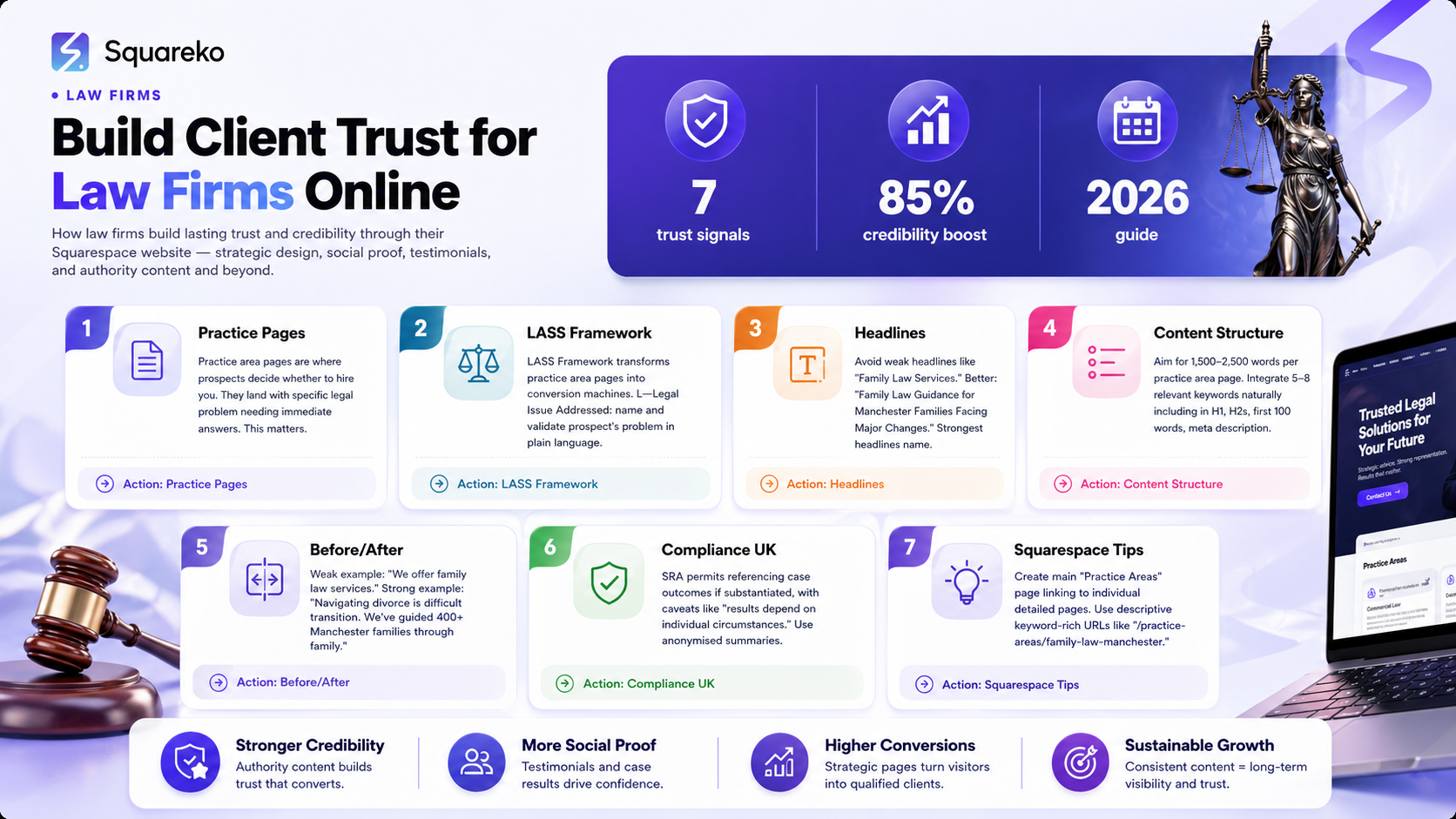
Use the LASS Framework (Legal Issue → Attorney Approach → Success Stories → Simple Next Step) to structure every practice area page for clarity and conversion
Write compelling headlines that address the client's problem directly, not your service name
Integrate long-tail keywords naturally into page sections without sacrificing readability or trust
Include client testimonials or case outcomes (where bar rules allow) to build authority and credibility
Optimise your Squarespace page structure for both search engines and user experience with internal linking and calls-to-action
Ensure all pages comply with Solicitors Regulation Authority (SRA) and Bar Standards Board advertising guidelines
Create a consistent internal linking strategy across practice areas to distribute page authority and keep visitors engaged
Understanding Your Practice Area Page's Role
A practice area page serves three critical functions: education, persuasion, and conversion. A prospect lands on your family law page because they're facing a divorce, custody issue, or mediation need. They've likely already searched dozens of solicitor websites. In those crucial 10–15 seconds, they decide: does this firm understand my situation?
This is where most attorney websites fail. They publish a generic description:
We provide comprehensive family law services including divorce, separation, mediation, and financial settlements. That's information, but it's not persuasion. It doesn't address the prospect's emotional state, their specific concerns, or their likelihood of hiring you over a competitor.
Effective practice area pages do something different. They acknowledge the client's position (A contested custody case is emotionally draining and legally complex), demonstrate your expertise (We've guided over 400 families through family law matters in the North West), and create a clear next step.
The LASS Framework Explained
The LASS Framework is a simple, repeatable structure for writing practice area pages that educate and convert. Each letter represents a section:
L — Legal Issue Addressed
Begin by naming and validating the prospect's problem. Don't assume they know legal terminology or the scope of what's possible. Instead, describe the situation in plain language and explain why they might need a solicitor.
Example openings:
Going through a divorce? You're managing legal paperwork, finances, and emotional upheaval—all at once.
Suffered a serious injury due to someone else's negligence? We help people claim the compensation they're entitled to.
Expanding your business into the EU? Complex regulations and cross-border agreements require expert guidance.
This section validates the visitor's concern and establishes relevance. It typically runs 80–120 words.
A — Attorney Approach
Now explain how you work and what makes your approach distinctive. This is where you build authority without boasting. Describe your methodology, your philosophy, and what clients can expect when they work with your firm.
What makes your approach different? Perhaps you:
Favour mediation over contested court proceedings
Combine legal expertise with business acumen in corporate matters
Prioritise clear communication and regular updates
Offer flexible fee arrangements or fixed-fee services
This section should feel confident but not arrogant. Use specific details about your process rather than generic claims. Run this section 150–200 words.
S — Success Stories
Include evidence of your impact. For UK law firms, this might be client testimonials (with consent), case outcomes, or data points about your expertise (Helped 150+ clients secure personal injury settlements or 10 years' experience in employment law). Be mindful of SRA guidelines on case results and ensure any claims are substantiated.
Testimonials should be brief, specific, and from a real client (or clearly noted as representative). A paragraph like this works well:
After my redundancy, I felt out of my depth with the legal process. Sarah walked me through every step and explained my rights clearly. I secured a settlement I wasn't initially offered. Highly recommended. — Mark T., Manchester
This section runs 100–150 words and significantly boosts conversion rates.
S — Simple Next Step
End with a single, clear call-to-action. Don't overwhelm the prospect with multiple options. Offer one primary action: book a consultation, call your office, request a callback, or download a guide. Make it frictionless and prominent.
Example CTAs:
Book a free 30-minute consultation: [button]
Call us on 0161 234 5678 to discuss your case
Ready to discuss your options? Email us or use our contact form below.
This section should be 20–40 words and visually distinct on the page.
Writing Headlines That Convert
Your H1 and subsequent headlines are critical. They're scanned before body text is read, and they're key SEO signals.
H1 Best Practices
Avoid: Family Law Services Better: Family Law Guidance for Manchester Families Facing Major Changes Even Better: Navigating Divorce, Custody, and Separation with Experienced Manchester Family Solicitors
The stronger headline:
Names the problem or benefit clearly
Includes location for local SEO
Uses natural language, not jargon
Answers the question Why should I hire you? implicitly
Subheading Strategy
Use H2s to break up content and guide the reader through your LASS structure:
H2: Your Family Law Issue, Explained
H2: Our Approach to Family Law Matters
H2: How We've Helped Manchester Families
H2: Next Steps: Schedule Your Consultation
Each H2 becomes a natural stopping point and gives readers multiple entry points into your content.
Structuring Content for SEO and Conversions
SEO and conversions aren't opposing forces; they reinforce each other. Here's how to structure a practice area page for both:
Keyword Integration
Identify 5–8 relevant keywords for each practice area. For family law, these might be:
Family law solicitor Manchester
Divorce solicitor near me
Mediation services family disputes
Child custody solicitor Manchester
Naturally integrate these into your page without keyword stuffing. Include keywords in:
H1 and H2 headlines (primary keyword in H1)
First 100 words of the introduction
Meta description and page title
Image alt text
Internal link anchor text
Avoid forcing keywords where they disrupt readability. Search engines now penalise keyword density; focus on helpfulness instead.
Word Count and Depth
Aim for 1,500–2,500 words per practice area page. This length allows you to cover the topic thoroughly, address multiple keyword variations, and provide genuine value. Shorter pages (300–500 words) rarely rank well or convert effectively.
Internal Linking
Link strategically to related pages:
From a practice area page to relevant blog posts
From practice area pages to your contact page or consultation booking system
Between practice area pages
From your homepage or services page to practice area pages
This internal linking distributes authority, keeps visitors on your site longer, and signals to Google that your content is interconnected and thorough.
Page Structure on Squarespace
On Squarespace, structure your practice area pages like this:
H1 headline (auto-generated from page title)
Brief introduction (80–120 words)
Key Takeaways section (bulleted list)
LASS Framework sections with H2s
Related practice areas or services (as a list or linked section)
Testimonial or case outcome section
Clear CTA (button or form)
FAQ section (structured for schema)
Author bio and metadata
This structure is scannable, mobile-friendly, and guides prospects toward conversion.
Before and After Examples: Three Practice Areas
Example 1: Family Law
Before (Weak): We offer family law services including divorce, separation, and mediation. Our solicitors are experienced in all aspects of family law.
After (Strong): Navigating a divorce or separation is one of life's most difficult transitions. At [Firm Name], we've guided over 400 Manchester families through family law matters—from contested divorces to amicable separations. We combine expert legal knowledge with empathy, offering mediation-first approaches where possible to reduce conflict and costs. Our clients appreciate our clear communication and proactive support. Whether you need help negotiating financial settlements or child arrangements, we're here to help you move forward. Book a free 30-minute consultation to discuss your situation.
Improvement: Acknowledges emotion, includes numbers, explains methodology, and offers a specific CTA.
Example 2: Personal Injury
Before (Weak): We handle personal injury claims. We work on a no-win, no-fee basis and have recovered millions in claims.
After (Strong): A serious injury can derail your life—medical bills pile up, work becomes impossible, and stress mounts. We help injured people claim the compensation they're entitled to from negligent parties. With 15 years' experience and over £3.5 million in successful settlements, we understand what personal injury claims involve. We work on a no-win, no-fee basis, so you pay nothing if we don't succeed. Our clients consistently tell us they appreciate our straightforward advice and regular updates throughout their claim. If you've been injured due to someone else's negligence, get in touch. We'll review your claim at no cost and advise on your options.
Improvement: Addresses emotional impact, includes credibility markers, explains the process, and removes fear of upfront costs.
Example 3: Corporate/Commercial Law
Before (Weak): Our corporate team advises on mergers, acquisitions, contracts, and commercial matters. We have extensive experience.
After (Strong): Growing your business means navigating complex legal terrain—employment contracts, intellectual property, regulatory compliance, and more. Our corporate law team advises businesses at every stage, from startup to multi-million-pound acquisition. We combine deep commercial knowledge with practical advice. Rather than legal jargon, we explain your options in plain language and help you make confident decisions. Recent clients include tech startups, manufacturing firms, and professional services companies across the North West. Whether you're entering a partnership, negotiating a supplier contract, or exploring acquisition opportunities, we're here to protect your interests and accelerate growth. Get in touch for a confidential business consultation.
Improvement: Shows understanding of business priorities, names specific industries, emphasises practical advice, and invites conversation.
Compliance Considerations for UK Law Firms
The Solicitors Regulation Authority (SRA) and Bar Standards Board have clear rules about legal marketing. Ensure your practice area pages comply:
Advertising Case Results
You may reference case outcomes or settlement amounts, but:
Claims must be substantiated with evidence
Include appropriate caveats
Don't imply you'll achieve similar results for every client
Avoid typical or average claims without strong data
Better approach: Our clients often achieve settlements between £15,000–£50,000 in injury claims, depending on liability, injury type, and other factors. Your outcome will depend on your specific circumstances.
Client Testimonials
Testimonials are powerful but must be genuine:
Obtain written consent before publishing
Use real clients (or clearly mark testimonials as representative)
Avoid fabricated quotes or stock photos
Include the client's name, location, and relevant details (within privacy limits)
Claims of Experience
Avoid absolute claims like best family law solicitor in the UK or guaranteed results. Instead, use:
Specific data: 15 years' experience in family law
Client outcomes: Helped 400+ families
Recognised credentials: Law Society Accreditation in Family Law
Squarespace Implementation Tips
Setting Up Practice Area Pages
Page Structure: Create a main Practice Areas page with links to individual practice area pages. This improves navigation and internal linking.
URL Slugs: Use descriptive, keyword-rich URLs:
Good: /practice-areas/family-law-manchester
Avoid: /services/item-3 or /pa1
Meta Tags: Squarespace allows custom meta titles and descriptions. Use them—include your primary keyword and a compelling call-to-action.
Image Optimisation: Use high-quality images (professional photos, not stock clichés) and add descriptive alt text including relevant keywords.
Button CTAs: Make your call-to-action button highly visible. Use your brand colour (or a contrasting colour) and clear text like Book Consultation or Contact Us Today.
Mobile Optimisation: Squarespace is mobile-responsive, but test your pages on phones. Ensure buttons are easily tappable and text is scannable.
Internal Linking Blocks: Use Squarespace's summary blocks to link to related practice area pages or blog posts. This keeps visitors engaged and improves SEO.
Suggested Squarespace Template Approach
Use Squarespace's Brine or Seventh template, which offer clean, professional designs suited to law firms. Customise colours to match your brand (the navy blue #1B5E8A works well for legal websites). Ensure font sizes are readable (minimum 16px for body text) and headings are distinct.
Frequently Asked Questions
-
Aim for 1,500–2,500 words per page. This length allows you to address the core topic thoroughly, incorporate keyword variations naturally, and demonstrate expertise to both users and search engines. Shorter pages (under 800 words) rarely rank competitively or convert well because they lack depth. However, length alone doesn't drive rankings—quality, clarity, and relevance matter most. A 1,800-word page packed with irrelevant filler will underperform a tightly written 1,200-word page that directly addresses user intent. Focus on providing genuine value rather than padding with fluff.
-
Yes, but carefully. Case results and client outcomes are powerful conversion drivers—they demonstrate your track record and build confidence. However, you must comply with SRA and Bar Standards Board guidelines. Always include appropriate caveats: "Results depend on individual circumstances, liability, and other factors. This is not a guarantee of future results." Avoid implying you'll achieve similar outcomes for every client. Use data where possible: "Recovered £2.3 million in personal injury settlements over the past five years" is stronger than "Won a £500,000 case." Testimonials (with client consent) complement case results and often resonate more emotionally with prospects.
-
For each practice area, target a mix of keywords: the primary keyword (your focus term), secondary keywords (variations), and long-tail keywords (specific, high-intent phrases). For example, a family law page might target "family law solicitor Manchester" (primary), "divorce solicitor" and "mediation services" (secondary), and "contested custody case Manchester" or "collaborative divorce approach" (long-tail). Use keyword research tools like Ahrefs, SEMrush, or free tools like Google Keyword Planner to identify search volume and competition. Include keywords naturally in headlines, the first 100 words, and throughout the page without forcing them. Internal linking with keyword-rich anchor text (e.g., "learn more about our mediation services") also helps. Avoid keyword stuffing—Google penalises it, and it damages readability.
-
Recognise that visitors arrive at practice area pages with different intentions: some are educating themselves, others are ready to hire. Use the LASS Framework to address both. The "Legal Issue" section educates and validates concerns. The "Attorney Approach" section builds credibility. The "Success Stories" section convinces. The "Simple Next Step" section converts. You might also create a separate "FAQ" section addressing common concerns (costs, timelines, process steps). This layered approach allows someone early in their decision journey to find educational content, while someone ready to hire finds a clear path to consultation or engagement.
-
Absolutely. For UK law firms, local SEO is critical. Include your location in page titles, headings, and body text naturally. For example: "Family Law Solicitor in Manchester and Surrounding Areas." Add your address to your Squarespace footer on every page (search engines use this for local signals). Create individual practice area pages for each major location if you serve multiple towns. Use Google Business Profile (formerly Google My Business) to reinforce your location and services. Local citations (mentions of your firm name, address, and phone number on other websites) also boost local rankings. When a prospect searches "family law solicitor near me," they expect location-specific results—make sure you're visible.
-
Create a main "Practice Areas" or "Services" page that links to individual pages for each practice area. Each practice area page should be comprehensive (1,500–2,500 words) and include internal links to related areas. For example, your family law page might link to your mediation services page, and your employment law page might reference discrimination law. This structure improves user experience, keeps visitors on your site longer, and distributes page authority. On your main services page, use summary blocks or a simple list to showcase all practice areas—keep this as an entry point, not a deep-dive page. Squarespace's navigation menu should feature a "Practice Areas" link with sub-items; this helps both users and search engines understand your site structure.
-
Use professional language without jargon. Explain legal concepts clearly—if you must use a technical term, define it. For example: "We'll handle the mergers and acquisitions (M&A) process, managing due diligence, regulatory approval, and contract negotiation." Use the second person ("you") to create connection: "When you're facing a redundancy claim, you need a solicitor who understands employment law inside out." Include client testimonials in plain language—prospects relate to peers' experiences more than corporate speak. Show personality without undermining credibility. A phrase like "This process can feel overwhelming, and that's normal" is warm without being unprofessional. Use short paragraphs, bullet points, and clear headings to improve readability. Test your tone with a trusted colleague or client—does it feel accessible and authoritative?
Ready to Build Your Law Firm Website on Squarespace?
Your practice area pages are often the difference between a prospect choosing you or a competitor. They're where expertise meets clarity, and where potential clients decide whether to take the next step.
The LASS Framework gives you a proven structure: validate the client's legal issue, explain your distinctive approach, share evidence of your success, and guide them toward a simple next step. Combined with thoughtful SEO, compliance-conscious claims, and Squarespace's clean design, this framework transforms practice area pages into conversion tools.
If you're rebuilding your law firm website or refining existing practice area pages, the principles here apply regardless of your practice area or firm size. Whether you specialise in family law, personal injury, employment, corporate, or conveyancing, the framework works.
Not sure where to start? Squareko specialises in Squarespace web design for legal professionals. Our team understands the unique needs of solicitors and barristers—from compliant client testimonials to internal linking strategies that boost SEO and conversions. We've helped dozens of UK law firms build websites that don't just look professional; they convert prospects into clients.

From custom website design to SEO strategy, we help businesses launch a site that looks professional and performs better.

Author Bio
I'm Walid Hasan, a Certified Squarespace Expert and Squarespace Circle Platinum Partner with over 12 years of hands-on experience designing and optimizing high-performing websites. Over the years, I've had the privilege of building more than 2,000 Squarespace websites for clients around the world, always focusing on clean design, strong user experience, and conversion-driven results.