AI Search Strategy for Therapists on Squarespace: Get Found in 2026
Introduction
Something fundamental has shifted. In 2024, someone searching for "therapist anxiety London" would click through a Google results page, perhaps scanning a few websites before deciding who to contact. In 2026, that same person might ask ChatGPT: "I need a therapist in London who specialises in anxiety. Who would you recommend?" And ChatGPT might respond with three specific therapists—including you, or not.
This is the new search landscape: AI search engines (ChatGPT, Google AI Overviews, Perplexity, Gemini, Claude) are answering questions directly, often including specific business recommendations. Traditional SEO optimisation—keywords, links, page speed—still matters, but it's no longer the complete picture. You need an AI search strategy.
For therapists, getting recommended by AI search engines is critical. If you're not showing up in AI recommendations, potential clients won't find you, no matter how well-optimised your traditional SEO is. This guide walks you through everything you need to know about getting recommended by AI search engines and implementing it on your Squarespace website.
Key Takeaways
AI search is different from traditional Google search; AI engines prioritise clarity, structure, citations, and direct answers
To get recommended by AI search, you need clear entity definition (who you are, what you specialise in, where you're based)
Structured content (FAQs, how-to guides, schema markup) helps AI engines understand and recommend you
GEO (Generative Engine Optimisation) focuses on answering the specific questions AI engines are asked
AEO (Answer Engine Optimisation) means structuring your content to provide direct answers, not just informational content
Local intent content (therapist in London, CBT for anxiety) is weighted heavily by AI engines
Squarespace schema markup, structured FAQs, and clear local business information are essential for AI visibility
You need presence on professional verification sites (BACP, UKCP, BPS directories) to build AI credibility
Understanding AI Search vs. Traditional SEO
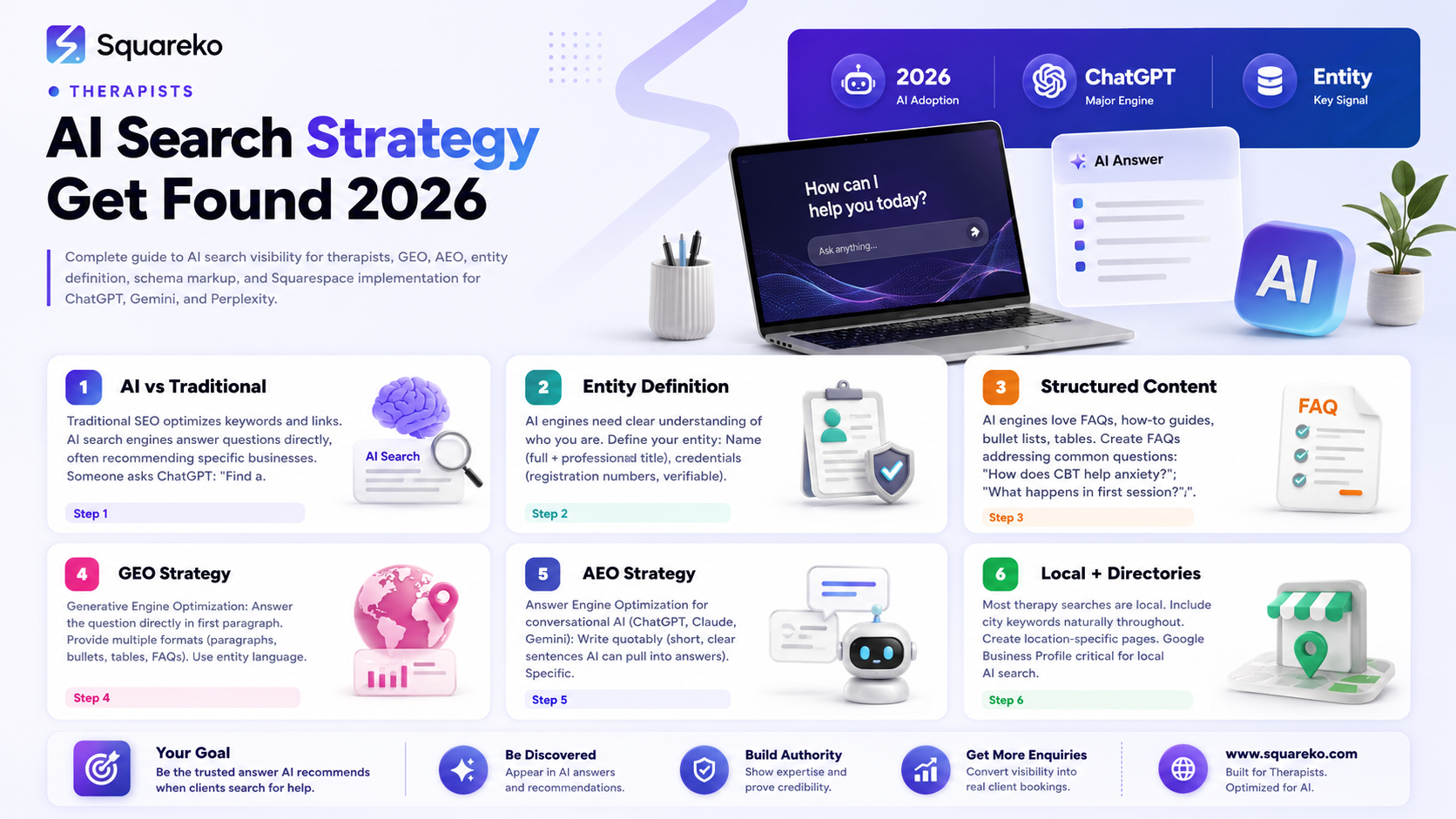
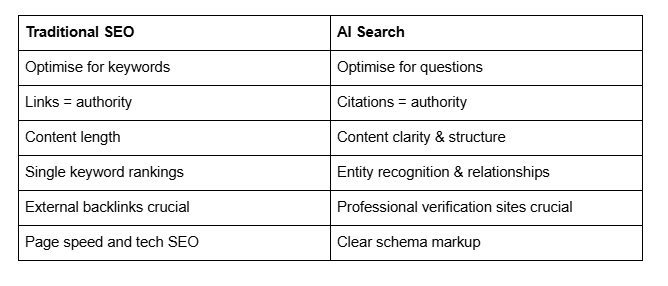
Traditional Google SEO focuses on keywords, links, page authority, and content length. You optimise for the Google algorithm, which ranks pages based on relevance, authority, and user experience.
AI search is different. AI search engines are answering questions, not matching keywords. When someone asks ChatGPT "What's the best approach to therapy for social anxiety?" they're not looking for a ranked list of websites—they're looking for an answer. ChatGPT reads multiple sources, synthesises information, and provides a single answer. That answer might include citations or recommendations to specific therapists or websites.
For therapists, this shift is significant. A therapy-seeker asking ChatGPT "Find me a therapist who specialises in EMDR in Manchester" isn't searching a results page—they're getting a conversational recommendation. If your Squarespace website is structured correctly with clear entity definition and schema markup, you're more likely to be included in that recommendation.
How AI Search Engines Work
Understanding how AI search engines evaluate your website helps you optimise it correctly.
Step 1: Crawling and Indexing
Like Google, AI search engines crawl your website and other sources (professional directories, reviews, news) to understand who you are and what you do. This is where clear entity definition matters.
Step 2: Entity Recognition
AI engines identify entities—that you're a therapist, your location (London), your specialisations (anxiety, CBT, EMDR), your credentials (BACP registered). This happens through:
Your website content (About page, service descriptions, FAQs)
Professional body registries (BACP, UKCP, BPS directories)
Structured data (schema markup on your website)
External citations (mention in directories, reviews, news)
Step 3: Relationship Building
AI engines build relationships between entities. They recognise: "Jane Smith is a therapist in London, trained in CBT, registered with BACP, specialises in anxiety, has positive reviews, is cited by multiple professional sources." These relationships inform recommendations.
Step 4: Query Matching and Recommendation
When someone asks ChatGPT "Find a CBT therapist in London for anxiety," the engine recalls entities matching those criteria and recommends based on:
Authority (professional credentials, citations from trusted sources)
Specificity (does your website clearly state you do CBT? That you're in London?)
Recency (is your information current?)
Verification (are you registered with professional bodies?)
Step 5: Citation and Attribution
AI engines often include citations when recommending, linking to your website or professional directory. This drives traffic and builds trust.
Understanding this flow shows why traditional keyword optimisation isn't enough. You need entity clarity, structural definition, and professional verification.
Entity Definition and Your AI Profile
Your "entity" is how AI engines understand and identify you. A clear, well-defined entity is more likely to be recommended.
Components of a strong therapy entity:
1. Name and Credentials
Full name, professional title (e.g., "Jane Smith, BACP Registered Counsellor")
Credentials and certification numbers
Professional memberships visible and verifiable
2. Geographic Location
Primary office location (city, region)
Service area (e.g., "Serving London and the Home Counties," or "Online therapy worldwide")
Timezone (if online-only)
3. Specialisations and Modalities
Specific therapy approaches (CBT, humanistic, psychodynamic, EMDR)
Client populations (adults, couples, specific age groups)
Problem areas (anxiety, depression, trauma, relationships, grief)
4. Credentials and Verification
Professional body registration (BACP, UKCP, BPS, etc.) with registration number
Educational background
Additional training or certifications
Insurance status (if applicable)
5. Contact and Availability
Phone number
Email
Office address or "Online only"
Session types offered
Availability (Monday-Friday, evenings, etc.)
How to strengthen your AI entity on Squarespace:
Create a clear "About You" page with:
Your full name and professional title
Your location clearly stated
Your credentials with registration numbers
Your therapeutic approach in plain language
Your specialisations (specific, not vague)
Use schema markup (LocalBusiness, Psychologist, FAQPage)
Squarespace allows you to add code in the code injection area
Structured data helps AI engines understand your entity
List yourself in professional directories
BACP Find a Therapist
UKCP Therapist Finder
BPS Psychologist Finder
Therapist directories (iTherapy, TherapyWorks, etc.)
Google Business Profile (free local listing)
Keep information consistent across all platforms
Your name, location, credentials should match everywhere
Inconsistency confuses AI engines
Add rich contact information
Phone number (callable from your website)
Email (monitored and responsive)
Office address (if location-based) or "Online" (if remote)
AI engines recognise well-defined entities. Ambiguity—"I help people," vague location, hidden credentials—weakens your entity and reduces recommendation likelihood.
Structured Content for AI Visibility
Structured content means content that's organised in a way AI engines can easily parse and understand. This includes:
FAQs (Frequently Asked Questions)
AI engines love FAQs. They're questions and direct answers, exactly what AI search engines look for. A strong FAQ section on your Squarespace site helps AI engines understand:
What clients ask about therapy
What your answers reveal about your expertise
Your therapeutic philosophy
Example FAQ for a CBT therapist:
Q: How does CBT help with anxiety? A: CBT helps you identify thoughts and beliefs that fuel anxiety, then gradually confront anxious situations to reduce their power over you. Most people see significant improvement within 8-12 weeks.
This FAQ directly answers a question an AI engine might be asked. It demonstrates expertise and provides specificity.
Include FAQs for:
"What is [your specialisation]?"
"How does [your modality] work?"
"Who can benefit from your services?"
"What happens in a first session?"
"Are you registered with [professional body]?"
"Do you accept insurance?"
"Can I cancel my appointment?"
"How long does therapy usually take?"
How-To Guides and Educational Content
AI engines also recognise how-to content. A guide like "How to Find the Right Therapist for Social Anxiety" (on your blog) signals expertise and helps AI engines understand your knowledge area.
Service Descriptions
Don't just say "I offer CBT." Explain:
What CBT is (in plain language)
Who it helps best
What to expect
How many sessions are typical
What outcomes are realistic
Clear descriptions help AI engines categorise and recommend you.
Case Studies and Outcomes (Anonymised)
If you share anonymised case examples ("Client presenting with work anxiety improved by 70% within 6 weeks of twice-weekly CBT"), AI engines recognise this as outcome-based content and weight it highly.
Testimonials and Reviews
Structured, BACP-compliant testimonials (anonymised, focused on therapeutic relationship) help AI engines build credibility signals.
GEO: Generative Engine Optimisation
Generative Engine Optimisation (GEO) is optimising your content to appear in AI-generated answers. It's different from traditional SEO.
GEO Principles:
1. Answer the Question Directly
If the question is "What's the best therapy for panic disorder?", your first paragraph should answer:
"Cognitive Behavioural Therapy (CBT) is the gold-standard treatment for panic disorder, with research showing 60-80% of people experience significant improvement. The approach focuses on understanding the panic cycle and gradually confronting feared situations."
Not: "Panic disorder is a serious mental health condition affecting millions..."
2. Provide Multiple Answer Formats
AI engines like content in different formats:
Text paragraphs (traditional)
Bulleted lists (structured)
Tables (comparative)
FAQs (Q&A)
A single article with paragraphs, bullet points, and FAQs is more likely to be cited by AI than the same content in paragraph form alone.
3. Use Entity Language
Don't say "We help with stress." Say "I specialise in anxiety disorders, including generalised anxiety disorder, social anxiety, panic disorder, and health anxiety."
Entity language—specific conditions, modalities, populations—is what AI engines are trained to recognise.
4. Include Authoritative Citations
If you mention research, cite it: "Research published in JAMA Psychiatry shows CBT reduces anxiety symptoms in 75% of clients." AI engines value cited claims.
5. Clear Headings and Structure
Your H1, H2, and H3 headings tell AI engines what your content is about.
Example GEO-optimised content:
# How CBT Helps Social Anxiety
Cognitive Behavioural Therapy (CBT) is an evidence-based treatment for social anxiety, with efficacy rates of 60-70% in clinical trials.
## How CBT Works for Social Anxiety
1. **Identifying anxious thoughts** — Recognising automatic negative predictions (e.g., "Everyone will judge me")
2. **Testing predictions** — Gradually confronting social situations to test whether fears come true
3. **Building new beliefs** — Over time, your brain builds evidence that social situations are less threatening
## Timeline for Improvement
Most people experience noticeable improvements within 6-8 weeks of twice-weekly sessions.
## FAQ
**Q: How many sessions of CBT for social anxiety?**
A: Typically 12-20 sessions over 6-12 weeks, depending on severity.
This format directly answers the question, provides structure, and uses entity language. AI engines are more likely to cite it.
AEO: Answer Engine Optimisation
Answer Engine Optimisation (AEO) is similar to GEO but focuses specifically on how conversational AI engines (ChatGPT, Claude, Gemini) retrieve and use your content.
AEO best practices:
1. Be Quotable
Write in a way that's quote-friendly. Short, clear sentences that AI engines can pull directly into answers.
Rather than: "One might posit that the cognitive-behavioural paradigm addresses underlying belief systems which precipitate affective dysregulation."
Use: "CBT helps you identify beliefs that fuel anxiety, then gradually confront anxious situations."
The second version is what AI engines will quote. Make your best content quotable.
2. Provide Specific, Actionable Information
AI engines prefer concrete advice over abstract discussion.
Rather than: "Therapy can be helpful for many people with various conditions."
Use: "If you experience panic attacks, starting with CBT typically involves learning to recognise panic symptoms, understanding the panic cycle, and gradually confronting situations you've been avoiding."
3. Create Long-Form Content with Clear Sections
Conversational AI engines do better with comprehensive articles than with short snippets. A 2,000-word article on "What Is CBT and How Does It Help Anxiety?" will be cited more readily than scattered paragraphs across multiple pages.
4. Use Natural Language
Write how real people talk, not how algorithms think.
Rather than: "Therapeutic modality: CBT. Application: anxiety disorders. Mechanism: cognitive restructuring."
Use: "I use CBT to help clients with anxiety. We work together to identify thought patterns that keep them stuck and develop new, more helpful ways of thinking."
5. Include Your Unique Perspective
AI engines cite sources that add genuine insight. If you share your specific experience—"In my 15 years of practice, I've noticed that clients with social anxiety often catastrophise about judgment, even from people who clearly like them"—that's valuable to AI engines.
Local Intent and Geographic Targeting
Most therapy-seekers are searching for local therapists. "Therapist in London" is a local intent query. AI engines recognise and prioritise local results.
How to optimise for local intent:
1. Local Keywords in Your Content
Naturally include your location in:
Your About page ("I'm based in London and see clients in my office in Clapham")
Service descriptions ("I offer online therapy across the UK and in-person sessions in London")
Blog post titles and content ("How Anxiety Manifests Differently in London Professionals")
FAQs ("Do you see clients online, or only in London?")
2. Google Business Profile
Create or claim your Google Business Profile (free). This is crucial for local AI search visibility.
Include:
Accurate address
Phone number
Specialisations
Hours
Website link
Verified photo
Google Business Profiles are indexed by multiple AI engines.
3. Multiple Location Pages
If you see clients in multiple locations, create location-specific pages:
"Therapy in London"
"Therapy in Manchester"
"Online therapy"
Each with location-specific content, contact information, and local references.
4. Mention Your Area Specifically
Rather than "I serve South London," mention specific areas: "I see clients in Clapham, Battersea, Balham, and throughout South London."
AI engines recognise specific place names and match them to local searches.
5. Local Citations and Directories
List yourself in:
BACP Find a Therapist
UKCP Therapist Finder
iTherapy, Therapyworks, other directories
Local business listings
Each citation reinforces your local entity.
Building Authority for AI Recommendations
Authority signals tell AI engines "this therapist is trustworthy and knowledgeable." Build authority through:
1. Professional Credentials and Verification
BACP, UKCP, BPS registration with publicly visible numbers
Links to your professional profile (so AI engines can verify)
Educational background and certifications
Continued Professional Development (CPD) and training
2. Content Authority
Original, thoughtful content on your website
Evidence-based information (cite research)
Unique perspective (your experience, not regurgitated advice)
Consistent voice and expertise over time
If you publish one blog post on anxiety, you're not authoritative. If you publish 20 thoughtful posts on anxiety, CBT, social anxiety, panic, generalised anxiety, etc., you're building authority.
3. External Citations
Mentions in professional publications
Interviews or features in respected outlets
Recommendations from other professionals
Positive reviews on therapy platforms
Links from professional organisations
4. Specialisation Depth
Rather than "I help people with anything," specialise: "I specialise in anxiety disorders and use CBT and mindfulness approaches." AI engines recognise depth of focus as an authority signal.
5. Transparency and Honesty
Clear limits of your practice
Honest about what therapy can and cannot do
Transparent about your credentials and training
Clear confidentiality and privacy policies
Transparency builds trust with both potential clients and AI engines.
Squarespace Implementation for AI Search
Now that you understand AI search strategy, here's how to implement it on Squarespace.
1. Schema Markup
Add schema markup to your Squarespace site (via code injection):
<!-- Please remove the commented script wrapper and add this schema inside a proper <script type="application/ld+json"> tag. -->
  {
  "@context": "https://schema.org",
  "@type": "LocalBusiness",
  "name": "Jane Smith, Psychotherapist",
  "@id": "https://yourwebsite.com",
  "url": "https://yourwebsite.com",
  "telephone": "+44 20 XXXX XXXX",
  "address": {
    "@type": "PostalAddress",
    "streetAddress": "123 High Street",
    "addressLocality": "London",
    "postalCode": "SW1X 1AA",
    "addressCountry": "UK"
  },
  "geo": {
    "@type": "GeoCoordinates",
    "latitude": "51.5074",
    "longitude": "-0.1278"
  },
  "openingHoursSpecification": [
    {
      "@type": "OpeningHoursSpecification",
      "dayOfWeek": "Monday-Friday",
      "opens": "09:00",
      "closes": "18:00"
    }
  ],
  "sameAs": [
    "https://www.bacp.org.uk/profile/yourprofile",
    "https://www.google.com/maps/place/your-business"
  ]
}
This structured data helps AI engines understand your entity.
2. FAQPage Schema
For your FAQ section:
{
  "@context": "https://schema.org",
  "@type": "FAQPage",
  "mainEntity": [
    {
      "@type": "Question",
      "name": "What is CBT?",
      "acceptedAnswer": {
        "@type": "Answer",
        "text": "CBT (Cognitive Behavioural Therapy) is an evidence-based therapy that helps you identify and change thought patterns and behaviours that fuel emotional distress. It's particularly effective for anxiety, depression, and panic."
      }
    }
  ]
}
3. Clear Navigation and Structure
Ensure your site structure makes entity information clear:
Homepage — Your main entity (name, credentials, specialisation)
About page — Detailed entity information (biography, credentials, approach)
Services page — Specialisations and modalities
Blog — Authoritative content on your specialisations
Contact page — Phone, email, office address, availability
4. Professional Body Links
Link to your professional profiles:
"I'm registered with BACP: [link to your profile]"
"You can verify my credentials here: [link]"
This builds authority and helps AI engines verify your entity.
5. Google Business Profile
Claim and optimise your Google Business Profile. This appears in AI search results and helps Google, Bing, and other engines recognise your local presence.
6. Mobile Optimisation
Ensure your Squarespace site is mobile-friendly. Many AI search users are on mobile devices.
7. Content Strategy
Focus on:
Long-form educational content (1,500+ words) on your specialisations
FAQ sections addressing common questions
Local content ("Therapist in London," location-specific articles)
Entity-specific language (specific modalities, conditions, populations)
Mid-Post CTA
Is your Squarespace website optimised for AI search?
Most therapy websites are still built for traditional Google search. They focus on keywords and links, but miss the mark on entity clarity, structured content, and AI visibility. The result: potential clients find you through Google, but not through ChatGPT, Gemini, or Perplexity—and increasingly, that's where people are searching.
If you're ready to get your Squarespace website positioned for 2026's AI search landscape, Squareko specialises in exactly this. We configure your site for AI visibility through:
Clear entity definition and schema markup
Structured content and FAQ optimisation
Local intent and geographic targeting
Professional verification and authority building
Content strategy for AI engines
Whether you're starting a new site or optimising an existing one, we ensure your Squarespace website shows up when potential clients ask AI engines for recommendations.
Frequently Asked Questions
-
Traditional Google search ranks pages based on keywords and links. AI search answers questions directly, often recommending specific businesses or individuals. For therapists, this means optimising for clarity, entity definition, and structured content rather than keyword density. A well-structured FAQ or service description matters more to AI engines than keyword optimisation.
-
ChatGPT and other AI engines use your public website content. To be recommended by ChatGPT, ensure: your website clearly states who you are (name, credentials, location), what you specialise in, how to contact you. Add schema markup so AI engines can parse your information. List yourself in professional directories (BACP, UKCP, BPS). The more structured and clear your information, the more likely ChatGPT will include you in recommendations.
-
Very important. Google Business Profile information feeds into Google AI Overviews and is used by other AI engines. Claiming and optimising your Google Business Profile—with accurate address, phone, specialisations, hours, and verified photo—is foundational to AI visibility.
-
Not entirely different, but with adjustments. For AI, focus on: answering questions directly (not keyword-stuffing), structuring content clearly (headings, FAQs, bullets), entity-specific language (specific modalities and conditions, not vague "I help people"), quotable sentences (conversational AI engines will quote you). Traditional SEO best practices (clear writing, good structure, mobile-friendly) still apply.
-
No. AI recommendations aren't guaranteed the way traditional search rankings aren't guaranteed. But you can significantly increase the probability by: clear entity definition, structured content, professional verification, authoritative content, local optimisation. Build these foundations, and AI visibility will follow.
-
Keep entity information (name, credentials, location, services) current at all times. Update service descriptions and FAQs when your offerings change. For blog content, evergreen articles (how CBT works, what to expect in therapy) age well. Publish new content regularly (monthly or quarterly) to demonstrate ongoing expertise.
-
Not yet, but AI search is growing rapidly. By 2026, AI search will account for a meaningful portion of therapy-seeker searches, especially younger demographics. You shouldn't abandon traditional Google SEO, but you should add AI search optimisation to your strategy.
-
Start with: BACP Find a Therapist (if BACP registered), UKCP Therapist Finder (if UKCP registered), BPS Psychologist Finder (if BPS registered), Google Business Profile (free, all therapists). Then add: iTherapy, Therapyworks, Ratemytherapist, and other UK therapy directories. Each listing is a citation that builds your authority.
Get Found by AI in 2026: Your Squarespace Strategy Starts Now
Search is changing. By 2026, a significant portion of therapy-seekers will find you through ChatGPT, Gemini, Perplexity, and Google AI Overviews—not traditional Google results. If your Squarespace website isn't optimised for AI search, you're leaving potential clients behind.
But here's the good news: optimising for AI search isn't complicated. It requires the same clarity, authenticity, and structure that serves your therapy practice well. Clear entity definition, organised content, professional verification, and authoritative writing—these benefit both AI engines and your human clients.
If you're ready to position your Squarespace website for AI search visibility—to get recommended by ChatGPT, featured in Google AI Overviews, and found by therapy-seekers searching with conversational AI—Squareko is here to help.

From custom website design to SEO strategy, we help businesses launch a site that looks professional and performs better.

About the Author
Walid | squareko
I'm Walid Hasan, a Certified Squarespace Expert and Squarespace Circle Platinum Partner with over 12 years of hands-on experience designing and optimizing high-performing websites. Over the years, I've had the privilege of building more than 2,000 Squarespace websites for clients around the world, always focusing on clean design, strong user experience, and conversion-driven results.