AI Search Strategy for SaaS Companies on Squarespace in 2026
Key Takeaways AI Search Strategy for SaaS Companies on Squarespace in 2026
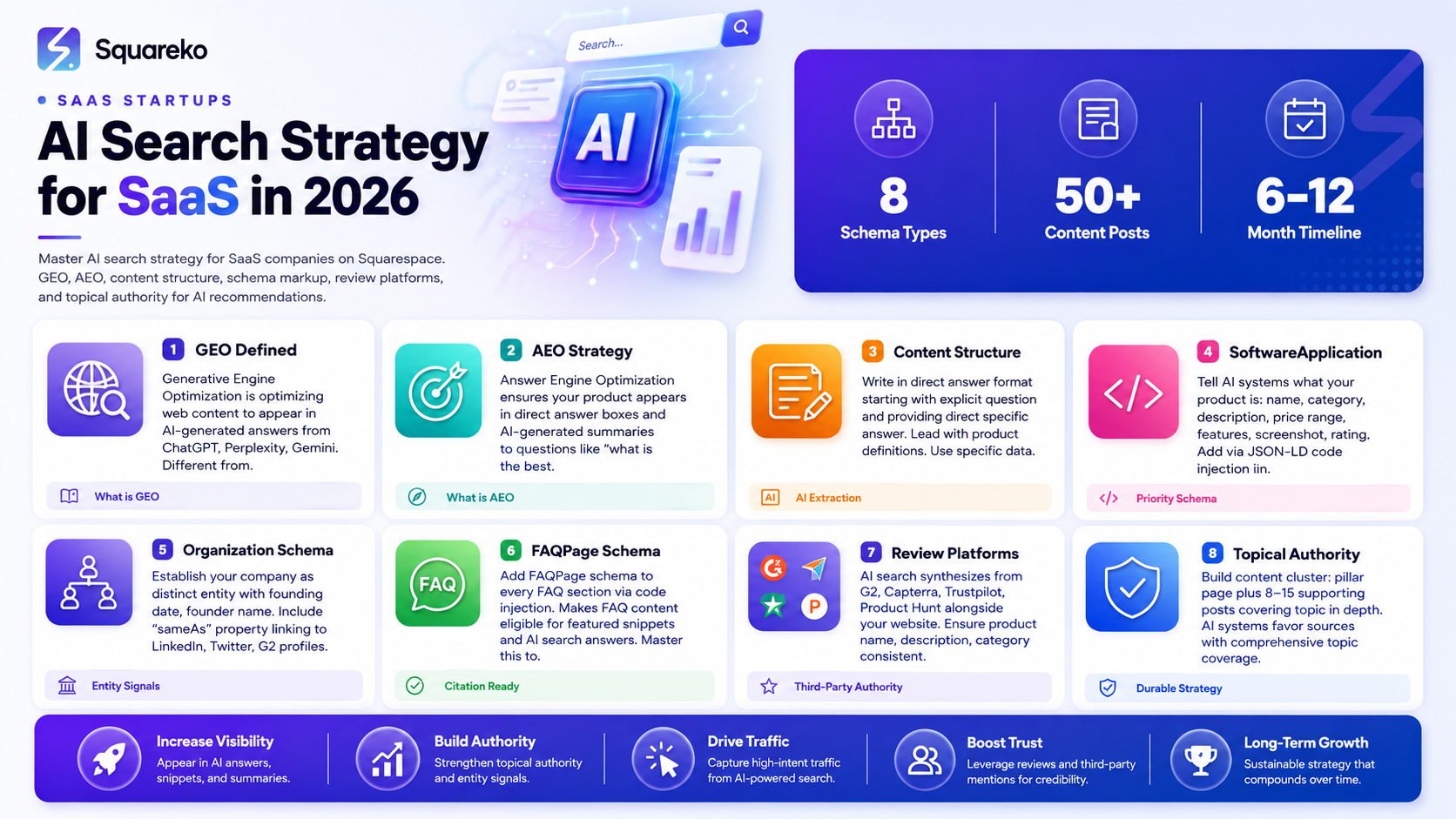
AI search platforms (ChatGPT, Perplexity, Gemini) are now a meaningful SaaS discovery channel — optimizing for them is no longer optional
GEO (Generative Engine Optimization) requires a different content approach than traditional SEO — more conversational, more structured, more authoritative
SaaS companies that get recommended by AI search engines have clear product definitions, comprehensive FAQ content, and strong review platform presence
Schema markup (SoftwareApplication, FAQPage, Organization) significantly increases your likelihood of being cited in AI-generated answers
Building topical authority through a deep content cluster is the most durable AI search strategy available in 2026
How AI Search Is Changing SaaS Discovery
In 2024 and early 2025, SaaS buyers started asking AI assistants questions that previously went to Google: What's the best project management tool for a remote team of 10? Which CRM integrates with HubSpot and has the best free tier? Recommend a client reporting tool for a marketing agency.
By 2026, this behavior is mainstream. AI search platforms — ChatGPT, Perplexity, Gemini, Claude — are a primary discovery channel for SaaS products alongside Google search, G2, and word-of-mouth. The companies appearing in AI-generated software recommendations are getting qualified, high-intent traffic without a click — just a recommendation in a conversational answer.
The mechanics of getting recommended by AI search engines are different from traditional SEO — and most SaaS companies haven't adapted their content strategy yet. This guide covers exactly what's required.
What GEO and AEO Mean for SaaS Companies
GEO (Generative Engine Optimization) is the practice of optimizing your web content to appear in AI-generated answers from large language model-based search platforms. It's not a replacement for SEO — it's an additional layer that works alongside it.
AEO (Answer Engine Optimization) is the practice of structuring your content to appear in direct answer boxes — featured snippets, voice search answers, and AI-generated summaries. For SaaS companies, AEO is about ensuring your product appears in answers to questions like what is the best [category] software? and how much does [your product] cost?
The relationship between GEO, AEO, and traditional SEO: they share a foundation (high-quality, well-structured, authoritative content) but have different specific tactics. Traditional SEO prioritizes keyword placement, link building, and technical performance. GEO/AEO additionally requires direct Q&A format, explicit entity definition, schema markup, and third-party validation signals.
How AI Search Engines Select SaaS Recommendations
AI search platforms don't rank results the way Google does — they synthesize information from multiple sources to generate a response. Understanding how they select which SaaS products to recommend helps you optimize for their specific requirements.
Clarity and Specificity of Product Definition
AI systems that encounter your content need to clearly understand: what does this product do? Who is it for? What category does it belong to? The more explicitly and consistently you define these across your website, the more accurately AI systems can represent you in their answers.
An AI encountering three different descriptions of your product across three pages (because your messaging evolved) will have difficulty representing you accurately and may not cite you at all.
Topical Relevance and Depth
AI systems favor sources that have comprehensive, authoritative coverage of a topic. A SaaS company with 50 in-depth blog posts on their specific category will be cited more frequently than one with 5 thin posts, even if both have similar backlink profiles.
Structured, Citable Content
AI systems extract information most reliably when it's structured clearly:
Q&A format (FAQ sections)
Clear H2/H3 hierarchies with descriptive headings
Direct answer sentences (not buried in paragraphs)
Specific data points (numbers, timeframes, features)
Entity names used consistently (your product name, company name)
Third-Party Validation
AI systems combine their training data (which includes G2, Capterra, Trustpilot, and other review platform content) with live web content. A SaaS product with strong review platform presence is more likely to appear in AI recommendations because the AI has seen it referenced in credible third-party sources.
Schema Markup
Schema markup provides explicit machine-readable signals about your content. SoftwareApplication schema tells AI systems this is a software product along with its category, price range, and rating. FAQPage schema tells them these are questions about this product with authoritative answers. This structured data directly influences how AI systems represent your product.
Content Structure for AI Search Visibility
Write in Direct Answer Format
The conversational, direct format that AI search engines synthesize from is Q&A style. Structure your content around questions your target users ask — and answer them directly.
Instead of: Our platform provides comprehensive analytics capabilities for marketing teams who need to track campaign performance across multiple channels.
Write: What does [Product] track? [Product] tracks campaign performance across email, paid social, organic search, and direct traffic in a single dashboard — updated in real time.
The second version is more citable because it starts with an explicit question and provides a direct, specific answer.
Lead With Definitions
Define your product, your category, and your key terms explicitly. AI systems extract definitions and use them to explain concepts to users:
[Product] is a [specific category] tool designed for [specific user type]. Unlike traditional [category] tools, [Product] [specific differentiator].
Use Specific Data Points
AI systems prefer factual, specific content over vague claims:
Not: Users save significant time → Users report saving 4-6 hours per week on client reporting tasks
Not: Trusted by many companies → Used by 3,000+ marketing agencies in 45 countries
Not: Easy to set up → Most users complete their first setup in under 20 minutes
Specific data is more citable, more credible, and more useful to an AI system generating a recommendation.
Build FAQ Sections Everywhere
FAQ sections are prime AI extraction material. Every major page on your SaaS website should have an FAQ section:
Homepage FAQ: What is [Product]? Who is it for? How much does it cost? How does it compare to [competitor]?
Pricing FAQ: What happens when my trial ends? Is there a free tier? Can I change plans?
Feature page FAQ: Does [feature] work with [integration]? How long does setup take?
Add FAQPage schema markup to every FAQ section via Squarespace's code injection.
Schema Markup Strategy for SaaS Websites
Schema markup is the most direct technical signal available for AI search optimization. Here's the priority schema hierarchy for SaaS websites:
SoftwareApplication Schema (Homepage)
{
  "@context": "https://schema.org",
  "@type": "SoftwareApplication",
  "name": "[Your SaaS Product Name]",
  "applicationCategory": "BusinessApplication",
  "description": "[One clear sentence describing what your product does]",
  "url": "https://yourproduct.com",
  "offers": {
    "@type": "Offer",
    "price": "29",
    "priceCurrency": "USD",
    "description": "Starting price for monthly plan"
  },
  "featureList": "Feature 1, Feature 2, Feature 3, Feature 4",
  "screenshot": "https://yourproduct.com/product-screenshot.jpg",
  "operatingSystem": "Web-based",
  "aggregateRating": {
    "@type": "AggregateRating",
    "ratingValue": "4.7",
    "reviewCount": "285"
  }
}
Organization Schema (Homepage)
Establishes your company as a distinct entity:
{
  "@context": "https://schema.org",
  "@type": "Organization",
  "name": "[Company Name]",
  "url": "https://yourproduct.com",
  "description": "[What your company does]",
  "foundingDate": "2023",
  "founder": {
    "@type": "Person",
    "name": "[Founder Name]"
  },
  "sameAs": [
    "https://linkedin.com/company/yourcompany",
    "https://twitter.com/yourcompany",
    "https://g2.com/products/yourproduct"
  ]
}
Note the sameAs property — this links your Organization schema to your profiles on other platforms (LinkedIn, G2, Capterra, Twitter/X), helping AI systems understand that your website, your review profiles, and your social presence all refer to the same entity.
FAQPage Schema (Every FAQ Section)
Add FAQPage schema to every page with FAQ content. Add all Q&A pairs from the section as mainEntity items.
Article Schema (Blog Posts)
Mark up your blog posts with Article schema to help AI systems identify them as editorial content with authoritative information:
<!-- Please remove the commented script wrapper and add this schema inside a proper <script type="application/ld+json"> tag. -->
{
  "@context": "https://schema.org",
  "@type": "Article",
  "headline": "[Post Title]",
  "author": {
    "@type": "Person",
    "name": "[Author Name]"
  },
  "datePublished": "2026-01-15",
  "publisher": {
    "@type": "Organization",
    "name": "[Company Name]"
  }
}
Add schema to Squarespace via Settings → Advanced → Code Injection (for site-wide schema) or via individual page settings code injection (for page-specific schema).
Review Platforms and Third-Party Authority
AI search engines synthesize information from third-party sources in addition to your own website. Your presence and reputation on SaaS review platforms significantly influences AI search visibility.
Priority Platforms for SaaS AI Search Authority
G2: The most authoritative SaaS review platform. Strong G2 presence with detailed, genuine reviews significantly increases AI search citations. Claim your profile, add full product information, and actively encourage verified reviews from happy customers.
Capterra/GetApp/Software Advice: Gartner-owned platforms with strong authority in enterprise software searches. Free to list, high visibility.
Trustpilot: Strong for consumer-facing SaaS products. Less relevant for B2B.
Product Hunt: Strong for launch visibility and early adopter communities. Good for developer tools and productivity SaaS.
Industry-specific directories: For vertical SaaS (legal tech, fintech, HR tech), category-specific directories carry additional weight with AI systems trained on industry content.
Optimizing Your Review Platform Presence
Complete every field on your review platform profiles (description, categories, features, pricing, screenshots)
Ensure your product name, description, and category are consistent across all platforms
Encourage customers to write detailed, specific reviews (AI systems extract these as evidence of product quality)
Respond to reviews — both positive and negative — to signal an active, engaged company
SaaS Category Definition for AI Discoverability
One of the most underestimated AI search optimization tactics: being explicit and consistent about which software category you belong to.
AI systems use category signals to determine which recommendation queries you should appear in. If you're vague about your category — or use different category names in different places — you appear in fewer recommendation queries.
Be explicit and consistent about your category across:
Your homepage H1 and meta title
Your SoftwareApplication schema applicationCategory field
Your G2/Capterra product category
Your blog content (use the category name consistently)
Your LinkedIn company description
If you're a client reporting tool for marketing agencies, say that explicitly and consistently — not analytics platform, business intelligence software, and dashboard tool in different places. Category consistency is an entity clarity signal that AI systems use to generate accurate recommendations.
Building a SaaS Content Cluster for AI Authority
Topical authority is the most durable AI search optimization strategy. AI systems favor sources that have comprehensive coverage of a specific topic — not just one good page, but a cluster of deeply informative content.
For a client reporting SaaS targeting marketing agencies:
Pillar post: The Complete Guide to Client Reporting for Marketing Agencies
Supporting posts:
How to Automate Weekly Client Reports
Best Client Reporting Software for Agencies in 2026
What to Include in a Client Report
How to Format Client Reports That Actually Get Read
Client Reporting Templates for Marketing Agencies
How to Set Up Client Reporting Systems from Scratch
[Your Product] vs [Competitor]: Which Is Better for Agency Reporting?
Each supporting post links to the pillar and to other relevant supporting posts. The pillar links to all supporting posts. Over 6-12 months, this cluster builds recognized topical authority in your niche — making your site one of the go-to sources AI systems synthesize from when answering agency reporting questions.
In Squarespace, organize your content cluster using blog categories and tags. Consistently tag all cluster posts with a shared category name for internal organization.
Measuring AI Search Visibility for SaaS
Measuring AI search visibility is less straightforward than Google rankings — AI systems don't provide traditional search ranking data. But you can assess your AI search presence:
Manual testing: Regularly search for your product category in AI platforms (best [your category] for [your user type]) and note whether your product appears, how it's described, and whether the description is accurate.
Brand mention tracking: Tools like Brandwatch or Mention track where your product name appears online — including AI-generated content and review platform discussions.
G2/Capterra traffic: If AI systems are citing your review profiles, you'll see referral traffic from these platforms increase.
Organic traffic from informational queries: If your content cluster is building AI authority, you'll typically see associated increases in Google organic traffic from informational queries — a correlated signal.
AI Overview appearances: For queries where Google displays an AI Overview (AI-generated summary) at the top of results, check whether your site is cited in the Overview sources.
Build Your AI Search Strategy With Squareko
Squareko helps SaaS companies on Squarespace implement AI search optimization — from schema markup to content cluster architecture — alongside traditional SEO and conversion design.
FAQs
-
GEO (Generative Engine Optimization) is the practice of optimizing web content to appear in AI-generated search results from platforms like ChatGPT, Perplexity, and Gemini. For SaaS companies, this means structuring content with clear product definitions, direct Q&A format, consistent category naming, schema markup, and strong third-party review presence — all signals that AI systems use to generate software recommendations.
-
Build a comprehensive, structured web presence: clear product definition, SoftwareApplication schema, consistent category naming, FAQ content with FAQPage schema, strong G2/Capterra review profiles (with the same entity names as your website), and a content cluster covering your category in depth. AI systems synthesize recommendations from web content they've indexed — the more clearly and authoritatively your product is represented across the web, the more likely it appears in recommendations.
-
Yes, with important overlap. Both require high-quality content and technical foundations. AI search additionally requires: direct answer-format writing (not just keyword placement), explicit entity definition (consistent product/category naming), schema markup (especially SoftwareApplication and FAQPage), and third-party validation signals (review platforms). Traditional SEO requires: keyword research, backlink building, and page speed — all still relevant but not sufficient for AI search.
-
Very important. Schema markup provides explicit machine-readable signals that AI systems use to understand your product — what it is, what category it belongs to, how much it costs, and how it's rated. SoftwareApplication schema in particular directly informs AI product recommendations. Add it to your homepage via Squarespace's code injection.
-
Yes. AI search platforms synthesize from multiple sources including G2, Capterra, and similar review platforms. A strong, complete profile with genuine detailed reviews on these platforms significantly increases your AI search visibility. Ensure your product name, category, and description are consistent between these profiles and your website — inconsistency creates entity disambiguation problems.
-
Similar to traditional SEO: 3-6 months to establish initial presence, 6-12 months to build meaningful topical authority. The content cluster approach is a 12-month strategy — expect gradual compounding improvement rather than immediate results. Schema markup and category definition optimization can produce faster results for specific recommendation queries.
-
Directly, no — AI platforms don't provide recommendation analytics. Indirectly: test your category queries manually in AI platforms regularly, track brand mentions (including those in AI-generated content republished elsewhere), monitor referral traffic from G2/Capterra (increased if AI systems cite your review profiles), and watch for correlated increases in organic traffic from informational queries.
-
Direct Q&A content (FAQ sections), product comparison articles, category guides, integration documentation, and use-case-specific content all perform well for AI search citations. The common thread: content that provides specific, accurate, well-structured answers to questions — not promotional content or vague benefit language. AI systems favor information that genuinely helps their users evaluate software options.

From custom website design to SEO strategy, we help businesses launch a site that looks professional and performs better.

Author Bio
I'm Walid Hasan, a Certified Squarespace Expert and Squarespace Circle Platinum Partner with over 12 years of hands-on experience designing and optimizing high-performing websites. Over the years, I've had the privilege of building more than 2,000 Squarespace websites for clients around the world, always focusing on clean design, strong user experience, and conversion-driven results.