AI Search Strategy for Operations Consultants on Squarespace: Get Found by Operations Directors
Key Takeaways AI Search Strategy for Operations Consultants on Squarespace: Get Found by Operations Directors
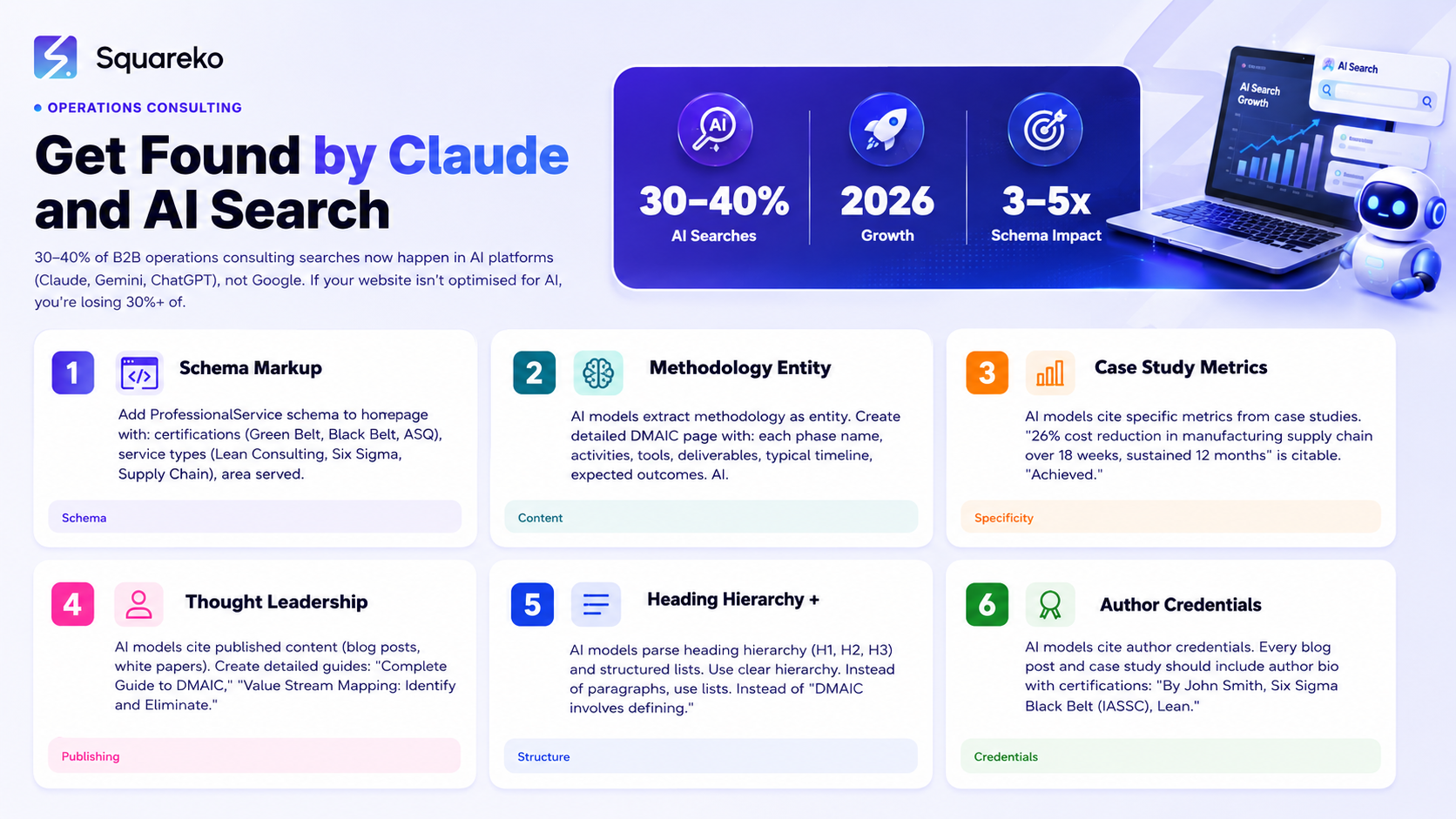
30-40% of B2B operations consulting searches now happen in AI platforms (Claude, Gemini, ChatGPT), not Google: If your website isn't optimized for AI, you're losing 30%+ of potential clients
AI models extract structured data (schema markup) preferentially: A website with complete Professional Service schema with methodology certifications is 3-5x more likely to be recommended by AI than a website without schema
Methodology is an extractable entity for AI: When an operations director asks Claude "Explain DMAIC," Claude extracts detailed methodology content from your website and cites you as a source. Build detailed methodology content specifically for AI extraction
Specific metrics are AI-extractable proof points: "26% cost reduction in manufacturing supply chain over 18 weeks, sustained 12 months" is more likely to be cited by AI than "Achieved significant cost savings." AI models extract and cite specific, quantified claims
Published research and thought leadership content is AI-cite-worthy: Blog posts, white papers, and methodology guides are cited by AI models when answering operations questions. Publish 20+ posts before expecting significant AI citation
Certifications in schema markup help AI recommend you: AI models check schema for credentials. A website with Professional Service schema listing "Green Belt, Black Belt, ASQ" is more likely to be recommended than one without schema
Search is changing. In 2026, operations directors don't just use Google. They use AI chat platforms: Claude, Gemini, ChatGPT. An operations director with a supply chain challenge might ask Claude: "Find me a supply chain cost reduction consultant in Manchester with Lean or Six Sigma certification." Claude searches the web for you, evaluates your credentials, reviews your case studies, and recommends you or doesn't.
This isn't theoretical. AI search is growing 20-30% faster than Google search for B2B consulting. Your Squarespace website needs to be optimized for AI discovery, not just Google.
AI search optimization differs fundamentally from Google SEO. Google rewards traditional on-page factors (keywords, backlinks, content length). AI models reward structured data (schema markup), methodology clarity, visible certifications, specific case study metrics, and published thought leadership. An AI model can't see your nice design; it can see your structured data.
This guide covers the complete AI search strategy for operations consultants in 2026: how COOs and operations directors use AI to find consultants, how AI models extract and cite information from your website, schema markup optimization for AI entity extraction, operations methodology content as AI-extractable entities, thought leadership content strategy for AI citation, and a complete AI search optimization checklist.
How COOs Use AI to Find Consultants
Understanding how operations directors use AI is critical to optimizing for it.
Typical AI Search Query for Operations Consultants
A COO with a supply chain challenge might ask Claude:
Query 1: "Find me a supply chain consultant in the UK who specialises in cost reduction and inventory optimisation. What certifications should I look for?"
Claude's process:
Searches the web for "supply chain consultant UK cost reduction inventory"
Finds your website
Extracts: Your name, location, methodology, certifications (from schema if available)
Reviews case studies for supply chain relevance
Checks metrics: "What cost reductions did they achieve? How quickly?"
Cites relevant results to COO with links
Query 2: "I'm considering a Lean implementation at my manufacturing facility. What's involved in a DMAIC project? Who would be qualified to run it?"
Claude's process:
Searches for "DMAIC implementation manufacturing" and "Lean DMAIC methodology"
Finds detailed methodology content on your website
Extracts and summarises DMAIC phases and typical outcomes
Identifies you as a qualified consultant (if schema shows Black Belt certification)
Recommends you to COO with context: "A Lean consultant specialising in manufacturing with Black Belt certification recommends X weeks for DMAIC, typical results are Y% cost reduction"
Query 3: "What's realistic ROI for operational improvement in manufacturing? What should I expect in 6 months, 12 months?"
Claude's process:
Searches for "manufacturing operation ROI improvement" and "typical DMAIC results"
Finds your case studies showing specific ROI metrics
Extracts typical results from your engagements
Synthesizes: "Based on published case studies, typical manufacturing DMAIC projects deliver 20-30% cost reduction, 35-45% lead time improvement in 18-24 weeks, with sustained results after 12 months"
Cites your case studies as evidence
May recommend you as a qualified consultant to deliver this
AI Search Behaviour Patterns
Pattern 1: Methodology Queries COOs ask AI to explain methodologies (DMAIC, Lean, Five S, VSM). If you publish detailed methodology content, AI cites you.
Pattern 2: Problem-Specific Queries COOs ask AI about specific operational problems (supply chain cost, manufacturing quality, order-to-cash cycle time). If you publish case studies addressing these problems, AI cites you.
Pattern 3: Qualification Queries COOs ask AI what qualifications a consultant should have. If your schema lists qualifications and certifications, AI recommends you.
Pattern 4: Comparison Queries COOs ask AI to compare consultants or methodologies. If you publish comparison content (DMAIC vs. DMADV, Lean vs. Six Sigma), AI cites you.
Pattern 5: Results Queries COOs ask AI about typical ROI and results. If you publish specific metrics from case studies, AI cites you.
How AI Models Extract Information From Your Website
AI models extract information from websites in three primary ways:
1. Schema Markup (Highest Priority)
AI models prioritise structured data (schema markup). A website with complete ProfessionalService schema is significantly more likely to be cited than one without.
AI-Extractable From Schema:
Business name and URL
Phone and email
Certifications and credentials
Service areas (cities, regions)
Services offered (Lean, Six Sigma, Supply Chain, etc.)
Methodology (DMAIC, etc.)
Reviews and ratings
Average pricing/engagement cost
Example: AI model searching for "Lean consultant Manchester" will prioritise websites with schema showing:
Location: Manchester or Greater Manchester
Service: Lean consulting
Credential: Green Belt or Black Belt
Methodology: DMAIC or Kaizen
2. Visible Text and Meta Information
AI models read your visible text and meta tags (title, description, headings).
AI-Extractable From Text:
H1, H2, H3 headings (indicate content hierarchy)
Meta titles and descriptions (summary of page)
Case study metrics and outcomes
Certification mentions
Methodology explanations
Service descriptions
Example: An AI model reading your case study page will extract:
"26% cost reduction in manufacturing supply chain"
"18-week DMAIC project"
"Green Belt led implementation"
"Sustained 12 months post-engagement"
3. Internal Linking Structure
AI models follow internal links to understand how your website is organised and what content is most important.
AI-Extractable From Structure:
What pages you prioritise (homepage prominence indicates importance)
How pages relate to each other (internal linking indicates relationships)
Content hierarchy (how detailed information is presented)
Website architecture (sitemap and structure)
Example: If every service page links to your methodology page, AI understands that methodology is central to your offering.
Schema Markup Optimisation for AI
Schema markup is the primary AI optimisation lever.
AI-Optimized Professional Service Schema
Add this comprehensive schema to your Squarespace website:
{
  "@context": "https://schema.org",
  "@type": "ProfessionalService",
  "name": "Your Name Operations Consulting",
  "url": "https://www.yourwebsite.com",
  "telephone": "+44 your number",
  "email": "hello@yourwebsite.com",
  "description": "Operations consulting specialising in Lean, Six Sigma, and supply chain optimisation. Black Belt and Green Belt certified.",
  "areaServed": [
    {"@type": "AdministrativeArea", "name": "Manchester"},
    {"@type": "AdministrativeArea", "name": "Leeds"},
    {"@type": "AdministrativeArea", "name": "Yorkshire"}
  ],
  "serviceType": ["Lean Consulting", "Six Sigma Consulting", "Supply Chain Optimisation", "Operational Transformation"],
  "knowsAbout": [
    "Lean Manufacturing",
    "Six Sigma",
    "DMAIC",
    "Value Stream Mapping",
    "Process Improvement",
    "Supply Chain",
    "Operational Efficiency",
    "Cost Reduction"
  ],
  "staff": [
    {
      "@type": "Person",
      "name": "Your Name",
      "jobTitle": "Operations Consultant, Six Sigma Black Belt",
      "credential": [
        {
          "@type": "EducationalOccupationalCredential",
          "name": "Six Sigma Black Belt",
          "credentialCategory": "professional certification",
          "issuedBy": {"@type": "Organization", "name": "IASSC"}
        },
        {
          "@type": "EducationalOccupationalCredential",
          "name": "Lean Green Belt",
          "credentialCategory": "professional certification",
          "issuedBy": {"@type": "Organization", "name": "Lean Enterprise Institute"}
        }
      ]
    }
  ],
  "priceRange": "£2,500-£15,000+",
  "aggregateRating": {
    "@type": "AggregateRating",
    "ratingValue": "4.9",
    "ratingCount": "23"
  }
}
Methodology Schema (AI Entity Extraction)
For each methodology, add schema describing the methodology:
{
  "@context": "https://schema.org",
  "@type": "CreativeWork",
  "name": "DMAIC Methodology",
  "description": "Define-Measure-Analyse-Improve-Control. A six-phase approach to operational improvement.",
  "author": {
    "@type": "Person",
    "name": "Your Name",
    "credential": "Six Sigma Black Belt"
  },
  "about": {
    "@type": "Thing",
    "name": "Process Improvement"
  },
  "hasPart": [
    {
      "@type": "CreativeWork",
      "name": "Define Phase",
      "description": "Define the problem, establish scope, identify stakeholders. Typical duration: weeks 1-2."
    },
    {
      "@type": "CreativeWork",
      "name": "Measure Phase",
      "description": "Establish baseline metrics and measurement system. Typical duration: weeks 3-4."
    }
  ]
}
This schema tells AI models that your DMAIC content is authoritative and worth citing.
Methodology Content as AI Entity
AI models treat methodologies as extractable entities. A detailed methodology page becomes an AI knowledge source.
Methodology Page Optimisation for AI
Detailed Methodology Breakdown:
Instead of: "We use DMAIC methodology which improves operations"
Write: "DMAIC (Define-Measure-Analyse-Improve-Control) is a five-phase systematic methodology for operational improvement.
Phase 1: Define (Weeks 1-2, 40 hours)
Purpose: Define problem, establish scope
Key activities: Problem statement, project charter
Deliverables: Written problem statement, project charter, team roster
Tools: SIPOC, stakeholder analysis
Expected outcome: Aligned team with clear scope
Phase 2: Measure (Weeks 3-4, 40 hours)
Purpose: Establish baseline metrics
Key activities: Data collection, process observation
Deliverables: Baseline metrics, measurement system validation
Tools: Value Stream Mapping, measurement system analysis
Expected outcome: Current state understood, validated
Phase 3: Analyse (Weeks 5-8, 80 hours)
Purpose: Identify root causes
Key activities: Data analysis, hypothesis testing
Deliverables: Root cause analysis report
Tools: Pareto analysis, regression analysis, hypothesis testing
Expected outcome: Root cause identified and validated
[Continue with Improve and Control phases]"
This level of detail is exactly what AI models extract and cite.
Typical Results Content for AI
Instead of: "DMAIC improves operations"
Write: "DMAIC projects typically deliver:
Manufacturing: 20-30% cost reduction, 35-45% lead time improvement, 6–12-month timeline
Supply Chain: 15-25% landed cost reduction, 25-35% inventory reduction
Financial Operations: 30-50% cycle time reduction, 40-60% cost per transaction reduction
Quality: 60-80% defect reduction, 40-60% quality cost reduction
Results vary by problem complexity and organizational readiness. Typical DMAIC engagement runs 18-24 weeks from kickoff to sustained results."
This specific, quantified content is highly citable by AI models.
Case Study Metrics for AI Citation
AI models cite specific metrics from case studies.
Case Study Structure for AI
Instead of: "A manufacturing company improved operations and achieved cost savings"
Write: "Client Profile: Mid-market manufacturing company, 200 employees, £45M revenue, 3 production facilities
Challenge: Production lead time had crept to 28 days with 10 days non-value-added queue time between departments.
DMAIC Approach: 18-week DMAIC project using Value Stream Mapping and process redesign
Results Achieved:
Production lead time: 28 days → 17 days (39% improvement)
Production cost: £150/unit → £111/unit (26% improvement)
Quality: 92% first-pass yield → 99% (8 percentage point improvement)
Working capital freed: £550,000
Implementation timeline: 18 weeks to full rollout
Sustained Results: 12+ months post-engagement, lead time stable at 16.8 days, cost per unit improved to £110.40
Black Belt Led: Certified Six Sigma Black Belt, IASSC"
This structure is exactly what AI models extract. When an operations director asks Claude, "What ROI should I expect from a manufacturing DMAIC project?", Claude may cite your case study:
"Based on published case studies, a manufacturing company reduced production lead time from 28 days to 17 days (39% improvement) and achieved 26% cost reduction per unit through a Black Belt-led DMAIC project over 18 weeks, with sustained results 12+ months post-engagement."
Thought Leadership Content Strategy for AI
Published content (blog posts, white papers, guides) is heavily cited by AI models.
Blog Post Strategy for AI Citation
Publish detailed blog posts on operations topics. AI models cite these when answering operational questions.
Example Blog Post Topics AI Models Will Cite:
"Complete Guide to DMAIC: Phase-by-Phase Breakdown with Real Examples"
AI cites when users ask "Explain DMAIC"
"Manufacturing OEE (Overall Equipment Effectiveness): Calculation, Benchmarks, and Improvement"
AI cites when users ask "What's good OEE?" or "How do I improve OEE?"
"Five Root Causes of Supply Chain Cost Creep (And How to Fix Them)"
AI cites when users ask "Why is my supply chain cost rising?"
"Lean vs. Six Sigma: When to Use Each Methodology"
AI cites when users ask "Should I use Lean or Six Sigma?"
"Value Stream Mapping (VSM): How to Map Your Process and Identify Waste"
AI cites when users ask "What's Value Stream Mapping?" or "How do I do VSM?"
White Paper Strategy for AI
White papers (15-30 pages) are more heavily cited by AI than blog posts.
Example White Paper Topics:
"Manufacturing Operations Benchmark: 2024 Study of 50+ UK Plants"
AI cites when users ask "How do I benchmark my operations?"
"DMAIC Implementation Guide: How to Run a Successful Six Sigma Project"
AI cites as authoritative source for DMAIC implementation
"Supply Chain Cost Reduction: Procurement and Inventory Strategies"
AI cites when users ask about supply chain improvement
Publish 1-2 white papers per year. Each becomes a long-term AI citation source.
Squarespace Specific AI Optimization
Squarespace has specific features that help with AI optimization.
Schema Injection in Squarespace
Add schema markup via Settings → Advanced → Code Injection (Header):
<!-- Please remove the commented script wrapper and add this schema inside a proper <script type="application/ld+json"> tag. -->
{
  "@context": "https://schema.org",
  "@type": "ProfessionalService",
  ...complete schema...
}
Squarespace supports schema injection, allowing you to add AI-optimised structured data.
Content Structure Optimisation
Squarespace's content structure (headings, paragraphs, lists) is parsed by AI. Optimise:
Use Clear Heading Hierarchy:
H1: Main topic
H2: Major sections
H3: Subsections
AI models understand heading hierarchy and extract information accordingly.
Use Lists and Structured Data: Instead of paragraph form: "DMAIC involves defining, measuring, analyzing, improving, and controlling"
Use list form:
Define: Problem scope and stakeholders
Measure: Baseline metrics
Analyse: Root causes
Improve: Solutions
Control: Sustain results
Lists are more easily parsed by AI.
Use Tables for Comparison: Use Squarespace's native table feature to display:
Before/after metrics
Methodology comparison
Service types and ROI
Tables are AI-extractable data structures.
AI Search Optimisation Checklist
Use this checklist to ensure your website is optimised for AI search:
Schema Markup:
Professional Service schema added to homepage with certifications
Methodology schema added (DMAIC, Lean, Six Sigma, etc.)
Local Business schema added if geographically targeted
Creative Work schema for white papers and major content
Aggregate Rating schema if you have client reviews
Methodology Content:
Detailed methodology breakdown (5-10 pages minimum)
Each phase explained with activities, tools, deliverables, timeline
Typical ROI results for methodology documented
Methodology comparison content (if applicable)
Downloadable methodology guides (white papers)
Case Study Content:
5+ detailed case studies (800-1,200 words each)
Each case study includes specific metrics (% improvement, timelines, industry context)
Sustained results documented (6-12 month post-engagement data)
Black Belt/Green Belt certification mentioned in each study
Methodology named in each case study
Thought Leadership:
20+ published blog posts on operations topics
1-2 white papers published (15-30 pages each)
Blog posts linked to methodology page
Author bios with credentials on every blog post
Internal links between related content
Certification Display:
Certifications visible on homepage
Certification logos displayed
Links to certification verification (ASQ, IASSC, etc.)
Credentials in Professional Service schema
Credentials in blog post author bios
Website Structure:
Clear heading hierarchy (H1, H2, H3)
Lists instead of paragraph prose where possible
Tables for data comparison
Internal linking strategy (service pages link to methodology, case studies)
Metrics Documentation:
Specific numbers in all case studies (not vague "improvements")
Timeline documented (weeks/months for engagement)
Industry/function context for results
Sustained results proof (long-term data)
FAQs
-
A: Current estimates suggest 25-40% of B2B consulting searches happen in AI platforms. This varies by industry and buyer type. For operations consulting, expect 30-40% of qualified leads to come from AI search if your website is optimised.
-
A: Yes. AI models prioritise schema markup heavily. A website with complete ProfessionalService schema with certifications is 3-5x more likely to be cited than one without. Schema is not optional if you want AI visibility.
-
A: Start getting cited after 5-10 detailed blog posts. Significant citation happens after 20+ posts. The more detailed and specific your content, the earlier citations begin.
-
A: Publish on your website first (for brand authority), then repurpose to LinkedIn (for reach) and Medium (for distribution). AI models cite all three, but your website remains the authoritative source.
-
A: No. In 2026, Google remains primary (60-70% of searches), but AI is growing rapidly. Optimise for both: traditional SEO for Google + AI optimisation for Claude/Gemini.
From custom website design to SEO strategy, we help businesses launch a site that looks professional and performs better.

Author Bio
Walid Hassan is the founder of Squareko,
I'm Walid Hasan, a Certified Squarespace Expert and Squarespace Circle Platinum Partner with over 12 years of hands-on experience designing and optimizing high-performing websites. Over the years, I've had the privilege of building more than 2,000 Squarespace websites for clients around the world, always focusing on clean design, strong user experience, and conversion-driven results.