How Operations Consultants Build Authority and Attract COO-Level Clients on Squarespace
Key Takeaways How Operations Consultants Build Authority and Attract COO-Level Clients on Squarespace.
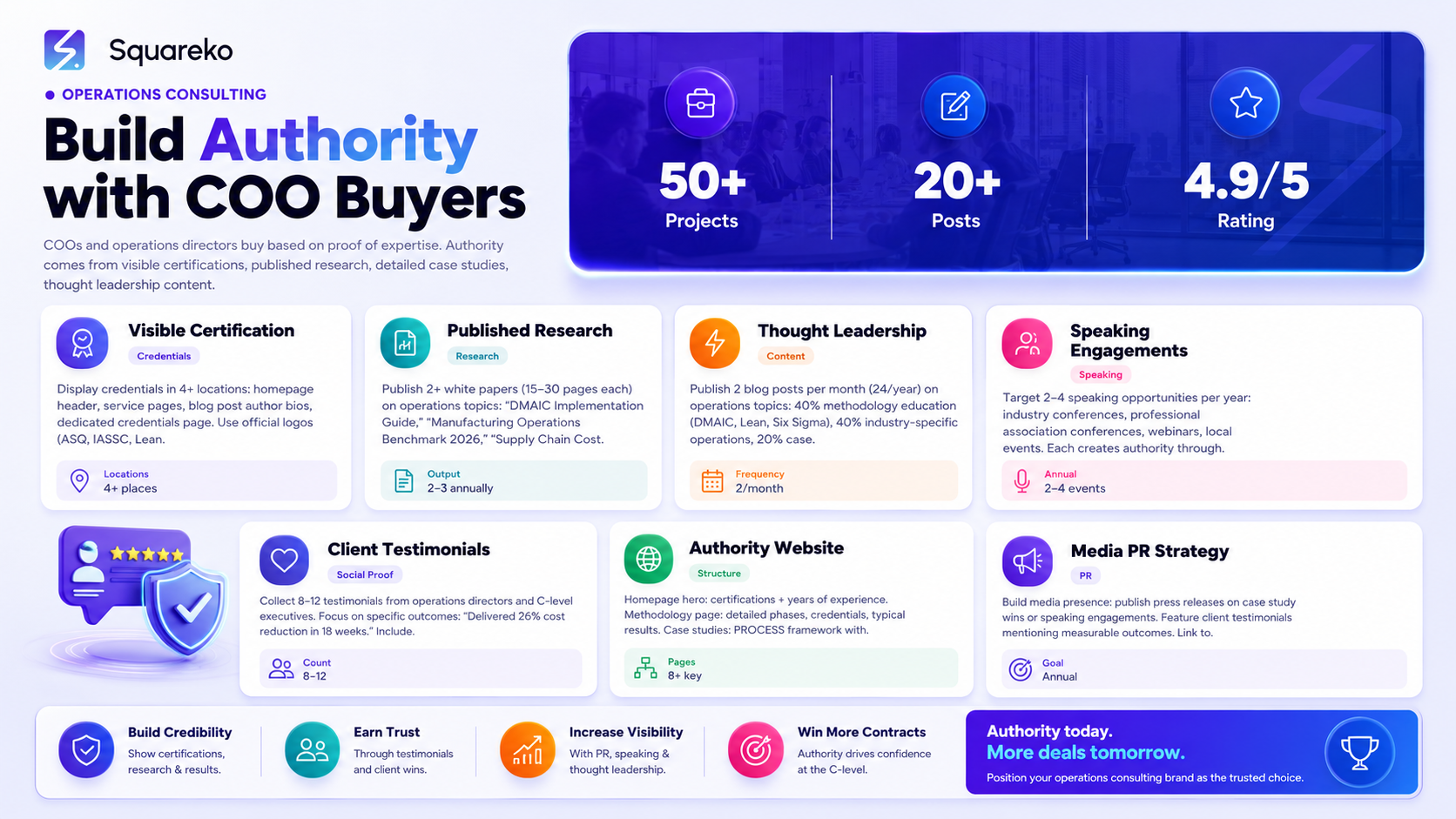
Visible certifications (Green Belt, Black Belt, ASQ, IASSC, PMP) are the foundation of authority: Display them prominently on your homepage, in your navigation, on every blog post author bio, and in your schema markup. Certifications are trust signals that operations directors recognize and verify.
Published research and white papers establish you as a thought leader: Operations directors trust consultants who publish extensively on their methodology. Publish 20+ blog posts, 3-5 white papers, or 1 e-book before expecting significant authority from your website.
Case studies with specific ROI metrics are your authority proof: A case study showing "26% cost reduction in 18 weeks with sustained results after 12 months" builds more authority than 10 testimonials. Quality proof matters more than quantity.
COO buyer psychology prioritizes operational discipline and risk mitigation: COOs are risk averse. They want to see systematic methodology, detailed implementation planning, team structure clarity, and post-engagement support. Your website must address this psychology.
Thought leadership (published articles, speaking engagements, media mentions) creates virtuous authority cycles: Each piece of published content or speaking engagement builds your authority, which attracts more COO inquiries, which creates more case studies, which creates more content.
E-E-A-T (Experience, Expertise, Authoritativeness, Trustworthiness) is Google's 2026 ranking priority for professional services: Your website must demonstrate all four dimensions. Build your website to show: Experience (years of consulting, case studies), Expertise (methodology, certifications), Authoritativeness (publications, speaking, media), Trustworthiness (client testimonials, verified credentials).
Authority is currency in B2B consulting. A COO or operations director doesn't hire based on likability or marketing polish. They hire based on proof of expertise. They're asking: "Have you actually done this? Can you prove it? Are you the expert here, or am I taking a chance?"
Building authority as an operations consultant means systematically proving your expertise through multiple channels: visible professional certifications (Green Belt, Black Belt, ASQ, IASSC, PMP), published research and white papers, detailed case studies with quantified metrics, thought leadership content (blogs, articles, speaking engagements), and testimonials from C-level executives.
Most operations consultants fail at authority building because they treat their website as a business card instead of an authority platform. Your Squarespace website should be the central hub of your expertise: your methodology explained in detail, your credentials verified and visible, your research and publications linked, your speaking engagements and media mentions showcased, your case studies detailed and metrics rich.
This guide covers the complete authority-building strategy for operations consultants on Squarespace: displaying expertise through certified credentials, publishing thought leadership, creating research and white papers, speaking and media strategy, building social proof, and architecting your website to project authority to COO-level buyers.
The Authority Foundation: Visible Certifications
Professional certifications are non-negotiable for operations consultant authority. COOs expect to see visible, verifiable credentials.
Certification Hierarchy
Tier 1 (Highest Authority):
Six Sigma Black Belt (IASSC, ASQ, or other)
Lean Master or Master Lean Consultant
PMP (Project Management Professional)
Tier 2 (Strong Authority):
Six Sigma Green Belt (IASSC, ASQ)
Lean Green Belt (Lean Enterprise Institute)
ASQ Certified Quality Engineer (CQE)
APICS CPIM or CSCP
Tier 3 (Supporting Authority):
Six Sigma Yellow Belt
Lean Yellow Belt
Industry-specific certifications
Displaying Certifications for Authority
Location 1: Homepage Hero Section Below your H1, display your top 3 certifications: "Six Sigma Black Belt | Lean Green Belt | ASQ Certified | PMP"
Or use badge/logo format: ASQ Logo Lean Institute Logo ASSC Logo PMI Logo
Location 2: About/Credentials Page Create a dedicated /credentials page listing:
Certification name
Issuing body (ASQ, IASSC, LEI, PMI)
Year earned
Verification link (link to issuing body's verification tool)
Location 3: Every Blog Post Author Bio End every blog post with: "By Your Name, Six Sigma Black Belt (IASSC), Lean Green Belt (LEI), ASQ Certified Quality Engineer. has completed 50+ DMAIC projects and specializes in manufacturing operations."
Location 4: Navigation Bar Add a small credential badge in your header:
• Six Sigma Black Belt
• Green Belt • ASQ"
Location 5: Schema Markup Include credentials in your Professional Service schema:
"credential": [
  {
    "@type": "EducationalOccupationalCredential",
    "name": "Six Sigma Black Belt",
    "credentialCategory": "professional certification",
    "issuedBy": {"@type": "Organization", "name": "IASSC"}
  }
]
Verification Strategy
COOs often verify certifications. Make this easy:
Use Official Logos:
Download certified logos from issuing bodies
Display alongside certification name
Official logos significantly increase credibility
Maintain Certifications:
Mention continuing education requirements
"Maintain ASQ CQE through 36 PDU renewal cycle"
This signals ongoing commitment to expertise
Thought Leadership Content Strategy
Thought leadership builds authority by proving you understand operational challenges deeply.
Thought Leadership Content Pillars
Pillar 1: Methodology Education (40% of content) Educate your audience about your methodology:
"Complete Guide to DMAIC: Define, Measure, Analyze, Improve, Control"
"Six Sigma vs. Lean: When to Use Each Methodology"
"Value Stream Mapping: Identifying and Eliminating Waste"
"PDCA Cycle: Plan-Do-Check-Act for Continuous Improvement"
"5S Methodology: Implementing Sustained Visual Management"
These articles position you as a methodology expert.
Pillar 2: Industry-Specific Operations (40% of content) Educate on industry-specific operational challenges:
"Manufacturing OEE (Overall Equipment Effectiveness): Benchmarks and Improvement"
"Supply Chain Cost Reduction: Procurement Strategy for Mid-Market Companies"
"Financial Operations: Cycle Time Reduction in Order-to-Cash Processing"
"Healthcare Operations: Reducing Patient Wait Times Through Lean"
"Retail Operations: Inventory Optimization and Inventory Turns Improvement"
These articles position you as an industry expert.
Pillar 3: Case Study Insights (20% of content) Share lessons from your case studies:
"5 Lessons from 30 Manufacturing DMAIC Projects"
"Why 70% of Process Improvement Projects Fail (And How to Succeed)"
"Common Root Causes in Supply Chain: What We've Learned"
"How Operations Leaders Overcome Resistance to Change"
These articles build social proof and demonstrate experience.
Publishing Frequency and Consistency
Publish minimum 2 blog posts per month (24 per year) to build topical authority. Consistency matters more than sporadic long-form content.
Publishing Schedule Example:
Week 1: Industry-specific methodology post (1,500-2,000 words)
Week 2-3: Case study insights or industry-specific challenge post (1,200-1,500 words)
Week 4: Short-form thought leadership (800-1,000 words)
Over 12 months, you'll have:
12 detailed methodology articles
12 industry-specific articles
12 case study/insights articles
Total: 36 posts, strong topical authority
Published Research and White Papers
White papers and e-books establish authority that blog posts can't match.
White Paper Strategy
White Paper 1: DMAIC Implementation Guide
15-20 pages
Target: "How to implement DMAIC in your organization"
Includes: Phase-by-phase breakdown, templates, checklist, tools overview
Lead magnet: Offer free download for email signup
White Paper 2: Industry-Specific Operations Guide
15-20 pages
Target: "Manufacturing Operations Improvement Roadmap" or "Supply Chain Cost Reduction Strategy"
Includes: Industry benchmarks, case studies, ROI calculator
Lead magnet: Free download for email signup
White Paper 3: Research Report
20-30 pages
Original research you've conducted
Example: "2024 Manufacturing Operations Benchmark: A Study of 100 UK Plants"
Establish yourself as a researcher, not just a consultant
E-book Strategy (Optional)
Consider writing an e-book (30-50 pages) that consolidates your best thinking:
"The Operations Consultant's Guide to DMAIC, Lean, and Six Sigma"
"Winning B2B Operations Contracts: A Methodology for Consultants"
E-books are downloadable, shareable, and build significant authority.
Publishing White Papers
Option 1: Host on Your Website Create a dedicated /resources page:
List all white papers
Email capture for each: Name, Email, Company → Download PDF
Link from blog posts and service pages
Option 2: Publish on LinkedIn Upload white papers to LinkedIn document format:
Adds 100-500 views per white paper
Drives LinkedIn profile authority
Links back to your website
Option 3: Submit to Industry Publications Submit summaries or full white papers to:
Industry magazines (Manufacturing Executive, Supply Chain Quarterly)
Professional association publications (IOM, Lean Institute, ASQ)
Consulting directories (Clutch, GoodFirms)
Speaking Engagements and Media Mentions
Speaking and media appearances are authority multipliers.
Speaking Opportunities
Tier 1 (High Authority):
Industry conferences (Manufacturing Leadership Summit, Lean Summit, Supply Chain Forum)
Professional association conferences (ASQ annual conference, IOM conference)
University business school guest lectures
Tier 2 (Medium Authority):
Local business events (Chamber of Commerce, trade associations)
Webinars (industry webinars, association webinars, internal corporate webinars)
Local networking events
Tier 3 (Building Authority):
Podcast interviews
Virtual summits
LinkedIn Live sessions
Local networking events
Speaking Strategy
Target 2-4 speaking engagements per year. Each creates:
Authority through association (speaking at prestigious venue)
Content (video/recording for your website)
Media mention (conference website, press releases)
Networking (potential client relationships)
Social proof (testimonial from event organizer)
Media Mentions and Press Releases
Proactively build media mentions:
Press Release Strategy:
Announce major case study win: "Operations Consultant Delivers 26% Cost Reduction for [Industry] Client"
Announce speaking engagement: "[Your Name] to Speak on Lean Implementation at [Conference]"
Publish annual research results: "2024 Operations Benchmark Report: Insights from 100+ Engagements"
Media Mention Strategy:
Link to every media mention on your /media or /press page
Include logos of publications that featured you
Quote: "Featured in Supply Chain Quarterly, Lean Magazine, Operations Today"
COO Buyer Psychology and Authority Positioning
Understanding how COOs make hiring decisions is critical for authority positioning.
The COO Decision Framework
Stage 1: Problem Recognition COO recognizes an operational problem (cost creep, lead time increase, quality issue, supply chain disruption)
Authority Question: "Is this consultant experienced in my specific problem?" Your Answer: Visible case studies showing similar problems solved
Stage 2: Expertise Validation COO verifies your expertise through credentials, methodology, and certifications
Authority Question: "What's their systematic approach? Are they certified?" Your Answer: Visible methodology, displayed certifications, published research
Stage 3: Proof Evaluation COO compares your case studies and results to competitors
Authority Question: "Have they delivered sustained, quantified results?" Your Answer: Detailed case studies showing Problem → Solution → Sustained Results with specific metrics
Stage 4: Risk Assessment COO evaluates risk: "If I hire this consultant, will they deliver? What's my downside?"
Authority Question: "Can they manage change, lead teams, and sustain results?" Your Answer: Testimonials from C-level executives, clear implementation methodology, post-engagement support structure
Stage 5: Fit Assessment COO determines if you're the right fit for their specific challenge
Authority Question: "Do they understand my industry, my team, my constraints?" Your Answer: Industry-specific case studies, published research on your industry, thought leadership targeting your industry
Authority Positioning for Each Stage
Homepage/Hero: Position your top authority signals above the fold:
"Six Sigma Black Belt with 15+ years of operations consulting"
"Specializing in your top 3 industries"
"Average ROI: 26% cost reduction, 40% lead time improvement"
"Clients include anonymized references: Mid-market manufacturing, automotive supply chain, etc."
Methodology Page: Position your systematic approach and credentials:
Named methodology (DMAIC, PROCESS, etc.)
Visual methodology framework
Credentials supporting this methodology
Success metrics associated with this methodology
Case Studies: Position specific, industry-relevant proof:
"Manufacturing: 26% Cost Reduction Through DMAIC"
"Supply Chain: £500K Annual Savings Through Procurement Optimization"
"Financial Services: 40% Order-to-Cash Cycle Time Reduction"
Each case study answers COO's specific authority questions.
About/Credentials Page: Position experience and expertise:
Years of consulting experience
Number of engagements completed
Industries served
Certifications and continuing education
Speaking engagements and media mentions
Team experience (if applicable)
Social Proof Architecture
Social proof (testimonials, case studies, reviews) is essential authority signal.
Types of Social Proof for Operations Consultants
Type 1: Executive Testimonials Quotes from COOs, operations directors, manufacturing directors:
"Delivered 26% cost reduction in 18 weeks. Systematic, professional, measurable results." Operations Director, Manufacturing
Type 2: Results Testimonials Testimonials focused on specific outcomes:
"We went from 28-day lead time to 17 days. This freed £550K in working capital that we reinvested in growth." — Manufacturing Company
Type 3: Process Testimonials Testimonials focused on your approach:
"The team brought discipline to our improvement process. Every phase had clear deliverables and measurable outcomes." — Operations Director
Type 4: Long-Term Testimonials Testimonials from clients 12+ months post-engagement (proof of sustained results):
"18 months later, the improvements have stuck. The team maintains the new process as standard. This is now how we work." — Manufacturing Company
Collecting Social Proof
Post-Engagement Survey: After engagement ends, ask:
"Would you recommend us to other operations leaders?" (Yes/No)
"In one sentence, what was the most valuable part of our engagement?"
"Can we feature your results as a case study? (anonymized or with permission)"
"Would you be willing to provide a testimonial?"
Email Follow-Up at 6-12 Months: "Your operational improvements are now sustained. Would you be willing to provide an update quote about the long-term impact?"
GBP Reviews: Ask satisfied clients to leave reviews on your Google Business Profile.
Displaying Social Proof
Homepage: Feature 2-3 testimonials prominently, focusing on results:
"Delivered 26% cost reduction in 18 weeks. Systematic methodology, clear results, highly professional." Operations Director, Manufacturing
Case Study Pages: Include a testimonial at the end of each case study:
"The improvement has stuck because it's now how we work. The team is thinking systematically about process improvement." Operations Director
Service Pages: Include industry-relevant testimonials:
On Lean service page:
"Reduced lead time from 28 days to 17 days without capital investment. Extremely valuable." — Manufacturing Company
Testimonial Page: Create a dedicated page featuring 8-12 testimonials from different industries, roles, and engagement types.
Building Authority on Your Squarespace Website
Your website architecture should reflect authority at every level.
Homepage Authority Architecture
Section 1: Hero (Above Fold)
H1 with authority: "Six Sigma Black Belt specializing in Industry operations improvement"
Subheading with proof: "Average ROI: 26% cost reduction, 40% lead time improvement, sustained 12+ months"
Visible credentials: "Green Belt | Black Belt | ASQ Certified"
CTA: "Book a free operational assessment"
Section 2: Authority Signals (Just Below Fold)
Certification logos (ASQ, Lean Institute, IASSC, PMI)
Number of engagements: "50+ completed DMAIC projects"
Average ROI: "26% average cost reduction, 40% average lead time improvement"
Client base: "Serving automotive, manufacturing, supply chain, financial services"
Section 3: Methodology Section
Named methodology (DMAIC, PROCESS)
Visual framework showing phases and outcomes
"Backed by Six Sigma Black Belt and Lean Green Belt certification"
Link to detailed methodology page
Section 4: Featured Case Study
Your strongest case study featured prominently
Before-and-after comparison
Quantified results
Client testimonial (anonymized or with permission)
Section 5: Thought Leadership
Latest blog posts (3-5 recent articles)
White paper download offer
Link to research/resources page
Purpose: demonstrate ongoing thought leadership
Section 6: Testimonials
3-4 strong testimonials with results
Focus on outcomes, not personality
Include role/title of testimonial giver
Section 7: CTA
"Ready to achieve similar results? Book a free operational assessment"
Inner Page Authority Architecture
Methodology Page (Critical Authority Page):
H1: "Our Operational Improvement Methodology"
Introduction: Why methodology matters
Detailed breakdown of methodology phases
Credentials section: Certifications backing this methodology
Published research section: Papers, white papers, blog posts
Downloadable methodology guide
CTA: "Learn how this applies to your challenge"
Blog Post Authority Architecture:
H1 and meta description optimised for keyword
Byline with full credentials: "By Your Name, Six Sigma Black Belt, Company"
1,500-2,000-word article with H2/H3 structure
Internal links to methodology page, service pages, case studies
CTA: "Ready to implement this in your operations? Book a consultation"
Author bio: Credentials, photo, link to full author page
About Page Authority Architecture:
Your professional photo
Bio: Years of experience, number of engagements, industries
Credentials listed with logos
Speaking engagements listed
Media mentions linked
Personal philosophy or approach
Team members (if applicable) with their credentials
Credentials/Media Page:
Certifications with verification links
Speaking engagements with dates/events
Media mentions linked (logos of publications)
Published research and white papers
Professional association memberships
Awards or recognition
FAQs
-
A: Start by completing your first 3-5 client projects and featuring them as detailed case studies. Pursue industry certifications (Green Belt, Black Belt, ASQ). Publish blog content on your methodology and industry. Be transparent about your experience: "Recently transitioned to operations consulting with 10 years of manufacturing operations background." New consultants often have less website authority but can compensate with demonstrated expertise in their previous role.
-
A: Yes. Operations directors care about experience. Include:
"15+ years of operations consulting"
"50+ completed DMAIC projects"
"10+ years in manufacturing operations before consulting"
"Served automotive, manufacturing, supply chain, and financial services industries"
Be specific and verifiable.
-
A: Publish 20+ blog posts (roughly 6-9 months of consistent publishing) before significant authority accrues. After 20-30 posts, you'll start ranking for high-intent keywords, which drives organic traffic and builds credibility. Don't claim "thought leader" status until you've published extensively.
-
A: Both. Blog posts drive organic traffic and SEO authority. White papers build authority and generate qualified leads through email capture. Strategy: Publish 2 blog posts per month (24/year) + 1-2 white papers per year (30-50 pages each).
-
A: Focus on case study depth and client testimonials. A single, detailed case study (800-1,200 words, specific metrics, sustained results proof) builds more authority than 10 generic blog posts. Also: get speaking engagements (local chamber, webinars), media mentions (press releases), and ensure your certifications are visible and verifiable.
From custom website design to SEO strategy, we help businesses launch a site that looks professional and performs better.

Author Bio
Walid Hassan is the founder of Squareko,
I'm Walid Hasan, a Certified Squarespace Expert and Squarespace Circle Platinum Partner with over 12 years of hands-on experience designing and optimizing high-performing websites. Over the years, I've had the privilege of building more than 2,000 Squarespace websites for clients around the world, always focusing on clean design, strong user experience, and conversion-driven results.