5 Operations Consulting Website Mistakes That Lose You B2B Contracts on Squarespace
Key Takeaways 5 Operations Consulting Website Mistakes That Lose You B2B Contracts on Squarespace
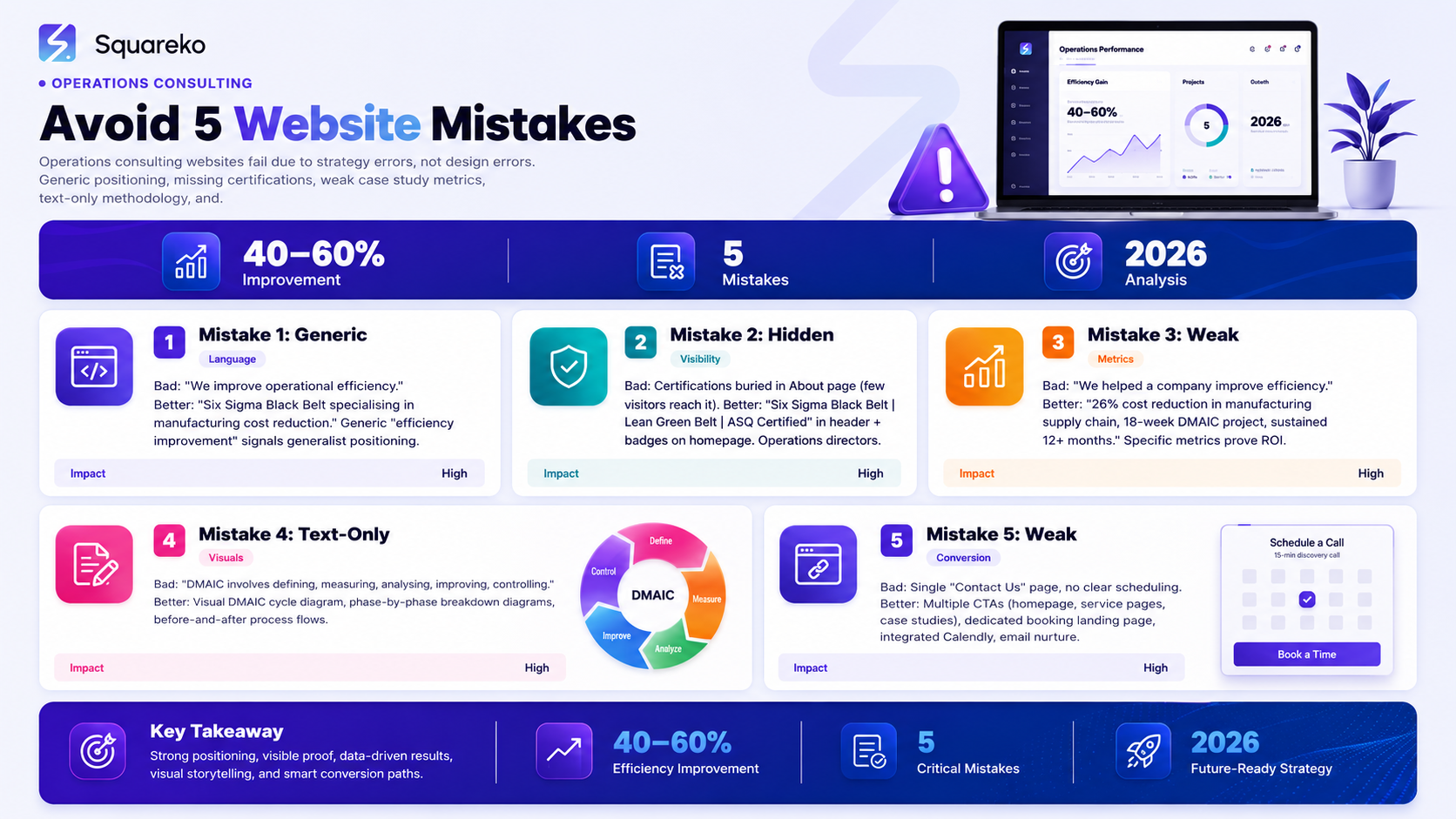
Generic "efficiency improvement" language loses deals to consultants with named methodology: Operations directors don't hire "efficiency consultants." They hire DMAIC specialists, Lean practitioners, or Six Sigma experts. Generic language signals generalist positioning, not expertise
Missing visible certification display signals risk: Buyers verify credentials before booking. If your Green Belt and Black Belt certifications aren't immediately visible, buyers assume you might not have them or aren't credentialed
Case studies without specific ROI metrics are useless: "We improved efficiency" doesn't move the needle. "26% cost reduction in 18 weeks, sustained 12 months" does. Without specific metrics, buyers think you don't deliver measurable results
Missing visual methodology framework loses credibility: Operations directors understand process flows and frameworks visually. A methodology page with no diagrams, only text, appears less credible and is harder to understand. Visual methodology presentation increases conversion 20-30%
Weak B2B discovery call conversion pages lose the deal at the finish line: You've convinced the buyer you're worth talking to. Then your "Book a Call" page is buried, unclear, or doesn't integrate with scheduling. Buyers leave without booking. Squareko fixes conversion pages to prioritise discovery booking
Your website is costing you contracts. Not because it's ugly or poorly designed. Because it fails to communicate the one thing operations directors care about: systematic proof that you deliver measurable operational improvement.
Most operations consultants make predictable website mistakes that sabotage their B2B lead generation. These aren't design errors; they're strategy errors. They reflect fundamental misunderstandings about what COOs and operations directors need to see before they'll book a discovery call.
This guide identifies five critical website mistakes operations consultants make—and explains exactly how Squareko fixes each one. For each mistake, you'll see the problem, the contract loss impact, and the solution.
Mistake 1: Generic "Efficiency Improvement" Language
The Problem: Your website says: "We help companies improve operational efficiency" or "We specialize in business process improvement."
This language is so generic it could describe any consultant. Operations directors don't hire for "efficiency improvement." They hire for specific solutions: Lean manufacturing, Six Sigma quality improvement, supply chain cost reduction, operational transformation.
Contract Loss Impact:
Operations directors assume you're a generalist, not a specialist
You compete on price, not expertise (price-based competition is a losing game)
Buyers choose consultants with specific methodology positioning ("Six Sigma quality improvement" sounds more expert than "operational improvement")
You lose 40-50% of potential contracts to specialists with clearer positioning
The Squareko Fix:
Replace generic language with methodology-specific positioning:
Bad H1: "Business Process Improvement Consulting" Better H1: "Six Sigma Quality Improvement and Lean Manufacturing Consulting"
Bad: "We help companies improve operations" Better: "We improve manufacturing operations through systematic DMAIC methodology, typically delivering 20-30% cost reduction and 35-45% lead time improvement"
Bad: "Business efficiency consulting" Better: "Lean implementation and Six Sigma for manufacturing, supply chain, and financial services"
Specificity signals expertise. Use named methodologies (DMAIC, Lean, Six Sigma, Kaizen, 5S, VSM) throughout your website instead of vague "efficiency improvement."
Mistake 2: Missing Lean/Six Sigma Certification Display
The Problem: Your certifications (Green Belt, Black Belt, ASQ, IASSC, PMI) are buried in your About page, if mentioned at all. Most visitors never reach the About page.
Contract Loss Impact:
Operations directors verify credentials before booking calls. If credentials aren't visible on your homepage or service pages, they assume you might not have them
Buyers lose confidence in your expertise positioning
You compete on brand, not credentials (and new consultants lose brand competition)
You lose 30-40% of potential contracts due to credential uncertainty
The Squareko Fix:
Display credentials prominently in at least 4 locations:
Location 1: Homepage Header/Navigation Add to navigation bar or header: "Six Sigma Black Belt | Lean Green Belt | ASQ Certified"
Location 2: Homepage Below H1 Display certification badges/logos: ASQ Logo IASSC Logo Lean Institute Logo PMI Logo
Location 3: Service Pages Each service page mentions the relevant certifications:
Lean Implementation Service Page: "Led by Green Belt and Black Belt certified consultant"
Six Sigma Quality Service Page: "Black Belt certified specialist"
Location 4: Blog Post Author Bio Every blog post ends with: "By Your Name, Six Sigma Black Belt (IASSC), Lean Green Belt (LEI), ASQ Certified Quality Engineer"
Additional: Verification Links Link to official verification tools: Verify ASQ Certification → Verify IASSC → Verify LEI →
This transparency significantly increases buyer confidence.
Mistake 3: Case Studies Without Specific ROI Metrics
The Problem: Your case studies say things like: "We helped a manufacturing company improve efficiency and reduce costs." No specific numbers. No timeline. No industry context.
Contract Loss Impact:
Operations directors can't evaluate your actual impact
They assume your results are mediocre (if results were strong, you'd show specific numbers)
They compare you to competitors who showcase detailed, metrics-rich case studies
You lose 50-60% of potential contracts due to lack of proof
The Squareko Fix:
Structure every case study using the PROCESS Framework with specific metrics:
Bad Case Study: "We helped a manufacturing company improve their operations. We reduced costs and improved efficiency. The client was very happy."
Better Case Study (PROCESS Framework):
Problem: Production lead time: 28 days, with 10 days non-value-added queue time (36% waste). Production cost: £150/unit.
Root Cause: Lack of integration between Production and Shipping created queue accumulation.
Operational Solution: DMAIC-based process redesign establishing coordinated Production-to-Shipping handoff.
Cycle-Time Reduction/Execution: 18-week implementation.
Efficiency Achieved:
Lead time: 28 days → 17 days (39% improvement)
Cost: £150/unit → £111/unit (26% reduction)
Quality: 92% → 99% first-pass yield
Working capital freed: £550,000
Sustained Results: 12+ months post-engagement, improvements sustained.
Every case study should include specific metrics, timelines, and industry context.
Mistake 4: No Visual Methodology Framework Presentation
The Problem: Your methodology is explained in text only: "DMAIC involves defining, measuring, analyzing, improving, and controlling. We follow a disciplined approach..."
Operations directors are visual thinkers. Process flows, frameworks, and diagrams are how they understand complex methodologies.
Contract Loss Impact:
Methodology appears less credible and harder to understand (text-only presentation is harder to grasp than visual)
Operations directors can't quickly visualize how you'd approach their problem
You lose mindshare compared to competitors with visual methodology frameworks
You lose 20-30% of potential contracts due to weaker methodology communication
The Squareko Fix:
Create visual methodology frameworks using Figma, Canva, or similar tools:
Visual 1: DMAIC Cycle Diagram Central circle with 5 segments (Define, Measure, Analyse, Improve, Control). Arrows showing cyclical flow. Each segment color-coded. Timeline for each phase.
Visual 2: Phase-by-Phase Breakdown For each DMAIC phase, create a detailed diagram showing:
Activities within that phase
Tools used
Deliverables
Typical timeline
Expected outcomes
Visual 3: Before-and-After Process Flow Show process flow before and after your improvement:
Before: Shows queue points, waste areas (highlighted in red)
After: Shows streamlined, optimized flow (highlighted in green)
Visual 4: ROI Timeline Show how improvements unfold over the engagement timeline:
Week 1-2: Problem defined, baseline metrics established
Week 3-4: Data collected, current state validated
Week 5-8: Root cause identified
Week 9-12: Solutions piloted and refined
Week 13+: Results sustained
Visual presentation increases methodology credibility 20-30%.
Mistake 5: Weak B2B Discovery Call Conversion Pages
The Problem: Your website has a single "Contact Us" page, or worse, no clear booking mechanism. Visitors have convinced themselves you're worth talking to, but can't easily book a call.
Contract Loss Impact:
Friction at the conversion point loses 30-40% of potential bookings
Visitors leave without booking because booking is unclear or cumbersome
You lose deals at the finish line when you should be closing them
The Squareko Fix:
Create a dedicated B2B discovery call conversion strategy:
Strategy 1: Multiple CTA Points Throughout Website
Homepage: "Book a Free Operational Assessment"
Service pages: "Schedule a Service Consultation"
Case study pages: "See how we achieved similar results. Book a call"
Methodology page: "Learn if DMAIC is right for your challenge. Schedule a consultation"
Sticky footer: Always-visible "Book a Call" CTA
Strategy 2: Dedicated Booking Landing Page Create /book-a-call or /discovery-call landing page:
Clear H1: "Schedule Your Free Operational Assessment"
Explain what happens on the call: "30-minute conversation with [Black Belt/consultant name] focused on understanding your challenge and outlining next steps"
Embedded Calendly or Acuity scheduling widget
Optionally, pre-call questionnaire
Social proof: 2-3 testimonials specifically about the discovery call experience
Strategy 3: Service-Specific Booking Don't force all bookings into one generic slot. Offer:
"Book a Lean Assessment" → links to Lean methodology page
"Book a Six Sigma Consultation" → links to Six Sigma methodology page
"Book a Supply Chain Review" → links to supply chain page
Each CTA leads to booking for that specific service.
Strategy 4: Email Capture + Nurture When visitors download methodology guides or case studies, trigger email sequence:
Email 1: "Thanks for downloading. Here's your resource + 3 tips"
Email 2: "Does this methodology apply to your challenge? Book a consultation"
Email 3: "Ready to discuss your operational improvement? Here's how to book"
Strategy 5: Exit-Intent Popup When visitors are about to leave without booking: "Before you go: Get a free 30-minute operational assessment."
Weak B2B conversion pages lose deals. Squareko prioritises conversion architecture to get discovery calls booked.
How Squareko Fixes These Mistakes
Squareko is a Squarespace web design agency specialising in operations consultants. We fix these five mistakes systematically:
Mistake 1 Fix: Methodology-Specific Positioning
Reposition your H1 and homepage messaging around specific methodologies (DMAIC, Lean, Six Sigma, etc.)
Segment your service pages by methodology and industry
Replace generic "business consultant" language with "Lean Manufacturing Specialist" or "Six Sigma Black Belt"
Mistake 2 Fix: Prominent Certification Display
Display certifications in header, navigation, service pages, and blog posts
Add certification logos (ASQ, IASSC, Lean Institute, PMI)
Include verification links to official issuing bodies
Update schema markup to include credentials
Mistake 3 Fix: PROCESS Framework Case Studies
Restructure every case study using Problem → Root Cause → Operational Solution → Cycle-Time Reduction → Efficiency Achieved → Sustained Results
Ensure every case study includes specific metrics (% improvement, timelines, industry context)
Add visual elements (before-and-after process diagrams, metrics comparison, timeline displays)
Organize case studies by industry or service type
Mistake 4 Fix: Visual Methodology Framework
Create DMAIC cycle diagram, phase-by-phase breakdown diagrams, before-and-after process flows
Add visual elements to methodology page using Figma or Canva designs embedded in Squarespace
Ensure every service page includes visual methodology framework relevant to that service
Create before-and-after comparison visuals for case studies
Mistake 5 Fix: B2B Discovery Call Conversion Pages
Create dedicated /discovery-call landing page with integrated scheduling
Add multiple CTA points throughout website (homepage, service pages, case studies, etc.)
Implement email nurture sequences triggered by resource downloads
Add exit-intent popups offering free assessments
Ensure every CTA leads to easy, visible booking
FAQs
-
A: Likely yes. 80%+ of operations consulting websites we review make at least 3-4 of these mistakes. You can quickly audit yourself: (1) Is your H1 specific to methodology? (2) Are certifications visible on homepage? (3) Do your case studies include specific metrics? (4) Is your methodology visual? (5) Can visitors easily book a call?
-
A: Fixing all 5 mistakes typically improves discovery call bookings 40-60%. Fixing methodology-specific positioning (#1) alone improves lead quality 30-40%. Fixing certification display (#2) improves trust and reduces booking abandonment 20%. Fixing case study metrics (#3) improves conversion 30-40%.
-
A: Fix mistakes in this order: (1) Methodology-specific positioning (biggest impact on lead quality), (2) Visible certifications (biggest impact on trust), (3) Specific case study metrics (biggest impact on proof), (4) Visual methodology (ease of understanding), (5) Booking pages (conversion).
-
A: You can fix some (positioning, certifications, case study metrics) yourself. Visual methodology frameworks and B2B conversion page architecture benefit from professional expertise. Squareko specialises in fixing these mistakes for operations consultants.
From custom website design to SEO strategy, we help businesses launch a site that looks professional and performs better.

Author Bio
Walid Hassan is the founder of Squareko,
I'm Walid Hasan, a Certified Squarespace Expert and Squarespace Circle Platinum Partner with over 12 years of hands-on experience designing and optimizing high-performing websites. Over the years, I've had the privilege of building more than 2,000 Squarespace websites for clients around the world, always focusing on clean design, strong user experience, and conversion-driven results.