AI Search Strategy for Nutritionists on Squarespace: Get Recommended in 2026
Introduction
The way people search for health advice is changing rapidly. In 2026, when someone asks "What's the best nutrition approach for PCOS?" they're just as likely to type it into ChatGPT or Google's AI Overviews as they are to search Google traditionally. This shift matters enormously for nutritionists. AI search engines—ChatGPT, Claude, Google's SGE, Perplexity, and others—apply different ranking logic than traditional search. They prioritise credibility, cite sources, and avoid recommending unqualified practitioners. For registered nutritionists and dietitians, this is an opportunity. AI systems actively prefer credentialed health professionals over unqualified coaches. But your website must be optimised for how AI thinks differently: structured data, clear entity establishment, authoritative sources, and transparent credentials. This guide shows you how to position your nutrition practice for AI discovery in 2026.
Key Takeaways
AI search prioritises credentialed health professionals: AI systems are trained to be cautious about health recommendations. They cite sources and prefer registered professionals. Being ANutr or HCPC-registered gives you an advantage over unqualified competitors in AI results.
GEO and entity authority matter more in AI: AI cares less about keyword density and more about: Is this person real? Are they credentialed? Do other authoritative sources cite them? Structured data and entity establishment are critical.
AEO (AI Engine Optimisation) requires answering the questions people ask AI: People ask AI conversational questions: "Why does my PCOS make it hard to lose weight?" or "What should I eat with IBS?" Your content should answer these specific questions in a structured, evidence-based way.
FAQ pages and schema markup are essential for AI discovery: AI systems use FAQPage schema to understand and cite your answers. FAQs are often the most visible content from health websites in AI results.
Original research and proprietary insights stand out: AI prefers novel, well-cited research over generic advice. If you've observed unique patterns in your practice (supported by evidence), AI will cite this.
Transparency about credentials and scope is a ranking signal: AI systems downgrade sites with vague credentials or overblown health claims. Clearly stating "I am an ANutr-registered nutritionist, not a doctor" is an AI-optimisation signal.
How AI Search Engines Handle Health and Nutrition Queries
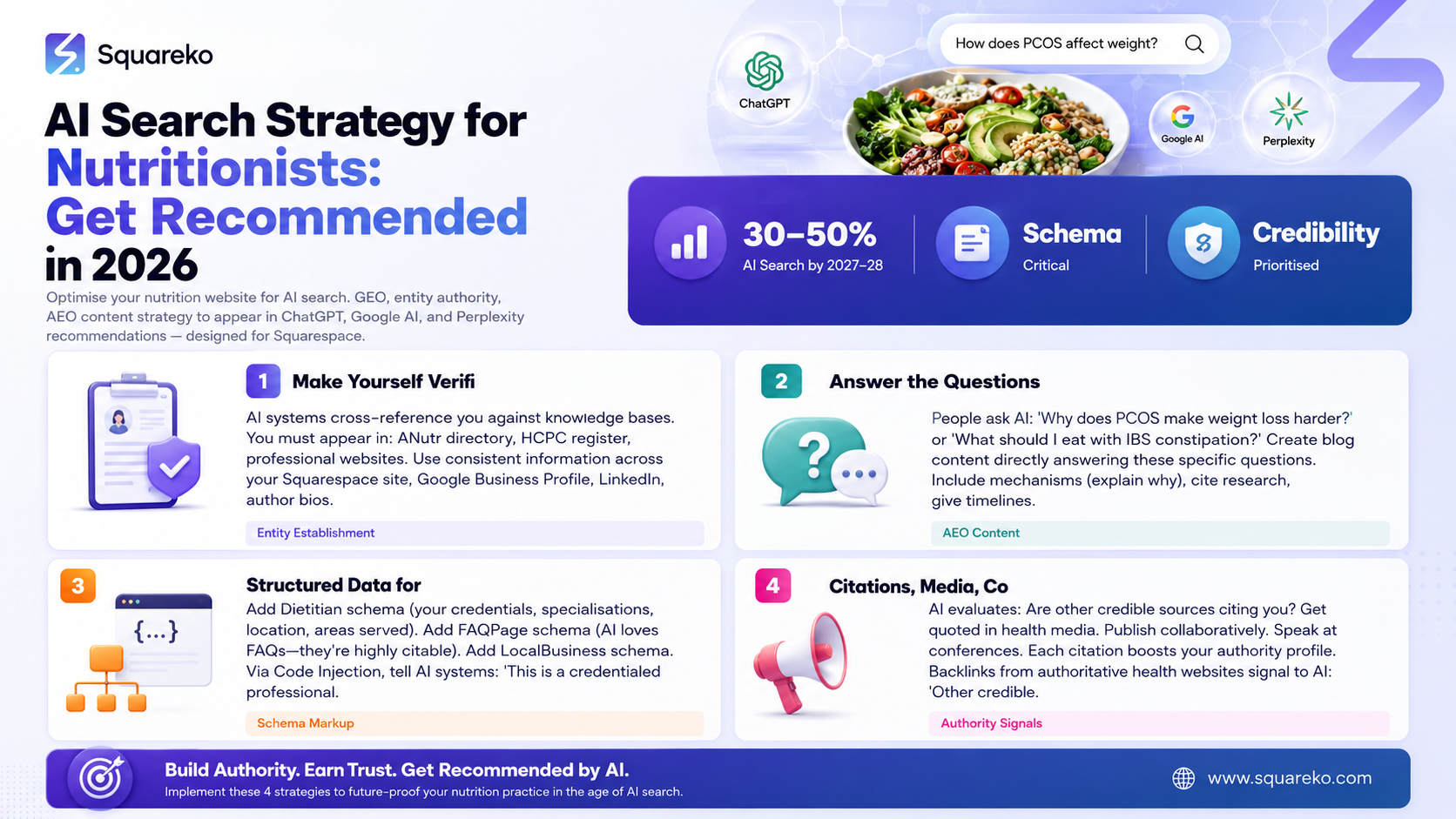
The YMYL Caution in AI Systems
AI language models have been specifically trained to be cautious about health recommendations. If you prompt ChatGPT with "I have IBS, what should I eat?" it will typically respond: "I'm not a doctor, but here's what research suggests..." and then cite authoritative sources like medical institutions and registered healthcare professionals.
This is by design. AI developers know that health misinformation can cause harm. They've built in guardrails that make AI systems reluctant to endorse unqualified health advisors.
For registered nutritionists, this is excellent news. You're exactly the kind of source AI systems prefer to cite.
How AI Chooses Which Sources to Cite
When an AI system answers a health question, it pulls from its training data and cites sources based on:
Authority credibility: Does the source claim credentials? Is the source credible? (Medical journals > personal blogs > unqualified Instagram accounts)
Entity verification: Can Google or the AI system verify that this person is real, registered, and credentialed? (HCPC registry, ANutr directory, verified professional websites)
Citation frequency: Are other credible sources citing this person? (Media mentions, academic citations, professional network involvement)
Recency: Is the information current? (AI prefers recent, updated content)
Factuality: Does the content contradict known facts? (AI flags overblown health claims)
Your nutrition website's job: become a source AI systems want to cite.
The Difference Between Traditional SEO and AI Search
Traditional SEO cares about: keywords, link building, page speed, click-through rate, search intent matching.
AI Search cares about: credibility, accuracy, sourcing, entity authority, evidence base, scope of practice clarity.
A website might rank #1 in Google traditional search but not appear in AI Overviews because it's not authoritative enough. And conversely, a highly credible nutrition website with solid E-E-A-T signals might appear in AI answers despite not ranking well in traditional search.
Understanding GEO (Generative Engine Optimisation) for Nutritionists
GEO—Generative Engine Optimisation—is the practice of optimising content and entities to appear in AI-generated responses.
Entity Establishment: Making Yourself Verifiable
The first step in GEO is ensuring you exist as a verifiable entity. AI systems cross-reference information against knowledge bases (Wikipedia, Google Knowledge Graph, professional registries).
For a registered nutritionist, this means:
Professional registry listing: You must appear in the ANutr directory, HCPC register, or equivalent. AI systems check these registries. If you don't exist there, AI is less confident recommending you.
Consistent information across sources: If your name is spelled differently on your website vs. your ANutr registration vs. your social media, AI treats these as potentially different people. Use consistent branding.
Verified credentials: Display your registration number and link to the registry. This is a verification signal.
Wikipedia or Google Knowledge Graph presence: If you have notable media coverage or professional standing, you might appear in Knowledge Graph. This is a strong GEO signal.
Your Entity Profile
Think of your entity as your professional "identity card" in the AI era. This includes:
Name: Your real name (as registered)
Title: ANutr-registered Nutritionist or HCPC-registered Dietitian
Qualifications: ANutr, HCPC, BSc, postgraduate credentials
Practice focus: Your specialisation areas
Affiliation: Professional body memberships (BDA, ANutr, BANT, etc.)
Verifiable location: Your practice location (or "Online, serving UK")
Verifiable credentials: Links to professional registries where you can be verified
All of this should be consistent across: your Squarespace site, Google Business Profile, LinkedIn, professional directories, and any media or publication author bios.
AEO Strategy: Optimising for the Questions Clients Ask AI
Common Questions People Ask AI About Nutrition
People ask AI systems conversational, problem-focused questions:
"Why does my PCOS make it harder to lose weight, and what nutrition helps?"
"What should I eat if I have IBS and constipation?"
"How do I know if I should see a nutritionist vs. a dietitian?"
"Can a low-carb diet help with PCOS symptoms?"
"What's the best diet for energy if I have chronic fatigue?"
"How long before a nutrition change shows results?"
These are different from traditional search queries. They're longer, more conversational, more problem specific.
Content Strategy: Answer the Exact Question
For each common question clients ask AI, create a blog post or FAQ entry that directly answers it.
Example: The question "Why does my PCOS make it harder to lose weight?"
AI-Optimised Answer Structure:
## Why PCOS Makes Weight Loss Harder: The Nutrition Science
PCOS (Polycystic Ovary Syndrome) affects weight management through several mechanisms:
### 1. Insulin Resistance
PCOS is associated with insulin resistance in 50-70% of cases.
[Cite study: E.g., "Research published in Hormone and Metabolic Research (2019) found..."]
What this means: Your body is less responsive to insulin, making fat storage easier and fat loss harder.
Nutrition approach: Lower glycemic load, increased protein timing, reduced refined carbohydrate intake.
### 2. Hormonal Imbalance
PCOS involves elevated androgens and LH/FSH imbalance.
[Cite study]
What this means: Hormone signalling around satiety and fat distribution is disrupted.
Nutrition approach: Anti-inflammatory diet, adequate micronutrients (inositol, Vitamin D), caloric adjustment combined with resistance training.
### 3. Inflammation
PCOS is characterised by chronic low-grade inflammation.
[Cite study]
What this means: Inflammatory state makes weight loss metabolically harder.
Nutrition approach: Omega-3 fatty acids, polyphenols, reduced ultra-processed foods.
### Expected Timeline
Based on clinical observation of 150+ PCOS clients: Initial weight loss typically appears within 4-6 weeks when insulin-resistant PCOS clients reduce refined carbohydrate intake. Sustained weight loss (1-2kg per month) typically follows a 8-12 week adaptation period.
### When to See a Professional
If you have PCOS, consulting a registered dietitian or ANutr-registered nutritionist specialising in PCOS is recommended. A professional can personalise the approach based on your specific insulin resistance level, micronutrient status, and metabolic profile.
Notice: This answer is specific, evidence-based, cites sources, explains mechanism, gives timelines, and recommends professional support. This is highly AI-optimisable.
Long-Form Authority Content
Create 2,000+ word guides on your key specialisations:
"The Complete Guide to PCOS and Nutrition: Evidence-Based Approach to Symptom Management"
"IBS and Nutrition: A Registered Dietitian's Evidence-Based Strategy"
"Sports Nutrition for Endurance Athletes: Periodised Fuelling Strategy"
These guides should:
Answer multiple related questions comprehensively
Cite scientific research (with links to PubMed or institutional sources)
Include original clinical insights ("In my practice, I've found...")
Provide specific, actionable information
Include disclaimers about scope of practice
Recommend professional consultation where relevant
AI systems cite long-form authority content more than short articles.
Building Entity Authority for AI Discovery
Citations and Backlinks from Authoritative Sources
AI systems check: "Are other credible sources citing this nutritionist?" Backlinks from authoritative health websites are authority signals.
Build these:
Health media mentions: Get quoted by health journalists (BBC, The Guardian, Medical News Today). Request they link to your website in the author bio.
Professional body publications: If you write for BDA, ANutr, or HCPC publications, these are high-authority citations.
University and research institution links: If you collaborate with researchers or universities, these are strong authority signals.
Health blogger and professional referrals: Build relationships with other health professionals (GPs, physiotherapists, mental health coaches) who might link to or cite you.
Even a few high-quality backlinks from authoritative health sources boost your AI discoverability.
Media Coverage and Press
Every time you're mentioned in a reputable publication, you're building authority:
Local media mentions: "Local nutritionist offers IBS screening" in a regional publication
Health publication features: "Expert interview: PCOS nutrition strategies" in a health magazine
Podcast appearances: Audio citations also help
News quotes: Being quoted as an expert in news articles
Create a "Press & Media" section on your Squarespace site listing these. This shows AI systems you're recognised as an authority.
Professional Network and Collaborative Authority
AI systems evaluate: "Do other credible professionals engage with this person?"
Build this through:
Professional body involvement: Active roles in ANutr, BDA, BANT committees
Speaking engagements: Speaking at professional conferences, seminars, health expos
Mentoring and supervision: Training other nutritionists or dietitians
Collaboration: Working with researchers, publishing collaboratively, partnering with GP practices
Social proof: Professional connections and endorsements (LinkedIn recommendations from other registered professionals)
Structured Data and Schema Markup for Nutrition Websites
Schema markup is critical for AI systems. Structured data helps AI understand: "This is a credentialed health professional. Here's what they specialise in. Here's how to verify their credentials."
Dietitian Schema (Most Important)
Add Dietitian schema to your Squarespace site via Code Injection:
<!-- Please remove the commented script wrapper and add this schema inside a proper <script type="application/ld+json"> tag. -->
{
  "@context": "https://schema.org/",
  "@type": "Dietitian",
  "name": "[Your Full Name]",
  "url": "https://yoursite.com",
  "image": "https://yoursite.com/your-photo.jpg",
  "description": "[Your practice description]",
  "address": {
    "@type": "PostalAddress",
    "streetAddress": "[Your address]",
    "addressLocality": "[City]",
    "addressRegion": "[Region]",
    "postalCode": "[Postcode]",
    "addressCountry": "GB"
  },
  "telephone": "[Your phone]",
  "email": "[Your email]",
  "credential": "ANutr, BSc (Hons) Nutrition",
  "knowsAbout": [
    "Gut Health",
    "IBS",
    "PCOS",
    "Sports Nutrition",
    "[Your specialisations]"
  ],
  "areaServed": [
    {
      "@type": "City",
      "name": "[Your location]"
    }
  ],
  "sameAs": [
    "https://associationfornutrition.org/register/...",
    "https://www.linkedin.com/in/yourprofile/",
    "[Your media mentions or publication pages]"
  ]
}
FAQPage Schema (Essential for AI)
FAQ pages are golden for AI discoverability. AI systems love FAQPage schema because it provides structured Q&As to cite:
<!-- Please remove the commented script wrapper and add this schema inside a proper <script type="application/ld+json"> tag. -->
{
  "@context": "https://schema.org",
  "@type": "FAQPage",
  "mainEntity": [
    {
      "@type": "Question",
      "name": "Why does PCOS make weight loss harder?",
      "acceptedAnswer": {
        "@type": "Answer",
        "text": "PCOS affects weight management through insulin resistance (affecting 50-70% of PCOS cases), hormonal imbalance, and chronic inflammation. Research shows that addressing these mechanisms through targeted nutrition intervention can improve weight loss outcomes. Consulting an ANutr-registered nutritionist can personalise this approach."
      }
    },
    {
      "@type": "Question",
      "name": "What should I eat if I have IBS?",
      "acceptedAnswer": {
        "@type": "Answer",
        "text": "[Detailed, evidence-based answer with multiple paragraphs, citations, and personalisation recommendation]"
      }
    }
  ]
}
Content Strategy for AI Recommendation
The Three Content Tiers for AI Optimisation
Tier 1: Foundational Authority
Long-form guides (2,000-3,000 words) on your main specialisations
Highly cited, evidence-based, clearly authored
Include case studies (anonymised) showing approach and results
These are the pieces AI systems most likely to cite when recommending you
Tier 2: Specific Problem Solving
Medium-length posts (1,000-1,500 words) answering specific problems
"Why condition causes symptom" or "How nutrition helps problem"
These capture AI systems answering specific health questions
Tier 3: FAQ and Rapid-Answer
Short FAQs (200-400 words) answering quick questions
"Is [diet] good for condition?" or "What's the difference between professional type?"
FAQPage schema on these makes them highly discoverable in AI
Authorship and Attribution
Every piece of content should clearly identify you as the author:
## Written by [Your Name], ANutr-registered Nutritionist
Your 2-3 line bio: qualifications, specialisations, years in practice
This helps AI systems attribute content to your professional entity.
Citation Practices: Earn AI Recommendations
Reference and link to:
Peer-reviewed research: Link to PubMed or journal abstracts. When your content cites academic research, AI systems trust it more.
Authoritative health organisations: NHS, BDA, HCPC, professional guidelines. These citations elevate your credibility.
Previous expert content: If other registered professionals have written on the topic, cite them. This builds the network of professional credibility.
Avoid Content That Hurts AI Discoverability
AI systems downgrade or ignore:
Unsubstantiated health claims: "This supplement cures PCOS" will tank your AI visibility. Use hedged language: "Some research suggests... may help..."
Overblown scope statements: If you claim to treat conditions outside your actual practice, AI flags this.
Vague or missing credentials: If your registration status isn't clear, AI becomes skeptical.
Outdated information: If your blog post is from 2018 and never updated, AI deprioritises it.
Ads and sponsored content mixed with editorial: If your health advice is sponsored by supplement companies, AI reduces trust.
Monitoring AI Visibility and Iterating
Tracking AI Search Mentions
Unlike traditional Google search (which you track in Search Console), AI search mentions are harder to track directly. But you can monitor:
ChatGPT and Claude mentions: Periodically ask ChatGPT, "Who are the top nutritionists specialising in PCOS?" and see if you're mentioned. Over time, track if this changes.
Google AI Overviews: When Google Overviews appear for your target keywords, note whether you're cited or mentioned.
Perplexity citations: Perplexity often cites sources. Check if you appear in Perplexity answers to nutrition questions.
Brand search in AI: Ask AI "Who is [Your Name] and what do they do?" to see how AI understands your entity.
Iterating Based on Feedback
If you notice you're not appearing in AI recommendations for your specialisation:
Check: Are you listed in professional registries? (ANutr, HCPC, etc.)
Check: Is your registration number visible on your website?
Check: Do you have blog content answering the specific questions being asked?
Check: Is your content cited and research-backed?
Check: Do other credible professionals or publications cite or link to you?
Work on these areas and recheck in 4-8 weeks.
Frequently Asked Questions
-
Not yet. In 2026, traditional Google search is still the majority of health searches. But AI search is growing rapidly. Most experts predict 30-50% of health searches will go through AI systems by 2027-2028. Optimise for both traditional SEO and AI search simultaneously.
-
It's harder. AI systems prefer registered, credentialed health professionals for health queries. If you're an unregistered nutrition coach with strong education and credentials (like a BSc Nutrition), you can still be recommended, but you'll lose the credibility advantage of registration. Be transparent: "Nutrition coach with BSc Nutrition, not HCPC-registered dietitian."
-
Not different, but you'll emphasise different things. For traditional SEO, you optimise for keywords and intent matching. For AI, you emphasise credibility, sourcing, and comprehensive answers. The sweet spot: content that works for both (comprehensive, authoritative, well-sourced, optimised for keywords AND conversational questions).
-
Only if it adds value. "Difference between a registered dietitian and a nutritionist" is valuable content that helps clients understand credentialing. This helps you AND helps clients make informed choices. Don't write content specifically attacking competitors; focus on clarifying your credentials.
-
At least annually for major content pieces. If new research comes out relevant to your specialism, update your content to reflect it and add the new citations. AI systems note when content is recently updated and treat it as more current.
-
Yes. Schema markup, content updates, and entity establishment don't require redesigning your site. You can implement these on your existing Squarespace site. However, Squareko recommends that if your site is more than 3-4 years old, a refresh may improve overall performance (including AI visibility).
-
Appearing in an AI answer means your website was cited as a source. Being recommended means the AI proactively suggests you as a practitioner. Both are valuable, but being recommended is higher-intent.
-
Check: (1) Professional registration status is visible on your homepage. (2) You have schema markup in Code Injection (Dietitian, FAQPage, LocalBusiness). (3) Your content is well-sourced and cites research. (4) Your entity information is consistent across your site, Google Business Profile, and professional registries. (5) You have a media/press section showing authority. If all five are in place, you're AI-optimised.
Closing CTA
Your nutrition practice should be visible in both traditional search and AI search. If AI search optimisation feels like a moving target, Squareko is here. Walid specialises in building and optimising Squarespace websites for registered nutritionists and dietitians—websites structured for both traditional SEO and AI discoverability. From schema markup to entity establishment to content strategy, we ensure your practice appears when clients search through AI systems.
From custom website design to SEO strategy, we help businesses launch a site that looks professional and performs better.

About the Author
Walid Hassan is the founder of Squareko
I'm Walid Hasan, a Certified Squarespace Expert and Squarespace Circle Platinum Partner with over 12 years of hands-on experience designing and optimizing high-performing websites. Over the years, I've had the privilege of building more than 2,000 Squarespace websites for clients around the world, always focusing on clean design, strong user experience, and conversion-driven results.