5 Nutritionist Website Mistakes That Cost You Bookings on Squarespace
Introduction
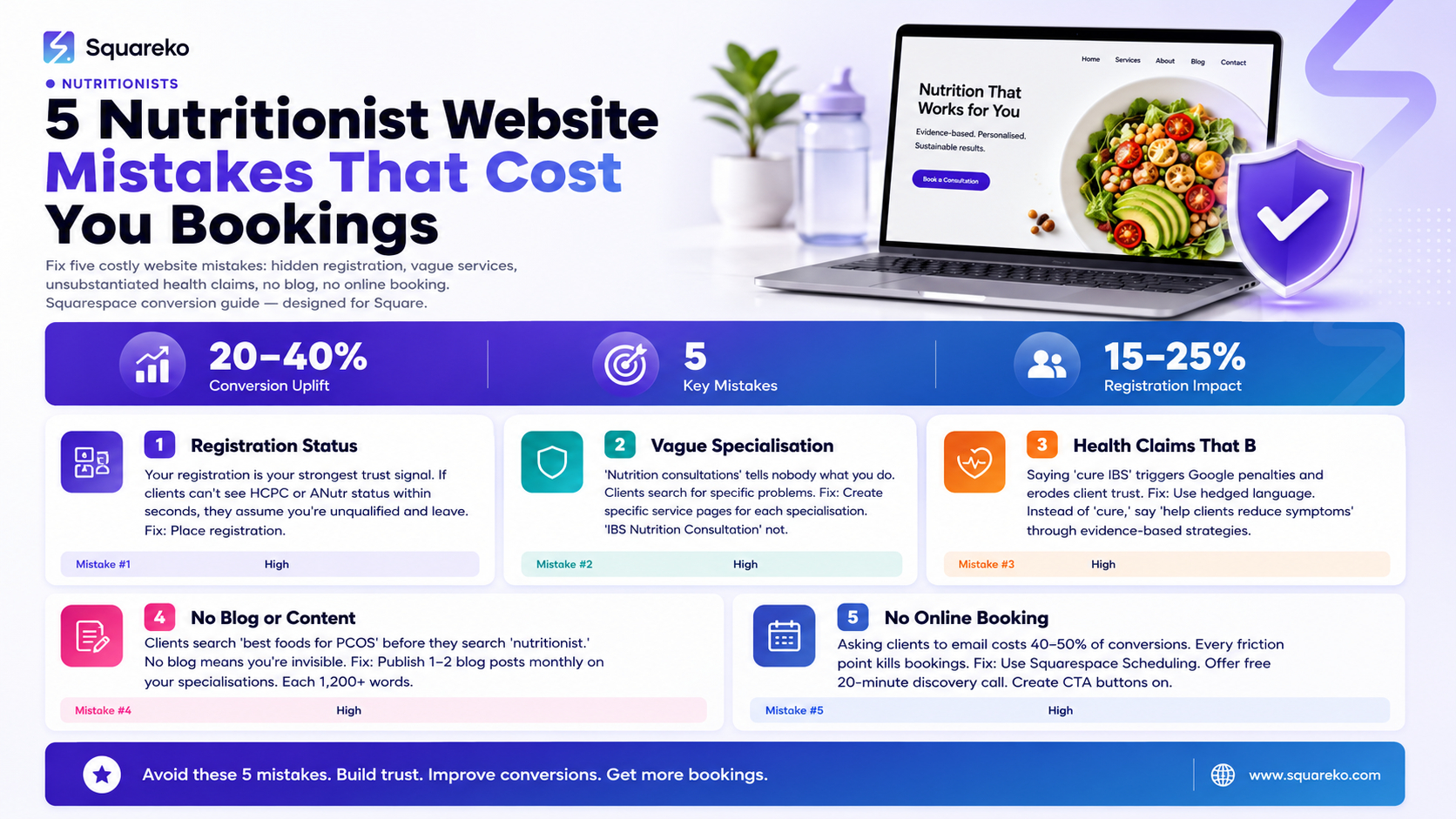
Your nutrition website should work like a sales funnel. A potential client lands on your site, sees that you're qualified and trustworthy, reads about your approach, and books a consultation. But most registered nutritionists' websites break this funnel at critical points. The result: qualified clients arrive but don't convert. They leave unsure whether you're actually registered, unclear what you specialise in, or unconvinced you can help their specific problem. Some sites even repel clients by making unsubstantiated health claims that trigger Google penalties. This guide identifies the five most costly website mistakes nutritionists make on Squarespace and exactly how to fix them.
Key Takeaways
Registration status buried costs conversions: Your ANutr or HCPC registration is your highest trust signal. If it's not prominently displayed on every page, potential clients assume you're unqualified.
Vague service descriptions don't convert: "Nutrition consultations" tells nobody what you do. "I help women with PCOS manage weight and hormonal symptoms through evidence-based dietary intervention" is bookable and specific.
Health claims that breach YMYL guidelines trigger penalties: Saying "my gut health programme cures IBS" is both legally problematic and search-engine penalised. Hedged, evidence-based language is both safer and better for SEO.
No blog content = no organic discovery: Clients search for "best foods for PCOS" and "how to fix IBS" before they search for "nutritionist". No blog means you're invisible at the moment clients are researching.
No online booking system kills conversions: Asking clients to email or call when they're ready to book adds friction. Every friction point kills conversions. Squarespace Scheduling with a free discovery call is the fix.
Mistake #1: Registration Status Buried or Missing
The Problem
Your registration is your most valuable asset. When a client lands on your site, they think: "Is this person qualified?" Your answer should be immediate and unmistakable.
But most nutrition websites bury this. Registration appears only in an "About" page footer, in tiny text, or not at all. The result: visitors assume you're unregistered and leave.
Why This Costs Bookings
Nutrition is YMYL (Your Money or Your Life). Clients are actively trying to avoid unqualified practitioners. When they can't immediately see that you're ANutr-registered or HCPC-registered, they assume the worst and move on.
Studies of professional service websites show that trust signals on the homepage increase conversion rates by 20-40%. For nutrition, where regulatory protection matters, the impact is even higher.
The Fix
On your homepage:
Make your registration status visible in the hero section or immediately below:
Hero Section
Professional photo + Your name] + Registration badge
---
Sarah Mitchell
HCPC-Registered Dietitian | 12 Years' Clinical Practice
Specialising in IBS and Gut Health
Or use a text-based approach:
Registered Dietitian (HCPC) | BSc Nutrition | 12 Years in Practice
On every service page:
Reiterate registration at the top:
# IBS Nutrition Consultation
**HCPC-Registered Dietitian | Specialising in IBS and Digestive Health**
I offer evidence-based nutrition consultations for clients with IBS...
In the footer:
Add a small badge or line:
HCPC logo/badge HCPC-Registered Dietitian
Link to HCPC register verification page
On your about page:
Make registration the first section:
# About Sarah Mitchell, HCPC-Registered Dietitian
## Professional Registration & Credentials
HCPC-Registered Dietitian, Registration #: DT12345
Link to HCPC register where clients can verify
BSc (Hons) Nutrition, University of Leeds
Diploma in Advanced Dietetics
Implementation on Squarespace
In Squarespace, edit your site sections:
Homepage hero: Click the text box and add your registration status prominently. Use bold or larger font size.
All service pages: Add a consistent header showing your registration.
Footer: Add a footer code block (Settings > Advanced > Code Injection) with your registration badge and HCPC link.
The Result
Clients see immediately: "This person is qualified and registered. I can trust her." Conversion rates typically improve 15-25% just from this change.
Mistake #2: Vague Specialisation and Generic Service Descriptions
The Problem
Your services page says:
# Nutrition Consultations
I offer one-to-one nutrition consultations for adults.
Pricing: £60 per session.
This tells a client nothing. They don't know:
What conditions do you treat?
How do you work?
Will this help my specific problem?
How long until I see results?
They leave because you haven't answered their question.
Why This Costs Bookings
Clients don't search for "nutrition consultations". They search for IBS dietitian or "PCOS nutrition coach". They have a specific problem and want to know if you solve it.
A vague service description doesn't convert because it doesn't make a specific promise. Specific promises convert.
The Fix
For each specialisation, create a specific service page with:
Service name: Not Nutrition Consultations but Condition Nutrition Programme"
# IBS Nutrition Consultation
**What is IBS and how can nutrition help?**
IBS affects 15% of the UK population, causing abdominal pain, bloating, and irregular bowel habits. Nutrition plays a central role in IBS management. Research in Neurogastroenterology & Motility (2023) shows that structured dietary intervention can reduce IBS symptoms by 40-60% in responsive clients.
**Who this programme is for:**
- Adults with diagnosed IBS (any subtype: IBS-D, IBS-C, IBS-M)
- People trying to understand IBS triggers
- Clients wanting evidence-based dietary strategies instead of restrictive elimination diets
**Who this programme isn't for:**
- Acute gastrointestinal illness (consult your GP first)
- Suspected coeliac disease (medical diagnosis required first)
- People seeking medical diagnosis or treatment (I'm not a doctor)
My approach:
**How I Work**
1. **Initial Consultation (60 minutes, £60)**
- Detailed history: your IBS timeline, triggers, symptoms, diet, lifestyle
- Symptom tracking review
- Explanation of your IBS subtype and how nutrition interventions work for you
- Initial dietary strategies
2. **Follow-up Sessions (30 minutes, £40, typically 4-6 sessions over 12 weeks)**
- Track progress: symptom changes, tolerance improvements
- Introduce new dietary strategies (e.g., low FODMAP, fibre adjustment, micronutrient optimisation)
- Troubleshoot barriers
- Prepare for independence
3. **Results Timeline**
- Weeks 1-2: Clients often notice increased energy and reduced bloating
- Weeks 4-8: Symptom improvement becomes consistent
- 12 weeks: Most clients see sustained symptom reduction and have developed habits for independence
Client results:
**What Clients Achieve**
Of 80+ IBS clients managed in 2024:
- 75% reported significant symptom improvement (≥50% reduction in bloating, pain, irregular bowel patterns)
- 90% developed sustainable dietary habits they could maintain independently
- 60% reduced reliance on medication (in consultation with their GP)
- Average time to first improvement: 3-4 weeks
Specific testimonial:
"I've had IBS for 15 years and tried every diet. Sarah explained that my IBS wasn't about 'eating clean', it was about understanding my individual triggers and what my gut actually needs. In 10 weeks, I went from having to plan my life around my symptoms to just getting on with it. First time I've felt genuinely better, not just managed." — Michael, Manchester
Squarespace Implementation
Create a new page for each specialisation:
Duplicate your current service page (or create new)
Add all sections above: specific problem, who it's for, your approach, results, testimonial
Link to booking page prominently at the bottom
Include a CTA button: "Book your Condition consultation now"
The Result
Clients see: "This person specialises in my problem. They have a specific approach. Other people like me have gotten results." Conversion rates typically improve 30-50% with specific service pages.
Mistake #3: Health Claims That Break YMYL Guidelines
The Problem
Your website says:
"My gut health programme will cure your IBS"
Or:
"Nutrition can reverse type 2 diabetes completely"
These are common claims on nutrition websites. They're also extremely problematic.
Why This Costs Bookings (and Rankings)
Legally: You're overreaching your scope of practice. Dietitians can support condition management; they don't "cure" conditions (which is medical terminology). Unqualified claims create liability.
For Google: YMYL penalties are severe. If Google detects unsupported health claims, your site drops in rankings. In severe cases, sites are deindexed entirely.
For clients: Clients reading exaggerated claims become skeptical. They wonder if you're trustworthy. Responsible language actually builds more trust.
The Fix
Use hedged language that's both legally safe and more trustworthy:
Instead of: "My programme cures IBS" Say: "I help clients reduce IBS symptoms through evidence-based dietary strategies. Most clients see significant symptom improvement (40-60% reduction based on clinical data) within 8-12 weeks."
Instead of: "Nutrition reverses diabetes" Say: "Evidence-based nutrition intervention can support improved blood sugar control and reduce medication requirements (in consultation with your doctor). Research shows that structured dietary approaches can improve HbA1c by 1-2% on average."
Instead of: "This supplement will fix your gut" Say: "Research suggests that supplement may support gut microbiome diversity. It's typically used as part of a broader dietary strategy, not as a standalone intervention."
The Pattern
Always include:
What the research shows: "Studies in journal suggest that..."
What you actually do: "I help clients implement..."
What clients typically experience: "Most clients see..."
Appropriate scope: "In consultation with your doctor..." or "This is educational, not medical advice."
Squarespace Implementation
Review every page that mentions health outcomes
Edit claims to use hedged language
Add citations where possible (e.g., "Research published in Nutrition Reviews shows...")
Add scope disclaimers to service pages and blog posts
Example revision:
Before:
Functional Nutrition for Autoimmune Conditions
Heal your autoimmune disease with nutritional intervention. I specialise in reversing autoimmune conditions through elimination diet and supplementation.
After:
Nutrition Support for Autoimmune Conditions
Many autoimmune conditions involve inflammatory activation that nutrition can address. While I cannot diagnose or treat autoimmune disease (this requires medical oversight), evidence-based nutrition intervention can support symptom management and quality of life.
My approach focuses on:
- Identifying potential dietary triggers (often individualised, not one-size-fits-all)
- Anti-inflammatory nutrition strategies supported by research
- Micronutrient optimisation often deficient in autoimmune populations
- Collaboration with your rheumatologist or physician
I work as part of your healthcare team, not as a replacement for medical care.
The Result
Your website becomes legally compliant, ranks better in Google, and clients actually trust you more because your language is realistic and responsible.
Mistake #4: No Blog or Educational Content
The Problem
Your nutrition website has:
Homepage
Services page
About page
Contact page
But no blog.
Why This Costs Bookings
Clients don't search for "nutritionist". They search for:
"Best foods for PCOS"
"How to fix IBS bloating"
"Can nutrition help hormonal acne?"
"Low FODMAP foods list"
If you have no blog, these search queries never lead clients to you. You're invisible at the moment clients are researching.
Additionally, clients want to know you're knowledgeable. A blog demonstrates expertise. A site with no blog signals: "This person doesn't create content. Are they thought leader or just a practitioner?"
The Fix
Create a blog and publish at least 1 post per month (ideally 2-4). Topics should be:
Condition-specific:
"Complete Guide to PCOS and Nutrition"
"IBS and Gut Health: What the Evidence Shows"
"Nutrition for Endurance Athletes: Periodised Fuelling Strategy"
Problem-focused:
"Why Do I Have Zero Energy Despite Eating? (And How Nutrition Helps)"
"Bloating After Eating: 5 Root Causes and Nutrition Strategies"
Myth-busting:
"Myth: All Fats Are Bad. Here's What the Evidence Actually Says."
"Is Keto Safe? A Registered Dietitian's Evidence-Based Analysis"
Educational:
"The Microbiome Explained: How Your Gut Bacteria Affect Health"
"What's the Difference Between a Nutritionist and a Dietitian?"
Each post should:
Be 1,000+ words (longer content ranks better)
Cite research (links to studies, clinical evidence)
Include your clinical experience ("In my practice, I've found...")
Have a clear author bio (with your credentials)
Include a CTA at the end (e.g., "Ready to work with me? Book a consultation.")
Squarespace Implementation
Enable Blog: In Squarespace settings, enable the Blog feature
Create categories: Organise by condition (PCOS, IBS, etc.) or topic (research, myths, education)
Post monthly: Set a calendar reminder to publish 1-2 posts monthly
Link from homepage: Add a "Latest Articles" section to your homepage linking to blog
Content Calendar Example
Month 1: "Complete Guide to PCOS Nutrition" (2,500 words)
Month 2: "5 Signs You Need an IBS Dietitian" (1,200 words)
Month 3: "Myth: Carbs Make You Fat" (1,000 words)
Month 4: "Amino Acids and Athletic Performance" (1,500 words)
The Result
Organic traffic to your site increases 2-5x over 6-12 months. Clients arrive with specific problems already educated about nutrition. They're ready to book because they've already built trust through your content.
Mistake #5: No Online Booking Option
The Problem
Your website says:
When potential clients are ready to book, they want instant confirmation. They don't want to email and wait 24 hours for a response. They don't want to call and risk hitting voicemail.
If booking requires friction (email, phone call, uncertain response time), many clients simply don't book. They move on to a competitor with online scheduling.
Why This Costs Bookings
Conversion psychology: every friction point kills 10-30% of conversions. Friction points in booking:
Client must compose an email
Client must wait for response
Client must coordinate times asynchronously
Client unsure if appointment is confirmed
Result: 40-50% of clients who reach this point don't book.
The Fix
Use Squarespace Scheduling to offer online booking directly on your site.
Setup:
Enable Squarespace Scheduling: Settings > Advanced > Scheduling
Create a service: "Initial Consultation" (60 min, £60)
Add appointment slots: Open 3-5 slots per week
Create a clear CTA: Button on every page saying "Book Your Consultation Now"
Recommended approach:
Offer a free 20-minute discovery call (instead of paid consultation directly):
Lower friction (free removes booking hesitation)
Allows you to qualify the client (is their problem within your scope?)
Allows them to ask questions about your approach
Naturally leads to paid consultation booking for qualified clients
Setup:
Squarespace Scheduling > Create Service
Service Name: "Free 20-Minute Discovery Call"
Duration: 20 minutes
Price: £0
Description: "Chat with me about your nutrition goals, ask questions, and see if we're a good fit. No obligation."
Then link to this booking option prominently:
Homepage CTA: "Book Your Free Discovery Call"
Top of every service page
End of every blog post
Squarespace Implementation
Settings > Advanced > Scheduling > Enable
Create services (e.g., "Initial Consultation £60", "Free Discovery Call")
Set your availability (e.g., Monday-Thursday 2-5pm, Saturday 10am-12pm)
Create CTA buttons linking to /book or your scheduling page
Add to every page (even blog posts: "Ready to discuss your nutrition? Book a free call.")
The Result
Conversion rate at "ready to book" stage increases 3-5x. Clients confirm bookings instantly instead of emailing and waiting. Your schedule fills faster.
Quick Wins: Fixes You Can Implement Today
Add registration badge to homepage: 15 minutes. Immediate conversion boost.
Rewrite your services pages with specific specialisations: 1-2 hours per page.
Audit and hedge health claims: 1-2 hours. Find-and-replace problematic language.
Enable Squarespace Scheduling: 30 minutes. Creates instant booking option.
Plan your first blog post: 2 hours. Publish within 2 weeks.
Start with #1 and #4 (quickest wins). Then move to #2 (highest impact).
Frequently Asked Questions
-
No. You should state clearly: "I offer online nutrition consultations via video call, serving clients across the UK." This tells clients your scope. Even if you're online-only, list your location (where you're registered/based). This helps with local SEO and verification.
-
Be transparent, but frame positively: "Newly qualified ANutr Nutritionist (registered 2024) bringing current evidence-based training and supervised practice." People expect newer practitioners; transparency builds trust.
-
Not really. Even with research cited, you must hedge language appropriately. Don't claim something "cures" or "reverses" conditions. Use: "evidence suggests," "may help," "can support," "associated with improvement."
-
At least 1,200 words (ideally 1,500+). Longer, comprehensive content ranks better and demonstrates deeper knowledge. Your first post should be on your primary specialisation.
-
Create a blog category for each. Publish alternating posts: one IBS post, one PCOS post, one general nutrition post. Over time, you build authority in both areas.
-
Yes, but ethically. After a successful consultation, email clients: "I'd love to hear your experience. Would you be happy to leave a quick review?" Never incentivise reviews (Google penalises this).
-
No. Squarespace templates are good enough. Content is what converts. A beautifully designed site with no blog and hidden registration status converts worse than an "ugly" site with clear credentials, specific services, and monthly blog posts. Focus on content and trust signals first.
-
Track: (1) Monthly visitors (Squarespace analytics). (2) Bookings from website (ask new clients how they found you). (3) Bounce rate (% of visitors who leave without action). Target: 30-50% of bookings from your website (after 6 months of blogging).
Closing CTA
Your nutrition website should book you clients, not cost you bookings.
If your site has any of these five mistakes—hidden credentials, vague services, unsubstantiated claims, no blog, or no online booking—you're leaving money on the table. Every day without these fixes costs you consultations.
Squareko specialises in fixing exactly these problems. Walid builds Squarespace websites for nutritionists that have clear credentials, specific services, evidence-based content, and frictionless booking. We'll audit your site, identify what's costing you bookings, and fix it.

From custom website design to SEO strategy, we help businesses launch a site that looks professional and performs better.

About the Author
Walid Hassan is the founder of Squareko,
I'm Walid Hasan, a Certified Squarespace Expert and Squarespace Circle Platinum Partner with over 12 years of hands-on experience designing and optimizing high-performing websites. Over the years, I've had the privilege of building more than 2,000 Squarespace websites for clients around the world, always focusing on clean design, strong user experience, and conversion-driven results.