How Nutritionists Build E-E-A-T and Clinical Trust on Their Squarespace Website
Introduction
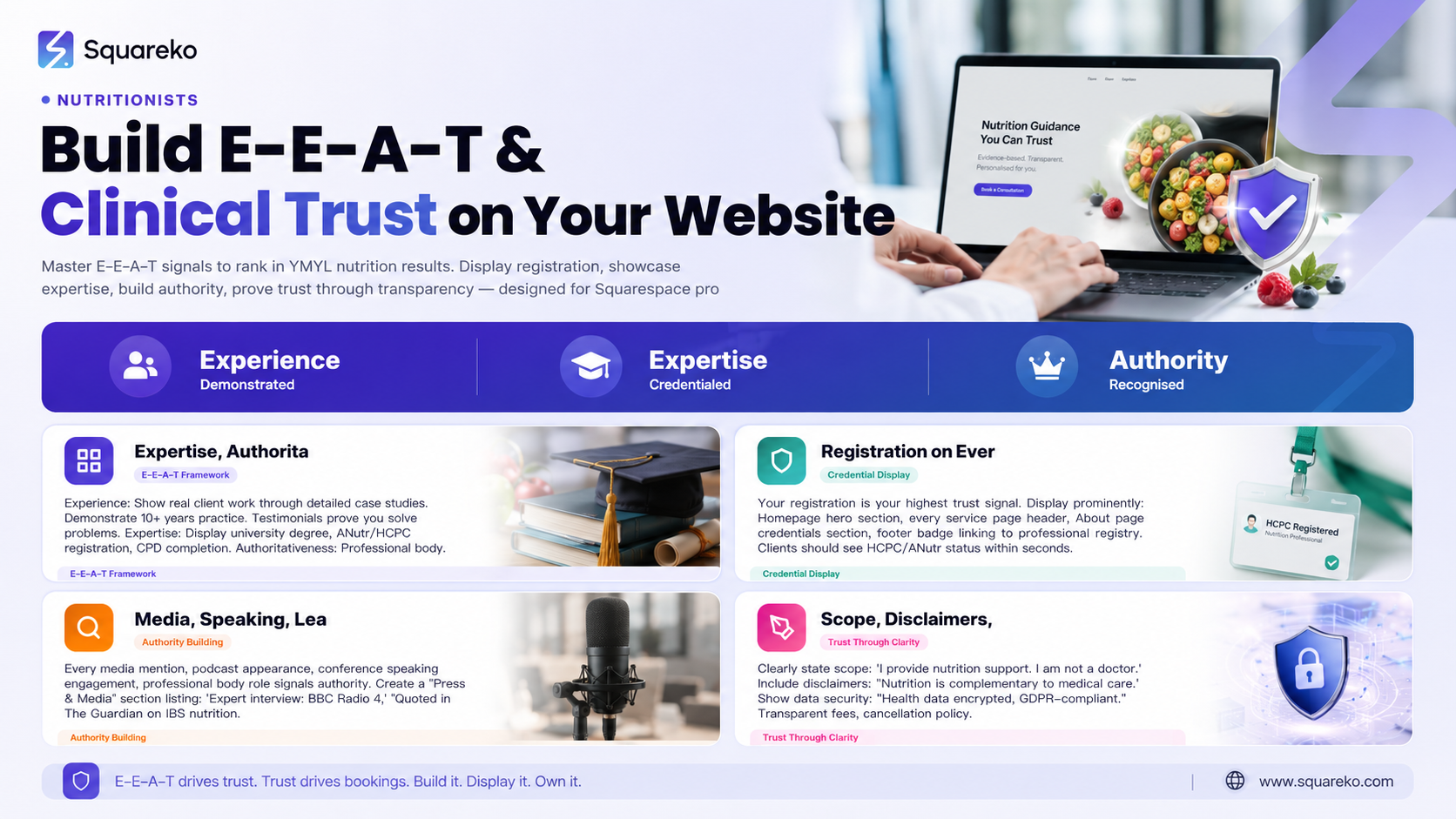
Google's E-E-A-T framework—Experience, Expertise, Authority, and Trust—sits at the centre of how the search engine evaluates health and nutrition websites. Nutrition is classified as YMYL (Your Money or Your Life), the highest-risk content category. A false diet claim, unsupported supplement recommendation, or misleading health assertion can cause real harm. Because of this, Google holds nutrition websites to an exceptionally high standard. Registered nutritionists and dietitians building a Squarespace site must understand that trust isn't optional—it's the foundation of visibility and conversions. This guide shows you exactly how to demonstrate E-E-A-T to Google and to your clients: displaying your registration status prominently, showcasing your qualifications and clinical experience, building authority through evidence-based content, and creating the security and transparency that health professionals require.
Key Takeaways
E-E-A-T is Google's YMYL trust framework: Nutrition is the highest-risk content category. Every element of your Squarespace site must signal credibility, professional registration, and clinical expertise or Google will suppress your rankings.
Registered status (ANutr, HCPC, RNutr) is your highest trust signal: Prominently displaying that you're a registered nutritionist or HCPC-registered dietitian should appear on every page—not buried in an about section. This is the single most important trust element.
Experience is demonstrated through case studies and client results: Show, don't tell. Detailed (but confidential) case studies showing how you've helped clients with specific conditions build clinical credibility faster than any bio.
Expertise requires visible credentials, CPD, and evidence-based content: Your qualifications (BSc, ANutr, HCPC), continuing professional development records, published or cited articles, and media mentions all count. Your blog should reference research and explain your reasoning.
Authority comes from being seen as a leader: Speaking at conferences, media mentions, professional body roles, and citations by other credible sources position you as an authority in your specialism.
Trust is built through transparency, data security, and clear disclaimers: Health data is sensitive. GDPR compliance, transparent fees, clear scope of practice, and professional indemnity insurance visibility all build trust with clients.
Understanding E-E-A-T in the Context of YMYL Nutrition
Why Nutrition Is the Highest YMYL Risk Category
YMYL content is anything that could impact health, safety, financial security, or civic integrity. Nutrition sits at the very top of the YMYL hierarchy because:
Direct health impact: A nutritionist's advice shapes what people eat. Poor advice can cause nutritional deficiencies, worsen chronic conditions, or delay proper medical treatment.
Vulnerable populations: Many nutrition clients are managing serious health conditions (IBS, PCOS, diabetes, cancer recovery). They're actively seeking solutions. A misleading nutritionist can cause real harm.
Regulatory complexity: Dietitians (HCPC-registered) have legal prescriptive scope. Nutritionists do not. The distinction matters legally and clinically. Clients must know who they're consulting.
Misinformation abundance: The internet is saturated with unqualified "nutrition experts" making false claims. Google must differentiate credible professionals from charlatans.
Because of this risk, Google's algorithm treats nutrition websites with extreme scrutiny. Your E-E-A-T signals must be unambiguous.
Google's E-E-A-T Rubric for Health Professionals
Google's quality raters use this framework when evaluating health websites:
Experience: "Does this person have real experience in this medical field?" For a registered nutritionist: Have you worked with real clients? Can you show results? Do you understand the practical, day-to-day challenges of your specialism?
Expertise: "Does this person have recognised credentials in nutrition?" For a registered nutritionist: ANutr registration, HCPC registration, relevant degree (BSc Nutrition, Dietetics, etc.), continuing professional development. Unqualified "nutrition coaches" fail this test entirely.
Authority: "Is this person recognised as a leader in their field?" For a registered nutritionist: Have you published? Been cited? Spoken at conferences? Do other credible professionals reference you? Are you part of professional bodies (BDA, ANutr)?
Trust: "Can I trust this person with my health?" For a registered nutritionist: Is your practice transparent? Are credentials verified? Do you have professional indemnity insurance? Is your scope of practice clear? Is client data secure?
Google's algorithm now evaluates all four pillars. A nutrition website with weak trust signals—no visible credentials, no client results, no evidence of clinical experience, no professional affiliations—will rank below one with strong E-E-A-T even if the content quality is identical.
Experience: Demonstrating Clinical Practice and Client Results
Why Clinical Experience Matters
A registered nutritionist with 10 years of clinical practice helping PCOS clients is more credible than a newly qualified nutritionist, even if their knowledge is equal. Experience signals: "I've done this hundreds of times. I understand what works and what doesn't."
Google's raters look for evidence of real experience. For nutritionists, this means client work.
Case Studies: The Gold Standard of Experience
Case studies are powerful trust builders. A detailed case study showing:
Client situation: "Female client, age 34, diagnosed with PCOS five years ago. Referred to me by her GP. Main goal: lose 12kg and improve energy levels."
Your approach: "3-month nutrition intervention focused on low-glycemic-index carbohydrates, optimised protein timing for satiety, and micronutrient optimisation (Vitamin D, inositol support)."
Results: "At 12 weeks: 8kg weight loss, sustained energy throughout day, improved cycle regularity (self-reported), reduced bloating."
Client quote: permission: 'For the first time in years, I feel like my nutrition is working with my body, not against it.'
This is more persuasive than any credential. It shows: you have real clients, you have a structured approach, you measure results, and clients are willing to endorse you publicly.
Constraints: Always obtain explicit written consent. Use client initials or first names only. Consider anonymising condition specifics if the client prefers. Share only outcomes the client has explicitly authorised you to mention.
Outcomes and Testimonials
Beyond case studies, collect and display:
Before-and-after outcomes: "Clients see improved energy in 3–4 weeks, improved IBS symptoms in 6–8 weeks, sustained weight loss and confidence in 3–6 months."
Specific testimonials: Not generic ("Great nutritionist!") but specific: "I was sceptical about cutting out gluten, but [Nutritionist] explained the mechanism and I've had zero bloating in 8 weeks. Worth every penny."
Client results: If appropriate, share anonymised data: "Of 127 clients with IBS managed this year, 84% reported significant symptom improvement. Average time to first symptom relief: 5 weeks."
Testimonials are powerful E-E-A-T signals. They tell Google: "Real people trust this professional."
Years in Practice and Continuity
Your website should state: "Registered Dietitian with 12 years of clinical practice" or "ANutr-registered Nutritionist since 2015". This signals stability and depth of experience. If you're newly qualified, highlight: "Newly qualified ANutr Nutritionist, but mentored by [Experienced Nutritionist], bringing both current evidence and clinical oversight."
Expertise: Your Credentials, Qualifications, and Continuing Professional Development
The Trust Hierarchy of Nutrition Credentials
Tier 1 (Highest Trust): HCPC-registered Dietitian. This is a protected, legally-regulated title. Clients immediately know you've passed rigorous training and assessment.
Tier 2 (High Trust): ANutr-registered Nutritionist (Association for Nutrition) or RNutr (Registered Nutritionist). These are professional standards requiring formal assessment. The public can verify your registration.
Tier 3 (Medium Trust): BANT-registered (BANT practitioner) or CNHC-registered. These are legitimate professional bodies but less well-known than ANutr. Still credible, but below ANutr/HCPC.
Tier 4 (Lower Trust): Unregistered nutrition coach with a relevant degree (BSc Nutrition) or nutrition diploma. No formal registration, but formal training. Should be transparent about this.
Tier 5 (No Trust): Self-taught "nutrition expert" with no formal credentials. Google will suppress this site aggressively, and clients should be wary.
Your Squarespace site should immediately clarify your tier. Display your registration badge prominently.
Academic Qualifications
Your educational foundation matters. Display:
Degree: "BSc (Hons) Nutrition, University of [X]"
Relevant postgraduate: "Diploma in Sports Nutrition, International Society of Sports Nutrition"
Specialist training: "Accredited training in Low FODMAP Dietetics" or "Certified Intuitive Eating Counsellor"
These should appear on your homepage, about page, and service pages. Don't bury them.
Continuing Professional Development
CPD proves you stay current. Google raters know that nutrition science evolves. A nutritionist who does CPD is more credible than one who doesn't.
Display:
CPD hours completed annually: "150 hours CPD completed in 2024" (if relevant to your registration body's requirements).
Recent training: "Latest training: GI Microbiome and Metabolic Health, 2024"
Relevant certifications: "Certified Functional Nutrition Practitioner" or "Advanced Certificate in Nutrigenomics"
Professional body memberships: "Member of the BDA" or "Member of ANutr"
Add a small section on your about page: "Professional Development" listing recent CPD, courses attended, and areas of continuing study.
Published or Cited Work
If you've written for reputable publications, been quoted in media, or contributed to professional resources, display these:
Articles: "Published in the BDA's Evidence Analysis Library" or "Featured in Nutrition & Metabolism Journal"
Media: "Quoted by BBC News on intermittent fasting" or "Featured expert in The Guardian on IBS nutrition"
Professional resources: "Contributor to the HCPC's Dietitian Best Practice Guidelines"
Even one credible publication or media mention is valuable. Display it.
Authority: Building Your Professional Standing
Professional Body Involvement
Active involvement in professional bodies signals authority:
Leadership roles: "Chair of the BDA's Specialist Group for [Your Specialism]" or "Elected committee member, ANutr Professional Body"
Speaking engagements: "Keynote speaker at the British Dietetic Association Annual Conference, 2024"
Training others: "Supervisor for newly qualified ANutr nutritionists" or "Training provider for HCPC-accredited nutritionists"
If you're not in a formal leadership role, show engagement: "Active member of ANutr" is still better than no mention.
Conference Presentations and Speaking
Speaking at recognised conferences is a major authority signal:
List conferences you've presented at: "Speaker at the Functional Medicine Conference, 2024" or "Presented research at the International Society of Sports Nutrition Congress"
Include slides or publication of your talks if publicly available
Media Mentions and Expert Positioning
Every time a reputable publication quotes you or interviews you, it's an authority signal. Create a "Press" or "Media" section on your website listing:
Interviews: "Expert interview: IBS nutrition strategies, BBC Radio 4 Woman's Hour, 2024"
Quoted articles: "Nutrition expert commentary: New research on PCOS and inositol, Medical News Today, 2024"
Guest articles: "Guest post: The science behind elimination diets, British Dietetic Association blog, 2024"
Even one media mention builds significant authority. Start with local media (regional news, local radio) if national is hard to access.
Research and Thought Leadership
If you've conducted research or written thought leadership pieces:
Link to published research (PubMed, ResearchGate)
Share white papers or research summaries on your blog
Discuss emerging evidence in nutrition (e.g., new PCOS research, gut microbiome developments)
This positions you as someone who advances the field, not just practices it.
Trust: Transparency, Security, and Professional Standards
Professional Registration Display
This is the most critical trust signal. On your Squarespace site:
Homepage: Include a prominent badge or line stating your registration. "HCPC-registered Dietitian" or "ANutr-registered Nutritionist" should appear in the hero section or immediately below.
Every service page: Reiterate your registration. "I offer nutrition consultations as an ANutr-registered nutritionist..."
About page: Full credentials section with registration status, number, and link to verification page.
Footer: Small registration badge with a link to the professional body's verification page (e.g., HCPC register, ANutr directory).
The goal: A client should never wonder whether you're registered. They should know within seconds.
Professional Indemnity Insurance
Professional indemnity insurance is standard for registered nutritionists and required for HCPC registration. Display it:
"Covered by professional indemnity insurance" with the provider name (e.g., "Balens Professional Indemnity Insurance")
Link to the insurer's verification page if available
This assures clients that if something goes wrong, they're protected
GDPR Compliance and Data Security
Health data is sensitive. Show clients you take security seriously:
Privacy policy: Simple, clear, client-friendly (not just legal jargon). Explain: what data you collect, how it's stored, how it's protected, how long it's kept, what happens after the relationship ends.
Data security: "All client data encrypted and stored securely. No sharing with third parties without your explicit consent."
Consent forms: Clearly explain what clients are consenting to (nutrition advice, data collection, potentially referral to GP if needed).
Link to your privacy policy prominently (footer, about page).
Scope of Practice Clarity
This is crucial for YMYL trust. Clearly define what you do and don't do:
What I do: "I provide evidence-based nutrition advice for IBS, PCOS, and general health optimisation. I work collaboratively with your GP and other healthcare providers."
What I don't do: "I am not a doctor and cannot diagnose medical conditions, prescribe medication, or provide medical treatment. If you have an acute health concern, please consult your GP immediately."
When I refer: "If during our work together I identify a health concern outside my scope of practice, I will recommend you speak with your GP or relevant specialist."
This transparency builds trust and protects you legally. Clients should know exactly what to expect.
Fees and Pricing Transparency
Hidden costs erode trust. Display your fees clearly:
"Initial consultation: £60 (60 minutes)"
"Follow-up sessions: £40 (30 minutes)"
"6-week package: £200 (5 sessions + email support)"
Payment methods accepted
Cancellation policy
Any additional costs (supplements, lab tests) with explanations
No surprises. No hidden charges.
Client Testimonials (Verified)
Testimonials are trust signals, but only if they seem genuine. Best practices:
Photo with testimonial: A photo of the testimonial-giver (with their permission) is more credible than text alone.
Full first and last name: Or with explicit permission only. Anonymous testimonials are less credible.
Specific details: "Sarah, Manchester" is better. "Sarah M., IBS client" is even better (still confidential but specific).
Specific results: "I had zero energy for 18 months. After 8 weeks with [Nutritionist], I can exercise again without crashing." This is powerful.
Avoid generic testimonials: "Great nutritionist!" Tell stories instead.
Squarespace Implementation: Where to Place Trust Signals
Homepage Hierarchy
Your homepage is prime real estate for E-E-A-T signals:
Hero section: Registration status + professional photo + headline specialisation
Subheader or trust bar: "ANutr-registered Nutritionist | 12 years' clinical practice | Specialising in IBS and PCOS"
Above-the-fold credentials section: Simple, prominent display of your qualifications
Below hero: Client testimonial (photo + specific outcome)
Services overview: Links to detailed service pages (each with registration status reiterated)
Trust badges footer: GDPR-compliant, professional indemnity insurance, professional body member badge
About Page Structure
Your about page is your E-E-A-T showcase:
# About [Your Name], Registered Nutritionist
## Professional Registration & Credentials
[Registration status, number, verification link]
[Education: BSc, postgrad certifications]
[Years in practice, client numbers if relevant]
## Clinical Experience
[Summary of your client base and specialisms]
[Key conditions you work with]
[Results your clients achieve]
## Specialisation
[Why you specialise in what you do]
[Any personal or professional experience that led here]
## Approach
[Your philosophy to nutrition]
[How you work with clients]
[Evidence basis for your approach]
## Professional Development
[Recent CPD, courses, certifications]
[Professional body memberships]
[Speaking/teaching roles]
## Press & Media
[Any media mentions]
[Publications or articles]
## Outside the Practice
[Personal interests, human side—but stay professional]
Service Pages: Credibility for Each Specialism
Each service page (e.g., "IBS Nutrition Consultations") should include:
Registration status at the top
Why you specialise in this (experience + evidence)
Client results from this category
A specific testimonial from a client with this condition
Your approach (detailed, evidence-based)
What clients can expect
Clear scope of practice ("I provide nutrition advice; I do not diagnose IBS")
Footer Trust Signals
Your footer should include:
Registration status + verification link
Professional indemnity insurance provider
GDPR-compliant link to privacy policy
Professional body badge (BDA, ANutr, HCPC, etc.)
Copyright and disclaimer (brief)
Content Strategy for E-E-A-T
Blog: Evidence-Based Authority Building
Your blog is where you demonstrate expertise and build authority. Blog strategy for E-E-A-T:
Reference scientific research: Cite studies, explain findings, link to PubMed if possible. Show you're evidence-based.
Hedged language: "Current research suggests..." rather than "This will definitely cure your IBS." Health claims must be accurate.
Original insights: Don't just repeat other blogs. Share your clinical experience. "In my practice, I've found that clients with PCOS often respond well to..." This demonstrates experience.
Publish consistently: A nutrition website with 50 blog posts is more authoritative than one with 5. Aim for at least monthly publishing.
Author bio on every post: Include your credentials in your author bio. "Written by Name, ANutr-registered Nutritionist, 10 years' clinical practice in IBS and gut health."
FAQ Pages: Trust Through Transparency
FAQs answer the questions clients actually ask. They're also trust-builders:
"How do I know you're qualified?" (Answer: Link to registration, display credentials)
"How long before I see results?" (Answer: Evidence-based timeline, honest about individual variation)
"Will you tell my GP?" (Answer: Scope of practice, when you might refer, privacy commitment)
"What if your advice conflicts with what my doctor said?" (Answer: How you handle collaborative care)
FAQs are high-trust content because they address client concerns directly.
Scope of Practice Statements
Every content piece about health should include a scope statement:
I provide evidence-based nutrition advice. I am not a doctor and cannot diagnose conditions or prescribe medication. If you have health concerns, always consult your GP. If you're taking medication, always inform me and consult your doctor before making dietary changes.
This is legally protective and trust-building.
Frequently Asked Questions
-
E-E-A-T is the evaluation framework Google uses. YMYL is the content category Google monitors most strictly. All health and nutrition content is YMYL. Google evaluates all YMYL content using E-E-A-T. So: YMYL is the category, E-E-A-T is the lens.
-
Be transparent: "Newly qualified ANutr Nutritionist, registered 2024." Highlight: formal training, supervising mentor, qualifications from recognised institution, initial client results. Growth is credible. Everyone starts somewhere. The key is showing you're properly trained and supervised.
-
Not every one. List major CPD, recent CPD, and CPD directly relevant to your specialisation. "150 hours CPD in 2024 including: Advanced Low FODMAP Dietetics, Microbiome and Mental Health, Research Methods" is better than listing 20 one-hour webinars.
-
Start local: pitch stories to local news, local radio, local lifestyle magazines. "Local nutritionist offers free IBS screening" or "Registered dietitian demystifies PCOS nutrition" are angles journalists cover. HARO (Help A Reporter Out) is a free tool connecting journalists to expert sources. Also, pitch guest articles to established health websites and blogs.
-
For your profile photo: No. Use a professional headshot. This is too important for stock imagery. For other photos: minimise stock imagery. Real photos of your practice space, consultation setup, or team are more trustworthy.
-
Not if framed correctly. "I'm committed to continuous learning and stay current with the latest research" shows you're professional and growing. What damages trust is pretending expertise you don't have or using outdated information.
-
Tell them immediately: "That's outside my scope of practice. You should speak with your GP/specialist about this." Then refer appropriately. This builds trust, not erodes it. Clients respect professionals who know their limits.
-
Disclaimers should be clear and visible, but not overwhelming. A small statement like "Nutrition advice, not medical diagnosis" at the top of relevant pages is appropriate. Detailed scope-of-practice statements belong on your about page and service pages. The goal: clarity, not legal paranoia.
Closing CTA
Your nutrition website should communicate trust before you say a word.
If building E-E-A-T into your Squarespace site feels complex, Squareko is here. Walid specialises in designing websites for registered nutritionists and dietitians—websites that prominently display your credentials, showcase your clinical experience, and signal to both Google and potential clients that you're a credible, registered professional.
From custom website design to SEO strategy, we help businesses launch a site that looks professional and performs better.

About the Author
Walid Hassan is the founder of Squareko,
I'm Walid Hasan, a Certified Squarespace Expert and Squarespace Circle Platinum Partner with over 12 years of hands-on experience designing and optimizing high-performing websites. Over the years, I've had the privilege of building more than 2,000 Squarespace websites for clients around the world, always focusing on clean design, strong user experience, and conversion-driven results.