AI Search Strategy for Business Agencies on Squarespace: Be Recommended in 2026
Introduction
The way potential clients discover business agencies is changing. While Google Search remains important, AI-powered recommendation engines—including ChatGPT, Claude, Perplexity, and others—now influence how clients find the right professional services partner. When someone asks What business agency should I hire for digital transformation? or Which consulting firm specialises in brand strategy?, they're increasingly getting answers from large language models that cite specific agencies by name.
For your agency to appear in these AI-generated recommendations, you need a deliberate AI search strategy business agencies Squarespace 2026 approach. This isn't about gaming algorithms; it's about making your expertise discoverable and citeable by the systems that shape modern recommendations.
In this guide, we'll walk through the exact strategy that positions business agencies for AI citation and recommendation. We'll cover the technical foundations—schema markup and structured data—alongside the content strategy that makes AI models recommend you specifically. By the end, you'll have a clear roadmap to ensure your agency appears when clients ask AI systems for professional recommendations.
Key Takeaways AI Search Strategy for Business Agencies on Squarespace: Be Recommended in 2026
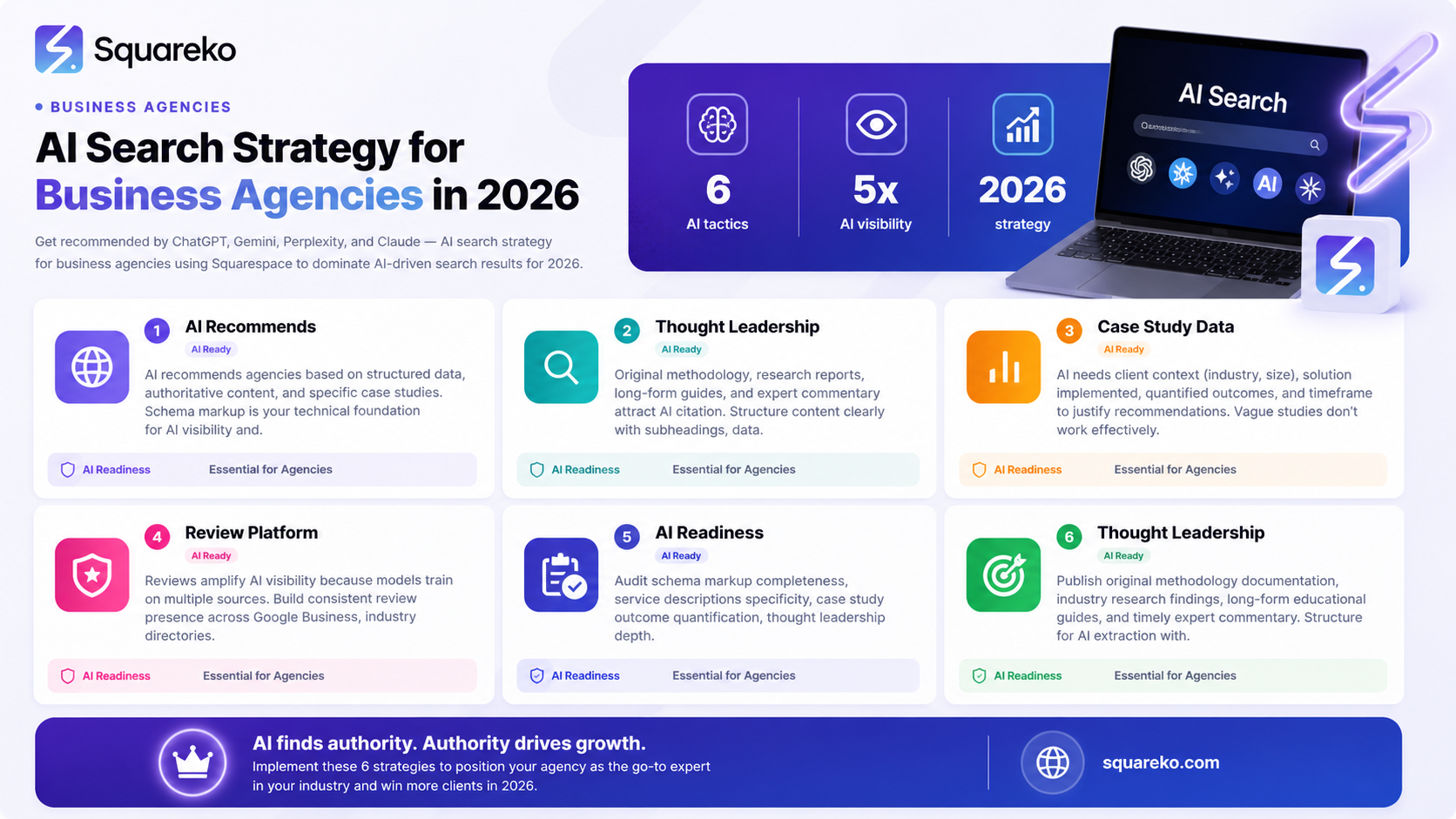
AI systems cite agencies based on structured data and authoritative content, not organic visibility alone. ProfessionalService schema is your technical foundation.
Thought leadership content attracts AI citation by providing original insights, methodology, and case study data that language models recognise and extract.
Review platforms and third-party mentions amplify AI visibility because AI models train on and cite multiple data sources, not just your website.
Agency case studies with quantified outcomes are gold for AI systems; they're what models extract to justify why they recommend you.
Topical authority signals expertise to AI through interconnected, well-structured content that demonstrates depth in specific service areas.
You control your narrative through schema and structured data, ensuring accurate, complete representation of your services, credentials, and track record.
Squarespace's native SEO features make AEO (AI Engine Optimisation) achievable without requiring complex custom development.
How AI Systems Recommend Business Agencies
AI systems don't work like Google Search. Google prioritises links and content freshness. AI systems work differently: they're trained on vast datasets that include your website, industry publications, case studies, review platforms, and business directories. When someone asks an AI system for a recommendation, it synthesises what it has learned across those sources and generates a response.
The crucial point: AI systems cite what they've been trained to recognise as authoritative and specific.
When ChatGPT, Claude, or another language model encounters a question like Which digital transformation agencies in the UK have strong brand strategy experience?, it draws from its training data to identify candidates. It then justifies its recommendation by citing the reasoning it extracted during training—usually specific case studies, testimonials, methodology, or notable client work.
For your agency to be recommended, three things must happen:
Your agency must exist in the training data (published on your website, industry publications, directories, review platforms)
Your expertise must be demonstrable through concrete examples (case studies, thought leadership, client testimonials)
Your information must be structured and complete (schema markup, author credentials, service descriptions, verified reviews)
Most business agencies miss the third element entirely. They create great content and case studies, but they don't structure the data in ways that AI systems can reliably extract and cite. This is where your competitive advantage lies.
Professional Service Schema: Your Technical Foundation for AI
Schema markup is a standardised language that tells AI systems—and search engines—exactly what your agency is, what you do, and who you serve. For business agencies, Professional Service schema is the single most important technical SEO element for AI visibility.
Unlike HTML, which is designed for humans, schema provides machine-readable structure. When you implement ProfessionalService schema correctly, you're saying to AI systems: Here is an agency. Here are its credentials. Here is the type of work we do. Here is proof of our capability.
Here's why this matters for AI recommendation: language models are trained on structured data. They learn patterns. When they see dozens of agencies with complete, well-structured ProfessionalService data, they learn to recognise and trust agencies that follow that same pattern. Conversely, agencies without schema are harder for AI to categorise and cite.
Core Components of Professional Service Schema for Agencies
Agency Name and Contact Information This is baseline. Your agency name, phone number, email address, and website URL must be clear and consistent across all channels. AI systems check consistency as a trust signal.
Service Description A clear, specific description of your core services. Don't write generic text. Write: Digital transformation consulting for mid-market financial services firms instead of We help businesses succeed.
Credentials and Qualifications If agency principals hold certifications, awards, or industry recognitions, include them. AI systems cite credentials to justify recommendations. This is especially powerful if your team holds recognisable qualifications.
Geographic Service Area Define where you work: UK-wide, London and South East, or Global with specific countries. Geographic specificity is a ranking signal for location-based AI recommendations.
Aggregated Rating and Review Count This is powerful for AI systems because it's quantified proof of client satisfaction. More on this below in the Review Platform Strategy section.
Thought Leadership Content Strategy for AI Citation
Thought leadership isn't just a marketing tactic anymore. It's the primary mechanism by which AI systems learn what your agency is capable of and should recommend you.
When you publish a substantive article about your methodology, share insights from recent client work, or explain a framework you've developed, that content enters the training datasets of future AI models. If that content is cited in industry publications, referenced in other experts' work, or shared across professional networks, it becomes even more valuable to AI systems.
Types of Thought Leadership That Drive AI Citation
Original Methodology and Frameworks If you've developed a unique approach—call it something memorable—and you document it thoroughly on your site, AI models learn to associate your agency with that methodology. When someone asks about that approach, you get cited.
Example: If your agency developed The Three-Pillar Brand Transformation Framework, and you've published comprehensive content explaining it, documented case studies showing it in action, and discussed it in interviews, AI systems will recognise and cite it.
Research Reports and Original Data Original research—surveys, benchmarking studies, industry analysis—is highly valued by AI systems. Language models are trained to recognise and cite original research as authoritative.
If you've conducted research on how brands in your sector approach digital transformation, publish that research. Include the methodology, key findings, and implications. This becomes a citation opportunity whenever someone asks about trends in your industry.
Long-Form Educational Content Comprehensive guides and tutorials on your core competencies establish topical authority. Write guides that are genuinely useful and wouldn't be out of place in a professional journal.
A guide titled How to Conduct a Digital Transformation Audit: A 12-Step Framework is far more likely to be cited by AI systems than 5 Digital Transformation Tips.
Expert Commentary and Industry Observations When industry events happen—regulatory changes, market trends, new technologies—publish sharp, timely analysis. AI systems are trained on recent content and recognise current commentary as authoritative.
Structure Your Thought Leadership for AI Extraction
AI systems extract information more reliably from well-structured content. When writing thought leadership:
Lead with insights, not platitudes. State your core finding or perspective in the first paragraph. AI systems extract the opening section as summary.
Use subheadings to signal structure. AI systems scan subheadings to understand content hierarchy and key points.
Include specific data points and examples. AI systems cite specific numbers, client examples, and methodologies. Generic observations are less valuable for citation.
Link to related content on your site. Internal linking signals topical authority to AI systems.
Optimise author credentials. Include a detailed author bio with credentials, expertise, and social proof. AI systems cite authors when recommending content.
Case Study Data: What AI Models Extract and Why It Matters
Case studies are the most powerful tool for AI agency recommendation—if they contain the right information.
When an AI system recommends your agency, it needs to justify that recommendation. It does this by citing specific evidence: They helped a mid-market financial services firm reduce onboarding time by 40% through digital transformation or Their brand strategy work helped a B2B SaaS company increase ARR by £2.3M.
Vague case studies don't work. AI systems need:
Client context
Solution implemented
Quantified outcomes
Timeframe
Structuring Case Studies for AI Extraction
Use clear categories and labels. Instead of writing narrative prose, structure your case study like this:
Client: [Industry, company size]
Challenge: [Specific problem]
Solution: [What you implemented]
Results: [Quantified outcomes]
Duration: [Project timeline]
This format allows AI systems to parse and extract information reliably.
Include specific, measurable outcomes. Instead of improved efficiency, write reduced project delivery time from 16 weeks to 10 weeks or increased qualified lead generation by 156%.
Name your methodology. If you followed a specific process or framework, name it. AI systems recognise named methodologies and cite them.
Publish case studies on your website. Don't just keep them in PDFs. Publish full case studies as blog posts or dedicated pages. AI systems index web pages more reliably than documents.
Case Study Schema Implementation
UseCase Study schema markup when publishing on Squarespace (through custom code blocks). This tells AI systems explicitly: This is a case study. Here is the client, problem, solution, and results.
Even if Squarespace doesn't have a built-in block for Case Study schema, you can add it via the code blocks or in your site's header through custom CSS/JavaScript. We'll cover implementation specifics below.
Building Topical Authority on Your Squarespace Site
Topical authority is about depth and interconnection. When your Squarespace site demonstrates comprehensive knowledge of specific topics, AI systems recognise you as an authority. This leads to more citations and recommendations.
Instead of publishing one article about brand strategy, publish a series:
How to conduct a brand audit
Developing a brand positioning statement
Building an employee advocacy programme
Measuring brand strategy ROI
Brand transformation for scale-ups
Then link them together. This interconnected content signals to AI systems that you've written deeply about brand strategy. When someone asks an AI system about brand strategy consulting, they're more likely to recommend your agency because your site demonstrates comprehensive expertise.
Topical Clusters on Squarespace
Organise your content into clear topical clusters:
Pillar page: A comprehensive overview of a major topic
Cluster content: 5–10 supporting articles that explore specific aspects
Internal linking: Link cluster articles back to the pillar and to each other
Squarespace's built-in blogging tools and linking features support this structure well. Use category tags to group related content and make your topical clusters visible to both visitors and AI crawlers.
Author Authority and Credentials
Each piece of thought leadership should have a detailed author bio that includes:
Professional title and credentials
Years of experience in the field
Key achievements or recognition
Social proof
This signals to AI systems that your content is written by recognised experts, not by generalist content teams.
Review Platform Strategy for AI Visibility
AI systems train on multiple data sources. Review platforms—Google Reviews, Trustpilot, Industry-Specific Directories—are important sources of training data.
Here's what happens: when an AI system is trained, it learns patterns from reviews. It learns what clients say about their experience with your agency. When someone asks an AI system for a recommendation, it draws on those learned patterns and may cite review data to justify its recommendation.
Which Review Platforms Matter for AI Training?
Google Business Profile Google reviews are indexed and included in training datasets for large language models. Maintain an active, complete Google Business Profile with current contact information, service descriptions, and encourage client reviews.
Industry-Specific Review Platforms For B2B agencies, platforms like Clutch, The Manifest, and Good Firms are gold standard. These platforms are specifically recognised by AI systems as authoritative sources for agency information and client feedback.
LinkedIn LinkedIn company pages and employee recommendations are increasingly part of AI training data. Ensure your company page is complete with detailed service descriptions, employee testimonials, and case studies.
Your Own Website Reviews Customer testimonials and case studies on your website count too. Structure them with clear attribution (client name, role, company) so AI systems can recognise and cite them as verified feedback.
Building Your Review Strategy
Identify 3–5 key platforms where your target clients look for agencies
Claim and complete your profiles on each platform with comprehensive service descriptions and contact information
Encourage client reviews after successful project completion. Make this a formal part of your offboarding process.
Respond to reviews (both positive and constructive feedback). This signals active engagement to AI systems.
Monitor review consistency across platforms. Ensure your description of services, credentials, and geographic service area is consistent everywhere.
Consistency across multiple platforms is a trust signal that tells AI systems your information is reliable and worth citing.
Implementing Professional Service Schema on Squarespace
Squarespace has improved its schema support in recent years, but you'll likely need to implement custom schema for optimal results.
Native Squarespace Schema Support
Squarespace automatically adds basic schema to:
Business information (name, address, phone)
Blog posts (articles with publication date, author)
Basic organisation data
This is a good starting point, but it's not sufficient for full AI visibility. You need ProfessionalService schema specifically.
Adding Custom ProfessionalService Schema
Here's the recommended approach for Squarespace:
Step 1: Add Code to Your Site Header
Go to Settings → Website → Advanced → Code Injection and add the following JSON-LD schema in the header:
{
  "@context": "https://schema.org/",
  "@type": "ProfessionalService",
  "name": "Your Agency Name",
  "image": "https://yoursite.com/your-logo.png",
  "description": "Your agency description and core services",
  "address": {
    "@type": "PostalAddress",
    "streetAddress": "Your Street Address",
    "addressLocality": "Your City",
    "addressRegion": "Your Region/County",
    "postalCode": "Your Postcode",
    "addressCountry": "GB"
  },
  "telephone": "+44 (0) Your Phone Number",
  "email": "contact@youragency.com",
  "url": "https://yoursite.com",
  "priceRange": "Price range if applicable",
  "areaServed": ["GB", "USA", "Other countries if applicable"],
  "knows": {
    "@type": "Service",
    "name": "Your Core Service 1",
    "description": "Description of service 1"
  },
  "aggregateRating": {
    "@type": "AggregateRating",
    "ratingValue": "4.8",
    "reviewCount": "Number of reviews"
  },
  "sameAs": ["Your social media URLs"]
}
Step 2: Add Service-Specific Schema
For each major service your agency offers, add detailed Service schema. Do this on individual service pages:
{
  "@context": "https://schema.org/",
  "@type": "Service",
  "name": "Digital Transformation Consulting",
  "description": "Comprehensive digital transformation services for mid-market enterprises",
  "provider": {
    "@type": "ProfessionalService",
    "name": "Your Agency Name"
  },
  "areaServed": "GB",
  "serviceType": "Consulting"
}
Step 3: Add Case Study Schema
For case study pages, use Case Study schema:
{
  "@context": "https://schema.org/",
  "@type": "Case",
  "name": "Case Study Title",
  "description": "Brief case study description",
  "caseNumber": "Case-001",
  "plaintiff": "Your Agency Name",
  "defendant": "Client Name (or 'Anonymous' if confidential)",
  "judge": "Project Outcome",
  "url": "https://yoursite.com/case-study-url"
}
Note: Squarespace doesn't have a dedicated Case Study content type. You'll need to add this schema to case study blog posts using code blocks or header injection. You can also use the Article schema with custom fields that reference case study data.
Step 4: Verify Your Schema
Use Google's Rich Results Test to verify your schema is correctly implemented. This isn't specific to AI systems, but it ensures your structured data is valid—and valid schema is more likely to be extracted by AI systems.
Agency AI Search Readiness Assessment
Before implementing your full AI search strategy, evaluate your current readiness. Answer these ten questions honestly:
The Assessment
1. Do you have complete ProfessionalService schema implemented on your website?
No (0 points)
Partial implementation (5 points)
Complete implementation across all service pages (10 points)
2. How many comprehensive case studies with quantified outcomes do you have published?
0–2 (0 points)
3–5 (5 points)
6+ (10 points)
3. How complete and consistent is your information across Google Business Profile, LinkedIn, and industry review platforms?
Minimal presence; inconsistent information (0 points)
Present on 1–2 platforms; partially consistent (5 points)
Complete across 3+ platforms; fully consistent (10 points)
4. Do you publish original thought leadership (research, methodology, frameworks) monthly or more frequently?
No regular thought leadership (0 points)
Quarterly or occasionally (5 points)
Monthly or more frequently (10 points)
5. Do you have clear topical clusters on your website (interconnected content around specific service areas)?
No topical structure (0 points)
Beginning to organise by topic (5 points)
Clear topical clusters with internal linking strategy (10 points)
6. Are your team members' professional credentials, certifications, and achievements clearly documented on your website?
No (0 points)
Partially documented (5 points)
Fully documented with links to verification sources (10 points)
7. What percentage of your case studies include specific, quantified business outcomes?
0–25% (0 points)
26–75% (5 points)
76–100% (10 points)
8. Do you actively encourage and collect client reviews on industry-standard platforms like Clutch, The Manifest, or Google?
No systematic approach (0 points)
Ad hoc requests (5 points)
Formal process with regular requests and monitoring (10 points)
9. Does your website have an author profile system where content creators are identified with credentials?
No author profiles (0 points)
Basic author identification (5 points)
Detailed author profiles with credentials, social proof, and expertise areas (10 points)
10. Have you conducted an audit of how AI systems currently cite or mention your agency?
No awareness of AI mentions (0 points)
Occasional checking of AI responses (5 points)
Regular monitoring across multiple AI platforms (10 points)
Scoring and Interpretation
0–30 points: Early Stage Your agency is not yet optimised for AI visibility. Start with ProfessionalService schema implementation and publishing one comprehensive case study per quarter.
31–60 points: Developing You have foundations in place. Focus on expanding thought leadership and ensuring data consistency across platforms. Add 2–3 more case studies to your portfolio.
61–80 points: Advanced You're well-positioned for AI citation. Optimise topical clusters and author credentials. Begin monitoring AI platforms to see results.
81–100 points: Industry-Leading Your agency is highly visible to AI systems. Focus on maintaining consistency and expanding your thought leadership reach through speaking, interviews, and media contributions.
Thought Leadership Content Strategy for AI Citation (Expanded)
We touched on thought leadership earlier, but it deserves a deeper exploration because it's central to AI recommendation.
Why AI Systems Cite Thought Leadership
Large language models are trained on vast amounts of text from the internet, academic sources, industry publications, and business websites. When they're trained, they learn to recognise expertise markers. These include:
Original frameworks and methodologies
Research and data
Detailed case examples
Expert credentials and recognition
Consistent publication in a specific domain
When you publish thought leadership aligned with these markers, you're making your agency's expertise learnable and citable by AI systems.
A 12-Month Thought Leadership Calendar
Month 1: Methodology Deep Dive Publish a comprehensive guide to your core methodology. Include historical context, step-by-step breakdown, and examples. This becomes a cornerstone piece that AI systems will reference repeatedly.
Month 2: Original Research Launch Publish findings from original research—a survey, benchmarking study, or analysis of industry trends. Include methodology, key findings, and implications.
Month 3: Case Study Release Publish a detailed case study with quantified outcomes. Structure it to highlight your methodology in action.
Month 4–6: Topical Deep Dives Over three months, publish a series of articles exploring different aspects of a core competency. Link them together strategically.
Month 7: Industry Trend Commentary Write sharp analysis of current industry events, regulatory changes, or market shifts. Position your agency's perspective.
Month 8: Original Interview Series Conduct and publish interviews with clients, industry experts, or thought leaders. This adds authority and creates linking opportunities.
Month 9: Practical Guides Publish step-by-step guides for core processes your agency helps with. These are highly citable because they provide actionable value.
Month 10: Certification or Award Win If your team achieves certification or recognition, publish details. This is a credential marker that AI systems value.
Month 11: Year-in-Review Analysis Publish comprehensive year-in-review analysis of industry trends, client outcomes, or market movements.
Month 12: Strategy Forecast Publish forward-looking analysis predicting next-year trends and opportunities.
This calendar ensures consistent, strategic publication that builds authority with AI systems. Each piece reinforces the others, creating a strong topical authority signal.
-
Getting recommended by ChatGPT, Claude, or similar AI systems requires three elements working together:
First, your agency must exist in the training data. This happens through your website, published content, case studies, and presence on industry platforms. ChatGPT's training data has a knowledge cutoff (for ChatGPT, it's April 2024; for Claude, it's more recent). Your website and published content must be live and discoverable during the training period.
Second, your agency must be clearly identified as an expert in your domain. This happens through thought leadership, credentials, and case studies. When an AI model is trained, it learns patterns. If it sees your agency consistently publishing expert content, winning awards, or being cited by others, it learns to associate you with expertise.
Third, your data must be structured and consistent. Use ProfessionalService schema. Ensure your contact information, service descriptions, and credentials are identical across your website, Google Business Profile, LinkedIn, and review platforms. Consistency signals reliability to AI systems.
To actively improve your chances: publish monthly thought leadership, maintain 4–6 detailed case studies with quantified outcomes, actively seek reviews on Clutch and Google, and ensure your team's credentials are visible.
Remember: you can't guarantee you'll be recommended, because you don't control the AI model's training or recommendation algorithm. But you can control the data you make available and how you structure it. Do that well, and recommendations become far more likely.
What schema markup should a business agency use for AI search?
The primary schema for agencies is ProfessionalService. This tells AI systems exactly what you are.
Additionally, implement:
Service schema for each major service you offer
Person schema for senior team members, with credentials and expertise areas
Case schema or structured case study data for project examples
Article schema for thought leadership and blog content
AggregateRating schema for client reviews
On Squarespace specifically, implement ProfessionalService and Service schema via code injection (as detailed above). For other schema types, Squarespace's native blog functionality handles Article schema automatically. Add Case Study schema through custom code blocks on relevant pages.
The key is being comprehensive. Each piece of schema provides another data point that AI systems can extract and cite. More data = more citation opportunities.
-
Topical authority is built through depth and interconnection.
Step 1: Identify 3–5 core service areas (e.g., "Digital Transformation," "Brand Strategy," "Change Management").
Step 2: For each core service area, create a pillar page—a comprehensive guide that covers the entire topic. This pillar should be 2,000+ words and cover history, methodology, current best practice, and common challenges.
Step 3: Create 5–8 supporting articles for each pillar that explore specific subtopics. These might be case studies, tactical guides, or expert interviews.
Step 4: Link cluster articles back to the pillar and to each other. Use consistent internal linking language and anchor text.
Step 5: Organise your blog using category tags that match your topical clusters. This makes structure visible to visitors and to AI crawlers.
Step 6: Update pillar pages quarterly to add new supporting content and refresh information.
On Squarespace, use the native blog functionality with categories and tags. This provides the structure AI systems expect. Additionally, manually add internal links between related posts—Squarespace's built-in linking tools make this straightforward.
Published depth in specific topics signals authority. AI systems recognise topical authority and cite agencies with it more frequently than generalist competitors.
-
Yes, but you'll need to go beyond Squarespace's native tools for full AI optimisation.
Squarespace automatically adds:
Basic organisation schema
Article schema for blog posts
Mobile optimisation and site speed features
These are good foundations. But Squarespace doesn't offer built-in ProfessionalService schema, Case Study schema, or detailed Person schema. You'll need to add these via code injection (the approach detailed above).
Additionally, Squarespace's built-in SEO tools focus on traditional search optimisation (keywords, headings, internal linking). AI visibility requires content strategy (thought leadership, case studies, topical authority) more than technical SEO tools. Squarespace is perfectly capable of hosting that content strategy, but you'll need to execute the strategy yourself.
Use Squarespace's native tools as your base, then extend with custom schema implementation and intentional content strategy.
-
For thought leadership, aim for monthly or bimonthly publication. This frequency signals consistency to AI systems and keeps your topical clusters fresh. If monthly feels challenging, minimum is quarterly—but quarterly is barely adequate in 2026.
For case studies, aim to add one new detailed case study every three months. If you're doing less than one per quarter, you're not providing enough citeable data for AI systems. Ideally, aim for one per month, but one per quarter is a reasonable baseline.
Update existing content quarterly. Refresh case study outcomes if new data is available, update thought leadership guides if information has changed, and refresh your pillar pages with latest industry developments. This shows AI systems your content is current and maintained.
-
SEO optimises for Google's algorithm: links, keyword relevance, content freshness, user experience. SEO is still important, and most of what you do for SEO helps with AI visibility too.
AI search optimisation focuses on different priorities:
Structured data and consistency matter more than backlinks for AI systems
Depth and specificity matter more than keyword frequency
Citeable data points (case outcomes, credentials, research findings) matter more than optimised copy
Multi-platform presence (your website, reviews, directories, social media) matters more than on-page optimisation alone
For business agencies, the best approach is to do both:
Maintain solid SEO (technical fundamentals, organic content quality, link building)
Layer on AI search optimisation (structured data, thought leadership strategy, case study depth, review platform presence)
On Squarespace, you can do both effectively. The platform has good SEO tools, and its flexibility with code injection allows you to implement the additional schema and technical requirements for AI visibility.
Conclusion
AI systems are reshaping how clients discover business agencies. The firms that thrive in 2026 will be those that optimise deliberately for AI visibility—not by trying to game algorithms, but by making their expertise genuinely discoverable and citable.
Your strategy has four pillars:
Structure your data with ProfessionalService schema and consistent information across all platforms
Build thought leadership that AI systems recognise as authoritative and original
Document your work with detailed case studies that include quantified outcomes AI systems can cite
Establish topical authority through interconnected content that signals expertise in specific service areas
On Squarespace, these strategies are entirely achievable. The platform's flexibility allows you to add custom schema, publish thought leadership systematically, and organise content in ways that support AI visibility.
The agency owners who implement this strategy now will be the ones recommended by ChatGPT, Claude, and next-generation AI systems for years to come. Your competitors are still focused on traditional SEO. You now have a roadmap to lead in the new AI-driven recommendation economy.
Agency AI Search Readiness Assessment (JSON-LD Schema)
{
  "@context": "https://schema.org/",
  "@type": "Quiz",
  "name": "Agency AI Search Readiness Assessment",
  "description": "10-question assessment to evaluate your agency's visibility to AI search systems",
  "educationalLevel": "Professional",
  "numberOfQuestions": 10
}
Get Help with Your AI Search Strategy
Building an AI-visible presence requires strategy, structure, and sustained content development. If you're a business agency using Squarespace, Squareko is here to help.
We specialise in optimising Squarespace sites for professional services agencies. We can help you:
Implement ProfessionalService schema and other structured data correctly
Develop a thought leadership content strategy aligned with your services and expertise
Structure and optimise case studies for AI citation
Build topical authority across your site
Coordinate your multi-platform presence for consistency and AI visibility
If you're ready to position your agency as a recommended expert in AI search results, book a consultation with our team. We'll audit your current AI visibility, identify gaps, and create a custom roadmap for 2026 and beyond.

Author Bio
I'm Walid Hasan, a Certified Squarespace Expert and Squarespace Circle Platinum Partner with over 12 years of hands-on experience designing and optimizing high-performing websites. Over the years, I've had the privilege of building more than 2,000 Squarespace websites for clients around the world, always focusing on clean design, strong user experience, and conversion-driven results.