5 Business Agency Website Mistakes That Lose You Contracts on Squarespace
Introduction
Your website is your business agency's most powerful sales tool—yet it's probably costing you contracts right now. When a prospect visits your site, they're not reading for pleasure. They're conducting due diligence, comparing you against competitors, and deciding whether to trust you with their money and their business problems.
The hard truth: most agency websites are built to look nice, not to win work. And that distinction matters enormously. A beautiful website that fails to demonstrate your value, prove your expertise, or differentiate your approach is essentially a digital storefront that turns prospects away rather than inviting them in.
We've audited hundreds of Squarespace agency websites—and the patterns are clear. The same business agency website mistakes keep appearing across the market, each one quietly eliminating qualified prospects from your pipeline. These aren't minor design quibbles. They're direct business development failures that stack against you every single day.
If you're wondering why your agency isn't winning contracts despite having decent traffic, the answer is probably sitting in one of these five categories. This guide reveals exactly what's wrong and how to fix it.
Key Takeaways 5 Business Agency Website Mistakes That Lose You Contracts on Squarespace
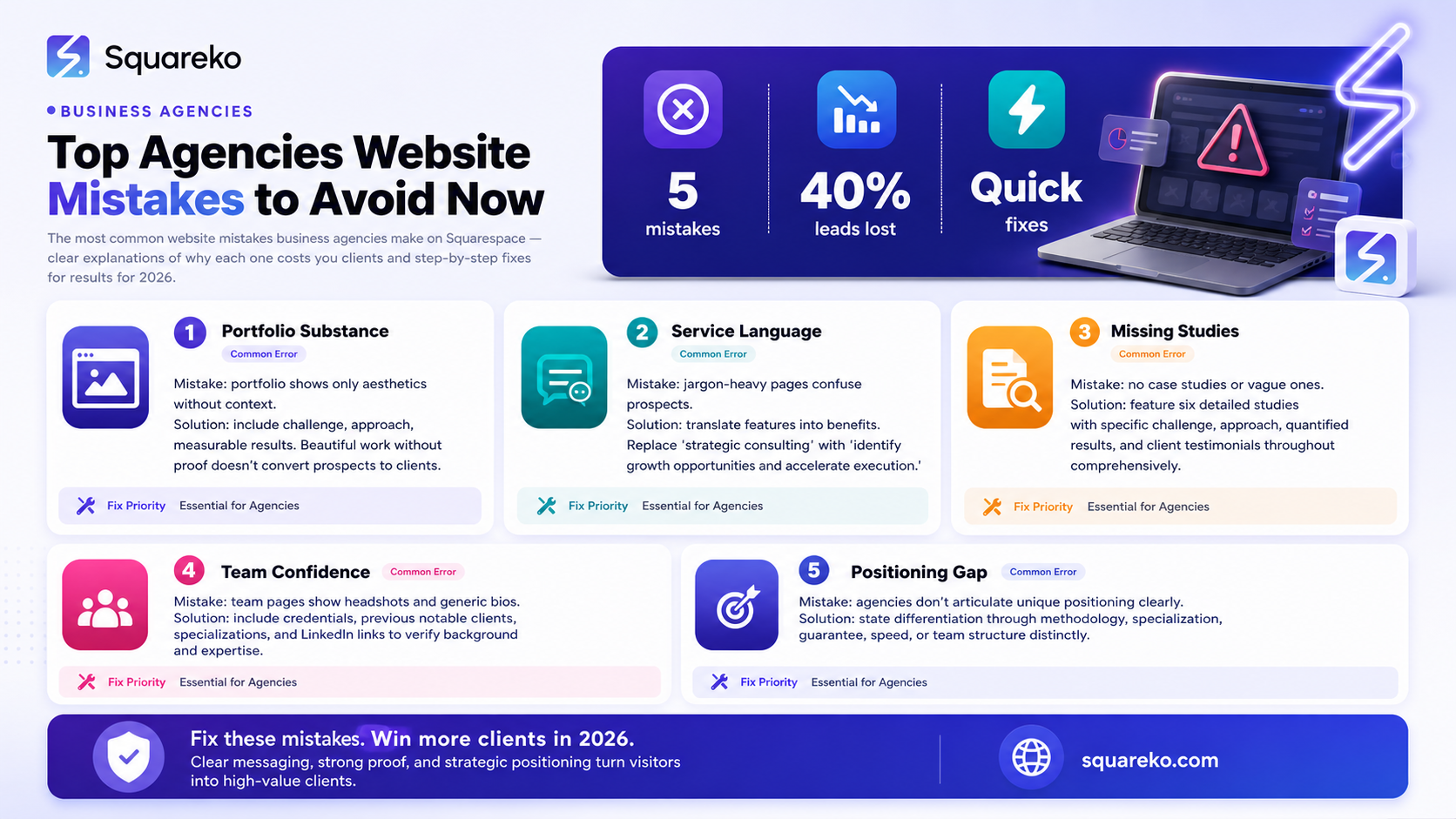
Weak portfolio presentations don't prove your value—prospects need to see specific results, not just pretty screenshots
Jargon-heavy service pages confuse buyers and make it impossible for them to understand what you actually do
Missing or poor case studies remove the social proof that turns interested prospects into paying clients
Weak team credibility sections signal inexperience—buyers hire people, not logos
No clear differentiation forces you to compete on price rather than demonstrated expertise
Mistake 1: Your Portfolio is All Style, No Substance
The Mistake
Your portfolio page displays 12 gorgeous project screenshots, each with a three-word description. The images look professional. The layout is clean. The visual hierarchy is excellent.
And prospects scroll past without clicking a single project.
Why It Loses Contracts
A portfolio built purely on aesthetics doesn't answer the questions a buyer is actually asking. When someone visits your portfolio, they're not asking: Does this look professional? They're asking: Can this agency solve my specific problem? What results did they achieve for similar clients? What was their actual role?
A vague portfolio becomes a commoditised portfolio. Without specifics, you're indistinguishable from ten other agencies showing ten other pretty screenshots. The prospect thinks: They've done nice work for nice-looking companies. So have their competitors.
Worse, vague portfolios signal weak results. A strong project description would highlight outcomes. The fact that you're not highlighting outcomes suggests they weren't remarkable.
The Squareko Fix
Reconstruct your portfolio as a results library. Each project needs:
The specific business problem the client faced
Your role and approach
Quantified outcomes
Visual proof
The client's industry
For example:
Weak: Digital transformation for luxury retailer. Redesigned e-commerce platform.
Strong: Luxury homeware retailer with flat online sales despite strong brand recognition. We rebuilt their e-commerce platform with personalised product recommendations and streamlined checkout. Result: 34% increase in online revenue within 6 months. Average order value increased 18%.
On Squarespace, use the Portfolio block to expand each project with this information. Add a case study link (which you should have, see Mistake 3). Link related services so prospects understand which of your capabilities solved this specific problem.
A portfolio built on results doesn't just look better—it converts better because prospects can see themselves in your past work.
Mistake 2: Your Service Pages Are Written in Consultant-Speak
The Mistake
Your service pages read like they were designed to impress other consultants. Words like synergise, optimise stakeholder engagement, facilitate change management, and strategic alignment fill your copy. The benefits are abstract. The language is formal.You sound intelligent. Your services sound confusing.
Why It Loses Contracts
Here's what happens in the buyer's brain: jargon creates friction. When a prospect can't immediately understand what you do, they don't blame themselves for being confused. They blame you for not explaining clearly. And that blame translates into lost trust.
Worse, when different team members speak about services differently, your credibility fractures. The prospect starts wondering: Do they actually know what they do? Are they making this up as they go?
Consultant-speak also makes it impossible for prospects to imagine working with you. They can't visualise the engagement or the outcome because the language is too abstract.
The Squareko Fix
Rewrite every service page using customer-first language. Here's the structure that works:
Headline: State the outcome the prospect wants (not what you offer).
Weak: Strategic Business Consulting
Strong: Increase Sales Without Increasing Your Marketing Budget
Problem section: Describe the specific frustration your ideal client experiences.
You're investing in customer acquisition, but your sales team isn't converting those leads into revenue. Meetings with prospects happen, but they choose competitors.
What we do section: Explain your approach in one paragraph using simple words.
We work with your sales and marketing teams to identify the specific reasons prospects aren't moving forward. We revise your positioning, train your team on objection handling, and restructure your sales process to move deals faster.
Outcome section: Show what success looks like and how it changes the client's business.
Clients typically see a 25–40% improvement in sales conversion within 90 days.
Services on this page: List what they get (very specifically, not vaguely).
Not: Sales enablement
Yes: Sales messaging audit, Sales collateral review, Team training (3 sessions), Sales process redesign, 90-day success planning
On Squarespace, use simple, short sentences. Use you language throughout. Break up walls of text with subheadings and bullet points. Prospects should never wonder what you do.
Mistake 3: You're Missing Case Studies (Or They're Too Vague)
The Mistake
You might have one case study on your site—or none. Or you have several, but they lack detail. They tell the story of your work without revealing what actually happened. We improved their marketing is not a case study. It's a claim without evidence.
Why It Loses Contracts
Case studies are the most powerful conversion tool in a services business. They prove you've done this before. They show outcomes. They reduce the risk in the prospect's mind because they're no longer taking your word for it—they're seeing evidence.
Without case studies, every interaction with a prospect starts at zero. The prospect has to take your word that you're competent, that you deliver results, that you're worth the investment. That's a high bar to clear in a single conversation.
With vague case studies, you're actually worse off than having no case studies. Vague case studies signal weak results—if the outcomes were strong, you'd brag about them.
The Squareko Fix
Create 3–5 in-depth case studies using this structure:
Client context:
Who they were (industry, size, approximate revenue if relevant)
What they were trying to achieve
The challenge:
The specific business problem (be precise)
Why it mattered to their business
What they'd already tried
Your approach:
What you recommended
How you worked together
Timeline (how long did it take?)
Results:
Quantified outcomes (percentages, numbers, revenue, cost savings)
Qualitative outcomes (improved team morale, reduced stress, clearer direction)
How this changed their business
Client quote:
A single powerful quote about the impact of your work
On Squarespace, create a dedicated Case Studies page. Link to case studies from your service pages. Feature a case study on your homepage. Consider creating PDF case study documents that prospects can download (this captures lead information and builds your email list).
A strong case study is worth three months of networking.
Mistake 4: Your Team Section Doesn't Build Buyer Confidence
The Mistake
Your team section shows headshots and job titles. Maybe there's a two-sentence bio for each person. The page serves a compliance function—Yes, we have a team—rather than a sales function.
Why It Loses Contracts
Prospects buy from people. When a buyer considers hiring your agency, they're essentially hiring the specific people who will work on their business. If your team section doesn't build confidence, the buyer's confidence in your agency falls.
A weak team section signals:
You're not proud of your expertise (or it's not distinctive)
You don't attract senior talent
You're a commodity agency where any team member is the same as any other
You're not investing in building your team's credibility
The Squareko Fix
Rebuild your team section to build buyer confidence. Each team member needs:
Professional photo:
High-resolution, professionally lit headshot
Consistent style across all bios (same background, same framing)
Friendly and professional expression
Name and role:
Be specific (Account Director, B2B Marketing not just Director)
Expertise summary:
3–4 sentences highlighting their specific expertise
Include their relevant experience (years in industry, notable past clients, relevant certifications)
What they specialise in on your team
Their value to your clients:
What unique perspective do they bring?
What results are they known for?
Social proof (optional but powerful):
Link to their LinkedIn profile
Include relevant credentials or certifications
If they've spoken at industry conferences, mention it
Client testimonial (very powerful):
A one-sentence quote from a past client about working with this team member
On Squarespace, use the Team block. Make sure each bio is at least 100 words (enough to build credibility without overwhelming). Link team members' LinkedIn profiles. Consider featuring your leadership team on your homepage.
A strong team section converts because buyers feel confident they're hiring experienced people, not a faceless agency.
Mistake 5: You Haven't Articulated Your Unique Positioning
The Mistake
Your homepage and service pages read like any other agency in your sector. You could swap your name out for three competitors and the copy would work just as well for them. You describe what you do (consulting, strategy, digital transformation) but not why your approach is different.
Why It Loses Contracts
Without clear differentiation, you're competing on price. The prospect reads your site, visits your competitors' sites, and thinks: These all sound basically the same. I'll go with the cheapest.
This is the death of agency pricing. You're trapped in a race to the bottom because you haven't given the prospect a reason to choose you beyond cost.
Differentiation isn't about being the biggest, best, or fastest. It's about being specifically right for your ideal client. It's articulating the one thing you believe that's different from how others in your sector operate.
The Squareko Fix
Define and articulate your positioning. Start with these questions:
Who is your ideal client?
Not mid-sized companies (too vague)
Professional service firms with 20–100 employees, bootstrapped founders who value profitability over growth, leadership teams stuck in $2–5m revenue range
What specific result do you deliver?
Not increased sales
Help sales-led professional service firms add £30k–50k revenue per partner within 18 months through pricing restructure and sales process optimisation
Why do you do this differently?
We believe most agencies over-complicate sales. We simplify it.
We believe business growth shouldn't require sacrificing profitability. We design growth strategies around your profit margins.
We believe strategy without execution is just consulting. We stay involved until results happen.
Once you've articulated this, weave it through your entire website:
Your homepage headline should reflect your positioning
Your About Us section should explain why you believe this
Your service pages should explain how this positioning translates into their specific results
Your case studies should feature clients who benefited from this unique approach
On Squarespace, use the Summary section and About page to articulate this clearly. Update your homepage to make your positioning impossible to miss.
Clear positioning doesn't make you smaller. It makes you more valuable to the right people.
-
There are usually three reasons: (1) your portfolio and case studies don't prove your value, (2) your service pages don't clearly explain what you do and what results you deliver, or (3) you haven't articulated why prospects should choose you instead of competitors. Start by auditing your portfolio, service pages, and positioning. If they're weak, prospects won't take the next step.
-
Clients look for five things: proof you've solved their specific problem (case studies), clear explanation of what you actually do, evidence of your expertise (credentials, team bios, thought leadership), specific results you deliver (not vague promises), and a clear sense of what working with you looks like. If your website is missing any of these, you're losing prospects.
-
Your website probably needs work if: (1) you haven't updated it in more than 18 months, (2) you're not tracking conversions or leads generated, (3) prospects mention confusion about what you do, (4) your portfolio doesn't clearly show results, or (5) you're competing primarily on price. A refresh focusing on clarity and results often matters more than a complete redesign.
-
A blog is valuable if you're publishing thought leadership that attracts your ideal clients and establishes your expertise. It's not valuable if it's just general industry news that anyone could write. Consider: Does this post help my ideal client solve a specific problem? Does it prove I understand their challenges? If yes, publish it. If no, skip it and focus on case studies and clear service pages instead.
-
Start with 3–5 in-depth case studies. Each should tell a complete story (challenge, approach, results). One generic case study is worse than none. Three excellent case studies that prospects can relate to are worth more than ten vague ones. Focus on quality over quantity.
-
Yes. Squarespace has the portfolio blocks, team sections, form builders, and SEO features necessary for an agency website that converts. The limitation isn't Squarespace—it's how most agencies use it. Squarespace websites fail when they prioritise design over clarity and results.
Conclusion
Your website is leaking contracts—and the fix is often simpler than you think.
The five mistakes we've covered aren't about design or technology. They're about communication. They're about failing to prove your value, failing to explain what you do, failing to build buyer confidence, and failing to articulate why prospects should choose you.
Every single mistake is fixable. You don't need a redesign. You need a reframe. You need to rebuild your website around what buyers actually need to see: proof you've done this before, clarity on what you do, evidence of your expertise, and specific reasons to choose you.
Start with the mistake that's costing you the most. Is it a weak portfolio? Rebuild it around results, not aesthetics. Jargon-heavy service pages? Rewrite them in customer-first language. Missing case studies? Create three in-depth ones. Weak team section? Rebuild it to build confidence. No clear positioning? Define it and make it visible throughout your site.
The agencies that win the most contracts aren't always the biggest. They're the ones with the clearest websites. The ones that make it easy for prospects to understand their value, see proof of their expertise, and decide to take the next step.
Your competitors are probably making all five mistakes. That's your opportunity.
Get Your Free Website Audit
Stop guessing whether your website is costing you contracts.
At Squareko, we specialise in building Squarespace websites that convert for professional service agencies. We've audited hundreds of agency websites and we know exactly which mistakes are losing you business.
We're offering a free website audit specifically for business agencies. We'll analyse your portfolio, service pages, case studies, team section, and positioning—then send you a detailed report identifying which of these five mistakes are costing you contracts, and exactly how to fix them.
Your audit includes:
Portfolio strength assessment (do your projects prove value?)
Service page clarity audit (do prospects understand what you do?)
Case study analysis (is your social proof working?)
Team section evaluation (does it build buyer confidence?)
Positioning assessment (why should prospects choose you?)
Specific action steps to implement immediately

From custom website design to SEO strategy, we help businesses launch a site that looks professional and performs better.

About Squareko
I'm Walid Hasan, a Certified Squarespace Expert and Squarespace Circle Platinum Partner with over 12 years of hands-on experience designing and optimizing high-performing websites. Over the years, I've had the privilege of building more than 2,000 Squarespace websites for clients around the world, always focusing on clean design, strong user experience, and conversion-driven results.