How to Write Agency Service Pages That Win New Business on Squarespace
Introduction
Your agency service pages are silent salespeople. They work 24/7 to explain what you do, why it matters, and why a prospect should choose you over competitors. Yet most agencies treat service pages as an afterthought—a place to dump features and jargon that confuses rather than converts.
The truth? Agency service pages on Squarespace have one job: translate what you offer into outcomes your clients actually care about. When you get this right, prospects arrive with 80% of their objections already answered. They're ready to click Get in touch.
This guide shows you how to write agency service pages that win new business. Whether you're a marketing firm, consulting practice, or creative studio, you'll learn the frameworks that convert browsers into clients—and the specific copywriting techniques that work within Squarespace.
Key Takeaways How to Write Agency Service Pages That Win New Business on Squarespace
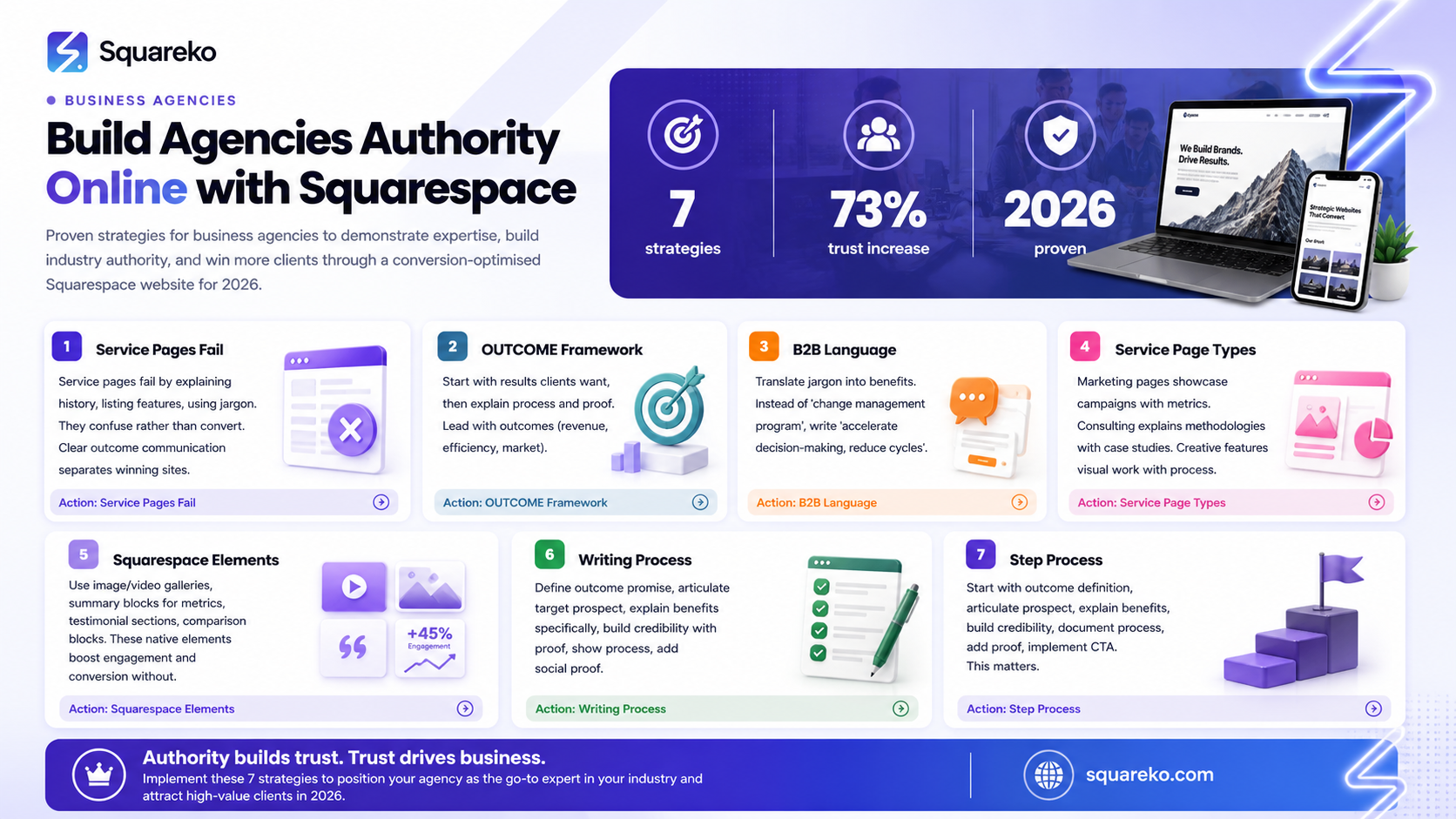
The OUTCOME First Framework reverses traditional copywriting: Start with results clients want, then explain your process and proof
B2B buyer language differs from B2C—translate agency jargon into benefit-focused statements that resonate with decision-makers
Three agency service page types (marketing, consulting, creative) require different emphases, structures, and proof elements
Specificity wins conversions: Replace vague claims with concrete examples, metrics, and client outcomes
Squarespace features like image galleries, testimonials, and forms create opportunities to strengthen your service page narrative
Page length matters: Aim for 1,200–1,800 words per service page—long enough to build trust, short enough to hold attention
Clear next steps (CTAs, contact forms, consultation scheduling) must appear at three points on your service page
Why Most Agency Service Pages Fail to Convert
Before we explore what works, let's examine what doesn't.
Many agency service pages begin with the agency. They explain company history, values, and philosophy. They list features: "We offer strategic consulting, brand development, and market research." They use industry jargon that sounds impressive but leaves prospects confused.
Here's the problem: Your prospect doesn't arrive on your service page thinking about you. They arrive thinking about their problem.
A marketing manager searching for agency marketing services isn't wondering about your agency's origin story. They're wondering:
Can you increase our lead generation?
How fast? What's the cost?
What if you fail?
Service pages fail when they prioritise what the agency wants to say over what the prospect needs to hear. They fail when they substitute complexity for clarity. They fail when they don't answer the one question every B2B buyer asks: What happens after we hire you?
Page Length Standard: This approach works best when applied consistently across your service page collection. An effective strategy is to dedicate 1,200–1,800 words to each distinct service.
The agencies winning new business online have discovered that service pages aren't about you. They're about your clients' transformation.
The OUTCOME First Framework: A Copywriting Method That Works
Most copywriting frameworks follow this sequence:
Features (what we do)
Benefits (why it matters)
Social proof (testimonials, case studies)
Call to action (contact us)
This approach works for consumer products. It fails for B2B agencies because prospects have competing priorities, budget constraints, and risk anxiety.
The OUTCOME First Framework inverts this sequence. It's designed specifically for professional service pages on platforms like Squarespace where your goal is to move prospects from awareness to commitment.
Step 1: Lead With Client Outcome
Your service page must begin by naming the specific outcome your client achieves. Not what you do. What they get.
Weak: We provide digital marketing strategy services.
Strong: Increase qualified leads by 40% in 90 days without increasing ad spend.
The first sentence of your service page should answer: What does success look like when we work together?
This works because B2B decision-makers evaluate services against internal outcomes. Finance needs revenue impact. Marketing needs lead volume. Operations needs efficiency gains. Your outcome statement directly addresses their success metric.
Step 2: Describe Your Process
Once you've established the outcome, explain the process your clients experience. This section should answer: What's involved? How long does it take? What do we expect from you?
Structure this as 3–5 clear phases. Use numbers and timeframes. Be specific about deliverables.
Example for a creative agency:
Our brand strategy process unfolds across four phases:
(1) Discovery—we interview stakeholders, analyse competitors, and audit current brand perception;
(2) Strategy—we develop your brand positioning, messaging framework, and visual direction;
(3) Rollout—we create brand guidelines and train your team;
(4) Optimisation—we monitor performance and refine over the first 90 days.
This section reduces uncertainty. Prospects understand what's involved. They can visualise the timeline. They feel more confident committing.
Step 3: Provide Evidence
Evidence comes in multiple forms. On Squarespace service pages, include:
Numbers: "We've helped 47 B2B firms improve their sales process efficiency by an average of 34%."
Before/After Metrics: Our clients average 18 months to ROI, with the fastest achieving positive returns in 6 months.
Case Study Reference: See how a mid-market consulting firm increased proposal close rates from 22% to 31% in this case study.
Client Logos: Visual proof that recognised brands trust you.
Testimonial: A specific quote addressing the exact outcome you promised.
Don't include vanity metrics. Focus on outcomes the prospect cares about: revenue, efficiency, time saved, risk reduced, market share gained.
Step 4: Define the Next Step
Your service page must end with a clear, unmistakable call to action. Not Contact us. Something specific.
Examples:
Schedule a free 30-minute strategy session
Download our service guide: [PDF name]
Book a consultation to discuss your specific needs
Join our webinar: How Agencies Like Yours Increase Lead Quality
Squarespace's native forms and scheduling integrations make this straightforward. The clearer your next step, the more prospects will take it.
The B2B Buyer Language Guide: Jargon to Benefit Translation
B2B agencies excel at using industry language. This is a strength internally it signals expertise. But on your service page, it creates distance between you and prospects unfamiliar with your terminology.
The solution isn't to dumb down your messaging. It's to translate jargon into benefit-focused language that resonates across different buyer personas.
Translation Framework
For each piece of jargon your agency uses, ask three questions:
What does this actually mean?
Why should the client care?
What outcome does this enable?
Common Agency Jargon—Translated
Original: "We conduct comprehensive stakeholder interviews and ethnographic research.
Translated: "We talk to your team and your customers to uncover what's actually driving behaviour. Most companies skip this step. It's why their strategies miss the mark. We ensure yours doesn't.
Original: Our data-driven methodology optimises campaign performance across multiple channels.
Translated: We track every pound you spend and shift budget toward channels generating the best return. You know exactly what's working and what isn't.
Original: We specialise in integrated brand architecture and positioning strategy.
Translated: If you've got multiple products or divisions, we help them work together instead of competing for attention. Customers understand what you do faster. Sales cycles shorten.
Original: Our full-funnel approach addresses awareness, consideration, and decision stages.
Translated: We build your business development plan across the entire journey—from the moment someone first hears about you through to the day they sign. No stage is ignored.
Original: We employ advanced segmentation and persona development.
Translated: "We identify your most valuable customer types and show your team exactly how to reach them. You stop wasting effort on prospects who'll never buy.
The pattern here: Agency jargon tends to describe what you do. Translated language describes what changes for the client.
When writing your service page, audit every sentence. If you've used industry terminology, translate it. Your prospect—the busy operations director or finance manager without agency experience—will engage far more deeply with clarity than complexity.
Three Agency Service Page Types: Structure and Content Strategies
Not all agency service pages are identical. Different service categories require different emphases, proof elements, and structural approaches.
Type 1: Marketing Services
Focus: Lead generation, pipeline impact, revenue outcomes.
Prospect Psychology: Marketing managers are measured on lead volume, quality, and cost per acquisition. They're under pressure to prove ROI. They're risk-averse because failed campaigns are highly visible.
Page Structure:
Outcome Hook: Lead with the metric—Generate 200+ qualified leads per month" or "Reduce customer acquisition cost by 35%.
The Problem: Acknowledge the marketing funnel challenge. Most companies struggle with volume or quality or both.
Your Approach: Explain your methodology. Use the 3–5 phase framework.
Specific Services Under This Category: List deliverables.
Proof Section: Include metrics from past campaigns, before/after engagement rates, client logos, and at least one detailed case study reference.
ROI Calculator: If possible, embed a simple Squarespace form or calculator showing projected impact.
Timeline: Be explicit. Most clients see meaningful lead increase within 60 days. Full pipeline maturation takes 120–180 days.
CTA: Schedule a 30-minute marketing assessment or Download our Lead Generation Playbook.
Example Sections:
The Cost of Inconsistent Lead Generation
How We Build Your Pipeline [Your process]
Marketing Services We Specialise In [List: Content Marketing, Paid Advertising, Landing Page Design, etc.]
Client Results [Metrics, logos, testimonials]
Next Steps: Your Free Marketing Assessment
Type 2: Consulting Services
Focus: Efficiency, strategy, transformation, time saved.
Prospect Psychology: C-suite executives and operations leaders hiring consultants want to solve specific business problems. They're evaluating you against internal resources. They expect expertise, structured thinking, and deliverables they can implement independently afterward.
Page Structure:
Outcome Hook: Lead with the business outcome—Reduce operational costs by 20% or Launch your new service line in 6 months, not 18.
The Challenge: Describe the typical problem this service solves.
Why This Requires External Expertise: Briefly explain why internal teams often can't solve this independently.
Your Consulting Approach: Detail your process. Emphasise structure, objectivity, and handoff (they should feel confident implementing without you).
Specific Consulting Areas: List practice areas.
Proof Section: Case studies should focus on measurable business outcomes, not activities. Include client testimonials from actual decision-makers.
Investment & Timeline: Consulting is expensive. Be transparent. Typical engagements range from £50,000–£250,000 and span 3–9 months depending on scope.
CTA: Schedule an exploratory conversation or Request our consulting overview.
Example Sections:
The Cost of Operational Inefficiency
Why Consulting Works
Our Four-Phase Consulting Model [Your process]
Consulting Services [List areas]
Client Case Study: [Company] Achieved [Outcome]
Investment & Expected Return
Type 3: Creative Services
Focus: Output quality, brand alignment, measurable impact on perception or behaviour.
Prospect Psychology: Creative services buyers (marketing directors, brand managers) want visible, tangible work they can show stakeholders. They're evaluating aesthetic quality and strategic thinking. They want partners who understand their brand deeply and translate that into assets.
Page Structure:
Outcome Hook: Lead with the perception or behaviour change—Redesign your brand and increase customer perception of innovation by 40% or Launch a campaign that generates 500K impressions and 40K engaged visitors.
The Problem: Describe weak creative output—generic design, misaligned messaging, underutilised visual assets.
Your Creative Process: Emphasise strategy before execution. We don't begin with design. We begin with brand strategy. Design follows strategy.
Specific Creative Services: List offerings (brand identity, web design, campaign creative, video production, etc.).
Portfolio Section: Squarespace's image gallery and portfolio features are crucial here. Show before/after examples. Include industry context.
Client Testimonials: Include quotes on how the creative work performed. Our website redesign increased conversion rate by 24% or The campaign creative generated 3x higher engagement than previous campaigns.
Creative Philosophy: Briefly explain your approach—minimalism, brand authenticity, data-informed design, user-centric thinking, etc.
Timeline: Brand identity projects typically span 6–8 weeks. Website redesigns take 10–14 weeks depending on scope.
CTA: View our full portfolio and schedule a creative consultation or Download our brand strategy workbook.
Example Sections:
Why Generic Design Costs You Customers
Our Brand-First Creative Philosophy
Creative Services We Offer
Portfolio Highlights
Client Testimonials: Creative Work That Performs
How We Work Together
Squarespace Elements That Strengthen Your Service Page
Squarespace offers native features designed to boost engagement and conversion on service pages. Use them strategically.
Image and Video Galleries
Strongest Use: Portfolio galleries for creative services, before/after comparisons, process visualisations.
Squarespace's gallery block allows you to present work in a clean, gallery-style format. For creative agencies, this is essential. For consulting or marketing services, use galleries to visualise your process or show client results.
Pro Tip: Include captions and alt text that describe the strategic thinking behind the work, not just what's visible. Example: Brand identity system for a fintech startup. The geometric shapes reference innovation while maintaining approachability.
Testimonial Blocks
Strongest Use: Client quotes addressing the specific outcome promised on this service page.
Don't use generic testimonials. Select quotes that directly reinforce your service's unique value. Include the client's name, title, and company. Ideally, add a photo.
Better Yet: Link to a full case study page where the client discusses their challenge, your approach, and measurable results.
Contact Forms and Scheduling Integration
Strongest Use: CTAs at three points—mid-page (after describing your process), sidebar, and footer.
Squarespace integrates with Calendly, Acuity Scheduling, and similar tools. Offer consultation scheduling alongside a contact form. Let prospects choose how to engage.
Pro Tip: Create form fields that capture information qualifying the prospect. Example fields:
What's your biggest challenge right now?
What's your timeline?
This data helps your team prioritise follow-up.
Text and Image Blocks with Contrast
Strongest Use: Emphasising key statements, breaking up dense copy, directing attention to CTAs.
Squarespace's design flexibility allows you to alternate text-heavy sections with image-focused sections. Use this rhythm to maintain engagement across a longer service page.
Stats or Metrics Blocks
Strongest Use: Displaying client results, process outcomes, or proof of expertise.
If Squarespace's native blocks don't provide what you need, many agencies use simple custom HTML or embed tools like Airtable to display metrics. Example: Avg. ROI: 300% | Avg. Timeline: 90 days | Client Retention: 92%
Button CTA Styling
Strongest Use: Making next steps unmistakable.
Squarespace allows custom button colours, text, and styles. Your main CTA buttons should contrast sharply with the page background and match your brand colour. Test button text like Schedule a consultation (specific) vs. Get in touch (vague).
Writing Your Service Page: Step-by-Step Process
Now that you understand the frameworks and Squarespace tools, here's how to write your service page from scratch.
Step 1: Define Your Outcome (The Promise)
Before writing a single sentence, define the specific business outcome your service delivers. Not activities. Outcomes.
Questions to answer:
What does success look like for your client?
How is that success measured?
What's the typical improvement ?
What does the client's reality look like after your work is complete?
Write your outcome in one sentence. This is your north star. Everything else follows from this.
Example: We help B2B consulting firms increase proposal close rates from 25% to 40% in 90 days.
Step 2: Map Your Process
Outline the phases or steps your clients experience. Aim for 3–5 phases.
For each phase, answer:
What happens?
How long does it take?
What's the deliverable?
What's the client's role?
Write these in plain English. Avoid jargon.
Step 3: Gather Your Proof
Collect:
At least one detailed case study (or case study reference)
Client testimonials
Metrics from past work
Client logos (with permission)
Before/after examples (if applicable)
If you don't have detailed case studies, create them now. They're critical to converting service page visitors.
Step 4: Write the First Draft
Use this outline:
Opening (H1 + first 150 words): State your outcome promise. Acknowledge the prospect's challenge. Position your service.
The Problem Section: Describe the cost of the problem (wasted time, missed revenue, internal struggle).
Your Approach: Describe your process using the 3–5 phases you mapped.
What You Deliver: List specific services or deliverables.
Proof Section: Metrics, case study, testimonials, logos.
Implementation & Timeline: Be specific about investment, timeline, and expected return.
Objection Handling: Include a short section addressing common hesitations.
CTA: Define your next step clearly.
Step 5: Optimise for Reading (Not Just SEO)
Use:
Clear H2 subheadings (one every 250–300 words)
Short paragraphs (2–4 sentences max)
Bullet points for lists
Bold text to emphasise key statements
Whitespace generously
Step 6: Replace Jargon With Benefits
Read through your draft and highlight any industry terminology. Use the B2B Buyer Language Guide above to translate each term.
Step 7: Test and Iterate
Share your draft with:
A team member unfamiliar with the service
A recent client
A prospect who didn't convert
Refine based on feedback.
Optimising for Search While Keeping Prospects Engaged
Your service page must work for two audiences: search engines and human prospects. These goals can align.
Keyword Integration
Include your focus keyword naturally in:
H1 title
First 100 words
At least one H2 subheading
Body copy
Meta title and description
For a service page targeting agency service pages squarespace win new business, you might write:
H1: How to Write Agency Service Pages That Win New Business on Squarespace
First paragraph: Your agency service pages have one job: translate what you offer into outcomes your clients care about. When you write agency service pages correctly, prospects arrive ready to convert.
H2 subheading: Why Most Agency Service Pages Fail to Convert
Body mention: The frameworks you'll learn here apply whether you're writing marketing service pages, consulting service pages, or creative service pages on Squarespace.
This approach integrates keywords naturally without keyword stuffing.
Internal Linking Strategy
Link from your service page to:
Case studies
Related service pages
Your blog
Your contact or consultation booking page (multiple times through CTAs)
Meta Information
Meta Title (50–60 characters):Write Agency Service Pages That Win New Business
Meta Description (150–160 characters): Learn how to write compelling agency service pages on Squarespace that convert prospects into clients. Discover the OUTCOME First Framework and B2B copywriting strategies.
These appear in search results. They should entice clicks while including your primary keyword.
Length and Depth
Search engines favour comprehensive content. Your service page should be 1,200–1,800 words, covering the topic in depth without unnecessary fluff. Each major service type deserves its own section or dedicated page.
Longer isn't always better, but thorough is. If you can cover everything in 1,200 words, don't pad to 1,800. If the topic requires 2,000 words, don't truncate.
-
A: Focus on client outcomes, not agency features. Begin every service page by stating the specific result your client achieves. Then explain your process, provide proof, and define a clear next step. The OUTCOME First Framework in this guide walks you through the exact structure successful service pages follow. Test and refine based on actual prospect feedback—what converts depends on your specific market and offering.
-
A: Transparency around pricing builds trust, but service pricing is often complex and project-dependent. Consider these approaches:
Publish Price Ranges: "Typical projects range from £15,000–£75,000 depending on scope." This sets expectations without committing to a fixed price.
Publish a Pricing Page Separately: If you offer tiered service packages, create a dedicated pricing page linked from your service page.
Include Price Ranges in Your CTA: "Schedule a consultation to discuss investment and expected return."
Use Consultative Sales: If your services are heavily customised, it's acceptable to reserve detailed pricing for initial conversations. However, your CTA should hint at investment range.
The key: Never force prospects into a sales call to learn whether they can afford you. Provide enough information that serious prospects self-qualify.
-
A: Aim for 1,200–1,800 words per service page. This length allows you to thoroughly explain your process, provide compelling proof, and address common objections without requiring multiple pages.
Some agencies offer multiple related services on a single page (e.g., "Content Marketing & SEO Services"). If you do this, ensure you've allocated 400+ words per service area. Otherwise, create separate pages for each distinct service.
Squarespace loads quickly even with longer pages, so length isn't a performance concern. Engagement matters more.
-
A: Include enough detail that a prospect understands what's involved and feels confident committing, but not so much that you're giving away your methodology.
Aim for the "process overview" level: "We conduct stakeholder interviews, develop a strategy, design assets, and train your team." Don't include "On Tuesday, we schedule 90-minute interviews with each of your 8 key decision-makers using this specific question framework we've developed."
The balance: Transparency about structure + confidence in your expertise without exposing proprietary methods.
-
A: Create dedicated service pages for each major offering. If you offer "Content Marketing & SEO Services," these are distinct enough to deserve separate pages with distinct outcomes, processes, and proof.
On your main services page, link to individual service pages. This structure helps both search engines (better content depth) and prospects (faster path to relevant information).
If you genuinely have only one service, one comprehensive service page is fine. Most agencies find that being specific (not broad) converts better anyway.
-
A: Double down on industry-specific outcomes and case studies. Instead of a generic "Marketing Services" page, create "B2B SaaS Marketing Services" with outcomes, case studies, and proof specific to that industry.
Your prospect—a SaaS founder—wants to know you've solved their specific challenge before. Generic service pages don't build this confidence. Industry-specific service pages do.
-
A: Test multiple CTAs:
"Schedule a free consultation" (low-friction, time-bound)
"Book your strategy session" (specific activity)
"Request a proposal" (decision-makers ready to commit)
"Download our service guide" (top-of-funnel, educational)
The best CTA depends on your sales process and prospect maturity. Most B2B service pages perform well with "Schedule a consultation" because it's low-commitment and action-oriented.
Include your primary CTA at least three times: after the process section, in a sidebar widget, and in the footer.
-
A: Review annually. Update immediately if:
Your process or offering changes
You've achieved significant new metrics or client results
Industry language or buyer priorities shift
Your page's conversion rate drops unexpectedly
Squarespace makes updates straightforward. Don't let outdated copy diminish your credibility.
Conclusion
Writing agency service pages that win new business isn't about clever copywriting or design tricks. It's about clarity, specificity, and genuine insight into what your clients care about.
The OUTCOME First Framework works because it mirrors how B2B buyers actually evaluate services. They arrive with a problem. They want to know what success looks like. They need confidence that you can deliver it. And they need a clear path to getting started.
The agencies capturing the most business online aren't the ones with the most impressive portfolios or the most premium pricing. They're the ones who explain their services in language their prospects actually understand—benefit language, not feature language. They're transparent about their process and evidence. They make taking the next step obvious.
Your Squarespace website has all the tools you need to do this. Image galleries, testimonial blocks, forms, scheduling integrations—they all support the frameworks in this guide. What matters is applying them strategically.
Start with one service page. Choose your highest-value service. Apply the OUTCOME First Framework. Map your process. Gather your proof. Write with benefit language. Test and iterate.
Then watch what happens when prospects arrive understanding not what you do, but what they become after working with you.
Ready to Build Service Pages That Convert?
At Squareko, we specialise in building Squarespace websites for professional service businesses—agencies, consulting firms, and creative studios included. We understand the unique challenge of translating sophisticated services into compelling, conversion-focused copy.
Whether you're redesigning existing service pages or building your Squarespace site from scratch, our team knows how to structure your services page for maximum impact. We've helped B2B service firms increase their consultation bookings by an average of 43% through strategic copywriting and Squarespace optimisation.
Ready to build service pages that actually win business?
Schedule a consultation with Squareko. We'll review your current approach, identify conversion opportunities, and show you exactly how to apply these frameworks within Squarespace.
From custom website design to SEO strategy, we help businesses launch a site that looks professional and performs better.

About the Author
I'm Walid Hasan, a Certified Squarespace Expert and Squarespace Circle Platinum Partner with over 12 years of hands-on experience designing and optimizing high-performing websites. Over the years, I've had the privilege of building more than 2,000 Squarespace websites for clients around the world, always focusing on clean design, strong user experience, and conversion-driven results.