
AI Search Strategy for Accounting Firms on Squarespace: Get Found by Business Clients in 2026
Introduction
AI search has fundamentally changed how business owners find and choose their accountants. When a freelancer asks ChatGPT, Do I need an accountant for my freelance business?, they're not seeing search engine results—they're getting an AI-powered response that may recommend (or ignore) your firm. When a startup founder searches for accounting firm for tech startups, generative AI provides curated recommendations alongside traditional search results. This shift represents both a challenge and an opportunity.
The accounting firms winning in 2026 aren't just optimising for Google; they're building what we call AI search visibility —positioning that makes them visible and trustworthy to artificial intelligence systems that are increasingly mediating client discovery. To get found by AI, your website must satisfy specific technical and content requirements: structured data that AI can understand, E-E-A-T signals that prove your expertise, and FAQ content that addresses the exact questions your ideal clients ask. This guide will show you exactly how to build AI search visibility for your accounting firm on Squarespace, so you're found whether your next client is searching Google, asking ChatGPT, or browsing LinkedIn. We'll cover YMYL +considerations, schema implementation, content optimisation, and a practical readiness assessment you can use today.
Key Takeaways AI Search Strategy for Accounting Firms on Squarespace: Get Found by Business Clients in 2026
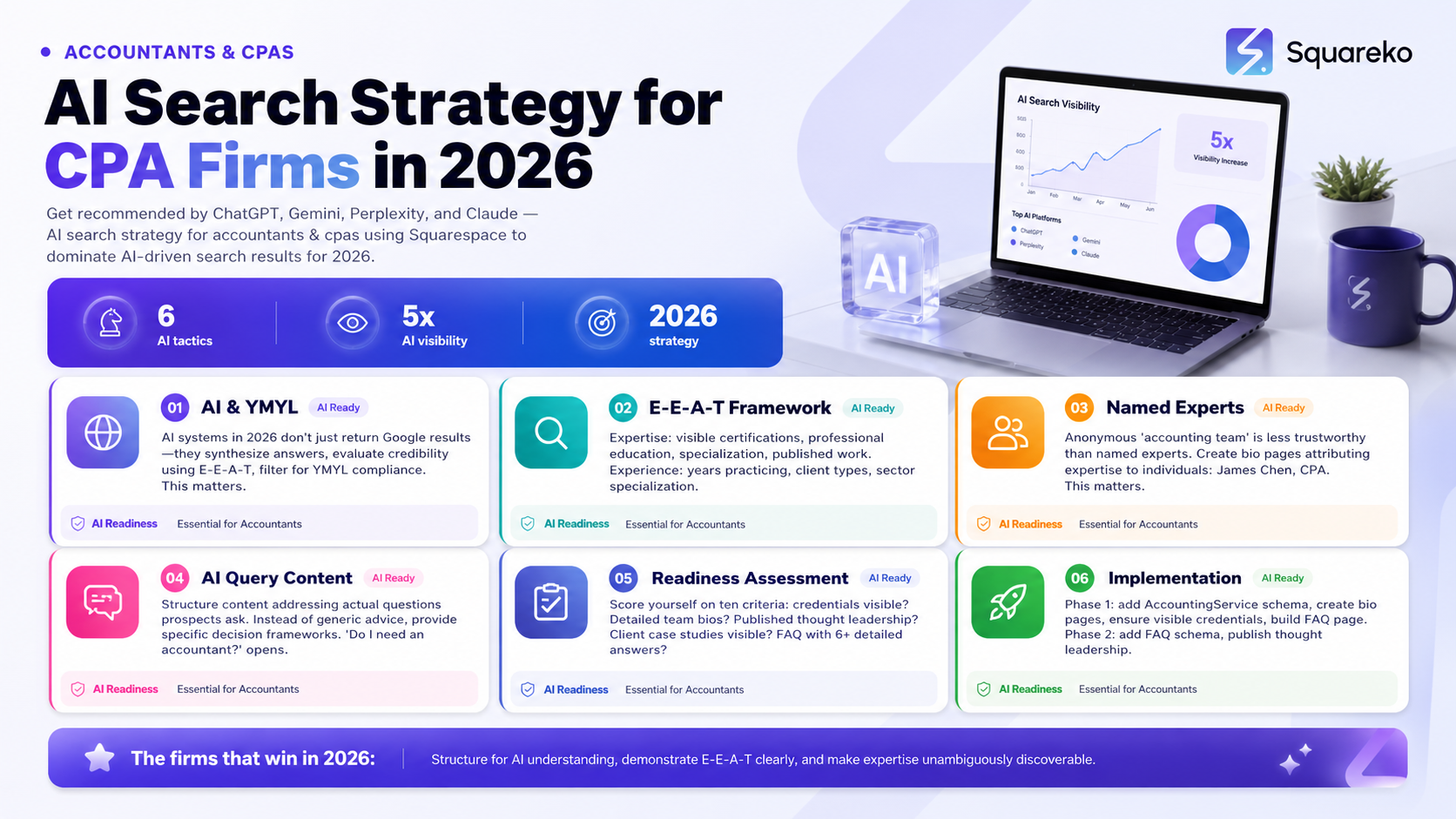
YMYL (Your Money or Your Life) accounting content requires highest E-E-A-T standards; AI systems treat financial advice as high-stakes and penalise low-authority content
E-E-A-T signals—author credentials, client results, industry certifications, published work—are critical for AI visibility; generic about us pages aren't sufficient
Accounting Service schema markup tells AI assistants exactly what services you offer, your location, pricing, and credentials; Squarespace supports this with custom code
FAQ schema and detailed answer content help AI systems answer Should I hire an accountant? and What does an accountant cost? questions with your firm's recommendations
Named expert positioning (featuring specific team members with visible credentials) builds trust signals that AI systems prioritise
Client results and case studies demonstrate E-A-T and are heavily weighted by AI systems evaluating recommendation credibility
Continuous content updates and authority building signal to AI that your site is a trusted, active source of financial guidance
Understanding AI Search and YMYL Financial Content
How AI Assistants Recommend Accountants
When someone asks ChatGPT, Should I hire an accountant? or Claude, What does an accountant cost?, the AI doesn't simply return the top Google result. Instead, it:
Searches the web for relevant, authoritative content
Evaluates source credibility using E-E-A-T signals (expertise, experience, authority, trustworthiness)
Filters for YMYL compliance — your money or your life content must meet high standards
Synthesises an answer that may include a direct recommendation or a framework for choosing
If your accounting firm's website lacks clear E-E-A-T signals or YMYL-appropriate content, AI systems simply won't recommend you, even if you rank well on Google.
What AI Systems Look For in Accounting Content
AI prioritises accounting websites that demonstrate:
Real expertise — Specific certifications (ACA, ACCA, CPA, CTA), not just experienced
Specific results — We typically save clients 12–18% on tax bills beats We help reduce tax
Client feedback — Testimonials, reviews, case studies (anonymised) that prove impact
Active, updated content — Sites showing recent activity are trusted more than stale sites
Professional presentation — Poor grammar, unprofessional design, or outdated information is a red flag
Clear scope and limitations — Reputable financial sites state what they do and don't do
Author credentials — Named experts with visible qualifications, not anonymous team voices
Your Squarespace site must visibly demonstrate these signals. Generic website content won't cut it.
The YMYL Imperative for Accountants
Your Money or Your Life is Google's formal designation for content that could significantly impact someone's financial security. Accounting advice absolutely qualifies. Because YMYL is high-stakes:
AI systems apply stricter evaluation to your content
You must prove authority more explicitly than you would for other topics
Credentials, certifications, and published work matter much more
Client results and testimonials carry significant weight
Outdated or vague content is penalised more harshly
This isn't about gaming the system—it's about demonstrating you're a responsible, expert resource worth recommending to someone seeking financial guidance.
E-E-A-T: The Framework That Matters to AI
Understanding E-E-A-T
E-E-A-T stands for Expertise, Experience, Authority, Trustworthiness. AI systems evaluate your website against all four dimensions. Let's break down what each means for accounting firms.
Expertise
What AI is looking for: Do the people on your site actually have accounting qualifications and specialised knowledge?
How to demonstrate it:
Prominent certifications — Display ACA, ACCA, CPA, CTA, or relevant tax credentials clearly on your site. Don't bury them in a team bio; put them in visible places (header, executive bios, service pages).
Professional education — Where did your team train? University attended, accounting bodies they're members of, all matter.
Specialisation — Generalist positioning is less authoritative than specialises in tech startup accounting or expert in contractor tax strategy.
Published work — Have your team published articles in accounting journals, industry publications, or reputable platforms? Link to them. AI systems see published work as evidence of expertise.
Experience
What AI is looking for: How many years have you been doing this? What have you actually worked with?
How to demonstrate it:
Timeline — 15+ years of accounting experience is better than no timeframe. Put this on your bio pages.
Client types — Specific mentions of client industries and business sizes you've worked with.
Sector specialisation — 8 years exclusively serving tech startups shows more relevant experience than 30 years of general accounting.
Growth or milestone achievements — If you've grown your practice significantly, expanded into new areas, or hit specific milestones, these signal experience and success.
Authority
What AI is looking for: Are you recognised as a leader in your field? Do other reputable sources cite or recommend you?
How to demonstrate it:
Thought leadership — Regular, high-quality content addressing real client challenges.
Speaking and visibility — If you've spoken at conferences, been featured in publications, or hold any professional roles , mention these.
Client social proof — Strong testimonials and reviews from recognisable businesses.
Partnerships or affiliations — Professional associations, certifications, or partnerships with other reputable firms.
Backlinks from authority sites — Links from industry publications, professional bodies, or highly regarded websites boost your authority signal.
Trustworthiness
What AI is looking for: Are you honest, transparent, and acting in clients' interests?
How to demonstrate it:
Clear pricing and scope — Don't hide fees or make vague promises. Be transparent about what you offer and what you don't.
Client testimonials with details — Great service! is less trustworthy than John, restaurant owner, saved 18% on taxes after our strategy review.
Professional credentials and memberships — Display current professional body memberships prominently.
Conflict of interest disclosure — If you recommend specific software or partners, disclose any relationships.
Responsive client communication — Quick, professional contact and consultation booking options signal you're accessible and serious about clients.
Data privacy and security — Ensure your site clearly addresses how you handle sensitive financial information. GDPR compliance language is important.
Implement AccountingService Schema Markup
What Is Schema Markup and Why It Matters
Schema markup is code embedded in your website that tells search engines and AI systems exactly what you're offering. Rather than asking an AI to infer that you're an accounting firm, schema tells it explicitly: This is an Accounting Service offering tax planning, bookkeeping, and advisory services to startups.
AI systems heavily favour websites with proper schema because it removes ambiguity and provides structured information they can recommend directly.
Accounting Service Schema for Squarespace
Here's a complete Accounting Service schema template for your accounting firm. You'll add this to your Squarespace site's footer or page header using a Code Block:
{
  "@context": "https://schema.org",
  "@type": "AccountingService",
  "name": "[Your Firm Name]",
  "description": "[Brief description of your services]",
  "url": "https://yoursite.com",
  "telephone": "[Your phone number]",
  "email": "[Your email]",
  "address": {
    "@type": "PostalAddress",
    "streetAddress": "[Your address]",
    "addressLocality": "[City]",
    "addressRegion": "[Region]",
    "postalCode": "[Postcode]",
    "addressCountry": "GB"
  },
  "areaServed": {
    "@type": "AdministrativeArea",
    "name": "United Kingdom"
  },
  "priceRange": "£££",
  "serviceType": [
    "Tax Planning and Compliance",
    "Bookkeeping and Accounting",
    "Business Advisory",
    "Payroll Services"
  ],
  "knowsAbout": [
    "Personal Tax",
    "Corporation Tax",
    "VAT",
    "Payroll Tax"
  ],
  "hasCredential": {
    "@type": "EducationalOccupationalCredential",
    "credentialCategory": "Professional",
    "name": "Chartered Accountant",
    "issuingOrganization": {
      "@type": "Organization",
      "name": "ICAEW" or "[Your body]"
    }
  },
  "aggregateRating": {
    "@type": "AggregateRating",
    "ratingValue": "[Your rating, e.g., 4.8]",
    "ratingCount": "[Number of reviews]",
    "bestRating": "5",
    "worstRating": "1"
  },
  "review": [
    {
      "@type": "Review",
      "reviewRating": {
        "@type": "Rating",
        "ratingValue": "5"
      },
      "author": {
        "@type": "Person",
        "name": "[Client name or business]"
      },
      "reviewBody": "[Testimonial text]"
    }
  ]
}
How to Add This to Squarespace
Go to Settings > Advanced > Code Injection
Paste the schema into the Header section
Update all placeholder values with your actual firm information
Click Save
Squarespace will automatically display this schema on all pages, telling AI systems exactly who you are and what you offer.
Key Fields Explained
serviceType: List the specific services you offer
knowsAbout: Areas of financial expertise your firm specialises in
hasCredential: Your team's professional credentials—this is critical for E-E-A-T
aggregateRating & review: Client testimonials and ratings—crucial for trustworthiness signals
areaServed: Geographic scope of your practice (UK-wide, specific regions, etc.)
This schema makes it clear to AI systems that you're a credible, properly credentialed accounting firm, not just any website talking about taxes.
Optimise FAQ Content for AI Recommendations
Why FAQ Content Is Critical for AI Visibility
When someone asks ChatGPT, Do I need an accountant for my freelance business?, the AI draws from content across the web to synthesise an answer. If your site has a detailed FAQ section answering exactly this question with specific, helpful guidance, your firm is much more likely to be cited or recommended.
FAQ schema markup signals to AI systems that your content answers common questions. This is incredibly valuable because:
AI systems prioritise FAQ content — They see structured FAQs as reliable information sources
You control the narrative — Rather than relying on generic advice elsewhere, your expert perspective is front and centre
It matches search intent perfectly — People (and AI) searching financial questions expect Q&A formats
High-Value FAQ Topics for Accounting Firms
Create detailed FAQs addressing these questions:
For startups:
"When should a new startup hire an accountant?"
"What accounting records do I need to keep?"
"How much does accounting cost for a startup?"
"Should I do my own bookkeeping or hire an accountant?"
For freelancers:
Do I need an accountant as a freelancer?
What are the tax implications of being self-employed?
Can I claim home office expenses as a freelancer?
What's the difference between a sole trader and a limited company?
For contractors:
Am I employed or self-employed?
What are my contractor tax obligations in the UK?
When should I register for VAT?
For general clients:
How often should I review my accounting?
What does professional accounting typically cost?
How much should I pay in tax?
Should I incorporate my business?
Each FAQ answer should be 3–5 sentences, specific, and honest. If the answer is "it depends," explain what it depends on. If there's a risk, mention it. This honesty builds trustworthiness signals that AI systems weight heavily.
FAQ Schema for Squarespace
Add this schema to your FAQ section:
{
  "@context": "https://schema.org",
  "@type": "FAQPage",
  "mainEntity": [
    {
      "@type": "Question",
      "name": "Do I need an accountant for my freelance business?",
      "acceptedAnswer": {
        "@type": "Answer",
        "text": "Yes, if your annual turnover exceeds £1,000. Below that, you're not legally required to file, but most freelancers benefit from professional accounting for tax planning, expense tracking, and peace of mind. We typically help freelancers save 15–20% through optimised expense claims and tax-efficient structuring."
      }
    },
    {
      "@type": "Question",
      "name": "When should a startup hire an accountant?",
      "acceptedAnswer": {
        "@type": "Answer",
        "text": "Ideally from day one, or at least before your first VAT filing. Early accounting support ensures proper record-keeping, cash flow visibility, and tax planning. Many startups discover issues later that could have been avoided with early guidance. For seed-stage startups, many accountants offer scaled pricing."
      }
    }
  ]
}
Implementation on Squarespace
Create a dedicated FAQ page on your site
Structure each question and answer clearly (Heading 3 for questions, paragraph for answers)
Add the FAQ schema via Settings > Advanced > Code Injection
Ensure each answer is comprehensive (3–5 full sentences, specific examples)
Link FAQ answers to relevant service pages
When AI systems crawl your site, they'll see structured FAQs with authoritative, specific answers—exactly what they're looking for.
Build Named Expert Positioning
Why Named Experts Matter to AI
Anonymous accounting team is less trustworthy than named experts with visible credentials. When someone reads advice attributed to James Chen, CPA, 12 years startup accounting experience, they're getting author credibility signals that make them more likely to trust—and act on—the advice.
AI systems recognise this and prioritise content from named, credentialed experts over generic team content.
Creating Named Expert Content
For each key team member:
Create an individual bio page with:
Full name, professional photo, credentials
Years of experience and specific industries
Notable client results (anonymised)
Any published work, speaking engagements, or professional roles
Direct contact option
Attribute content to that person — Rather than publishing blog posts anonymously, attribute them: "Written by James Chen, CPA, Startup Accounting Specialist" or "By Sarah Williams, Chartered Tax Adviser."
Link expert names throughout your site — When you mention a team member in service descriptions, case studies, or testimonials, link to their bio page. This builds authority associations.
Maintain professional profiles — Ensure your team's LinkedIn profiles are complete, current, and link back to your Squarespace site.
Named expert example:
Rather than: Our team provides accounting for tech startups.
Better: James Chen, CPA with 12 years of startup accounting experience, leads our tech practice. James has helped 40+ seed-stage startups raise Series A investment with investor-ready financials. He speaks regularly on startup accounting at TechCrunch Disrupt and has published on startup tax strategy in Entrepreneur magazine.
The second version gives AI systems concrete E-E-A-T signals: named expert, specific experience, measurable results, published work, and platform visibility.
Walid at Squareko: Our Named Expert
At Squareko, we work with Walid, our lead strategy consultant, who brings 15+ years of digital business experience and specialises in B2B professional service positioning. When we recommend specific strategies to our accounting firm clients, we do so with Walid's expertise behind it. This named expert positioning builds trust and differentiates our service. Your accounting firm should do the same.
Create Content That Answers AI Search Queries
How People (and AI) Search for Accounting Services
Your ideal clients aren't searching accounting services UK. They're searching specific problems or decisions:
Do I need an accountant if I'm self-employed? (decision-making)
What's the cheapest accountant for freelancers? (comparison)
Should I incorporate my business? (business structure decision)
Can I claim home office expenses as a freelancer? (specific tax question)
How much should I budget for accounting fees? (cost planning)
What accounting software should I use with my accountant? (implementation)
When you optimise content around these specific searches, you're not just ranking on Google—you're answering the exact questions AI systems synthesise answers from.
Content Framework for AI Visibility
For each high-value search query, create content that:
Opens with a direct answer — Don't bury the answer in paragraphs. Yes, most freelancers benefit from professional accounting if your annual turnover exceeds £1,000 is clearer than gradually revealing this.
Provides specific context — It depends is vague. It depends on whether you're incorporated, your industry, and your projected tax liability" is specific. AI systems favour specificity.
Includes decision-making frameworks — Give readers (and AI) a way to evaluate their situation. Use this five-question checklist to determine if you need an accountant.
Cites expert perspectives — According to ICAEW guidelines or As HM Revenue & Customs advises" adds authority.
Links to relevant services — End with a link to the relevant service page. If you decide you need accounting support, here's how we help freelancers with structure optimisation.
Includes specific examples — A freelancer in digital marketing earning £45,000 annually would typically save £2,800–3,500 through tax-efficient structuring is more useful (and AI-friendly) than "You could save money.
Example: "Do I Need an Accountant?" Content
Instead of generic advice, structure your content like this:
Headline: Do I Need an Accountant for My Freelance Business? The 2026 Reality
Opening paragraph: If your freelance income exceeds £1,000 annually, you're legally required to report it to HMRC. However, the real value of a professional accountant goes beyond compliance. Most freelancers we work with discover they save 15–20% annually through tax optimisation, expense categorisation, and business structure advice.
Three decision points:
Your annual income level and growth trajectory
Your comfort with tax and bookkeeping complexity
Your interest in tax planning beyond basic compliance
Specific scenarios:
If you're earning under £5,000 and comfortable with bookkeeping tools, you might manage alone.
If you're earning £15,000+, the tax savings from professional accounting typically exceed the fees.
If you're planning to hire staff or expand, accounting guidance early prevents costly mistakes.
Call-to-action: Ready to explore whether professional accounting makes sense for your situation?
This structure gives AI systems clear, specific information to draw from when recommending (or not recommending) accounting services to users asking the same question.
Accounting Firm AI Search Readiness Assessment
Use this 10-question assessment to evaluate your AI search readiness. Answer honestly—this will identify gaps to address.
Assessment Questions
Expertise & Credentials Visibility
Are professional credentials prominently displayed throughout your site? (Yes / Partially / No)
Credentials should appear on homepage, service pages, bios, and blog author attributions
Do you have detailed team bio pages with specific expertise, years of experience, and credentials? (Yes / Partially / No)
Generic Meet the Team doesn't count; individual, detailed bios are required
Experience & Authority Signals
Have you published thought leadership content in industry publications or reputable platforms? (Yes / Partially / No)
Blog posts on your own site count; published work elsewhere carries more weight
Can visitors easily see client results or case studies? (Yes / Partially / No)
Anonymised case studies showing specific client outcomes are valuable
Content Quality for AI
Do you have a comprehensive FAQ section with 6+ detailed questions answered in 3–5 sentences each? (Yes / Partially / No)
Generic FAQs don't count; answers must be specific and helpful
Is your content regularly updated and current? (Yes / Partially / No)
AI systems favour active, maintained sites; outdated content raises red flags
Technical Implementation
Have you implemented AccountingService schema markup on your site? (Yes / No)
Without schema, AI systems have to infer what you offer; schema tells them explicitly
Have you added FAQ schema markup to your FAQ section? (Yes / No)
FAQ schema signals to AI systems that your content answers common questions
Trust & Transparency
Is your pricing transparent or clearly explained? (Yes / Partially / No)
Vague pricing is a trust red flag to both humans and AI systems
Do you clearly state what you do and don't offer? (Yes / Partially / No)
Scope clarity builds trustworthiness; vague scope undermines it
Scoring
9–10 Yes: You're AI-search-ready. Focus on ongoing content updates and expert visibility.
7–8 Yes: You're close. Prioritise schema implementation and FAQ expansion.
5–6 Yes: You have gaps. Start with schema markup and detailed bios.
0–4 Yes: Significant work needed. Follow the implementation checklist below.
Squarespace Implementation Checklist
Phase 1: Foundation (Complete First)
Add AccountingService schema to Settings > Advanced > Code Injection (Header)
Create individual bio pages for key team members with credentials, experience, results
Ensure credentials are visible on homepage, service pages, and bio pages
Create a dedicated FAQ page with 6–8 detailed, specific Q&As
Phase 2: Content & Optimisation (Complete Second)
Add FAQ schema markup via Code Injection (Header)
Publish 3–5 thought leadership blog posts addressing common client questions
Attribute all blog content to named, credentialed team members
Add case studies or client results (anonymised) to relevant service pages
Link expert names throughout your site to their bio pages
Phase 3: Authority Building (Ongoing)
Maintain professional team LinkedIn profiles linked from site
Publish monthly thought leadership content addressing client decisions/challenges
Collect and display client testimonials and reviews with permission
Update team bios quarterly with new results, speaking engagements, published work
Monitor "People Also Ask" in Google for emerging FAQ topics to address
-
ChatGPT and other AI assistants don't have a "recommendations list" you submit to. Instead, they find and evaluate content across the web. To get recommended, you need: (1) a website with clear, specific, authoritative answers to questions your ideal clients ask (2) visible expertise signals—credentials, experience, results, published work (3) proper schema markup so AI systems understand exactly what you offer (4) consistent, updated content that signals you're an active, trusted source. If your website fully demonstrates E-E-A-T, has structured FAQ and schema content, and answers the exact questions AI systems are asked, you'll naturally appear in AI-generated recommendations. There's no shortcut; it requires genuine expertise and good website implementation.
-
Demonstrated expertise with specific results. Generic credentials and vague claims don't impress AI systems. Instead, you need visible evidence that you've worked with specific client types, achieved specific results, and can speak authoritatively about their challenges. This might be detailed bio pages attributing expertise to named individuals, case studies showing specific outcomes, or published thought leadership. The second most important factor is schema markup (AccountingService schema), which tells AI systems explicitly what you offer and who you are. Without schema, you're relying on AI systems to infer; with it, you're giving them structured information they're built to understand.
-
Yes. Squarespace supports custom code injection, which means you can add AccountingService schema, FAQ schema, and any other structured data your strategy requires. The platform's limitations are minimal for schema implementation. The real work isn't technical; it's strategic. You need the content and positioning to back up the schema. Squarespace also has solid SEO foundations built in—clean URLs, fast loading, mobile-responsive design, all of which matter for visibility (both traditional and AI search). If you're implementing an AI search strategy, Squarespace is a perfectly capable platform, provided your content and positioning are solid.
-
AI search visibility builds on the same timelines as traditional search, typically 3–6 months before meaningful changes. However, the impact can be faster if you implement schema correctly and publish high-quality, targeted content. You'll likely see faster results targeting specific, long-tail queries ("accountant for e-commerce sellers") than competitive, broad terms ("accountant"). The key difference from traditional SEO is that AI prioritises E-E-A-T signals more heavily, so investing in visible expertise, credentials, and specific results yields returns faster. Most firms see initial AI recommendations within 2–3 months of solid implementation; significant visibility shift within 6 months.
-
No. AI systems currently source information primarily from Google's index. If you're not ranking on Google, AI systems won't find your content. However, the reverse isn't always true: you can rank on Google without being recommended by AI if you lack E-E-A-T signals. The firms winning in both traditional and AI search are those who: (1) rank on Google (basic SEO + content) (2) demonstrate clear E-E-A-T (credentials, results, authority) (3) implement proper schema (structured data). This combination makes you visible to both Google's algorithm and AI systems evaluating credibility.
-
Your firm will be at a competitive disadvantage. As AI search adoption increases, more clients will be influenced by AI recommendations. Firms without AI visibility will miss these referrals. Additionally, the elements required for AI search visibility—clear credentials, specific results, thought leadership, schema markup—are also elements that improve traditional search rankings and general website credibility. So even if you're sceptical about AI, implementing AI search strategy improves your overall marketing position. The question isn't whether AI search matters yet; it's how quickly it will matter to your specific client base, and whether you want to be ready before competitors are.
-
Tracking AI search directly is difficult because AI systems don't provide referral data like Google does. However, you can measure proxy indicators: (1) overall organic traffic growth, which may include AI-driven traffic (2) branded search increases, suggesting AI mentions are driving awareness (3) consultation bookings from clients who mention "I found you on ChatGPT" or similar (4) rankings for specific long-tail, AI-friendly queries like "Should I hire an accountant for my freelance business?" (5) schema validation—use Google's Rich Results test to confirm your schema is correct. The best approach is to implement AI search strategy alongside solid traditional SEO, then monitor overall visibility and lead quality improvements over 6 months.
Ready to Build Your Accounting Firm Website on Squarespace?
AI is reshaping how business owners find and evaluate accountants. The firms thriving in 2026 aren't just optimised for Google; they're built to be found by AI systems, trusted by AI recommendations, and positioned as expert advisors—not commodity service providers. This requires a specific combination: visible expertise, clear E-E-A-T signals, structured content that AI systems can understand, and genuine thought leadership.
At Squareko, we specialise in building Squarespace websites for professional service firms, including accounting practices. We've helped firms implement AI search strategies, build author positioning and schema markup, and develop content strategies that rank in both traditional and AI search. If you're uncertain whether your current website is ready for AI search, or if you want to build positioned-for-2026 positioning, we can help.
Ready to build your AI-ready accounting firm website? Book a free AI search strategy consultation with the Squareko team at squareko We'll audit your current visibility, assess your E-E-A-T signals, and provide a concrete roadmap to get found by business clients—whether they're searching Google or asking ChatGPT.

Author Bio
I'm Walid Hasan, a Certified Squarespace Expert and Squarespace Circle Platinum Partner with over 12 years of hands-on experience designing and optimizing high-performing websites. Over the years, I've had the privilege of building more than 2,000 Squarespace websites for clients around the world, always focusing on clean design, strong user experience, and conversion-driven results.
