How to Build a Coaching Website on Squarespace That Books More Discovery Calls
Introduction
Most coaching websites have a problem that isn't really a design problem. The fonts are fine, the colours look good, the headshots are professional. But the site isn't booking calls.
This is more common than you'd think, and the fix isn't usually a redesign. It's a restructure. Coaching websites that consistently convert visitors into booked discovery calls share a specific set of characteristics — a clear message in the first five seconds, a friction-free booking path, and strategic social proof placed at exactly the right moments.
This guide walks you through how to build a coaching website on Squarespace that does that job. We'll cover every page that matters, the specific Squarespace features and tools that support conversion, and the strategic decisions that separate a coaching website that generates leads from one that just sits there looking nice.
Whether you're building your first Squarespace site or rethinking one that isn't working, this is your step-by-step playbook.
Key Takeaways How to Build a Coaching Website on Squarespace That Books More Discovery Calls
A coaching website's job is to convert visitors into discovery calls — design without strategy won't do that
The homepage hero section must communicate who you help, how you help them, and what to do next — in under five seconds
Squarespace Scheduling (formerly Acuity) is the best native booking tool for coaches — integrate it early and prominently
Social proof (testimonials, client outcomes, press mentions) should appear on every page that asks for a commitment
Most coaching sites lose visitors at the same three places: vague headlines, buried CTAs, and a confusing navigation structure
Start with Strategy, Not Design
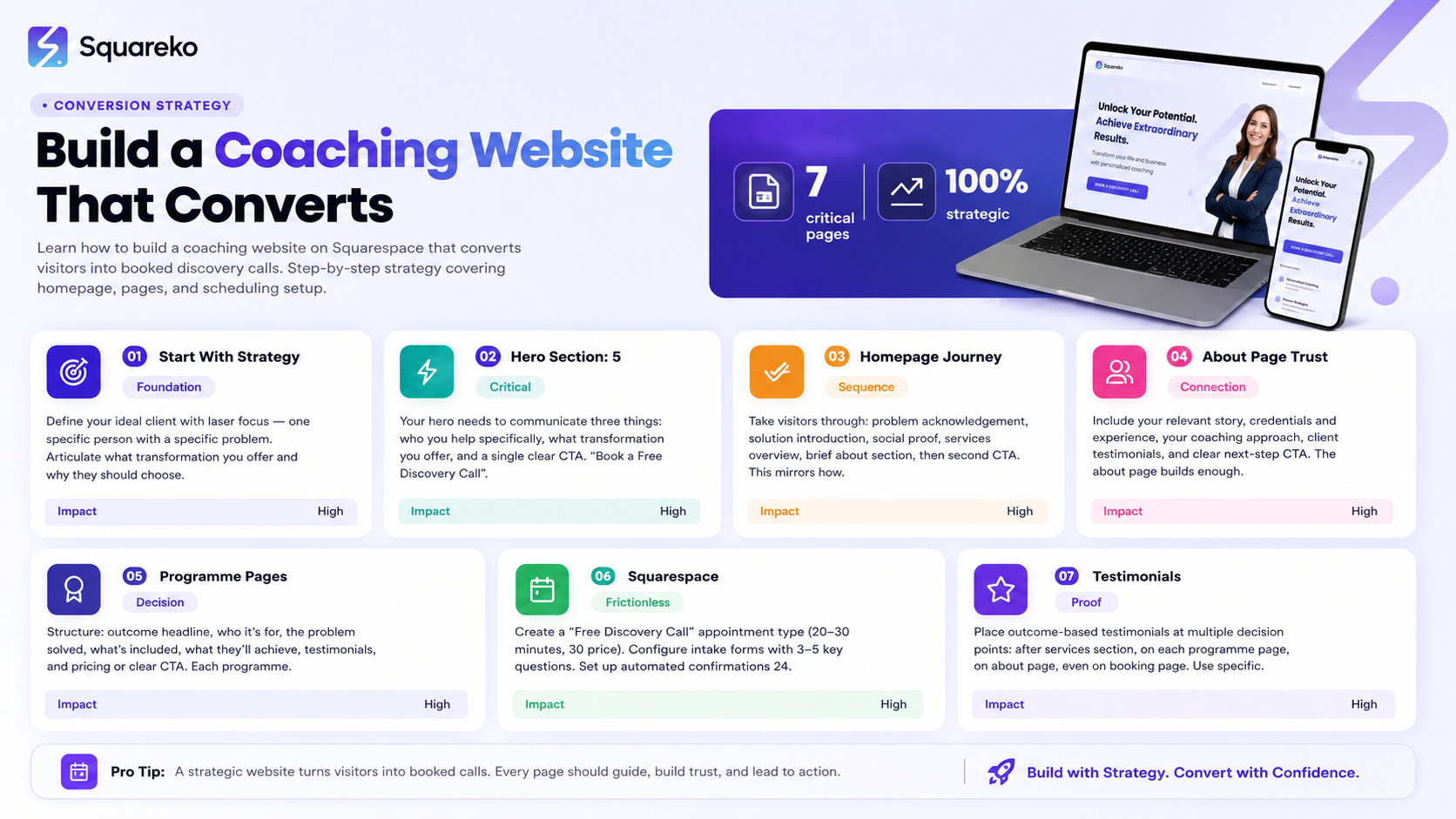
Before you touch a template or pick a colour palette, you need to answer three questions clearly. Skip this step and you'll end up redesigning your site again in twelve months.
Who Are You Talking To?
Your coaching website needs to speak to one type of client. Not everyone. Not all your past clients. One specific person with a specific problem.
This matters because the language on your homepage, your programme descriptions, and your CTAs all need to be calibrated to that person's world. A life coach working with women through major life transitions sounds completely different from a life coach working with C-suite executives on leadership presence. Same core skill set — very different websites.
Get specific about your ideal client: what's their situation, what's their frustration, what do they want to achieve, and what's holding them back? Your website copy is the answer to those questions, structured as an invitation.
What's the One Action You Want Visitors to Take?
Most coaching websites try to do too many things — sell a course, promote a podcast, build an email list, book a discovery call, and sell a download. The result is a site with no clear priority and visitors who leave without doing anything.
Choose one primary conversion goal. For most coaches, that's booking a discovery call. Everything else on your site — the blog, the testimonials, the about page — should support that single goal.
What Makes You the Right Choice?
Before building your site, articulate your point of difference. Why should a potential client choose you over the coach they just found on Google? This doesn't have to be some grand unique selling proposition — it might be your specific methodology, your own lived experience, your results, or the specific niche you serve. But it needs to be clear, and it needs to be on your homepage.
The Homepage: Your Most Important Converting Page
Your homepage is doing most of the work. The majority of visitors who arrive at your site from search, social media, or a referral will land here first. You have roughly five seconds to convince them to stay.
The Hero Section: Five Seconds to Clarity
The hero section — the first thing people see before they scroll — needs to communicate three things immediately:
Who you help. Not I'm a life coach. Specifically who. I help ambitious women in their 40s rebuild their confidence after burnout. Or: I work with mid-level managers ready to step into leadership roles.
What transformation you offer. What's the before and after? What does life look like for your clients after working with you? Lead with the outcome, not the process.
What to do next. A single, clear CTA button. Book a Free Discovery Call or Work With Me — action-oriented, specific, impossible to miss.
In Squarespace, you can build this hero section using a full-width image or video block with an overlay and a button. The button should link directly to your Squarespace Scheduling booking page — not to a learn more page that adds another step.
Homepage Flow: The Visitor's Decision Journey
After the hero, your homepage should take visitors through a journey that mirrors how they actually make decisions:
Problem acknowledgement — show you understand where they are right now
Solution introduction — introduce your approach and why it works
Social proof — testimonials, client outcomes, or press mentions
Services overview — brief, clear descriptions of how they can work with you
About snippet — a brief, personal intro that builds connection (with a link to your full about page)
Second CTA — another booking button, so they don't have to scroll back up
This flow isn't accidental — it's based on how people evaluate trust-based services. Don't skip steps or rearrange them without good reason.
Navigation: Simple and Purposeful
Your navigation should have five items maximum. A typical coaching website navigation looks like this: Home | About | Work With Me | Blog | Contact. Everything else is noise. Work With Me or Services is more enticing than Programmes — it implies a relationship, not just a product. Your blog link keeps it in the nav because it signals that you're actively building authority and have something to say.
The About Page: Building Trust Before the Booking
Coaches' about pages are often either too short (just a bio and a photo) or too long (an autobiography). Neither converts well. The about page has one job: build enough trust and connection that a potential client feels confident booking a discovery call.
What to Include on Your About Page
Your personal story — the relevant part. Why do you do this work? What's your connection to the transformation you offer? Clients want to know you've either lived the experience or have deep expertise in it. Be real, be specific, but be selective — share what's relevant to why they should trust you with their goals.
Your credentials and experience. What training have you done? What results have you helped clients achieve? How long have you been doing this? You don't need to list every certification, but give enough that a cautious potential client feels reassured.
Your approach or methodology. How do you work? What makes your coaching different? Even a brief paragraph about your philosophy gives clients a sense of what it's like to be in your corner.
Testimonials Yes, on your about page too. One or two client quotes placed strategically can dramatically increase conversion from this page.
A clear CTA. Your about page should end with an invitation to take the next step — Ready to see if we're a good fit? Book a free discovery call. Not Contact me — be specific about what happens next.
Service and Programme Pages: Where Decisions Are Made
Your service or programme pages are where visitors go from interested to ready to book. These pages do the heaviest conversion work on your site, and most coaches underinvest in them.
The Structure of a High-Converting Programme Page
Headline — the transformation or the result, not just the programme name. Stop Dreading Mondays: 90-Day Career Change Coaching is more compelling than Career Change Programme.
Who it's for — a specific description of the ideal client for this programme. This is one of the most important conversion elements on the page, because it makes the right person feel seen and reassured they're in the right place.
The problem it solves — articulate the frustration or situation the client is in before they work with you. The more accurately you describe their experience, the more they trust that you can actually help.
What's included — the structure of the programme. Sessions, format, duration, any resources or bonuses. Be clear without being overwhelming.
What they'll achieve — outcomes, not just outputs. Not six sessions but by the end of our work together, you'll have a clear career direction, a job search strategy, and the confidence to pursue it.
Testimonials — client quotes and ideally a short case study that shows the journey from problem to outcome.
Pricing or next steps — either publish your pricing (which builds trust) or have a clear Book a Discovery Call CTA that tells them what happens next. Don't make them guess.
How Many Service Pages Do You Need?
One per offering. If you have three programmes, you have three pages. Don't put all your services on one long page — it dilutes focus and makes it harder for search engines to rank each service.
Setting Up Squarespace Scheduling for Discovery Calls
Squarespace Scheduling is the most seamless way to handle discovery call bookings on a Squarespace site. Here's how to set it up effectively.
Creating Your Discovery Call Appointment Type
In your Squarespace Scheduling dashboard, create an appointment type called Free Discovery Call (or Free Strategy Session — test which converts better). Set it to 20–30 minutes. Keep it free — the discovery call is a conversion tool, not a revenue stream.
Write a compelling description for the appointment type. Something like: This call is your chance to tell me what you're working through, hear about how I work, and decide together whether we'd be a good fit. No pressure, no pitch — just a real conversation. This reduces friction and positions the call as a collaborative experience rather than a sales process.
Embedding Scheduling on Your Website
You have two options: embed the scheduling widget directly on a page, or link to a standalone Squarespace Scheduling page. Embedding the calendar on a dedicated Book a Call page works well — it removes the step of clicking to an external page. Squarespace makes this straightforward with a scheduling block you can add to any page in the editor.
Place a Book a Call button in your navigation, in your homepage hero, at the end of your about page, and at the bottom of each service page. Every page should have a path to booking without requiring visitors to navigate elsewhere.
Automated Reminders and Confirmations
Squarespace Scheduling handles email confirmations and reminders automatically. Set up at least a 24-hour reminder email to reduce no-shows. You can also configure intake forms within the scheduling system — asking clients to answer two or three questions before the call helps you prepare and filters out non-ideal clients early.
How to Use Testimonials and Social Proof Strategically
One testimonial at the bottom of your homepage is not a social proof strategy. Strategic social proof placement means putting the right kind of evidence in front of visitors at the exact moment they're making a decision.
Types of Social Proof That Work for Coaches
Outcome-based testimonials are the most powerful. Not Walid was so helpful but After 8 weeks with [Coach Name], I got promoted, negotiated a 20% pay increase, and finally feel confident in my professional direction. Specific results, specific transformation.
Story-based testimonials work well on about pages and longer service pages. A client sharing their journey in their own words builds far more trust than a short quote.
Video testimonials are becoming increasingly common and have a higher trust impact than text. If your clients are willing to record a short video, embed it on your homepage or service pages.
Press mentions, podcast appearances, or certifications signal authority, particularly for coaches in credentialed niches like finance, leadership, or clinical approaches.
Where to Place Social Proof
Place testimonials in these specific locations:
Homepage, after the services overview section
Each programme page, after the what's included section
The about page, after your credentials
Your booking page (yes, even there — reinforce the decision right at the moment of booking)
Don't save social proof for a standalone testimonials page that nobody visits. Put it where decisions happen.
The Blog and Content Strategy That Brings Warm Traffic
A coaching website that only has service pages and an about page relies entirely on referrals and direct traffic. A coaching website with a strategic blog becomes a search engine asset — bringing in potential clients who are already searching for the transformation you offer.
What to Write About
The most effective content strategy for coaches focuses on the questions your ideal clients are already asking. What are they googling before they find a coach? What problems are they trying to solve on their own? What information would help them understand they need professional support?
If you're a career coach, your ideal client might be searching how to change careers at 40 or signs you're ready for a promotion. A blog post that genuinely answers those questions — with real insight, not just surface-level advice — builds trust with a reader who is exactly your target client.
Structuring Blog Posts for Conversion
Every blog post should have a natural path to your services. Not a hard sell in every paragraph — but a contextual CTA that makes sense given the topic. At the end of a post about career change, a line like If you're ready to stop navigating this alone, let's talk — book a free discovery call is a natural next step, not a pushy sales pitch.
Use your blog to support your SEO strategy, build your authority, and warm up cold traffic. The readers who arrive via search and find three or four genuinely helpful posts are far more likely to book a call than someone who clicked a cold ad.
Ready to Build a Coaching Website That Actually Books Calls?
If you've read this guide and thought I know what needs to happen, I just don't have the time or skills to make it happen — that's exactly what Squareko is here for. We build custom Squarespace websites for coaches and educators. Every site we build is structured around one goal: converting the right visitors into booked discovery calls. We handle the strategy, the design, the copy framework, the scheduling setup, and the SEO foundations — so you can focus on coaching.
FAQs
-
At minimum, a coaching website needs four pages: a homepage, an about page, a services or programmes page, and a contact or booking page. For most coaches, adding a blog and individual pages for each service (rather than one combined services page) significantly improves both SEO and conversion. A dedicated "Book a Discovery Call" page is also worth having.
-
Squarespace has a built-in scheduling tool (Squarespace Scheduling, formerly Acuity Scheduling) that integrates natively with your website. You can embed a booking calendar directly on any page using the scheduling block in the Squarespace editor, or link to a standalone Squarespace Scheduling page. Both options allow clients to self-book appointments without any manual coordination.
-
The most common issues are: a vague headline that doesn't speak to a specific client, a CTA that's buried or unclear, not enough social proof at the moment of decision, and a navigation structure that confuses rather than guides. Fixing those four things — before anything else — typically produces the biggest increase in discovery call bookings.
-
This is one of the most debated topics in coaching. Publishing prices filters out non-ideal clients and saves time on both sides, which many coaches prefer. Not publishing prices means every interested visitor needs to book a call, which gives you more opportunities to convert — but also means more time spent on calls that won't convert. There's no single right answer, but if you find your discovery calls are mostly with people who can't afford your programmes, publishing prices is worth testing.
-
Enough to cover every major page where a visitor might hesitate. That typically means 3–5 on the homepage, 1–3 on each programme page, and 1–2 on the about page. Quality matters more than quantity — one specific, outcome-based testimonial is worth more than ten generic "great coach!" quotes.
-
You don't strictly need one, but a blog is the most effective long-term strategy for generating organic traffic and warming up cold leads. If you're relying entirely on referrals and social media to drive website visitors, a blog gives you a channel you own and control. Even 1–2 posts per month, consistently published, compounds significantly over time.
-
A service page is a permanent page on your website that lives in your navigation and describes an ongoing programme or offering. A landing page is typically a standalone page used for a specific campaign — a webinar, a launch, a limited-time offer — that has no navigation and is focused entirely on one conversion action. Both have their place in a coaching business, but most coaches need strong service pages before they need standalone landing pages.
-
Getting your coaching website to rank on Google requires three things: technically clean setup (Squarespace handles most of this), optimised page content (keyword-informed titles, headings, and copy), and ongoing content production (a blog covering topics your ideal clients search for). Local SEO matters too if you serve clients in a specific geography. This isn't a quick fix — it's a 3–6 month process minimum, but it compounds over time.

From custom website design to SEO strategy, we help businesses launch a site that looks professional and performs better.

Author Bio
I'm Walid Hasan, a Certified Squarespace Expert and Squarespace Circle Platinum Partner with over 12 years of hands-on experience designing and optimizing high-performing websites. Over the years, I've had the privilege of building more than 2,000 Squarespace websites for clients around the world, always focusing on clean design, strong user experience, and conversion-driven results.