5 Technology Consulting Website Mistakes That Lose Enterprise Contracts on Squarespace
Key Takeaways 5 Technology Consulting Website Mistakes
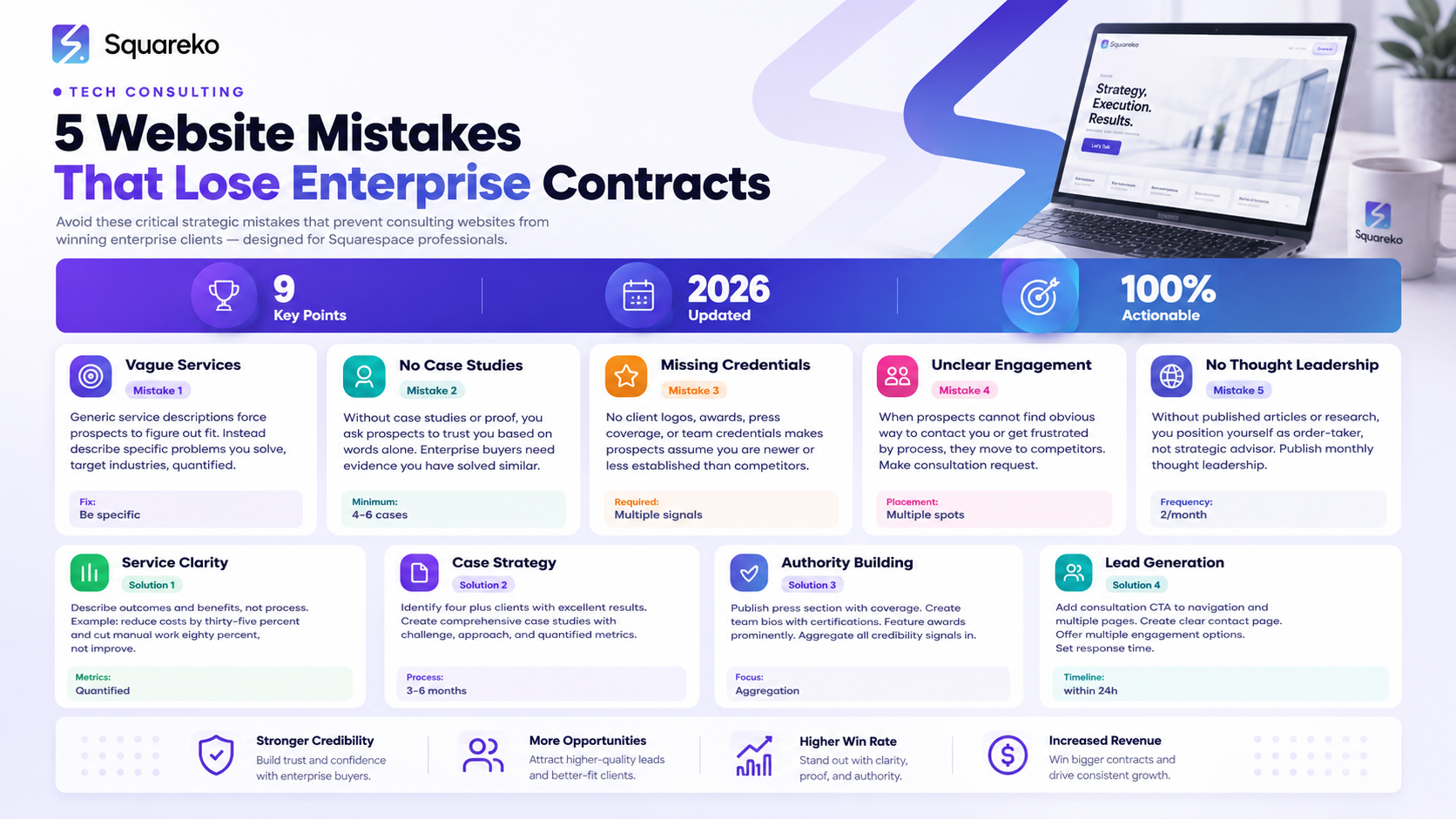
Vague service descriptions make prospects uncertain: Enterprise buyers need clarity on what you do and who benefits most
Missing case studies and proof leave Enterprise skeptical: Prospects evaluate you primarily through proof of past work
Poor credibility signaling loses to more established competitors: You must explicitly show why you're trustworthy
Unclear next steps frustrate prospects and lower conversion: Enterprise buyers need clear, friction-free paths to engagement
Thought leadership absence positions you as executor, not strategist: Prospects want consultants who think beyond their current role
Enterprise buyers visit your website to evaluate whether you're worth engaging. Your site either builds trust and moves them forward, or it creates doubt and sends them to competitors. Most consulting websites make critical mistakes that undermine credibility, obscure capability, and prevent conversions.
After working with dozens of consulting firms, I see the same avoidable mistakes repeatedly. These aren't design flaws or technical issues—they're strategic mistakes that lose enterprise contracts. This guide walks through the five most damaging mistakes and exactly how to fix them.
Mistake 1: Vague Service Descriptions
The mistake: Your service pages describe your process instead of client outcomes. You explain what you do without clarifying why it matters or who benefits most.
Example of vague description: We provide technology consulting services to help enterprises transform their operations through strategic technology implementation.
This describes nothing. What is technology transformation? Who is enterprises? What does strategic implementation mean?
Why enterprises are confused: Enterprise buyers search for solutions to specific problems. They need to quickly understand whether you address their challenge. Vague descriptions force them to spend time figuring out if you're a fit, and many just move to clearer competitors.
The Fix: Specific, Problem-Focused Service Descriptions
Better service description: We help Fortune 500 manufacturing companies modernize legacy production planning systems. Our approach replaces outdated systems with cloud-based platforms that improve production planning accuracy by 35% and reduce manual data entry by 80%. Most implementations complete in 12-18 months with zero production downtime.
This version:
Names the specific industry (manufacturing)
Describes the specific problem (legacy systems)
Explains the specific solution (cloud modernization)
Provides quantified outcomes (35%, 80%)
Sets timeline expectations (12-18 months)
Implementation Checklist
For each service on your website:
Replace consulting services with specific service name
Replace organizations with target customer type (industry, size)
Replace improve performance with specific metric (reduce time, save cost, improve quality)
Add timeline expectations
Include 2-3 quantified outcomes from past clients
Explain why this service matters to the prospect's business
Mistake 2: No Case Studies or Proof
The mistake: Your website has no case studies, client logos, testimonials, or proof that you've done what you claim. You expect prospects to trust you based on your word alone.
Why enterprises don't buy: Enterprise procurement is risk-averse. Decision-makers need proof you can deliver before committing significant budget. Without case studies, you're asking them to take a leap of faith that competitors don't require.
The numbers: Case studies are the highest-converting content type for B2B consulting. Prospects are 15-20x more likely to engage when they see proof through case studies versus sales claims.
The Fix: Comprehensive Case Study Strategy
Minimum case study portfolio: 4-6 comprehensive case studies
Case study structure:
Client context: Company, industry, size
Challenge: Specific problem they faced
Your approach: How you attacked the problem
Results: Quantified outcomes
Testimonial: Client quote praising results
Case study placement:
Dedicated case study page/gallery on your site
Link from service pages (case studies demonstrating that service)
Feature strongest case study on homepage
Include case study highlights throughout site
Getting case studies published:
Identify past clients with strong, quantifiable results
Reach out requesting permission to create case study
Offer different confidentiality options (named vs. anonymized)
Draft comprehensive case study
Get client approval
Publish and promote
Implementation Checklist
Identify 4+ past clients with excellent results
Reach out requesting case study permission
Create comprehensive case study for each
Publish case studies on dedicated page
Add case studies to service pages
Feature strongest case study on homepage
Link case studies internally
Update case studies annually
Mistake 3: Missing Credibility Signals
The mistake: Your website doesn't explicitly show why prospects should trust you. No client logos. No awards. No press coverage. No team credentials. Just a claim that you're experienced.
Why this is costly: Enterprise buyers evaluate credibility through third-party validation. They want to see:
Clients you've worked with (recognizable companies)
Recognition you've earned (awards, analyst firms, media)
Expertise credentials (education, certifications, publications)
Long-term stability (years in business, team size)
Without these signals, prospects assume you're newer, smaller, or less experienced than competitors.
The Fix: Comprehensive Credibility Architecture
Client visibility:
Display client logos (with permission)
Include case studies with recognizable companies
Mention well-known clients in about page
Media and press coverage:
Create press section featuring coverage
Link to articles mentioning your firm
Include press release announcements
Feature recent media mentions on homepage
Awards and recognition:
Display relevant industry awards
List analyst firm recognition (if applicable)
Feature best consulting firms list placements
Highlight association recognitions
Team credentials:
Create comprehensive team bios
Include professional degrees (MBA, relevant engineering degrees)
List relevant certifications (AWS, Google Cloud, etc.)
Document speaking engagements
Highlight publications and articles
Company stability signals:
Clearly state years in business
Mention team size or number of consultants
List geographic presence
Note client count or project portfolio size
Implementation Checklist
Create Press or Media page with coverage
Get permission from clients to use logos
Create detailed team bios with credentials
Display relevant awards prominently
List professional certifications
Feature client testimonials throughout site
Highlight media mentions on homepage
Create About page that establishes stability
Mistake 4: Unclear Contact and Engagement Process
The mistake: Your contact process is friction-filled or unclear. No obvious place to request a consultation. Contact us button buried in footer. Multiple contact form options with no guidance on which to use. Response time expectations never stated.
Why prospects don't engage: Enterprise buyers often research your firm multiple times before deciding to reach out. Each time they want to take a step forward but can't find an obvious way to do so, they lose momentum. By the time they figure out how to contact you, they've already engaged with competitors.
The Fix: Multiple, Clear Engagement Pathways
Primary engagement CTA:
Schedule a Consultation button in header/navigation (always visible)
Schedule a Consultation button at bottom of homepage
Schedule a Consultation button on every service page
Multiple engagement options:
Consultation request form (primary)
Resource download (for early-stage prospects)
Assessment (for prospects wanting self-evaluation)
Newsletter signup (for ongoing engagement)
Direct contact (email, phone)
Clear next-step communication:
After form submission: We'll reach out within 24 business hours
On contact page: Response time is typically within 24 hours
In footer: Phone number and email visible
In header: Contact phone visible
Engagement clarity:
Make it obvious which option is which
Schedule Consultation for direct engagement
Download Guide for resource download
Take Assessment for self-evaluation
Subscribe to Newsletter for ongoing updates
Implementation Checklist
Add Schedule Consultation button to header navigation
Place Schedule Consultation on homepage (multiple places)
Add consultation CTA to service pages
Create clear, easy-to-find contact page
Set form expectations: Response time: 24 business hours
Display phone number in multiple locations
Make email address easy to find
Provide multiple engagement options
Mistake 5: No Thought Leadership or Authority Content
The mistake: Your website contains no articles, research, publications, or thought leadership from you. You don't publish insights or perspectives. Your website is entirely service-focused with no content that establishes expertise.
Why this limits growth: Thought leadership serves multiple purposes:
Demonstrates expertise (you publish insights on your topic)
Improves SEO (more content, higher authority)
Builds trust with prospects (proves you think beyond current role)
Generates referrals (people share good content)
Attracts better clients (prospects self-qualify through your thinking)
Without thought leadership, you're positioning yourself as an order-taker, not a strategic advisor. Enterprise buyers prefer strategic advisors.
The Fix: Ongoing Thought Leadership Strategy
Start publishing:
Blog/insights section: Publish 1-2 articles monthly
Topics: Industry trends, problem analysis, best practices, case study insights
Length: 1500-2500 words per article
Quality: Thoughtful, original perspective (not regurgitating information)
Consistency: Regular publication, not sporadic
Expand beyond your site:
Guest articles: Submit to industry publications (LinkedIn, Medium, industry journals)
Research: Publish original surveys or research
Speaking: Get on podcasts, webinars, conferences
Social media: Share insights on LinkedIn and Twitter
Newsletter: Build email list with regular insights
Establish thought leadership:
Create Insights or Resources section on website
Feature latest articles on homepage
Link articles from service pages
Promote through social media
Repurpose content (article → LinkedIn post → podcast discussion)
Content Ideas for Technology Consulting
Why Digital Transformations Fail (and how to avoid it)
How to Evaluate Cloud Migration Vendors
The Real Cost of Technical Debt
Enterprise Modernization: Strategy vs. Execution
Industry trend analysis articles
Lessons learned from recent projects
Best practices guides
Framework explanations
Implementation Checklist
Create Insights, Resources, or Blog page
Plan publishing schedule (minimum 2 posts/month)
Write first 3-4 articles
Schedule regular publishing dates
Promote articles on social media
Link articles from relevant service pages
Feature latest articles on homepage
Identify 3-5 publications to contribute to
Target speaking engagements
Build email newsletter
Comprehensive Fix Checklist
Use this checklist to audit your consulting website against all five mistakes:
Service Descriptions
Service pages describe specific outcomes, not process
Include industry or customer type (not generic organizations)
Include quantified results or metrics
Set timeline expectations
Explain why this service matters to prospects' business
Case Studies and Proof
Have 4+ comprehensive case studies published
Case studies include client context, challenge, approach, results
Case studies feature quantified outcomes
Case studies are linked from relevant service pages
Strongest case study featured on homepage
Client logos visible on site (with permission)
Credibility Signals
Team members have visible, detailed bios with credentials
Professional certifications are displayed
Awards and recognition are featured
Media coverage and press mentions are aggregated
Client testimonials are included
Years in business and company stability are stated
Awards or recognition appear on homepage
Engagement Clarity
Clear consultation request CTA in navigation
Consultation request form on multiple pages
Multiple engagement options available
Contact page is easy to find
Response time expectations are set
Phone number is visible in multiple places
Email address is easy to find
Clear CTAs on service and homepage
Thought Leadership
Blog or insights section exists
Publishing schedule is established (2+ posts/month)
Recent articles are featured on homepage
Articles are linked from service pages
Original research or frameworks are published
Social media presence shares insights
Newsletter signup available
Speaking engagements documented
Frequently Asked Questions
-
Lack of case studies (#2) is most costly. Without case studies, you're asking enterprise prospects to trust you on faith. Case studies are your most powerful conversion tool. If you fix only one thing, publish comprehensive case studies.
-
Yes. These are content and strategy issues, not design issues. You can fix all five without changing your template. Add service clarity, publish case studies, add credibility signals, clarify engagement, and start publishing thought leadership—all possible within your current design.
-
3-6 months working steadily. Developing case studies takes time (gathering information, writing, getting approval). Publishing thought leadership takes consistent effort. Engagement design is quick (1-2 weeks). Credibility signal gathering takes ongoing effort (media monitoring, award research).
-
For case studies and thought leadership, yes. Those require writing skill and consistency. Gathering credibility signals and clarifying engagement can be done in-house. Strategy and planning is best done with expert guidance.
-
Anonymize your case studies while including enough detail (industry, company size, challenge, results) to be credible and relatable. Anonymized case studies work fine if they're specific and detailed. Client names aren't required—proof of capability is.
-
15-20 published articles at 1500+ words each typically generates meaningful search visibility. Publishing consistently (2+ per month) for 6-9 months usually produces noticeable traffic and lead generation.
-
Audit your current site against these five mistakes. Prioritize: fix service descriptions first (quick, high-impact), then develop case studies (highest ROI), then add credibility signals, then clarify engagement, then start thought leadership. A phased approach is more sustainable than trying to overhaul everything at once.
-
No. If your firm relies heavily on referrals, thought leadership may matter less initially. If you're new, credibility signals may be harder to gather. Prioritize based on your current biggest bottleneck in lead generation and conversion.
Call to Action
These five mistakes are costing you enterprise contracts. But they're fixable. Review your current Squarespace website against each mistake. Where do you fall short?
At Squareko, we help consulting firms audit their websites, identify critical gaps, and implement fixes that improve lead quality and conversion. From service description clarity to case study strategy, credibility signaling to engagement design, we help ensure your website actually wins contracts.
Ready to fix these costly mistakes? Schedule a consultation with our team to review your current website and discuss improvement opportunities.

From custom website design to SEO strategy, we help businesses launch a site that looks professional and performs better.

Author Bio
I'm Walid Hasan, a Certified Squarespace Expert and Squarespace Circle Platinum Partner with over 12 years of hands-on experience designing and optimizing high-performing websites. Over the years, I've had the privilege of building more than 2,000 Squarespace websites for clients around the world, always focusing on clean design, strong user experience, and conversion-driven results.