5 Marketing Consulting Website Mistakes That Undermine Your Expertise on Squarespace
5 Marketing Consulting Website Mistakes That Undermine Your Expertise on Squarespace
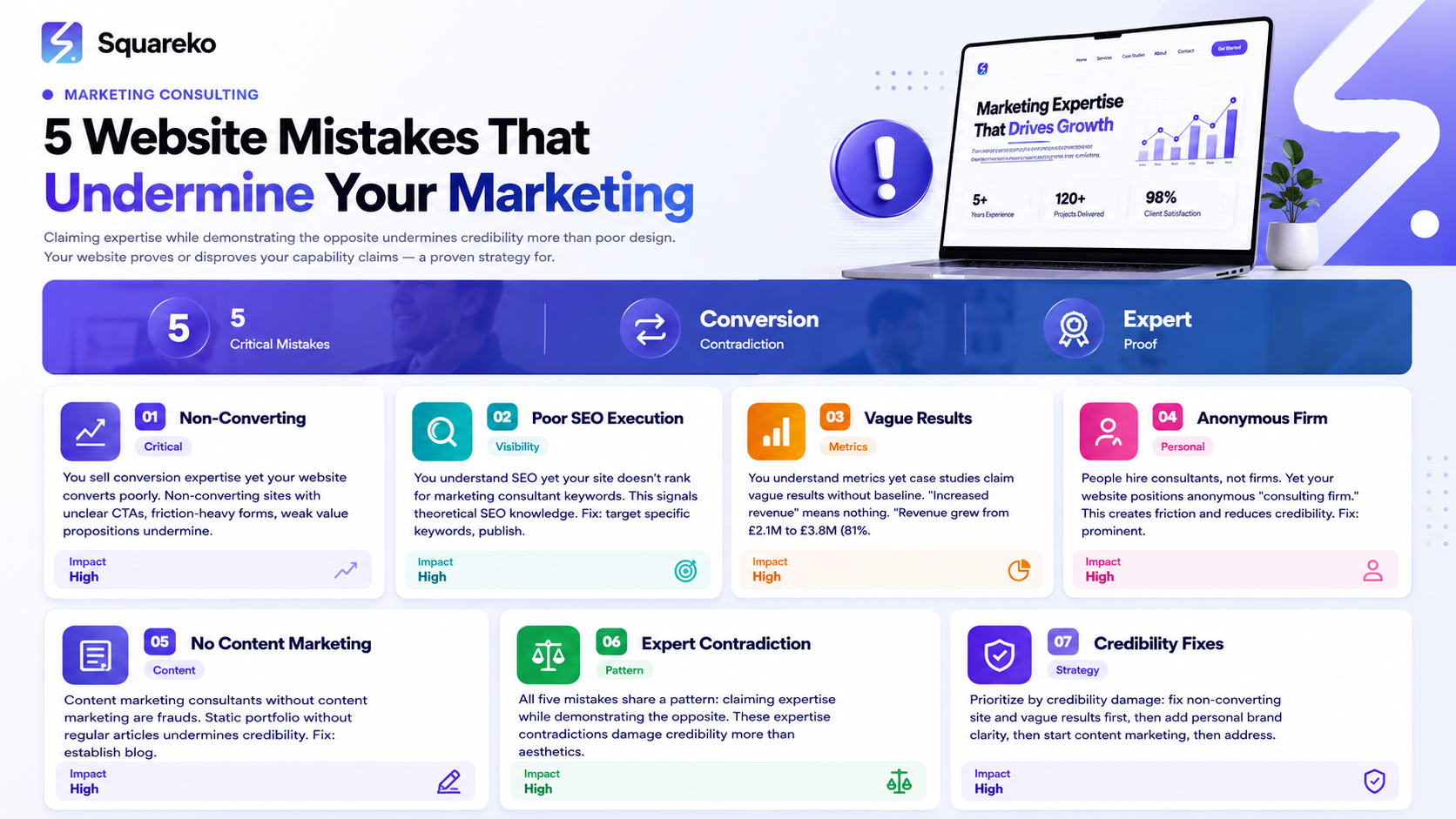
A marketing consultant whose own website doesn't convert is a contradiction.
You sell conversion expertise. Yet your website converts prospect interest into tire-kickers and time-wasters rather than consulting conversations. You claim marketing knowledge while your own website demonstrates the opposite.
This isn't harsh—it's the reality of how prospects evaluate marketing consultants. Your website is your proof. When your proof is weak, your expertise claim is undermined.
Most marketing consulting website mistakes aren't about design aesthetics. They're about contradictions—claiming expertise while demonstrating the opposite. These contradictions are more damaging to credibility than an ugly-but-functioning website.
This guide identifies five mistakes that marketing consultants commonly make, explains why each undermines expertise claims, and provides Squareko's fix.
Key Takeaways 5 Marketing Consulting Website Mistakes That Undermine Your Expertise on Squarespace
A non-converting website contradicts conversion expertise claims—most damaging mistake
Poor SEO execution on a marketer's website signals that SEO knowledge is theoretical
Campaign results without clear attribution language signal measurement avoidance
Anonymous firm positioning undermines personal brand credibility for consulting
Content marketing absence on a content marketing consultant's site is the ultimate contradiction
Mistake 1: Website That Doesn't Convert
The Contradiction
You sell conversion optimization. You advise clients on conversion-focused design, call-to-action placement, friction reduction. Yet your website has poor conversion architecture.
This is an expertise contradiction. Prospects instantly notice: "If this marketing consultant can't optimize their own conversion, how will they optimize mine?"
What Non-Converting Websites Look Like
Equal Visual Weight on CTAs
Hero section with "Services," "About," "Case Studies" equally prominent
Multiple links to contact/consultation without clear prioritization
Unclear which action prospects should take
Friction-Heavy Contact Process
Long contact forms (15+ fields)
Multiple steps to schedule consultation
Complicated calendar integration
Unclear process
Low Trust Signals
No testimonials or social proof
Generic claims ("marketing services for growing companies")
No specific outcomes in case studies
Vague about engagement model and pricing
Attention Direction Failure
Primary information not visually prioritised
Important details scattered throughout page
No clear visual hierarchy
Weak Value Proposition
Hero section doesn't immediately clarify what you do
Generic positioning (doesn't differentiate from other consultants)
No hook explaining why prospects should care
The Squareko Fix
Conversion-Focused Architecture:
Clear hero CTA ("Schedule Consultation") as primary action
Minimum 2-3 additional CTAs throughout page (case studies, service sections, footer)
Secondary CTA clarity (newsletter signup, download resource) lower friction
Trust Signal Integration:
Specific case study metrics (not vague success stories)
Client testimonials with outcomes mentioned
Clear engagement model explanation
Transparent about results attribution
Friction Reduction:
Contact form: 3-5 fields maximum
One-click calendar integration for scheduling
Clear next-step expectations
Visual Hierarchy:
Primary message dominates hero section
Supporting information in secondary hierarchy
Whitespace used intentionally to guide attention
Primary CTA visually distinct from other page elements
Why This Matters
A prospect arriving at your conversion-focused website sees your conversion execution before hearing your pitch. If it's poor, credibility is damaged before you speak.
Mistake 2: No SEO Optimisation
The Contradiction
You sell SEO services or understand marketing strategy that includes SEO. Your website doesn't rank for marketing consultant keywords. Prospects can't find you through organic search.
This signals:
You don't practice what you preach
You don't understand SEO well enough to apply it to your own site
You're not marketing yourself effectively
What Poor SEO Looks Like
No Keyword Strategy
Website not optimised for "fractional CMO," "digital marketing consultant," or similar
Generic meta descriptions
No keyword inclusion in H1s or page titles
Vague positioning language
Poor Site Structure
No internal linking strategy
Service pages aren't linked from relevant blog content
No clear information architecture
Related content isn't linked together
No Content Strategy
No blog or published content
Old content (most recent article from 2023)
Content without keyword focus
No regular publishing
Technical SEO Gaps
Slow page load speed
Poor mobile experience
Missing schema markup
Broken internal links
Local SEO Neglect
No Google Business Profile (or incomplete)
No local citations
No geographic keyword targeting
The Squareko Fix
Keyword Strategy:
Target specific keywords: "Fractional CMO London," "Digital Marketing Consultant," "Brand Strategy Consultant"
Research keyword variations for your services
Optimise homepage, service pages, and blog for relevant keywords
Meta descriptions include target keywords and compelling copy
Content Strategy:
Publish 1-2 articles monthly on marketing consulting topics
Blog articles target long-tail keyword variations
Articles link to relevant service pages
Content demonstrates your expertise and thinking
Technical SEO:
Ensure Squarespace site speed is optimized (test with Page Speed Insights)
Confirm mobile responsiveness
Implement schema markup (Professional Service)
Check for broken internal links
Local SEO:
Create/optimize Google Business Profile
Define service areas (London, South East, etc.)
Build local citations (Clutch, Good Firms, LinkedIn)
Create region specialty pages
Why This Matters
A marketing consultant ranking nowhere for marketing consulting keywords appears to have no SEO capability. This undermines both search visibility and credibility.
Mistake 3: Campaign Results Without Clear Attribution
The Contradiction
You understand marketing metrics and measurement. Yet your case studies claim vague results without clear attribution language or baseline establishment.
"Increased revenue" means nothing. "Revenue grew from £2.1M to £3.8M (81% growth) attributed to demand generation strategy shift" is credible.
Vague results signal measurement avoidance. This undermines expertise claims about marketing effectiveness and revenue attribution.
What Weak Results Look Like
No Baseline Establishment
"Revenue grew significantly" (from what?)
"Increased leads substantially" (how many originally?)
"Improved brand awareness" (baseline unknown)
No starting point context
Attribution Avoidance
"Resulted in revenue growth" (sole responsibility implied)
"Generated leads" (unclear contribution)
"Improved engagement" (what changed to cause this?)
No explanation of contributing factors
Vague Metrics
"Significant growth" (no numbers)
"Many leads" (no volume)
"Strong results" (unmeasurable)
Percentages without baselines (45% increase from what?)
No Client Context
No industry, company size, or engagement timeline mentioned
Can't assess relevance to prospect's situation
No information about what conditions enabled results
Outcome Persistence Unknown
No indication whether results were temporary or sustained
No follow-up on client performance
The Squareko Fix
Baseline Establishment:
Every case study states starting metrics clearly
Starting point provides context for change magnitude
Timeline stated explicitly (6 months, 18 months, etc.)
Attribution Language:
"Attributed to demand generation strategy shift" (clear)
"Contributed to revenue growth through lead quality improvement" (specific)
"Estimated 55% of revenue growth attributed to marketing strategy; 30% from sales efficiency; 15% from pricing"
Honesty about multi-contributor outcomes
Specific Metrics:
Revenue: £2.1M → £3.8M (81% growth, 18 months)
Lead volume: 45 → 153/month (240% growth)
Cost per acquisition: £12,500 → £8,125 (35% reduction)
Sales cycle: 6.2 months → 3.4 months (45% reduction)
Client Context:
Industry: Series B SaaS, HR Tech
Company size: 8-person team at start
Engagement model: Fractional CMO, 15 hours/week
Timeline: 18-month engagement
Outcome Persistence:
"18 months post-engagement, company continues to use improved demand generation model"
"Results have been sustained; client expanded internal marketing team to support strategy"
"Revenue growth has continued, reaching £7.2M ARR 24 months post-engagement"
Why This Matters
Vague results signal either poor measurement or measurement avoidance. Prospects wonder whether you actually achieve results or just claim to. Clear attribution builds credibility.
Mistake 4: No Personal Brand Clarity
The Contradiction
People hire consultants, not firms. Yet your website positions an anonymous "consulting firm" rather than you as an individual expert.
Prospects can't figure out who they'd be hiring. This creates friction and reduces credibility.
What Brand Confusion Looks Like
Anonymous Firm Positioning
Website doesn't clearly state who the consultant is
No professional photo or biography
You're not clearly named as the expert
Positioning focuses on "services" not "you"
Unclear Specialisation
Services described generically ("marketing consulting and strategy")
No clear focus on fractional CMO, demand generation, brand strategy, etc.
Positioning could apply to dozens of other consultants
Missing Executive Biography
No background or credentials visible
No explanation of why you chose consulting
No personality or distinctive voice
Could be any marketing consultant
No Personal Brand Visibility
LinkedIn profile not linked or incomplete
No thought leadership byline or personal brand
No speaking engagements or media presence
No visible expertise beyond website claims
The Squareko Fix
Personal Brand Clarity:
Your name is prominent on homepage
Hero section: "Your Name - Fractional CMO for Series B SaaS"
Professional photo throughout site
Clear positioning: not "marketing consultant" but "fractional CMO specialist" or "demand generation strategist"
Executive Biography:
Full professional background with specific roles and outcomes
Why you chose fractional CMO engagement (not full-time employment)
Industries or company stages you specialize in
Specific expertise areas and methodology
Personal Presence:
LinkedIn profile complete and linked from website
Thought leadership articles attributed to you by name
Speaking engagements or media appearances listed
Personal voice and perspective visible throughout content
Differentiation:
Why you specifically, not another fractional CMO?
What's your distinctive approach or framework?
What problems do you uniquely understand?
What specific outcome focus differentiates you?
Why This Matters
People hire people. Anonymous firm positioning creates psychological distance. Personal brand clarity creates connection
Mistake 5: No Content Marketing
The Contradiction
You're a content marketing consultant. Your website has no blog, no regular articles, no published thinking.
This is the ultimate credibility contradiction. You sell content marketing while demonstrating you don't do it yourself.
What Content Marketing Absence Looks Like
No Blog or Article Section
Website is purely portfolio/services (no thought leadership)
No regular article publishing
No blog feed or content updates
Static brochure-style website
Old Content
Most recent article from 2023 or earlier
No evidence of ongoing content creation
Appears inactive or abandoned
No Bylined Articles
No published articles in industry publications
No contributions to other platforms
Limited visibility beyond your own website
Not building thought leadership presence
No Email Newsletter
No email list building mechanism
No newsletter signup
Missing direct relationship-building opportunity
Prospect relationship ends after website visit
No Content Strategy Evidence
Content topics aren't strategically chosen
Articles don't demonstrate distinctive thinking
Content doesn't link to services or build narrative
Appears random or unfocused
The Squareko Fix
Blog Implementation:
Establish Squarespace blog
Publish 1-2 articles monthly minimum
Articles on topics your ideal clients search for
Articles demonstrate your thinking and expertise
Article Strategy:
Topics target your ideal client's problems
Articles present frameworks or methodologies you use
Some articles deep-dive into industry context
Some articles share case study insights
Content supports your positioning (fractional CMO, demand generation, etc.)
Bylined Presence:
Publish articles on your website under your name
Contribute to industry publications
Write LinkedIn articles
Byline includes credentials and link back to website
Email List Building:
Newsletter signup on website
Email capture offers (lead magnet, resource, framework)
Regular email publishing (weekly or bi-weekly)
Email builds direct relationship with prospects
Content Linking:
Blog articles link to relevant service pages
Service pages link to relevant blog articles
Articles link to each other (internal linking strategy)
Content supports conversion architecture
Why This Matters
Content marketing consultants without content marketing are frauds. There's no way around this contradiction. You must publish regular content to maintain credibility.
The Common Theme: Expertise Demonstration
These five mistakes share a common theme: claiming expertise while demonstrating the opposite.
You claim conversion expertise → website doesn't convert You claim SEO knowledge → site doesn't rank You claim measurement capability → results are vague You claim personal consulting → anonymous firm positioning You claim content marketing → no content
Each mistake is an expertise contradiction. Prospects notice these contradictions instantly. They undermine credibility more significantly than poor design aesthetics.
Fixing these mistakes is the foundation of consultant website credibility.
Ready to eliminate expertise contradictions from your consultant website?Squareko builds Squarespace websites for marketing consultants that demonstrate expertise through execution—conversion-focused design, SEO optimisation, clear results presentation, personal brand clarity, and ongoing content marketing. Your website should prove what you claim.
Frequently Asked Questions
-
Start with whichever mistake damages credibility most acutely. For most marketing consultants, either #1 (non-converting website) or #3 (vague results) is most credibility-damaging. Fix that first, then address others sequentially.
-
Conversion optimisation and results clarity can be fixed in 2-4 weeks. SEO optimisation is ongoing (3-6 months for ranking improvements). Personal brand clarity and content marketing are ongoing initiatives. You don't need perfection—progress matters.
-
1) Audit and clarify results (weak results are credibility-killer). 2) Add personal brand clarity. 3) Implement conversion optimisation. 4) Begin content marketing. 5) Address SEO. Sequence by damage to credibility.
-
Squarespace is fully capable of supporting all of these fixes. Conversion optimisation, personal brand clarity, and content marketing are all possible on Squarespace. You don't need to rebuild.
-
Track: conversion rate (consultation booking rate), organic traffic (Google Analytics), case study engagement (click tracking), email signup rate. You should see improvement within 4-12 weeks of implementation.
-
No. Starting content marketing today is better than never starting. Prospects will notice ongoing content activity. You don't need to apologise for historical absence—just begin publishing regularly now.

Make it stand out
Whatever it is, the way you tell your story online can make all the difference.

Author Bio
Written by the Squareko team,
I'm Walid Hasan, a Certified Squarespace Expert and Squarespace Circle Platinum Partner with over 12 years of hands-on experience designing and optimizing high-performing websites. Over the years, I've had the privilege of building more than 2,000 Squarespace websites for clients around the world, always focusing on clean design, strong user experience, and conversion-driven results.