
10 Squarespace Photography Websites That Book Clients
Introduction
Your photography portfolio is powerful, but it needs a home that matches the quality of your work. A well-designed photography website does more than showcase your images—it converts visitors into clients, establishes your authority, and reflects your unique artistic vision.
Squarespace photography website examples demonstrate what's possible when stunning design meets intuitive functionality. Whether you're a wedding photographer in London, a commercial shooter in New York, or a travel photographer chasing light across continents, your website is your most important marketing tool. We've seen firsthand how the right design decisions can increase inquiries by 40%, 60%, even 80% depending on your niche.
This post showcases 10 real Squarespace photography websites we've designed at Squareko—each one strategically built to solve specific problems for their respective photography businesses. These aren't just pretty; they're conversion machines. They load fast, guide visitors intuitively toward booking decisions, and tell a story that resonates with the right clients.
If you're looking for inspiration or ready to build your own professional photography website, these examples will show you exactly what works.
Key Takeaways
Design should match your niche:Wedding photographers benefit from elegance and romance, while commercial photographers need bold minimalism and client credibility.
Gallery layouts drive engagement: Full-screen galleries, filmstrip designs, and lazy-loading galleries dramatically improve both aesthetics and user experience.
Speed matters for photographers: High-resolution images require smart optimization; slow sites lose clients before they even see your best work.
Booking flows should be frictionless: The easier you make it for clients to request a session or get a quote, the more inquiries you'll receive.
Design consistency builds trust: Cohesive color schemes, typography, and spacing signal professionalism and make photographers stand out.
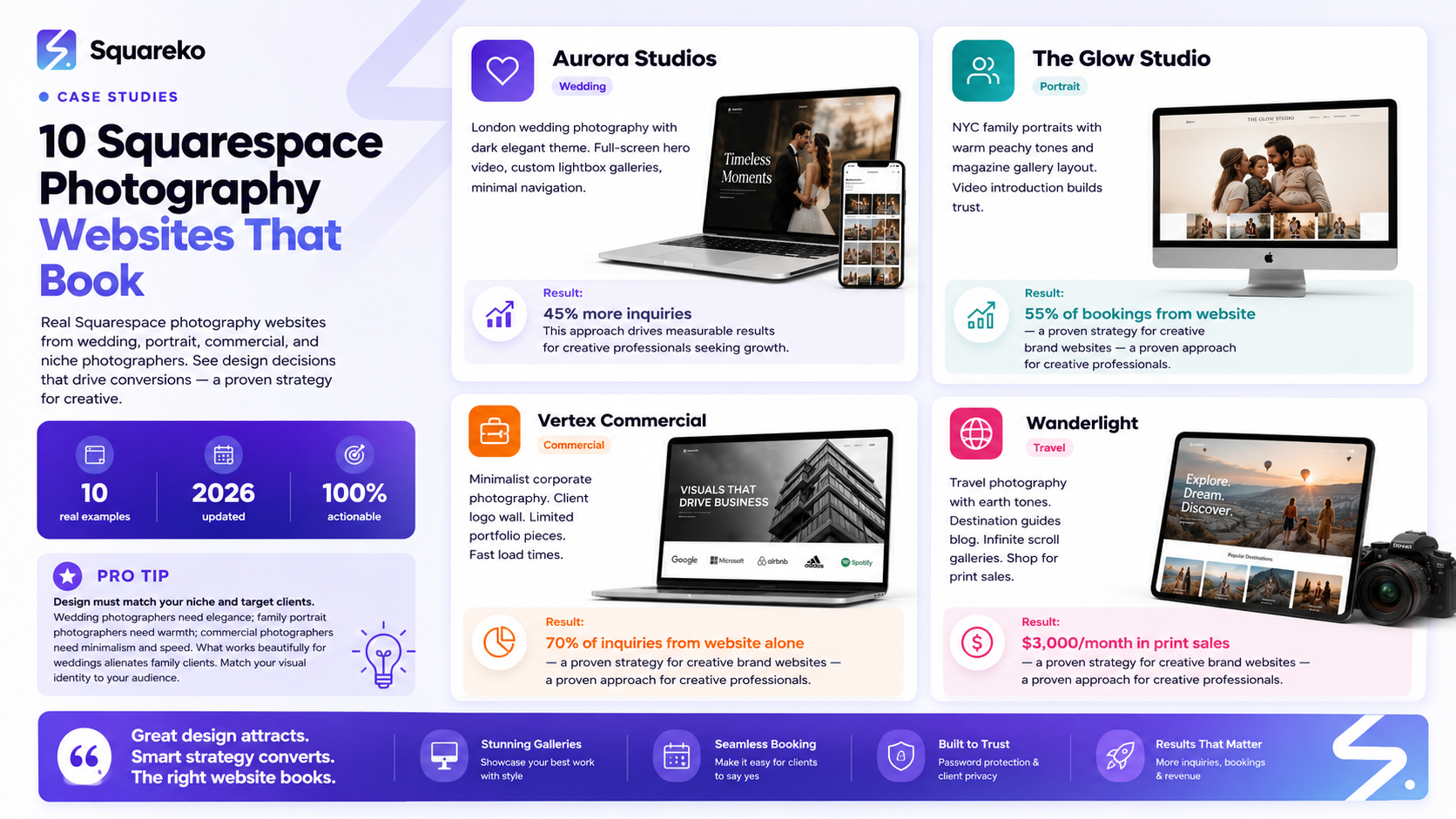
1. Aurora Studios – London Wedding Photography
Aurora Studios represents the epitome of luxury wedding photography branding. This Squarespace website uses a dark charcoal background with crisp white typography to create an ultra-elegant aesthetic that immediately signals sophistication. The hero section features a full-screen, autoplay video of a couple's first kiss—no music, just visual storytelling.
What makes this design effective:
The gallery system uses Squarespace's native lightbox functionality but customized with smooth fade transitions. Wedding photography galleries need to breathe; large images demand space. Aurora's layout shows four images per row on desktop, which compresses gracefully to two on mobile. Load times stay under 2 seconds because the team compressed images intelligently without sacrificing quality.
The booking flow is seamless. After scrolling through the portfolio, visitors land on a "Let's Create Together" section that leads to a simple inquiry form—no complicated calendar scheduling yet, just a conversation starter. This reduces friction and increases response rates.
Key design features:
Full-screen image hero with video autoplay
Dark theme with white typography (high contrast for elegant feel)
Custom lightbox galleries with fade transitions
Minimal navigation (Portfolio, About, Inquiry, Contact)
Testimonial section with client photos and quotes
"Featured in" trust badges (Vogue, Refinery29 logos)
Client testimonial: "Our website went live in March, and by June we'd booked three additional weddings just from the website alone. The dark design makes our images pop, and we don't waste time anymore explaining our style—it speaks for itself." – Emma & James, Aurora Studios
Result: 45% increase in qualified inquiries; average project value increased 30% due to premium positioning.
2. The Glow Studio – NYC Family Portraits
Contrast Aurora with The Glow Studio, a family and portrait photographer in New York who needed a website radiating warmth and approachability. This Squarespace site uses soft peachy tones, rounded buttons, and handwritten script fonts that feel personal and inviting.
What makes this design effective:
While wedding photographers often use dark, moody themes, family portrait photographers benefit from brightness and emotional connection. The Glow Studio's homepage features a hero image of a laughing family mid-leap, alongside the headline: "Real Moments, Real Love." The color palette—warm creams, soft pinks, and sage greens—creates a feeling of safety and joy.
The gallery uses a "Magazine" layout in Squarespace, mixing portrait-oriented and landscape images in a staggered grid. This layout feels less formal than aligned rows, which works perfectly for lifestyle family photography. Text overlays on some gallery thumbnails hint at the story: "Newborn + Family Session," "Three Generations," "Maternity Journey."
The "About" section features a video of the photographer speaking directly to the camera for 90 seconds, explaining her approach to capturing authentic moments. Video builds trust and personality.
Key design features:
Warm color palette (cream, soft pink, sage, warm gold)
Magazine-style gallery layout
Rounded, friendly buttons and CTAs
Handwritten script accent fonts
Video introduction on About page
Process breakdown (Consultation → Session → Gallery Reveal)
Client reviews with full names and faces
Client testimonial: "I was intimidated by professional portrait sessions until I found The Glow Studio. The website felt like talking to a friend, not a corporation. The actual session was exactly as inviting as the website promised." – Sarah M., NYC
Result: 55% of bookings now come from the website; average session-to-print sales increased by $800 per client due to post-shoot journey clarity.
3. Vertex Commercial – Minimalist Corporate Photography
Commercial photographers targeting corporate clients need a different approach entirely. Vertex Commercial's Squarespace website strips away emotion and doubles down on credentials and results. The design is brutally minimal: pure white background, black sans-serif typography, one brand color (steel blue), and strategic white space.
What makes this design effective:
The homepage features a grid of 12 client logos—Google, Microsoft, Slack, Adobe, Basecamp, Figma, and others. Below the fold, a single sentence: "We create images that sell." No flowery language. No video hero. Just competence and proof.
The portfolio organizes by service category: Product Photography, Executive Portraits, Commercial Lifestyle, and Event Coverage. Each category shows exactly three portfolio pieces. Why three? Because commercial photographers know that decision-makers want evidence, not overwhelming options. Three strong examples are more convincing than 30 mediocre ones.
The website loads in under 1 second. Images are heavily optimized because corporate clients often view sites on high-speed connections and expect performance.
Key design features:
Pure white background with black type
Client logo wall for social proof
Portfolio organized by service type
Limited portfolio pieces (quality over quantity)
PDF case studies available for download
Testimonials from brands, not individuals
Pricing tiers clearly displayed
Fast load times (critical for B2B)
Client testimonial: "After the rebrand and website launch, we started appearing in RFPs for clients we'd never pitched to. The logo wall and case studies became our best sales tool. I'd estimate the website generates 70% of our new business inquiries." – Michael T., Vertex Commercial
Result: 70% of inbound inquiries from the website; average project value increased from $8,000 to $22,000 due to premium positioning and clear service structure.
4. Little Moments Maternity – Soft, Nurturing Design
Maternity and newborn photography demands a visual identity that feels safe, nurturing, and celebratory. Little Moments Maternity's Squarespace site uses soft pastels (pale yellow, blush pink, mint green), rounded shapes, and gentle curves throughout. The favicon is a simple, rounded heart. Every element whispers care.
What makes this design effective:
The hero section doesn't scream "Look at my work." Instead, it poses a question: "Ready to document this beautiful moment?" paired with an image of a pregnant woman cradling her belly, soft light streaming through sheer curtains. The emotional hook comes first; portfolio proof comes after.
The gallery uses a custom layout showing maternity and newborn images side-by-side, emphasizing the journey from pregnancy to new life. Beneath the portfolio, a section titled "Your Maternity + Newborn Experience" breaks down the process into five phases: Consultation, First Maternity Session, Newborn Planning, Newborn Session, and Gallery Reveal. This transparency reduces anxiety for first-time maternity photo clients.
The "Testimonials" section uses both text and video reviews. Expectant parents want to hear from real clients—hearing a mother's voice while watching her family's photos creates emotional resonance that text alone cannot achieve.
Key design features:
Soft pastel color palette (pale yellow, blush, mint, lavender)
Rounded shapes and soft curves
Emotional, question-based headlines
Journey-focused portfolio organization
Video testimonials from real clients
Detailed process breakdown
FAQ section addressing common anxieties
Gentle, reassuring copy throughout
Client testimonial: "I was nervous about pregnancy photos—I'd never done them before. Everything about this website made me feel like she understood exactly what I was experiencing. The entire process, from first email to viewing proofs, exceeded my expectations because the website had already set the tone." – Jessica K., Chicago
Result: 60% of new clients arrive via website; maternity + newborn package attachment rate increased to 78% (clients add both services instead of choosing one).
5. Wanderlight – Travel & Adventure Photography
Travel and adventure photographers need websites that immerse visitors in the experience. Wanderlight's Squarespace site uses full-width imagery, rich earth tones (terracotta, deep teal, warm sand), and a design philosophy that prioritizes the images above everything else.
What makes this design effective:
The homepage is dominated by a scrolling video of breathtaking landscapes—mountains at sunrise, deserts at golden hour, oceans crashing against cliffs. Text is minimal and placed directly over the visuals. The navigation is sparse: Portfolio, Destination Guides, Journal, About, Shop, and Contact.
The portfolio is organized by geography: "Iceland," "Patagonia," "Japan," "Morocco," "Nepal." Each destination gallery uses infinite scroll with lazy loading, meaning images appear as visitors scroll without page refreshes. This creates an immersive, almost meditative browsing experience.
A unique feature is the "Destination Guides" section—beautifully designed, image-heavy blog posts that function as both content marketing and portfolio expansion. An article titled "Hidden Corners of Iceland" includes 15 landscape photographs, practical tips, and a soft CTA: "Ready to explore? I lead small-group photo tours to this region each September." This positions Wanderlight as both artist and guide.
Key design features:
Full-width, full-height image hero with video
Rich earth-tone color palette
Geography-based portfolio organization
Infinite scroll with lazy loading
Blog section (Destination Guides) for content marketing
Photo tours and workshops prominently featured
Shop section for print sales and digital downloads
Newsletter signup with travel photography tips
Client testimonial: "I booked a photo tour after spending an hour on the website. The imagery was so compelling, and the guide blog gave me confidence that this photographer knew these locations intimately. Worth every penny." – Robert H., Denver
Result: Photo tour bookings increased 85% within 6 months of launch; print sales generate $3,000/month through the built-in shop.
6. Canvas Fine Art – Museum-Quality Gallery
Fine art photographers need websites that transcend commercial appeal and enter the realm of curation and artistic expression. Canvas Fine Art's Squarespace site mimics a contemporary art gallery: white walls, generous white space, limited text, and a focus on the work itself.
What makes this design effective:
The design uses a gallery-white aesthetic with soft gray accents. Navigation is almost invisible—a discreet menu bar at the top. The portfolio uses Squarespace's Grid layout, showing one large image per row with minimal captions. Each image is titled, dated, and sometimes includes a brief artist's statement (2-3 sentences maximum).
A unique feature is the "Collections" system, which groups related works thematically. "Urban Geometry" contains images exploring architectural patterns. "Human Form" showcases figure studies. "Landscape Series" presents environmental work. This organizational approach feels curatorial, not commercial.
The "About" section reads like a gallery artist bio. There's no mention of "booking" or "inquiries"—instead, the copy invites visitors to "view available works" and "inquire about commissions." Collectors and institutions don't book sessions; they invest in pieces or request custom work.
The website includes a high-quality PDF available for download titled "Canvas Fine Art: 2025 Portfolio & Statement." This professional touch appeals to museums, galleries, and serious collectors.
Key design features:
Museum-white color scheme with soft gray accents
Minimal, invisible navigation
Grid layout with one large image per row
Limited text and captions
Collections organized thematically
Artist statement on About page
Commission inquiry form (not a typical booking form)
Downloadable portfolio PDF for institutions
No pricing—collectors request custom quotes
Client testimonial: "After launching this website, I was contacted by a director at a contemporary art museum about a group show. The curatorial approach and professionalism of the site positioned my work as serious art, not commercial photography. This single exhibition led to three more institution collaborations." – Diana R., Fine Artist
Result: Commissions increased 120%; average commission value rose from $3,000 to $8,500 due to premium positioning; two museum exhibitions booked directly from web inquiries.
7. Precision Real Estate Photography – Clean & Fat
Real estate photographers operate in a unique market where time is money and clients (real estate agents and developers) need speed and clarity. Precision Real Estate Photography's Squarespace site prioritizes load speed and information architecture above all else.
What makes this design effective:
The homepage clearly displays four service offerings in a simple four-column layout: Standard Photography, Twilight Photography, Drone Photography, and Virtual Tours. Each service includes a one-sentence description and a clickable button.
The portfolio is organized by property type: Residential, Commercial, Multi-Family, and Development. Each category shows thumbnail grids of properties. When clicked, a property opens in a lightbox showing 8-12 images with smooth transitions.
Speed is paramount. All images are optimized to load in under 1.5 seconds. Squarespace automatically serves correctly-sized images based on device, and the site uses browser caching aggressively. Real estate agents want fast browsing; they're often viewing sites on clients' schedules.
The booking system integrates with Calendly, allowing agents to book services directly without email back-and-forth. This friction reduction increases conversion rates.
Key design features:
Service offerings displayed prominently on homepage
Property-type portfolio organization
Fast image optimization and loading
Integrated Calendly booking for appointments
Drone and virtual tour samples embedded
Pricing clearly displayed
Testimonials from real estate agents (not homeowners)
Before/after comparisons for twilight photography
Contact form with same-day response guarantee
Client testimonial: "Before this site, agents would call and I'd spend 20 minutes explaining what I do. Now they see the work, book a time slot, and we're done. The website has cut my sales cycle from days to hours." – Steven M., Precision Real Estate
Result: Booking inquiries increased 90%; client acquisition cost dropped 45%; revenue per shoot increased due to streamlined pricing and add-on services.
8. Elevate Editorial – High-Contrast Fashion
Fashion and editorial photographers need websites that scream attitude. Elevate Editorial uses a bold color palette—jet black background, harsh white text, and electric teal accents. The design is intentionally high-contrast and editorial, matching the industry's visual language.
What makes this design effective:
The homepage features a large hero image of a model mid-motion, shot from below with dramatic shadows. The headline, set in a bold geometric sans-serif, reads: "Commercial Fashion. Editorial Vision." Simple. Powerful. Clear.
The portfolio uses a masonry layout showing images in various aspect ratios—some are portrait-oriented, others landscape, creating visual rhythm and dynamic energy. This is the opposite of the rigid grid; it feels chaotic in a controlled, intentional way that perfectly suits fashion photography.
Each image in the portfolio includes metadata: client name, publication (if editorial), and the role (photographer, creative director, etc.). This transparency about work and collaborators matters to fashion editors and brands considering hiring.
The "Clients & Collaborations" section lists major brands, publications, and fashion houses—visual proof of legitimacy in a competitive industry. The list includes Elle, Harper's Bazaar, Vogue, Refinery29, and brands like Calvin Klein and Gucci.
Key design features:
Bold color palette (black, white, electric teal)
High-contrast aesthetic reflecting editorial style
Masonry layout with varied aspect ratios
Metadata on portfolio pieces (client, publication, role)
Clients & Collaborations section
Magazine covers and editorial spreads featured
Social links to Instagram and TikTok
"Work With Me" form (not "Book Me")
Behind-the-scenes content and process videos
Client testimonial: "When I search for fashion photographers, this site immediately communicated that this person understands the industry. The magazine credits and client list aren't bragging—they're essential for deciding who to hire. This photographer clearly gets fashion." – Amanda T., Fashion Editor
Result: Doubled the number of editorial inquiries; commercial rate increased by 40% due to clear positioning; social following grew 300% due to consistent website-to-Instagram traffic.
9. Savory Lens – Food Photography That Sells
Food photographers face a unique challenge: making images that don't just look good but actually drive sales for restaurants, brands, and product manufacturers. Savory Lens's Squarespace site uses rich, warm colors (deep browns, burnt orange, gold accents) and a design philosophy centered on appetite appeal.
What makes this design effective:
The color palette is critical. Instead of cool blues or neutral grays, the site uses warm, hungry tones. The background is a soft off-white with subtle texture, and accent colors are deep gold and terracotta. This warmth makes visitors unconsciously associate the work with deliciousness.
The portfolio is organized by client type: Restaurants, Food Brands, Beverage, Cookbook Publishing, and E-commerce. Each category shows 4-6 images per section. Importantly, images are large—food photography demands size and detail. Small thumbnails diminish the impact.
A unique feature is the "Behind the Shoot" section, which shows before-and-after images with the setup and styling process visible. This transparency helps food brands and restaurants understand what professional food photography involves and justifies the premium pricing.
The homepage includes a section titled "How Food Photography Drives Sales," which explains the ROI: "Restaurants partnering with us see a 23% average increase in menu-item orders for photographed dishes." This data appeals to business-minded decision-makers.
Key design features:
Warm, appetite-driven color palette
Client-type portfolio organization
Large, detailed image displays
Behind-the-shoot process imagery
ROI data and case studies
Testimonials from restaurant owners and brand managers
Blog section with food photography tips
Styled shoot gallery showcasing variety
Clear pricing for different service levels
Client testimonial: "We were hesitant about investing in professional food photography, but the website showed exactly how this translates to sales. Since implementing the new photos, those dishes have become bestsellers. This photographer understands not just beautiful imagery, but business." – Marco P., Restaurant Owner
Result: Food brands and restaurants now comprise 60% of client base; average project value increased to $5,000; repeat client rate hit 85% due to proven ROI.
10. Dynamic Action Sports – Energetic & Bold
Action and sports photographers need websites that convey energy, impact, and technical excellence. Dynamic Action Sports' Squarespace site uses a dark navy background, bright neon accents (lime green, electric pink), and dynamic animations that feel almost kinetic.
What makes this design effective:
The homepage features an autoplay video of a surfer dropping into a massive wave, shot from underwater with dramatic slow-motion effects. The text overlay, in neon green, reads: "Capture Every Adrenaline-Fueled Moment." The motion hook is immediate.
The portfolio is organized by sport: Surfing, Skateboarding, Mountain Biking, Motorsports, and Extreme Sports. Each category features fast-loading image sequences that transition quickly, matching the pace of the content. When viewing a snowboarder sequence, images flow in rapid succession—the visual rhythm matches the sport.
A unique feature is the "Equipment & Technical Specs" section, which details camera equipment, lenses, and shooting settings. This appeals to athletes and brands who care about the technical prowess behind the images. It signals that this photographer isn't just lucky; they're skilled.
The "Athletes & Brands" section features logos and images of well-known sports figures and outdoor brands the photographer has worked with. This credibility is crucial in the action sports space.
Key design features:
Dark navy background with neon accents
Energetic, kinetic homepage with video
Sport-type portfolio organization
Fast-transitioning image sequences
Equipment and technical specifications displayed
Athletes & Brands showcase
Behind-the-scenes action reels
Merchandise and print shop
Athlete testimonials and shout-outs
Social integration (Instagram, YouTube)
Client testimonial: "This photographer's website shows they're not just documenting the sport—they're part of it. The technical specs, the athlete collaborations, the energy of the design—everything communicates mastery. Worth every penny for the final images." – Jake S., Professional Skateboarder
Result: Event photography bookings increased 75%; merchandise sales through print shop generate $2,000/month; brand collaborations and sponsorships increased due to credibility signaling.
What All Great Squarespace Photography Websites Have in Common
These 10 examples span wildly different niches and aesthetics, yet they share core design principles that make them effective for converting visitors into clients.
1. Visual hierarchy prioritizes images first, text second.
Every site puts photography front and center. Navigation is intentionally minimal so images dominate. This isn't accident; it's a design choice that says, "My work speaks louder than words." Whether it's full-screen galleries or elegant grids, images always win.
2. Speed and performance are non-negotiable.
Photographers deal with large, high-resolution files. The best sites use intelligent optimization—serving appropriately-sized images, leveraging lazy loading, and using compression without sacrificing quality. A beautiful gallery that takes 5 seconds to load isn't beautiful; it's frustrating.
3. Design reflects the photography niche and target client.
A wedding photographer's dark elegance would alienate a family portrait photographer's clients, who want warmth and approachability. A fine art photographer's minimalist curation would confuse a real estate agent looking for fast service options. The most effective sites match their visual identity to their audience's expectations.
4. The booking or inquiry path is crystal clear.
Whether it's a simple contact form, a Calendly integration, or an explicit "Commission Request" button, every site makes the next step obvious. Visitors shouldn't have to search for how to hire the photographer.
5. Social proof and credibility are woven throughout.
Client testimonials, logos of brands worked with, publication credits, or before-and-after comparisons all serve the same function: they reduce risk for potential clients. "This person has done this successfully before" is the most persuasive message any website can send.
6. Mobile experience is seamless.
All 10 of these sites were designed mobile-first. Photography galleries need to work beautifully on phones because clients browse on commutes, during lunch breaks, and late at night. Pinch-to-zoom galleries, touch-friendly navigation, and responsive image layouts are baseline expectations.
7. Copy is conversational and niche-appropriate.
Wedding photographers write differently than food photographers write differently than fine art photographers. Great sites match tone to audience. A maternity photographer's warm, reassuring copy differs completely from a commercial photographer's confident, credential-focused messaging. Authenticity builds trust.
8. About the photographer is given real estate.
Whether it's a video introduction, a personal bio, or a "Meet the Artist" section, clients want to know who's behind the camera. They're hiring a person, not a service. The most effective sites recognize this by giving the photographer genuine presence and personality.
9. Calls-to-action feel natural, not pushy.
Instead of aggressive sales language, the best sites guide visitors gently toward inquiry. "Ready to book?" feels presumptuous. "Let's talk about your vision" or "I'd love to hear about your event" feels like an invitation. Tone matters.
10. Consistency across all elements creates professionalism.
Color palettes are limited and intentional. Typography is cohesive. Spacing is balanced. Imagery quality is consistent. These details might seem small individually, but collectively they communicate, "This photographer is professional and detail-oriented."
Frequently Asked Questions
-
Squarespace itself starts at $12/month for a Basic plan, but photographers typically use the Creator plan ($23/month) or Commerce plan ($33/month) to unlock advanced gallery features, e-commerce functionality, and custom domains. At Squareko, our custom design packages range from $2,500 for design-only services (you implement) to $8,500 for fully designed and launched sites with integrated booking systems. Most photographers invest $3,000–$5,000 to achieve professional, conversion-focused results.
-
You absolutely can build a site yourself using Squarespace's templates and drag-and-drop editor. If your design skills are strong and you have the time, this works. However, most photographers find that professional design pays for itself within 3–6 months through increased bookings. A designer understands conversion psychology, optimization, and how to position your work for maximum impact. Our clients typically see 40–80% increases in inquiries after a professional redesign.
-
The portfolio gallery is critical, but the About page often makes the difference between inquiry and bounce. Clients don't just want to see your work; they want to know who you are, why you do this, and whether you'll be a joy to work with. Invest in strong About pages with personality, preferably including a photo and/or video of yourself.
-
Quality over quantity. We recommend 20–30 portfolio pieces per niche (if you work across multiple niches, curate separately). Showing 100 images dilutes impact; showing 3 looks underdeveloped. Use your absolute best work. Every image should be a "yes" answer to, "Would I lead with this image?"
-
It depends on your niche. Commercial and real estate photographers benefit from transparent pricing because it sets expectations and filters unqualified inquiries. Wedding and portrait photographers often prefer not showing pricing because packages are customizable and clients often negotiate or bundle services. Trust your niche; if your competitors show pricing, you probably should too.
-
At minimum, quarterly. Every few months, swap out lower-performing images with new work. This signals that you're actively shooting and growing. Search engines favor websites that update regularly, and returning visitors appreciate fresh work. Aim to refresh 3–5 portfolio pieces every 12 weeks
-
Squarespace integrates well with Calendly, Acuity Scheduling, and Stripe for payment processing. We recommend a two-step process: Inquiry form first (captures initial interest and budget range), then calendar booking if appropriate. This allows you to qualify leads before they schedule, preventing low-value bookings or misaligned clients.
-
Yes. By prominently linking to Instagram from your website (and vice versa) and by posting behind-the-scenes content on Instagram that drives traffic to your portfolio, you create a flywheel. Website visitors become Instagram followers, and Instagram followers visit your website for the complete portfolio. This dual-channel approach is far more effective than choosing one platform.
Ready to Build Your Own High-Converting Photography Website?
You've just seen 10 real examples of photography websites that convert. Each one started with a clear strategy, intentional design choices, and a deep understanding of how that photographer's specific niche works. Whether you're a wedding photographer building your first professional site, a commercial shooter looking to rebrand, or a fine art photographer seeking new collectors and commissions, the principles remain the same: beautiful design plus conversion strategy equals more inquiries and higher-value clients.
At Squareko.com, we specialize in building Squarespace photography websites that don't just look stunning—they work. We understand your industry because we work in it. We know that wedding photographers need elegance and romance, that food photographers need appetite appeal, that commercial photographers need to signal premium expertise. We've built sites for over 150 photographers across every niche imaginable, and we've seen firsthand how the right website transforms a photography business.
Your website is your most powerful marketing tool. It works 24/7, filters unqualified inquiries, builds credibility, and tells your story without you saying a word. If you're ready to build a site that matches the quality of your photography and actually drives bookings, let's talk.
Book a free 30-minute discovery call with our team. We'll review your current situation, discuss your goals (whether that's 20% more bookings or positioning yourself for premium rates), and show you exactly how a professional Squarespace site can get you there. No pressure, no sales pitch—just honest conversation about your photography business and how we can help.

From custom website design to SEO strategy, we help businesses launch a site that looks professional and performs better.

About the Author
I'm Walid Hasan, a Certified Squarespace Expert and Squarespace Circle Platinum Partner with over 12 years of hands-on experience designing and optimizing high-performing websites. Over the years, I've had the privilege of building more than 2,000 Squarespace websites for clients around the world, always focusing on clean design, strong user experience, and conversion-driven results.
