Squarespace Templates for Fitness Businesses: A Booking-First Buyer's Guide
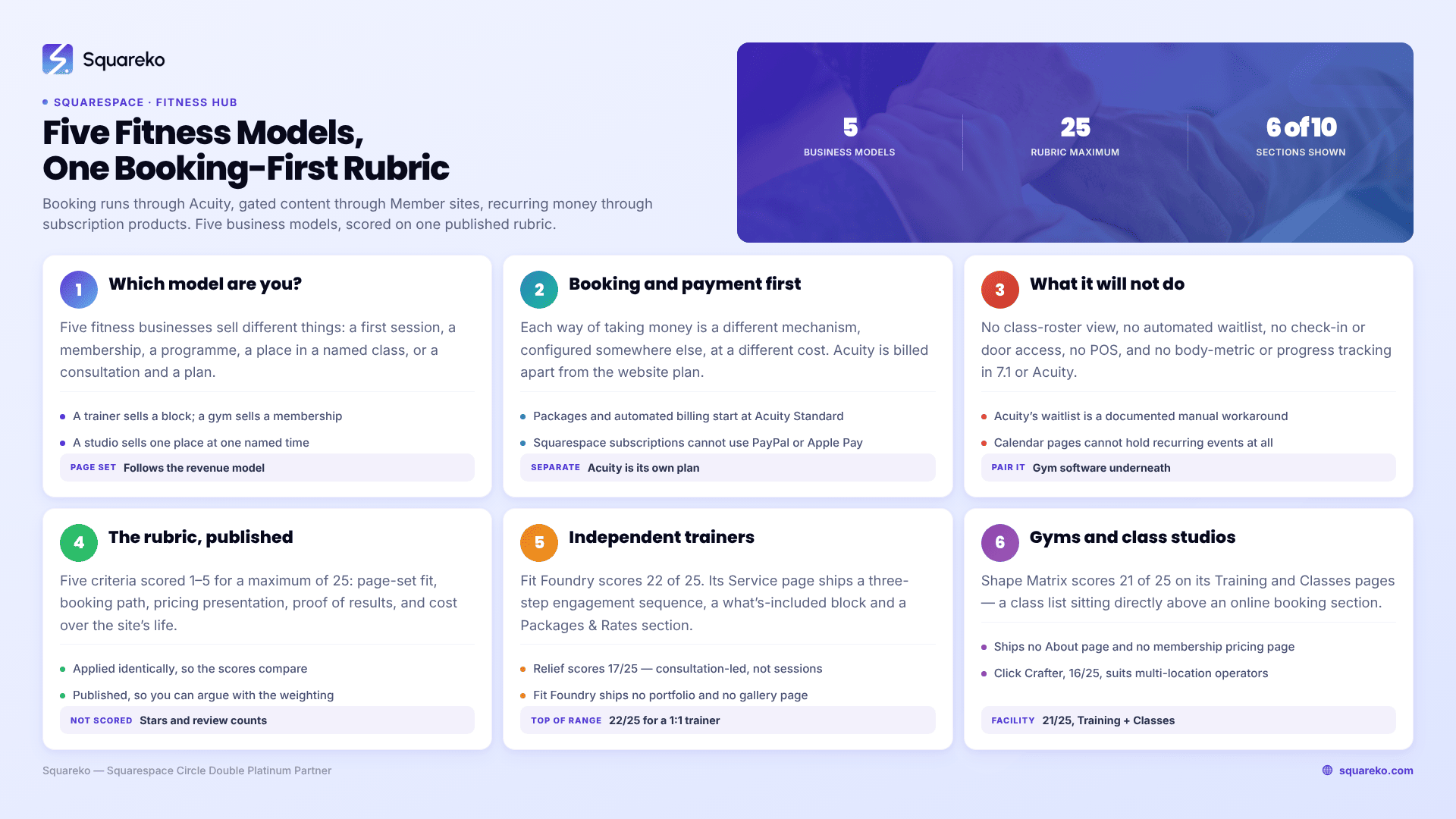
The short answer: A fitness website is decided by how people book and how people pay, not by how it looks. Booking runs through Acuity Scheduling, which is a separate subscription from your Squarespace plan. Gated programme content runs through Member Sites. Recurring money runs through subscription products. Pick the template whose page set already matches your revenue model — styling is a Site Styles change in Squarespace 7.1, page architecture is a rebuild.
This is the cluster hub. Five fitness business models are scored below against a published rubric, and the companion guides go deeper on each one.
Which fitness business are you?
The five models below sell genuinely different things, and the sites that work for each look nothing alike underneath.
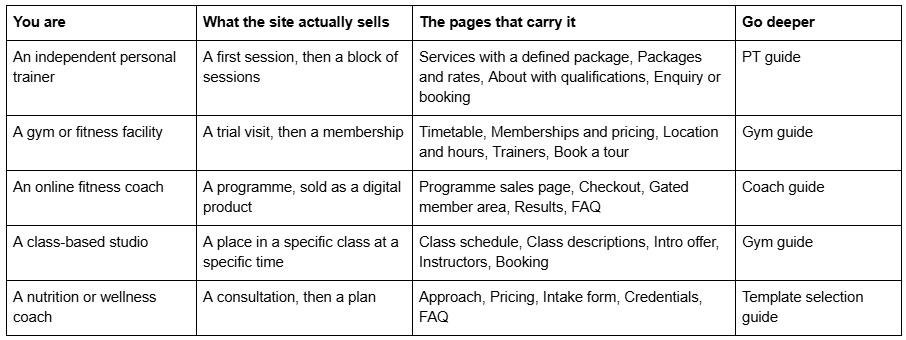
If you are choosing between two templates rather than choosing a business model, the fitness template selection guide covers which Squarespace 7.1 section patterns a fitness site needs and in what order. This post covers which template to start from.
Five further guides in this cluster take one discipline or comparison each: yoga studios, Pilates studios, wellness businesses, nutritionists, and a head-to-head on the best template for personal trainers.
The booking and payment decision comes first
Before any template comparison, work out which of these you are actually collecting money for. Each row is a different mechanism, configured in a different place, at a different cost.
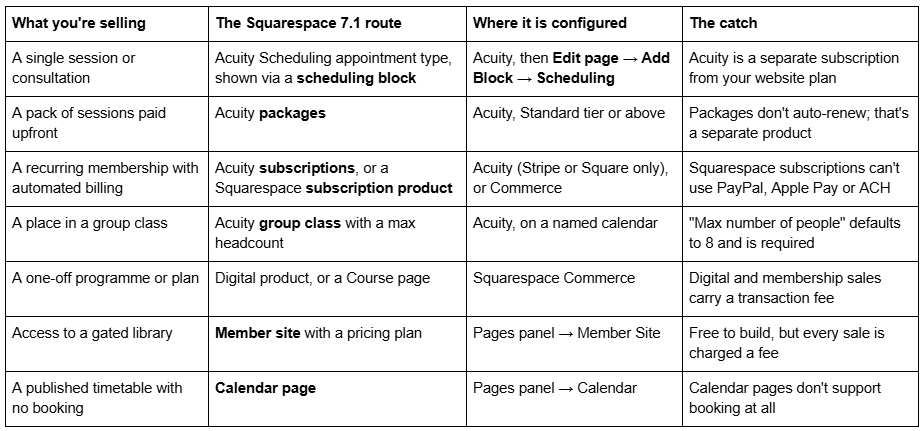
Two of those rows deserve the numbers spelled out, because they are the ones people discover after they have built the site.
Acuity is billed separately. Squarespace's own documentation is unambiguous: "Your Acuity subscription is separate from your site subscription. You can use Acuity on its own, or add it to a Squarespace website." There are three tiers. Starter gives you one bookable calendar. Standard is where bundled appointment packages and memberships with automated billing appear — which is the tier most fitness businesses actually need. Premium adds up to 36 calendars, custom CSS and API access, and HIPAA compliance.
Gated content is charged per sale. Squarespace's Digital Content and Memberships transaction fee runs 7% on Basic, 5% on Core, 1% on Plus and 0% on Advanced. That is separate from card processing. As of 23 July 2026 the old standalone Digital Products plan is closed to new signups — Squarespace's instruction is now to "upgrade your website plan to lower your transaction fees and increase video storage." For an online coach selling a $149 programme, the difference between Basic and Plus is roughly $9 a sale, which changes the plan maths well before it changes the template choice.
What Squarespace will not do for a fitness business
This is the part the design roundups leave out, and it is the part that decides whether you need a second system.
No class-roster management. Acuity holds attendees against a group class and lets you add and remove them, but there is no roster view built for a front desk, no attendance history per member, and no way to mark someone as a no-show and have it affect their pack balance automatically.
No automated waitlist. Acuity's own help documentation describes a manual workaround rather than a feature: create a second calendar called Waitlist, duplicate the classes you want a waitlist for, allow multiple bookings per slot, and move people across by hand when someone cancels. It states plainly that "Acuity won't prompt you to review incoming requests." For a studio running twenty classes a week, that is a job, not a setting.
No check-in, no door access, no POS. Nothing in Squarespace 7.1 or Acuity handles member check-in at a physical door, membership card scanning, or till transactions for retail at reception.
No body-metric or progress tracking. There is no client progress dashboard, no weight or measurement log, no habit tracking and no workout logging. A Member site can hold the content of a programme; it cannot record whether anyone did it.
No recurring events on Calendar pages. Squarespace states it directly: "It's not possible to set up recurring or repeating events." A weekly 6am spin class has to be duplicated per occurrence, or published as a static list section instead.
What people pair it with, in practice: Acuity for anything appointment-shaped, a dedicated gym management system (Mindbody, Glofox, TeamUp and similar) for facilities running rosters and door access, and a coaching platform (Trainerize, TrueCoach, Everfit and similar) for online coaches who need client check-ins and workout logging. The Squarespace site stays as the marketing and sales layer, which is the job it is good at.
How these Squarespace fitness templates were scored
This is an editorial rubric, not a lab measurement. It is applied identically to every template so the scores are comparable, and it is published so you can disagree with the weighting rather than guess at it.
Five criteria, each scored 1–5, maximum 25:
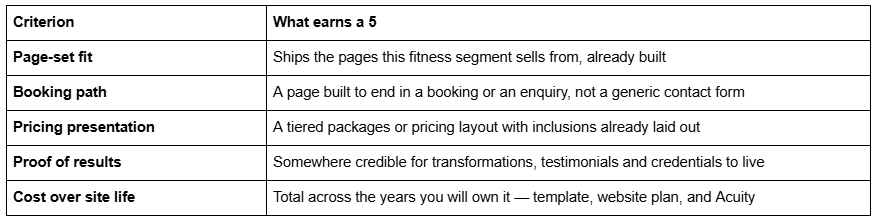
Not scored: star ratings, review counts and "trusted by" figures. Those are unverifiable from outside the shop publishing them.
Squarespace templates for independent personal trainers
A one-person training business sells a first session and then a block of sessions. The whole site exists to shorten the distance between "this person looks credible" and "I have a time in my calendar."
Fit Foundry — best overall for a 1:1 personal trainer
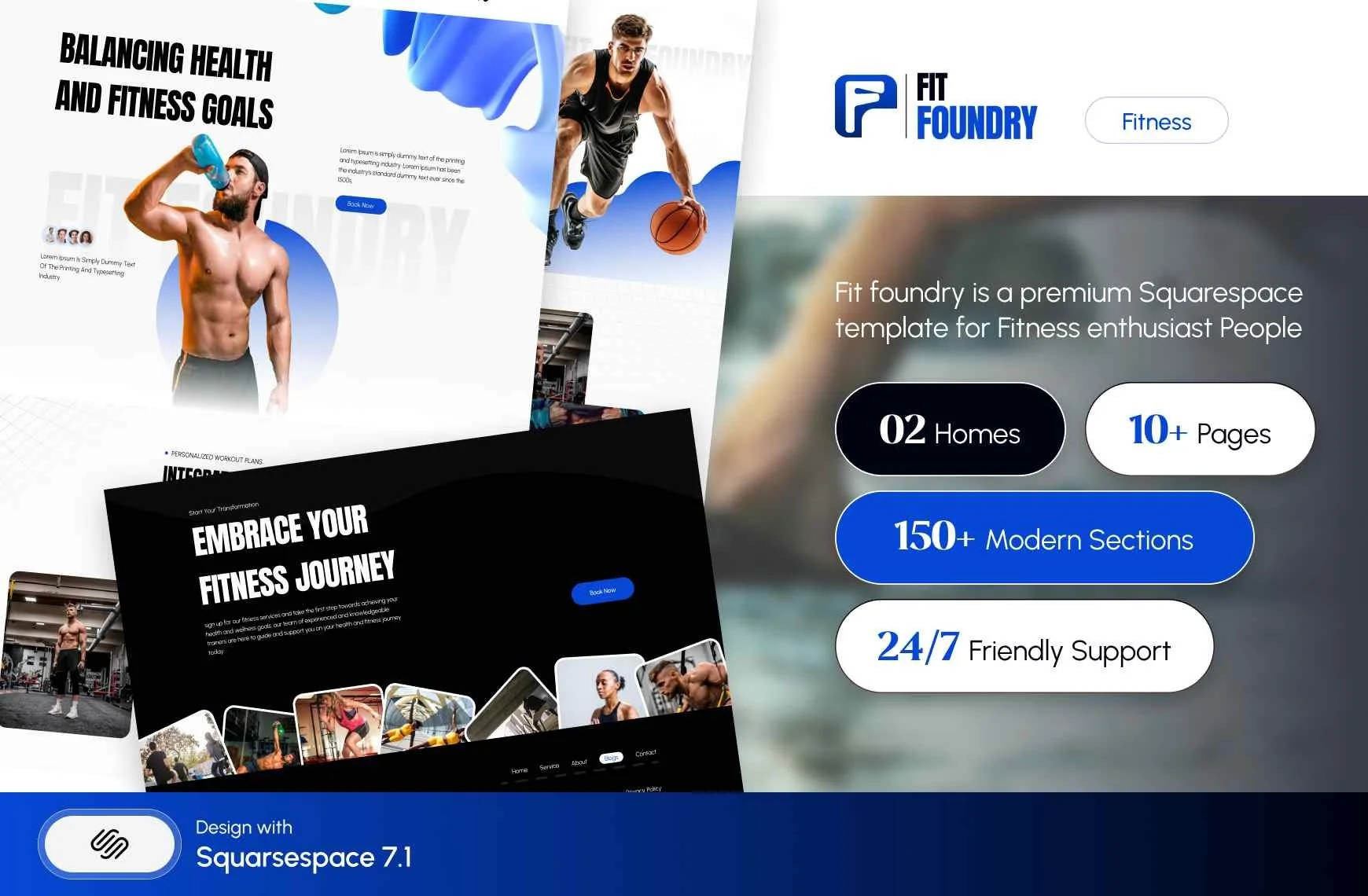
Score: 22/25. Fit Foundry is eleven pages: Home, Home 2, Service, About, Blog, Shop, Contact, Freebie, FAQs, a Style Guide and a 404.
The Service page is the reason to pick it. It ships a three-step engagement sequence — Meet up + consultation, Plan + develop strategy, Execute + weekly sessions — followed by a "What's included" block, a Packages & Rates section laid out as three monthly tiers, a testimonial row and an FAQ. That is the exact shape of a personal training offer, already built, and it is the section most trainers spend a weekend assembling from scratch. The FAQs page uses Squarespace's native Accordion block, which renders server-side in 7.1, so the question and answer text is crawlable rather than hidden behind JavaScript.
The Shop page matters more than it looks. A trainer selling programme PDFs, a nutrition guide or branded kit alongside sessions has somewhere to put them without adding a page type later.
Walk it on the Fit Foundry demo before deciding.
Page-set fit 5, booking path 4, pricing presentation 5, proof of results 4, cost over site life 4.
Worst for: anyone whose pitch is visual. Fit Foundry has no portfolio or gallery page, so before-and-after transformation work has no home beyond sections you build yourself.
Relief — best for a trainer selling consultations rather than sessions
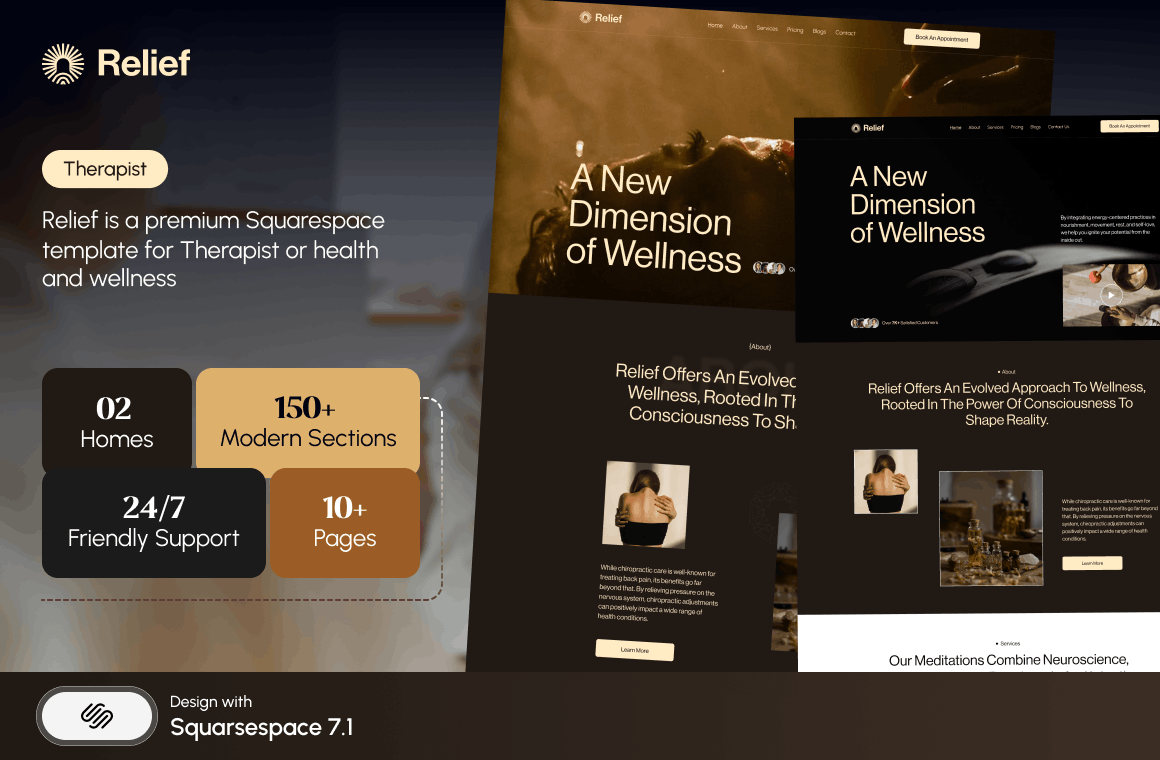
Score: 17/25. Relief is an eleven-page therapist and wellness coach template with a Pricing page and an FAQs page already built. It is structurally close to a nutrition coach or a rehab-focused trainer: consultation-led, package-priced, no retail. See the Relief demo.
Page-set fit 3, booking path 3, pricing presentation 5, proof of results 3, cost over site life 3.
Worst for: high-energy strength and conditioning brands. Relief reads calm and clinical, which is the wrong register for a bootcamp.
For a direct head-to-head between the two on the trainer use case specifically, see the best Squarespace template for personal trainers.
Squarespace templates for gyms, studios and class timetables
A facility sells a trial visit first and a membership second. That changes the page set: a timetable, a location with real opening hours, staff pages and a way to book a look around.
Shape Matrix — best for a gym or class-based studio

Score: 21/25. Shape Matrix is eleven pages: Home, Home 2, Training, Classes, Blog, Portfolio, Gallery, Contact, Freebie, a Style Guide and a 404.
Training and Classes are the two pages a facility genuinely needs and almost no template ships. The Training page carries a coaches section — three named trainer profiles — plus separate personal training and nutrition blocks. The Classes page is built as a class list with an online booking section beneath it, which is exactly where an Acuity scheduling block belongs. Portfolio and Gallery between them give transformation work and facility photography somewhere real to live.
Walk it on the Shape Matrix demo.
Page-set fit 5, booking path 4, pricing presentation 3, proof of results 5, cost over site life 4.
Worst for: anyone who wants an About page and a membership pricing page in the box. Shape Matrix ships neither, and a gym without a published membership price is a gym people phone a competitor about. Both are buildable from the included sections, but budget the afternoon.
Click Crafter — best for a multi-location or franchise operator

Score: 16/25. Click Crafter is a twelve-page agency and service template with a Portfolio, a Gallery, a Blog, a Shop and a Freebie page. Nothing about it is fitness-specific, and that is the point: its repeatable service-detail pattern is the most practical starting point for building genuinely distinct location pages across several sites. See the Click Crafter demo
Page-set fit 3, booking path 3, pricing presentation 3, proof of results 4, cost over site life 3.
Worst for: a single-site studio. Twelve generic pages is more scaffolding than one gym needs.
Squarespace templates for online fitness coaches
An online coach sells a programme, not a session. The site is a sales page plus a checkout plus somewhere gated for the content to live, and the template's job is to carry the first two convincingly.
Luminary scores 18/25. Eleven pages with a Shop, a Portfolio, a Gallery, a Courses page and a Freebie page. The Courses page is the draw — Squareko does not publish whether it is built as a Squarespace Course page or as a standard page, so check that on the Luminary demo rather than assuming. Luminary has no blog, which for a coach relying on organic search is a genuine gap.
Page-set fit 4, booking path 3, pricing presentation 3, proof of results 4, cost over site life 4.
Scholar scores 16/25. Eleven pages with a Shop, Portfolio, Gallery and Freebie, no blog. It is a fashion and course template rather than a fitness one, and it is worth knowing about only if you want a retail-forward feel. See the Scholar demo.
Fit Foundry scores 20/25 for this segment on the strength of its Shop and Freebie pages and its blog — a lower page-set fit than Luminary for course delivery, a much better one for lead capture.


The online fitness coach guide covers programme sales pages, cohort launches and the Member Sites checkout in full.
Squarespace templates for class-based studios
A class-based studio — reformer Pilates, spin, boxing, barre, yoga — is a distinct problem from a gym, because the unit being sold is a named place in a named class at a named time, not access to a building. Two things follow.
First, the timetable is the most-visited page on the site and it needs to be bookable, not decorative. That means Acuity group classes with a headcount limit, surfaced through a scheduling block, rather than a Calendar page. Squarespace's Calendar pages are genuinely useful for one-off workshops and events, but they support no booking and no recurring events, so a weekly schedule published there has to be duplicated by hand every occurrence.
Second, the intro offer does the selling. Most studio conversions come from a discounted first block — three classes for the price of one, a two-week unlimited pass — and that is an Acuity package, not a membership. Packages require the Acuity Standard tier and do not auto-renew, which is the correct behaviour for a trial.
Shape Matrix is the pick here on the same 21/25, because its Classes page ships as a class list sitting directly above an online booking section. That is the page shape a studio needs, and it is the one page nobody else builds. The yoga studio guide and the Pilates studio guide cover the two disciplines where class booking behaves differently — teacher-led drop-ins versus equipment-constrained reformer capacity.
Squarespace templates for nutrition and wellness coaches
Nutrition coaching, health coaching and rehab-focused work sell a consultation and then a plan. There is no timetable, usually no retail, and the credibility burden sits on qualifications and on a clearly explained method rather than on transformation photography.
Relief scores 19/25 for this segment — higher than it scores for personal training — because its eleven-page therapist and wellness set is built around exactly that: a Pricing page with consultation tiers, an FAQs page, and a calm register that suits clinical work. Fit Foundry scores 18/25 here, losing on tone rather than structure; its Service page sequence adapts cleanly to consultation, plan, review.
The nutritionist guide and the wellness business guide cover the credentialing and intake questions in full.
The practical constraint in this segment is intake. A nutrition coach needs a real intake form — medical history, medication, allergies, goals — and that belongs in Acuity's custom intake forms attached to the appointment type, not in a Squarespace form on the contact page, so the answers arrive attached to the booking rather than in a separate inbox.
Cost over the life of a fitness site
The template is the smallest number here, which is why choosing on template price alone is the wrong exercise.
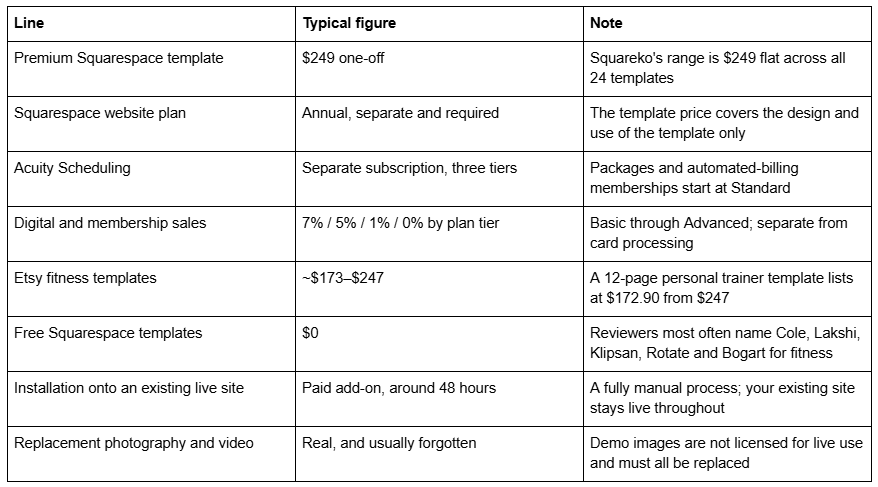
Two things worth stating plainly. Squareko templates are delivered as a Squarespace contributor invitation, not a file download — there is nothing to upload and no FTP step, which is a meaningful difference from most template shops. And all sales are final: digital products cannot be returned, exchanged or refunded under any circumstances. That is a reason to walk the demo properly before buying, not a reason not to buy.
Choosing, in order
Work it this way. Decide which of the five fitness business models you are. Decide how money arrives — session, pack, membership, programme or class place — because that determines whether you need Acuity Standard, a subscription product, a Member site, or none of them. Then, and only then, check whether the template ships the pages that model sells from. Styling comes last, because styling is the only part Squarespace 7.1 makes easy to change later.
If you want the fitness page set already built rather than assembled — Fit Foundry's Packages & Rates layout, or Shape Matrix's Training and Classes pages — both sit in our premium Squarespace templates range at $249, are installed for you rather than delivered as files, and come with 60 days of email support. That is worth most when you are launching against a fixed date, like a January intake or a studio opening.
If your booking flow already works and you are getting enquiries, a free Squarespace template and a better Acuity configuration will move more numbers than a new design will.
FAQ
-
Squarespace does not sell fitness-specific templates — every template shares the same 7.1 editor and sections — though it markets scheduling, packages and memberships at the trade on its Sports & Fitness solutions page. Premium shops do: Fit Foundry is an 11-page fitness template with a Packages & Rates layout, and Shape Matrix ships Training and Classes pages.
-
Through Acuity Scheduling, which is a separate subscription from your website plan. Create your appointment types or group classes in Acuity, then add a scheduling block to the page with Edit page → Add Block → Scheduling. You can display your general scheduler or filter it to one calendar, appointment type or category.
-
Yes, two ways. Squarespace subscription products bill recurring service products through Squarespace Payments or Stripe — not PayPal, Apple Pay or ACH — and a customer can only buy one subscription per order. Acuity subscriptions bill recurring appointments and require the Standard tier and Stripe or Square.
-
Less than shops imply. Every Squarespace 7.1 template runs the same engine, so gallery sections, Portfolio pages and Site Styles are identical across all of them. What differs is page architecture — how many service URLs arrive prebuilt — and that is worth a week of work, which is what you are buying.
-
Class-roster management, automated waitlists, member check-in, door access, POS and body-metric tracking. Acuity's documented waitlist is a manual workaround using a duplicate calendar, not a feature. Facilities normally pair a Squarespace site with a gym management system and keep Squarespace as the marketing and sales layer.
-
Yes — every Squarespace template is included with a subscription at no extra cost, and independent reviewers most often name Cole, Lakshi, Klipsan, Rotate and Bogart for fitness businesses. The trade-off is page count: free templates give you a design, not a pre-built packages layout, class page or trainer page.

Author Bio
I'm Walid Hasan, a Certified Squarespace Expert and Squarespace Circle Platinum Partner with over 12 years of hands-on experience designing and optimizing high-performing websites. Over the years, I've had the privilege of building more than 2,000 Squarespace websites for clients around the world, always focusing on clean design, strong user experience, and conversion-driven results.