Squarespace Templates for Personal Trainers
The short answer: An independent personal trainer's website has one job — get a stranger from "this person might be able to help me" to a confirmed time in your diary, in as few steps as possible. Everything else is secondary. Pick a template with a service page that already carries a defined package and a rates section, connect Acuity Scheduling to it, and sell blocks of sessions rather than single ones.
This is the independent-trainer post in the fitness template cluster. Gyms, studios and online-only coaches have different problems, covered separately.
The enquiry-to-first-session path
Map this before you look at a single template. Every stage is a page or a block, and every stage is somewhere people fall out.
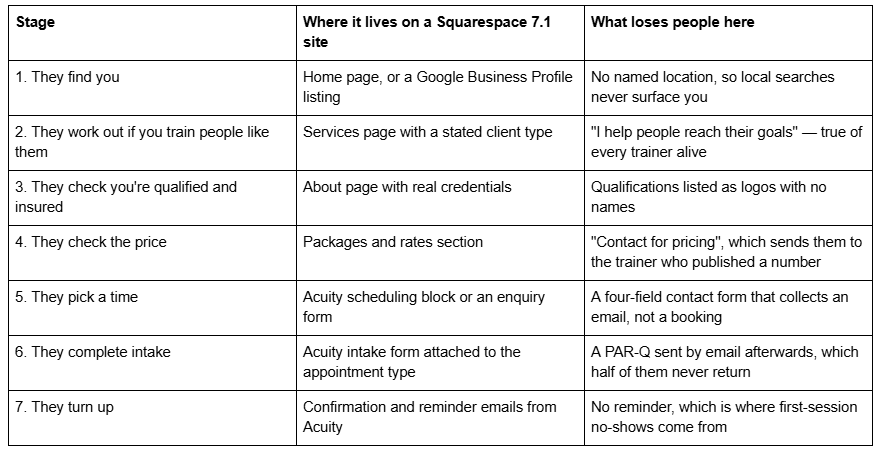
Stages 4 and 5 are where most trainer websites break. Publishing a price and putting a real booking mechanism on the page are the two highest-return changes on almost every PT site I am sent.
Selling packs of sessions: three routes compared
Single sessions are a bad business and a worse website. A pack of six or twelve is what makes the diary predictable, and Squarespace 7.1 gives you three genuinely different ways to sell one. They are not interchangeable.
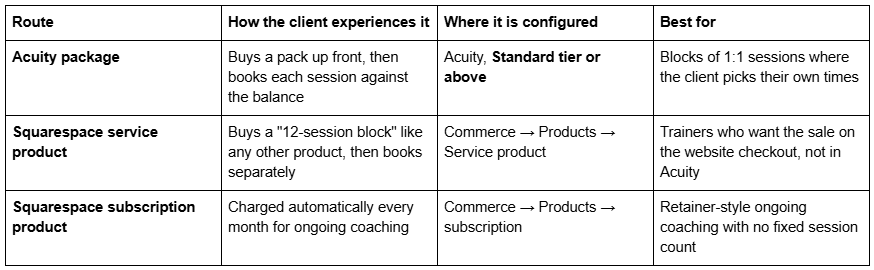
The Acuity package is the right default for a 1:1 trainer. It is the only one of the three where buying and booking are the same system, so the client's remaining balance is tracked automatically and you are not reconciling a spreadsheet against a diary. Acuity's own documentation notes the key difference from the alternative: "Unlike subscriptions, packages don't automatically renew." That is correct behaviour for a training block — you want the renewal conversation to happen in person.
The subscription product has real constraints, and they bite. Squarespace states them plainly: "You can't sell subscription products using PayPal, Apple Pay, or ACH payments," so you need Squarespace Payments or Stripe. And: "Customers can only purchase one subscription product at a time and can't include other types of products in the transaction." A client cannot buy your monthly coaching and a nutrition guide in one order. There is also no pause function — if someone wants to skip a month you cancel the pending order manually.
Acuity subscriptions sit between the two. They bill recurring appointments automatically, require the Acuity Standard tier, and only work with Stripe or Square as the processor.
A practical rule: if the client picks their own times, use Acuity. If you are selling a thing rather than a diary, use Commerce.
Free consultation or paid first session?
This is a real decision, not a formality, and the site should reflect whichever you choose rather than hedging between them.
A free 20-minute consultation lowers the barrier and works when your average client value is high enough to absorb the no-shows. Make it a distinct Acuity appointment type with its own short duration, its own intake questions, and a confirmation email that says what to bring. Do not make it the same appointment type as a paid session with the price set to zero — you lose the ability to report on conversion.
A paid first session filters harder and produces better-quality enquiries. It works when demand is already there. If you go this route, publish the price on the page and make it bookable directly; asking someone to enquire about a paid trial adds a step that costs you more than the friction it removes.
What does not work is "book a free consultation" as a button that opens a generic contact form. That is the worst of both — the low barrier of a free offer with the delay of an enquiry.
How to present personal training rates
Publishing rates is the single most common thing independent trainers get wrong, and it is worth its own decision rather than being inherited from whatever the template demo said.
Three tiers is the pattern that converts, because it gives the reader something to compare rather than something to accept or reject. Name the tiers after the commitment, not after metals — Starter block, 12-week transformation, Ongoing coaching beats Bronze, Silver and Gold, which tells the reader nothing.
Each tier needs four things stated: the number of sessions, the session length, what happens between sessions (programme, check-ins, nutrition guidance), and the total price. A per-session price with no block size is the version people cannot compare, which is why it gets skipped.
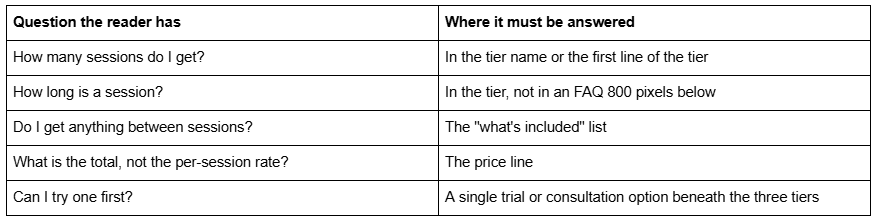
If your rates genuinely vary — corporate work, rehab referrals, travel outside your area — publish the standard blocks anyway and add one line saying what changes the number. Silence reads as expensive.
The page set an independent personal trainer needs
Six pages carry a solo PT business. Anything beyond these should earn its place.
Home — who you train, where, what it costs to start, and one booking CTA above the fold.
Services — one section per offer: 1:1 in person, 1:1 online, small group. Each with a defined session count, duration and what is included.
Packages and rates — the numbers, with inclusions. Three tiers is the pattern that converts.
About — qualifications with awarding bodies named, insurance, years, and the specific kind of client you are good with.
Results — testimonials with first names and a specific outcome, plus transformation photography if you have consented images.
Book — the Acuity scheduling block, not a contact form.
Two optional additions earn their keep. A blog is the only organic-search asset a solo trainer has, and it is how you rank for the questions your clients ask before they are ready to buy. A freebie or lead magnet page — a mobility routine, a first-four-weeks plan — captures the people who are interested but not ready, which for a PT is most of them.
Which Squarespace templates ship that page set
Fit Foundry — the closest fit for an independent trainer
Fit Foundry is eleven pages: Home, Home 2, Service, About, Blog, Shop, Contact, Freebie, FAQs, a Style Guide and a 404.
The Service page is why it wins for this use case. It ships a three-step engagement sequence — Meet up + consultation, Plan + develop strategy, Execute + weekly sessions — then a "What's included" block, then a Packages & Rates section built as three monthly tiers, then testimonials, then an FAQ. That is stages 2, 3, 4 and 5 of the enquiry path on one page, already laid out. Most trainers assemble that page over a weekend; here it is the page you edit.
The Freebie page covers the lead magnet. The Shop page gives programme PDFs and nutrition guides somewhere to live without adding a page type later. The FAQs page uses Squarespace's native Accordion block, which renders server-side in 7.1, so the text is crawlable rather than hidden behind JavaScript.
Walk the whole page set on the Fit Foundry demo before deciding.
Worst for: trainers whose pitch is visual. Fit Foundry has no portfolio or gallery page, so transformation galleries have to be built from gallery sections you add yourself. Note also that Squarespace gallery sections cannot hold video, so a trainer wanting technique clips needs video blocks or a separate Video page.
Relief — for consultation-led and rehab-focused trainers
Relief is an eleven-page therapist and wellness coach template with a Pricing page and an FAQs page already built. It suits a trainer whose work is closer to rehab, pre- and post-natal, or nutrition-led coaching, where the register should be calm rather than high-energy. It has no portfolio, no gallery and no shop. See the Relief demo.
Free Squarespace templates
Every Squarespace template is included with a subscription at no extra cost, and independent reviewers most often name Cole, Lakshi, Klipsan, Rotate and Bogart for trainers. They give you a design, not a pre-built packages layout — which is a fair trade if you are happy to build one section at a time and want to spend the budget on photography instead.
Handling local and online clients on one site
Most independent trainers run both, and the common mistake is folding them into one Services page. They are different products bought by different people.
Give each a distinct offer block on the Services page with its own price, its own session length and its own Acuity appointment type. Online clients need a video-call location — Acuity integrates with Google Meet, Zoom and GoToMeeting on all plans — and in-person clients need a real address and travel radius stated in text, because Google reads text and not map pins.
If local work is the bulk of your income, the address, service area and opening hours belong in the footer on every page and on a Google Business Profile listing. No template does that for you.
What the template will not do
Three things people attribute to the template that are not the template's job.
No template configures Acuity. Acuity Scheduling is a separate subscription from your Squarespace website plan — Squarespace's own wording is "Your Acuity subscription is separate from your site subscription." Appointment types, availability, buffers, packages and intake forms are all built in Acuity, then surfaced on the site with Edit page → Add Block → Scheduling.
No template ships a PAR-Q or health screening form. Build it as a custom intake form on the Acuity appointment type so the answers arrive attached to the booking. Treat health data with the care it deserves and check your obligations in your market before storing it.
No template tracks client progress. There is no workout log, no weight or measurement history and no check-in feature in Squarespace 7.1 or Acuity. Trainers who need that pair the site with a coaching platform such as Trainerize, TrueCoach or Everfit and keep Squarespace as the front door.
Where to start
Write the packages and the price first. Then choose a template that already has a page shaped to hold them. Then connect Acuity, and only then think about photography and colour, because Site Styles in Squarespace 7.1 makes styling the easiest thing on the list to change later.
If you would rather edit that page than build it, Fit Foundry sits in our premium Squarespace templates range at $249, is delivered as a Squarespace contributor invitation rather than a file download, and can be installed onto an existing live site as a paid add-on in around 48 hours. Note that all sales are final on digital products, so walk the demo properly first.
If your enquiries are already healthy and your problem is conversion, a free Squarespace template plus a published price and a working Acuity link will do more than a redesign.
FAQ
-
Six: Home, Services with a defined offer per client type, Packages and rates with real numbers, About with named qualifications and insurance, Results with testimonials, and a Book page carrying an Acuity scheduling block. A blog and a lead-magnet page are the two optional additions that earn their place for a solo trainer.
-
Three routes. Acuity packages let a client buy a pack and book against the balance in one system, and require the Acuity Standard tier. A Squarespace service product sells a block through the website checkout. A subscription product bills monthly automatically. For 1:1 training where the client picks their own times, Acuity packages are the right default.
-
Yes, two ways. Squarespace subscription products bill recurring service products through Squarespace Payments or Stripe — not PayPal, Apple Pay or ACH — and a customer can only buy one subscription per order. Acuity subscriptions bill recurring appointments and require the Standard tier and Stripe or Square.
-
Either works, but commit to one. Make a free consultation a distinct Acuity appointment type with its own duration and intake questions so you can measure conversion. If you charge for the first session, publish the price and make it directly bookable. What fails is a free-consultation button that opens a generic contact form.
-
Class-roster management, automated waitlists, member check-in, door access, POS and body-metric tracking. Acuity's documented waitlist is a manual workaround using a duplicate calendar, not a feature. Facilities normally pair a Squarespace site with a gym management system and keep Squarespace as the marketing and sales layer.
-
Yes — every Squarespace template is included with a subscription at no extra cost, and independent reviewers most often name Cole, Lakshi, Klipsan, Rotate and Bogart for fitness businesses. The trade-off is page count: free templates give you a design, not a pre-built packages layout, class page or trainer page.

Author Bio
I'm Walid Hasan, a Certified Squarespace Expert and Squarespace Circle Platinum Partner with over 12 years of hands-on experience designing and optimizing high-performing websites. Over the years, I've had the privilege of building more than 2,000 Squarespace websites for clients around the world, always focusing on clean design, strong user experience, and conversion-driven results.