Squarespace Templates for Wellness Businesses: Structure First
The short answer: The reason most wellness websites fail is not the design, it is that nobody can tell what you sell. "Wellness business" covers spas, breathwork facilitators, sound practitioners, reiki, massage, holistic therapy and half a dozen hybrids, and none of them has a standard page structure the way a restaurant or a law firm does. Define your unit of sale first, then build one page per thing you sell.
Of the Squareko range, Relief is the closest fit for a single-practitioner or multi-treatment practice: 11 pages including Services, Pricing and an FAQ page.
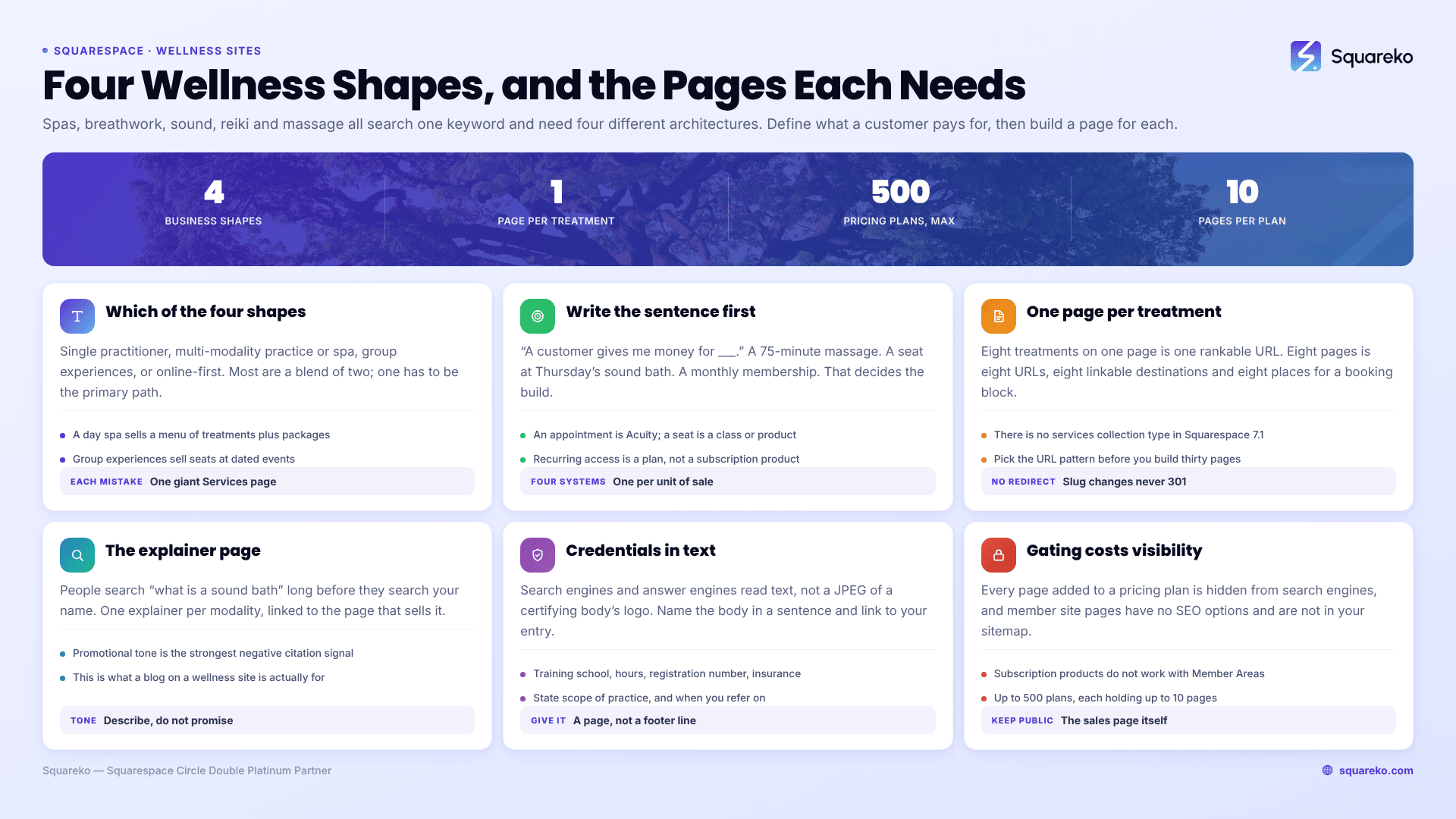
Which of these four shapes is your business?
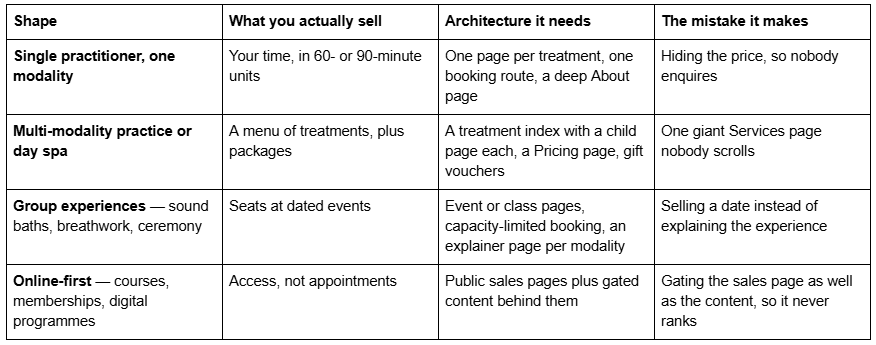
Most wellness businesses are a blend of two of these. That is fine — but the site has to make one of them the primary path, and every template decision follows from which one you pick.
Name the unit of sale before you pick a template
Write one sentence: "A customer gives me money for ___." A 75-minute massage. A seat at Thursday's sound bath. A six-week programme. A monthly membership. A £120 gift voucher.
That sentence decides the whole build, because Squarespace 7.1 handles those five things through four different systems:
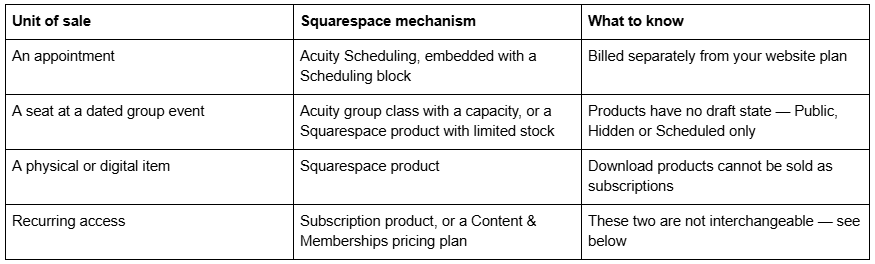
If you cannot write the sentence, no template will rescue the site. This is the single most common reason a wellness build stalls at 80% for four months.
One page per service, not one Services page
This is the structural decision that separates wellness sites that get found from wellness sites that do not.
A single Services page listing eight treatments gives Google one URL to rank for eight different searches, and gives you nothing to link from an advert. Eight pages, one per treatment, gives you eight rankable URLs, eight linkable destinations and eight places to put a booking block.
Each treatment page needs, in this order: what it is in plain language, who it is for, what actually happens during the session, how long it takes, what it costs, contraindications and who should check with a clinician first, what to bring or wear, and a booking button. That order matters — price after explanation, contraindications before the booking button.
Two Squarespace mechanics worth knowing. There is no "services" collection type in Squarespace 7.1, so treatment pages are ordinary pages, usually organised in a folder. Choose a URL pattern before you build — /treatments/sound-healing reads better than /sound-healing-1 and stays sane at thirty pages. And changing a page slug creates no automatic 301 redirect, ever, so get the pattern right first time or add the redirects manually under Settings.
The "what is this?" page is your highest-traffic page
Nobody searches for your business name until they already know you. What they search is "what is a sound bath", "what does reiki actually do", "is breathwork safe", "what is lymphatic drainage massage", "what happens in a cacao ceremony".
Those searches are the whole top of your funnel, and they are almost entirely unserved by wellness businesses, who write about their philosophy instead.
Write one explainer per modality you practise. Keep it genuinely informative — what happens, what it feels like, what the evidence does and does not say, who it suits, who should avoid it. Then link it to the treatment page that sells it. This is what a blog on a wellness site is actually for, and it is the reason to care whether a template ships one.
Be careful with the claims. In an unregulated field the temptation is to overstate outcomes, and overstating them is both a regulatory risk and — measurably — a ranking one. Promotional tone is the single strongest negative signal for AI citation. Describe what happens in a session; let the reader draw the conclusion.
Credentials are the trust layer, and they need to be visible text
Wellness is largely unregulated, which means the buyer cannot distinguish a 500-hour trained practitioner from someone who did a weekend workshop unless you make it obvious.
Publish, plainly: your training school and the qualification's name, hours of training, your professional body membership and registration number, your insurance, your DBS or equivalent check if you work with vulnerable people, continuing professional development, and any specialist qualification — pre- and post-natal, trauma-informed, oncology massage, hypermobility.
Three practical rules for building this in Squarespace:
Put credentials in visible text, not in a badge image. Logo strips are the standard way practitioners publish accreditation and the worst way. Search engines and AI answer engines read text; they do not read a JPEG of a certifying body's logo. Put the body's name in a sentence and link to your listing on their register.
Give it a page, not a footer line. An About page that carries your training, your practice history and one honest paragraph about why you do this is often the second-most-visited page on a wellness site.
State scope of practice explicitly. Say what you do not treat and when you refer on. Practitioners consistently underestimate how much confidence that sentence buys.
Pick the booking route before you build the pages
The native route is Acuity Scheduling — branded Squarespace Scheduling for several years, and now, per the Squarespace Help Center, "officially Acuity Scheduling" again. It is a separate subscription; Squarespace's documentation states "Your Acuity subscription is separate from your site subscription."
On the page you embed it with a Scheduling block, which can show your general scheduler or filter to a specific calendar, appointment type or category. Filtering is what lets each treatment page carry its own booking button rather than dumping every visitor into one long list.
Plan tiers set what you can do:
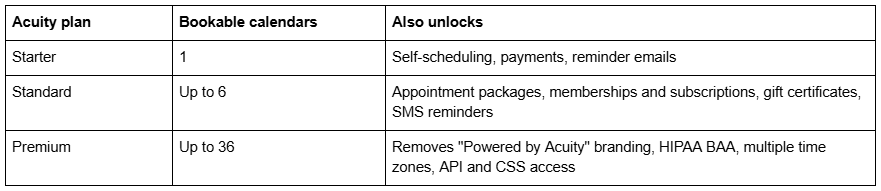
A solo practitioner fits Starter. A spa with four therapists and two treatment rooms needs Standard, and needs it anyway for gift certificates and packages.
What Squarespace and Acuity cannot do. There is no class roster and no attendance check-in, and the waitlist does not cover classes. Acuity added a native appointment waitlist on its higher tiers — clients join, choose preferred dates and get a text when a slot frees — but it applies to appointment types, not classes, and an older Acuity article still documents a manual duplicate-calendar workaround. Confirm which applies to your plan before you promise a waitlist. There is no room or resource assignment, and no retail point of sale. Practices that outgrow this pair Squarespace with Punchpass, Momence, WellnessLiving, Mindbody or a salon system such as Fresha, embedding the schedule in a Code Block. That needs the Core plan or above (Business, Commerce Basic and Commerce Advanced also qualify), because JavaScript and iframes in Code Blocks are gated to those plans.
Gift vouchers, packages and retail
Gift vouchers are frequently the largest single revenue line on a spa website in December, and there are two ways to sell them.
Acuity gift certificates live inside the booking system, so the recipient redeems against a bookable appointment. They require the Standard plan or above. Squarespace gift cards are ecommerce items that apply at checkout, which suits retail but not appointments. Pick one and say clearly on the page how it is redeemed — voucher confusion generates more support email than anything else on a spa site.
For retail and products: Squarespace products have no draft state. A product is Public, Hidden or Scheduled, so build new items as Hidden. If you sell physical goods alongside treatments, that is the argument for a template that ships a Shop page rather than bolting one on later.
Gating content costs you search visibility. Decide deliberately.
Plenty of wellness businesses want a members' area — a meditation library, recorded classes, a community.
Squarespace handles this through Content & Memberships pricing plans, which can be free, a fixed amount (paid once or in instalments), or a subscription. You can create up to 500 pricing plans, each holding up to 10 blog pages, course pages, member sites or videos pages.
Two consequences to plan around:
Gated pages disappear from search. All pages added to a pricing plan are hidden from search engines, and pages inside a member site have no SEO options and are not included in your sitemap. That is correct for the library and wrong for the sales page. Keep the sales page public and gate only what sits behind the purchase.
Subscription products and Member Areas are separate systems. Squarespace states plainly that subscription products don't work with Member Areas. If recurring billing has to unlock content, use a Content & Memberships subscription plan, not an ecommerce subscription product. Content and membership sales carry a transaction fee that runs roughly 5–7% on the entry and mid-tier website plans, 1% on Commerce and 0% on Commerce Advanced — confirm the current rate on the pricing page before quoting it.
Relief, Fit Foundry and Shape Matrix, by their actual pages
Relief — 11 pages, tagged Therapist & Wellness Coach: Home, a second homepage layout, About, Services, Pricing, Blog, FAQ, Contact, a privacy policy page, a 404 page and a Style Guide page. For a treatment-led practice this is the strongest base in the range. Services is the index your per-treatment pages hang off, Pricing solves the single most-omitted page on wellness sites, and FAQ is where contraindications, what-to-wear and cancellation policy live. It ships no Gallery or Portfolio, so treatment-room photography goes into Gallery sections on regular pages.
Fit Foundry — 11 pages: Home, a second homepage layout, About, Service, Shop, Blog, FAQs, Freebie, Contact, 404 and Style Guide. Choose this over Relief if retail or digital products are a real revenue line, and for the Freebie page, which is a built lead-magnet landing page most templates make you construct.
Shape Matrix — 11 pages: Home, a second homepage layout, Training, Classes, Blog, Portfolio, Gallery, Freebie, Contact, 404 and Style Guide. The right pick when group experiences are the primary path — sound baths, breathwork circles, workshops — because Classes carries the schedule and Gallery carries the room. Note it ships no About page, which for a credentials-led practice is the wrong gap to inherit.
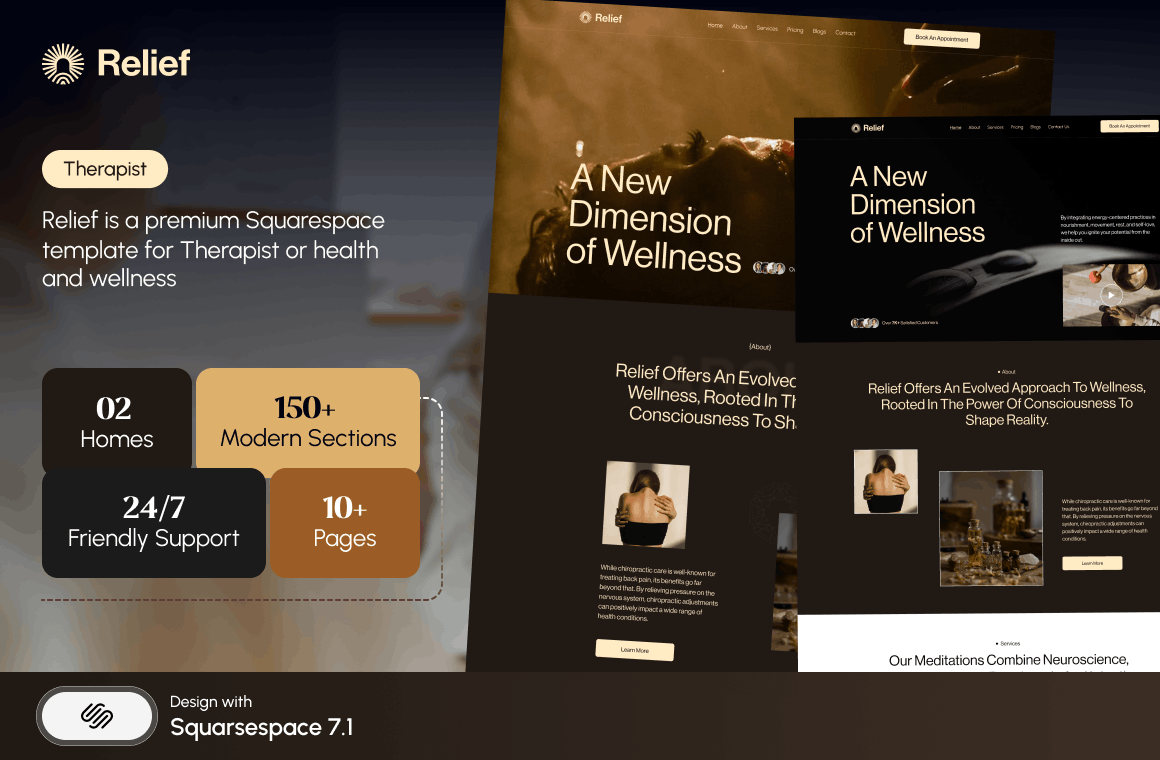

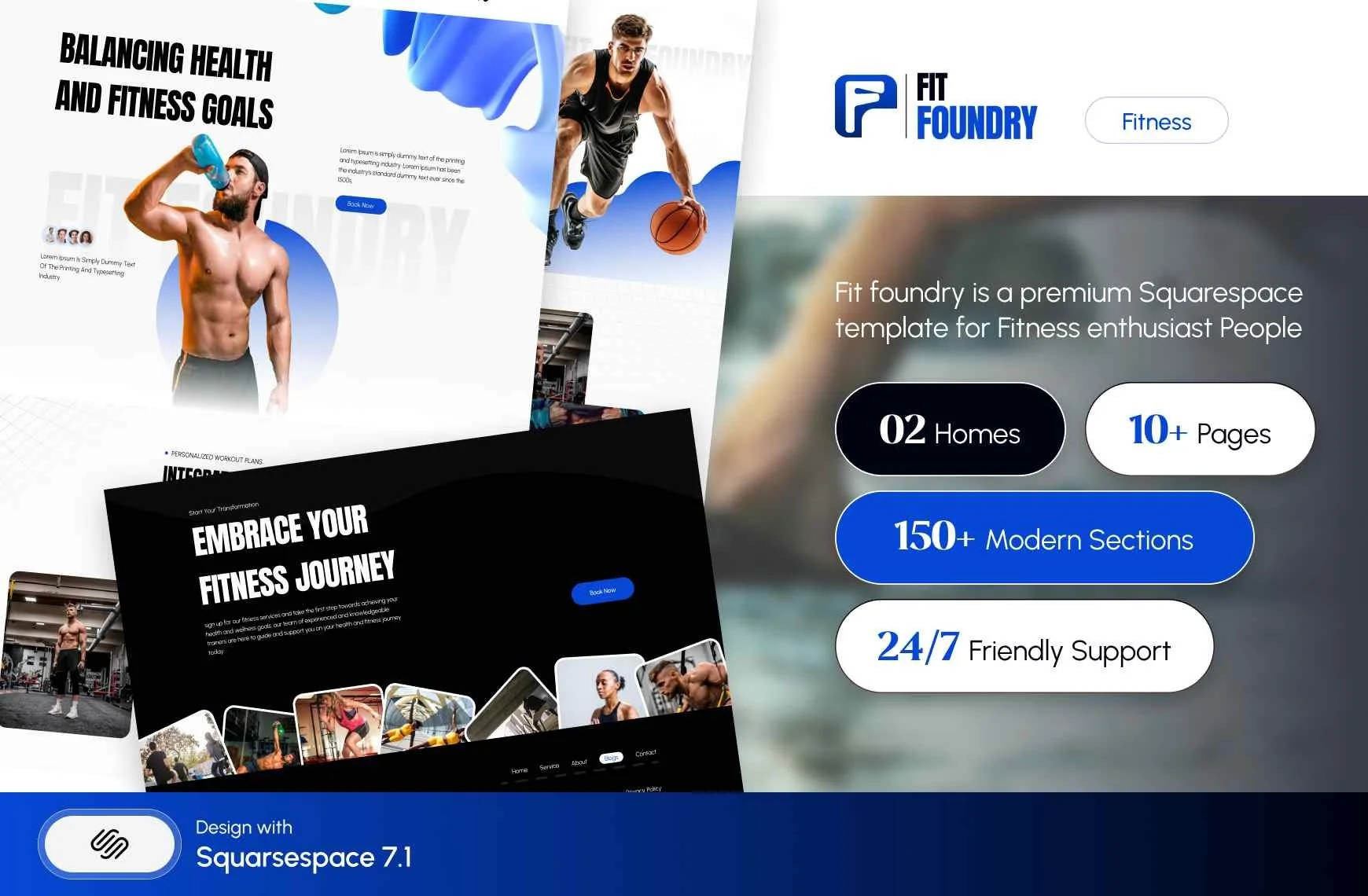
All three are $249, delivered as a Squarespace contributor invitation rather than files to download, with 60 days of email support. Customisation is not included, sales are final, and demo images are not licensed for live use — you replace every one. Each ships 150+ pre-designed sections, a Style Guide page and a 404 page.
Choosing a template for a wellness business
Identify your shape from the four-row table, write the unit-of-sale sentence, then count how many pages your service architecture actually needs. If that number is nine, a template with eleven pages is right. If it is twenty-five, you are buying a starting point, not a finished site, and you should choose on which pages are hardest to build rather than on which demo looks calmest.
Then write your prices, your credentials and your contraindications before you buy anything. Those three documents stall more wellness launches than any technical problem, and no template supplies them.
If you would rather not do the wiring — Acuity, treatment pages, vouchers, redirects — the premium Squarespace templates at Squareko are installed for you, onto a new site or an existing one, with the pages ready for your content. Most practitioners manage this themselves with the structure above; it is published because the structure is the hard part.
If your business is more specific than "wellness", read the post that matches it. Squarespace templates for yoga studios covers recurring timetables and multiple teachers. Squarespace templates for Pilates studios covers class capacity and apparatus. Squarespace templates for nutritionists covers discovery calls, intake forms and programme delivery. The cluster hub is Squarespace templates for fitness.
FAQ
-
One page per treatment or service, an explainer page per modality, a Pricing page, a credentials-led About page, an FAQ covering contraindications and cancellation, a contact and booking route, and a blog. The per-treatment pages matter most — a single combined Services page gives Google one URL to rank for many different searches.
-
Yes, with limits. Acuity enforces a per-class capacity and takes payment, which covers the core requirement. It does not assign specific machines to specific clients, offer a waitlist, or provide a front-desk check-in view. Studios needing those features run dedicated software and embed it in Squarespace.
-
Through Acuity Scheduling, which is billed separately from your website plan. You embed it with a Scheduling block that can be filtered to a specific calendar, appointment type or category, so each treatment page carries its own booking button rather than sending everyone to one long list.
-
Two routes. Acuity gift certificates sit inside the booking system and are redeemed against appointments, and need the Acuity Standard plan or above. Squarespace gift cards are ecommerce items applied at checkout, which suits retail rather than treatments. Pick one and state clearly on the page how it is redeemed.
-
Only if you sell recurring access to content. Be aware that pages inside a member site have no SEO options and are not in your sitemap, and pages in a pricing plan are hidden from search engines. Keep the sales page public and gate only what sits behind the purchase.
-
In visible text, not in a badge image — search engines and AI answer engines read text, not a logo JPEG. Name the training school, hours, professional body and registration number, insurance, and any specialist qualification, and state your scope of practice including when you refer on.

Author Bio
I'm Walid Hasan, a Certified Squarespace Expert and Squarespace Circle Platinum Partner with over 12 years of hands-on experience designing and optimizing high-performing websites. Over the years, I've had the privilege of building more than 2,000 Squarespace websites for clients around the world, always focusing on clean design, strong user experience, and conversion-driven results.