Squarespace Designer Retainers: How They Work and When They Pay Off
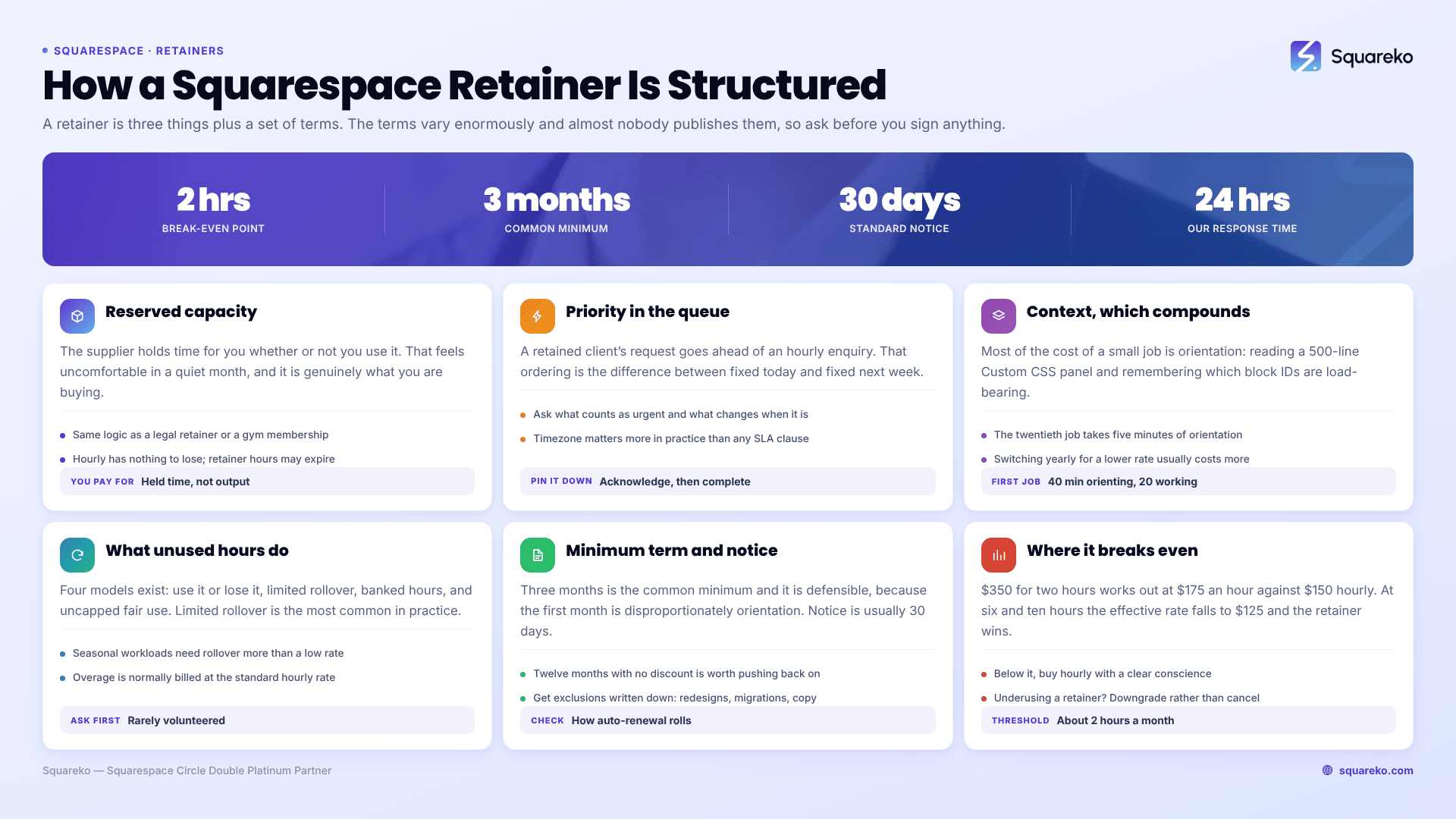
The short answer: A Squarespace designer retainer buys three things that hourly work does not — a reserved block of capacity, priority in a queue, and someone who already knows your site. The first is what you pay for, the third is what you actually get value from. The break-even point in practice is around two hours of real work a month; below that, hourly is cheaper and you should not be talked out of it.
The question worth answering carefully is not "is a retainer worth it" but "how is this specific retainer structured", because the terms vary enormously and almost nobody publishes them.
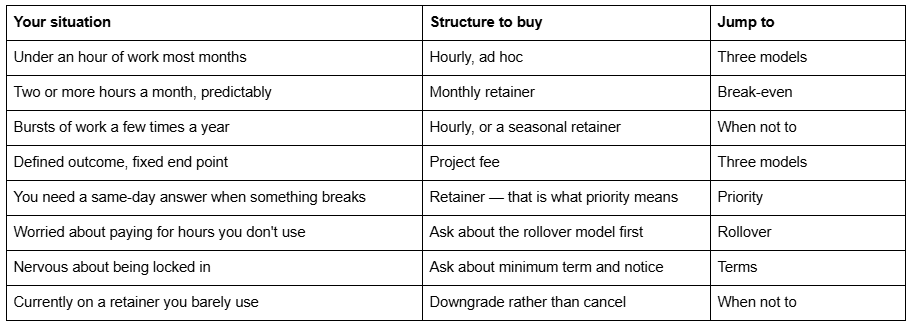
Which buying structure fits your situation
Retainer, project, hourly: what each one actually buys
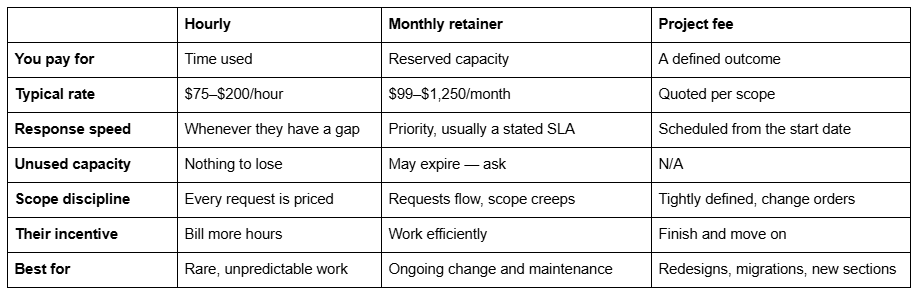
The incentive row is the one worth sitting with. Under hourly billing, a slow supplier earns more. Under a retainer, a supplier who resolves things quickly keeps more of their own margin — which aligns your interests, but also means a badly scoped retainer can push a supplier to do the minimum. That is why the hours figure, and what counts against it, needs to be explicit.
Project fees are not an alternative to the other two. They sit on top. A retainer covers change and maintenance; a redesign is a project, quoted separately, whether or not you are on a retainer.
What a Squarespace retainer buys that ad-hoc work doesn't
Three things, in ascending order of real value.
Reserved capacity. The supplier holds time for you whether or not you use it. This is the part that feels uncomfortable in a month where you send nothing, and it is genuinely what you are buying — the same logic as a gym membership or a legal retainer.
Priority in the queue. A retained client's request goes ahead of an hourly enquiry. When something on your site is broken and it is Thursday afternoon, that ordering is the difference between fixed today and fixed next week.
Context — the one that compounds. This is where the real economics sit. On an established Squarespace site, most of the cost of a small job is orientation: reading a 500-line Custom CSS panel, working out which block IDs are load-bearing, remembering that the header was customised and the mobile layout in that Fluid Engine section is set separately from desktop. Squarespace has no staging environment and no version history, so orientation cannot be short-cut by reading a changelog.
Someone doing their first job on your site spends 40 minutes orienting and 20 minutes working. Someone on their twentieth spends five and 20. That is not a discount you can negotiate — it is a structural property of a continuing relationship, and it is why the second year of a retainer delivers more work per pound than the first.
The corollary is real too: retainers get better over time, so switching suppliers annually to chase a lower rate usually costs more than it saves.
How unused retainer hours are handled
This is the single most important question to ask, and it is almost never volunteered. Four models exist in the market.
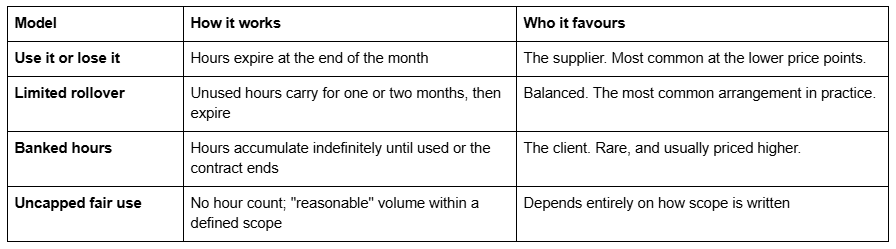
If your workload is seasonal — a retailer whose site changes in October and November and barely moves in February — limited rollover or banked hours matter far more than the headline rate. If your workload is steady, use-it-or-lose-it costs you nothing and may come with a lower price.
Three follow-up questions worth asking:
What happens when I go over? Overage is normally billed at the standard hourly rate, sometimes discounted for retained clients. Our own tiers, for reference, apply a 10% discount on extra hours at $750/month and 15% at $1,250/month — that structure is common and worth asking about.
How are hours measured and reported? You should get a monthly summary showing what was done and what it consumed. Without it, "six hours" is unverifiable.
Can I move a big month? Some suppliers will let you borrow forward against next month rather than pay overage. Ask before you need it.
Minimum terms, notice periods, and what to accept
Squarespace retainers sit at the informal end of the professional services market, and terms reflect that.
Minimum term. Three months is the common minimum, and it is defensible: the first month of any retainer is disproportionately orientation, so a one-month commitment loses the supplier money. Six months is reasonable if the plan includes discovery or a review cycle. Twelve months without a discount attached is worth pushing back on.
Notice period. 30 days is standard. Anything longer should come with something in return.
Auto-renewal. Expect it. Check whether renewal rolls month-to-month after the minimum term or into a fresh fixed term — the second is much less friendly and is easy to miss.
Price review. Annual is normal and should be stated. A retainer with no review clause is not generous; it just means the conversation is unscheduled.
What is explicitly excluded. Get this in writing. Typically: full redesigns, migrations between platforms, work on non-Squarespace sites, content writing, photography, and paid media. Excluded is not the same as unavailable — it means separately quoted.
One term to insist on: your data and access remain yours. Ownership of the Squarespace subscription, the domain, and a copy of the Custom CSS. Getting access and handover right matters more than any commercial term in the contract.
What "priority" actually means, and how to test it
Priority is the vaguest word in this market. Pin it to a number.
Ask for two figures: acknowledgement time — how long before a human confirms they have your request — and completion time for a standard change. Ours are published as a response within 24 hours and minor updates completed within 24–72 hours; that is a normal shape for this market and gives you something concrete to compare against.
Then ask the two questions that reveal whether the SLA is real:
"What counts as urgent, and what changes when something is?" A site that is down, a checkout that fails, a form that stopped delivering — these should have a different path from "change the homepage headline". If everything is the same queue, priority is a word.
"What are your hours, and where are you?" Timezone is a bigger practical factor than any SLA clause. It also cuts the other way in your favour: Squarespace's own English live chat runs on US business hours Monday to Friday, so a European or Asian business often gets faster answers from a retained supplier in a compatible timezone than from the platform itself.
Where a Squarespace retainer breaks even
Do the arithmetic rather than the feeling.
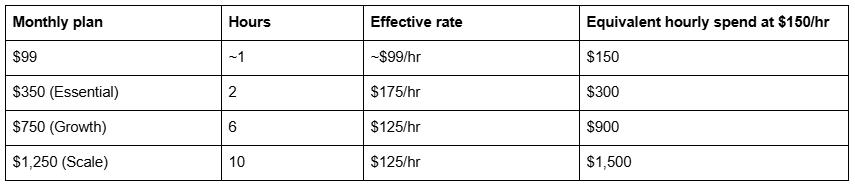
Read that table carefully, because it does not say what a sales page would want it to.
At two hours a month, a retainer is roughly line-ball with hourly on raw cost — $175 against $150. You are paying a modest premium for priority, reserved capacity and continuity, and whether that premium is worth it depends on how much a slow response costs you. If your site takes bookings or payments, it is worth it easily. If it is a brochure, it may not be.
At six and ten hours, the effective rate drops below the market hourly rate and the retainer wins on price as well as on service. That is the normal shape: volume discounts appear once the supplier can plan around your work.
The threshold to watch is roughly two hours of genuine work a month. Below it, buy hourly. At or above it — or if response speed carries real commercial cost — a retainer is the better purchase.
When a Squarespace retainer is the wrong call
Say this plainly, because most pages on this topic won't.
Your site barely changes. A five-page brochure site with no store, no bookings and no custom CSS may generate twenty minutes of work a quarter. Squarespace handles updates, security and SSL itself. A retainer on that site is buying reassurance, and reassurance is a legitimate purchase — just know that is what you are buying.
You have someone in-house. If a member of staff can confidently make content edits, you need code and integration help occasionally, not a monthly block. Buy hourly and keep the number.
Your work is genuinely seasonal. Unless the retainer offers rollover or banked hours, you will pay for eight quiet months to cover four busy ones. Ask for a seasonal arrangement instead — many suppliers will do it and few advertise it.
What you actually need is a project. If the honest answer is "the site needs rebuilding", a retainer will nibble at that for eighteen months and never finish it. Buy the project, then decide about ongoing support afterwards.
And if you are already on a retainer you consistently underuse, the right move is usually to downgrade a tier rather than cancel. Cancelling loses the context, and the context is the expensive part to rebuild.
How to decide
Work out your real monthly hours, not your imagined ones. Ask three questions of any retainer proposal: what happens to unused hours, what is the minimum term and notice, and what number sits behind the word "priority". Then compare the effective hourly rate against what you would otherwise pay, and add whatever a slow response genuinely costs your business.
If that maths lands under two hours a month, buy hourly with a clear conscience — a good supplier will tell you the same thing.
If it lands above, our Squarespace website support plans are published at $350, $750 and $1,250 a month for two, six and ten hours respectively, with discounted overage on the upper two tiers. The reason we publish the hours alongside the price is that the hours are the product; everything else in this article is just the terms around them.
FAQ
-
You pay a fixed monthly fee for a set number of hours of design and development work, plus priority in the supplier's queue. Requests are submitted through an agreed channel and drawn against the monthly allocation. Work beyond the allocation is billed at an hourly rate, often discounted for retained clients.
-
It depends entirely on the agreement, and you must ask. Four models exist: use-it-or-lose-it, limited rollover for one or two months, indefinitely banked hours, and uncapped fair use. Use-it-or-lose-it is most common at lower price points. Rollover matters most if your workload is seasonal.
-
Three months is the common minimum, because the first month is disproportionately spent on orientation rather than output. Six months is reasonable where discovery or a review cycle is included. Notice periods are usually 30 days. Check whether renewal rolls month-to-month or into a fresh fixed term.
-
Not always. At around two hours a month the effective rates are close, and you are paying a small premium for priority and continuity. At six to ten hours a month the effective rate typically falls below market hourly rates. Below two hours a month, hourly is usually cheaper.
-
The market runs from roughly $99 a month for about an hour of task time to $1,250 for ten hours. Squareko publishes three tiers: $350 for two hours, $750 for six hours, and $1,250 for ten hours. Compare effective hourly rates rather than headline prices.
-
It should mean two specific numbers: how long before a human acknowledges your request, and how long a standard change takes to complete. Ask what qualifies as urgent and what changes when something is. If every request enters the same queue regardless, priority is only a word.

Author Bio
I'm Walid Hasan, a Certified Squarespace Expert and Squarespace Circle Platinum Partner with over 12 years of hands-on experience designing and optimizing high-performing websites. Over the years, I've had the privilege of building more than 2,000 Squarespace websites for clients around the world, always focusing on clean design, strong user experience, and conversion-driven results.