Squarespace vs Shopify for Cosmetics Brands: Which Platform Wins in 2026?
Introduction
Launching a cosmetics brand online demands more than just a website it requires a platform that balances stunning visual design with robust selling capabilities. Squarespace and Shopify have emerged as the two leading contenders for beauty entrepreneurs, each offering distinct advantages and trade-offs. Whether you're selling luxury skincare, organic makeup, or wellness products, choosing between these platforms will shape how customers discover your brand, experience your products, and complete their purchases.
This comparison cuts through marketing claims to examine what matters most for cosmetics brands in 2026: template aesthetics, built-in SEO tools, payment processing, inventory management, and total cost of ownership. Both platforms have evolved significantly, but they serve fundamentally different business philosophies. Squarespace prioritises visual excellence and brand storytelling, whilst Shopify leads in feature customisation and scalability. The question isn't which is objectively better—it's which aligns with your brand vision and business priorities.
By the end of this guide, you'll understand the critical differences, see side-by-side comparisons, and know exactly which platform suits your cosmetics business.
Key Takeaways
Design matters in beauty:Squarespace's template library and native design tools edge ahead for visually-driven cosmetics brands, whilst Shopify excels for brands prioritising functionality.
SEO capabilities are comparable: Both offer solid SEO foundations, though Shopify's app ecosystem provides more advanced optimisation options.
Pricing scales differently: Squarespace offers all-in-one simplicity with fixed monthly costs, whilst Shopify's tiered model rewards high-volume sellers but charges per transaction.
E-commerce features favour Shopify: Advanced inventory, multi-variant products, and automation tools are stronger on Shopify, essential for growing brands.
Ease of use favours Squarespace: Non-technical founders find Squarespace's drag-and-drop interface more intuitive; Shopify requires more setup.
Customisation potential is Shopify's strength: Developers and agencies prefer Shopify for deeper customisation through apps and code.
Verdict: Squarespace wins for early-stage, design-conscious cosmetics brands; Shopify wins for ambitious, feature-focused growth operations.
Design & Templates
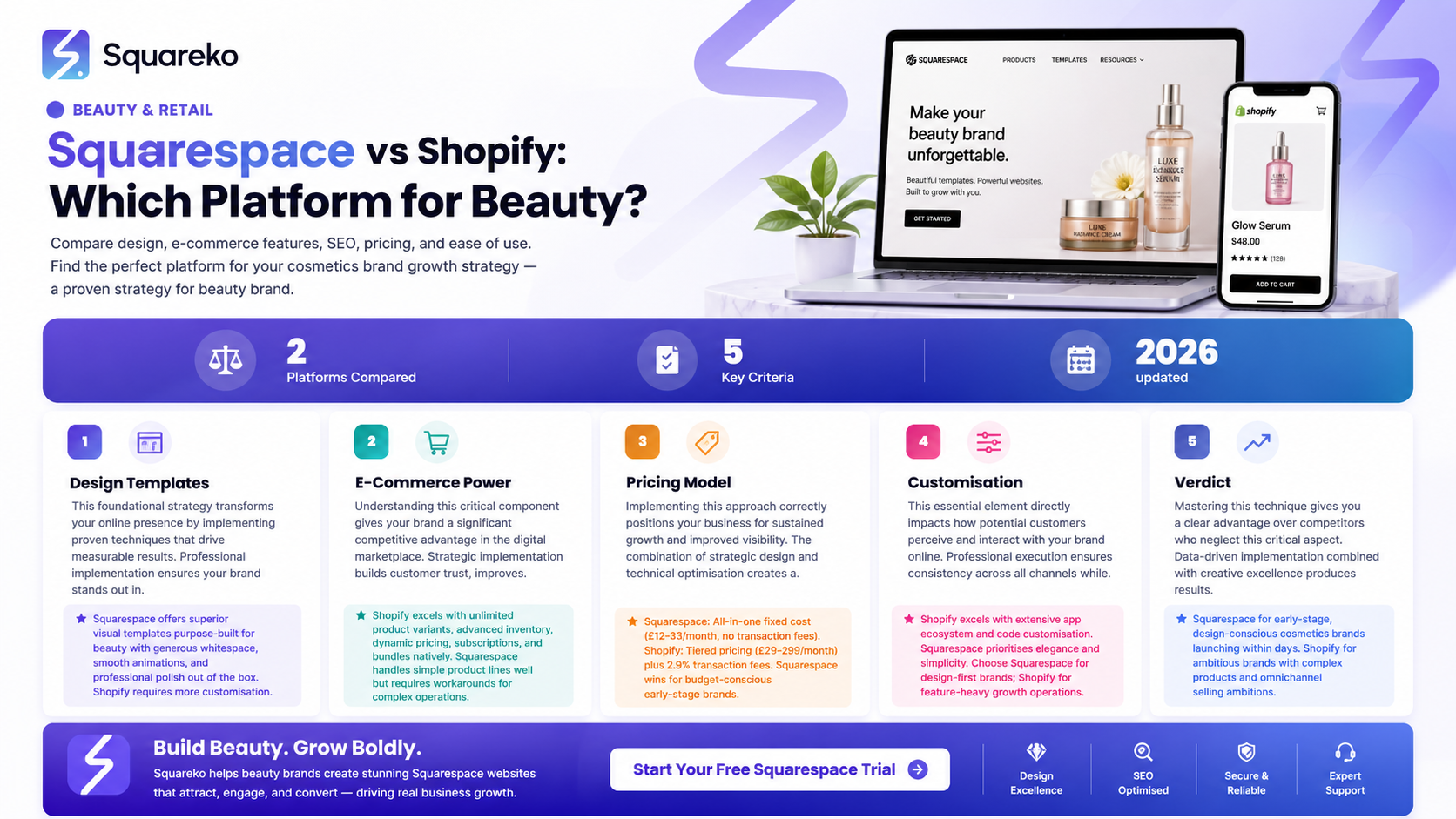
For cosmetics brands, first impressions are everything. Your website is a digital storefront that must communicate luxury, trustworthiness, and brand personality within milliseconds.
Squarespace's Design Advantage
Squarespace's template collection is purpose-built for visual storytelling. Each template is professionally designed, fully responsive, and requires minimal customisation out of the box. For cosmetics brands, this matters enormously. Templates like Sylhet, Brace, and Minuet showcase product photography beautifully, with generous whitespace, smooth scrolling animations, and typography that screams premium.
The platform's native design tools—colour palettes, font pairing, shadow effects—are accessible to non-designers. You can adjust layouts, reorder sections, and modify styling without touching code. The result is a cohesive, polished website that reflects your brand's aesthetic without months of development.
Shopify's Template Compromise
Shopify's themes are functional and diverse, but they often feel more utilitarian. Many themes prioritise conversion metrics over visual harmony. The good news: Shopify's app ecosystem unlocks design possibilities. Premium themes like Empire and Prestige are excellent for beauty, but require more tweaking to feel bespoke. Technical founders appreciate this flexibility; non-technical ones often find it overwhelming.
The Design Verdict
Squarespace is objectively superior for cosmetics brands that prioritise visual impact. If your brand identity rests on compelling imagery, refined aesthetics, and cohesive design language, Squarespace delivers faster and with less friction. Shopify requires theme customisation or app integration to achieve the same polish.
E-Commerce Features & Product Management
Beautiful design matters, but so does the machinery beneath—inventory management, variant handling, and order fulfilment.
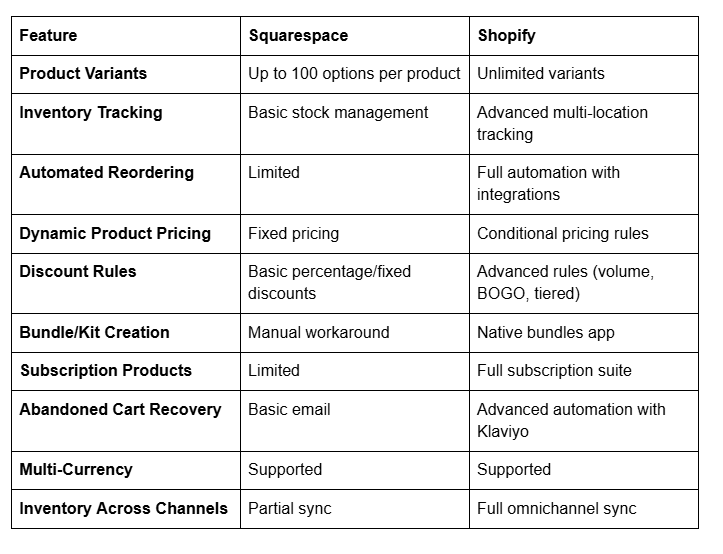
Feature Comparison Table
Squarespace's E-Commerce Sufficiency
Squarespace handles straightforward cosmetics operations admirably. You can manage stock, create product variants (up to 100 per product), process orders, and integrate payments. For a £5,000–£50,000 monthly revenue brand, Squarespace is entirely adequate. The interface is intuitive; the bottlenecks appear only at scale.
Where Squarespace falters: advanced inventory scenarios (multi-warehouse operations, pre-orders with backorder logic), complex discount structures (tiered pricing, volume discounts), and subscription products. A skincare line offering monthly box subscriptions would require workarounds or third-party apps.
Shopify's E-Commerce Dominance
Shopify was built for e-commerce. Its native features handle unlimited variants, multi-location inventory, advanced discounting, subscriptions, and bundles without apps. If your cosmetics line includes colour variants (foundations, lipsticks), multi-packs, gift bundles, or subscription options, Shopify's feature set feels purpose-built.
The Shopify app store extends this further. Apps like Bold (dynamic pricing), ReCharge (subscriptions), and Inventory Planner solve problems Squarespace forces you to hack around.
The E-Commerce Verdict
For simple product lines (single-variant creams, basic skincare), Squarespace suffices. For ambitious brands with variants, subscriptions, bundles, and sophisticated inventory, Shopify wins decisively.
SEO & Content Performance
Organic search is critical for cosmetics brands competing against established players. Both platforms offer SEO foundations, but differently.
Squarespace's Approach
Squarespace auto-generates clean code, optimised images, and proper heading structures. The platform handles technical SEO automatically—sitemap generation, mobile responsiveness, fast loading times. You can edit page titles, meta descriptions, alt text, and URLs. However, advanced features like schema markup, redirect management, and XML sitemap customisation require more effort.
Content marketing is strengthened by Squarespace's blog functionality, which integrates seamlessly with your store. Blog posts rank well and drive traffic to product pages naturally.
Shopify's SEO Ecosystem
Shopify's native SEO is competent but not exceptional. The platform generates proper markup and sitemaps, but optimization feels less polished than Squarespace's. However, Shopify's app ecosystem compensates: apps like SEO Manager, Smart SEO, and Yoast SEO unlock advanced optimisation.
Shopify's content capabilities (blogs, collections, filtering) are strong, though slightly less elegant than Squarespace's.
The SEO Verdict
Both platforms achieve comparable SEO results in practice. Squarespace requires less configuration; Shopify requires apps but offers more control. If SEO is your primary concern, both are viable—though Squarespace's default experience is smoother for non-technical founders.
Pricing & Hidden Costs
Pricing is rarely straightforward. Both platforms have base costs, but hidden fees accumulate quickly.
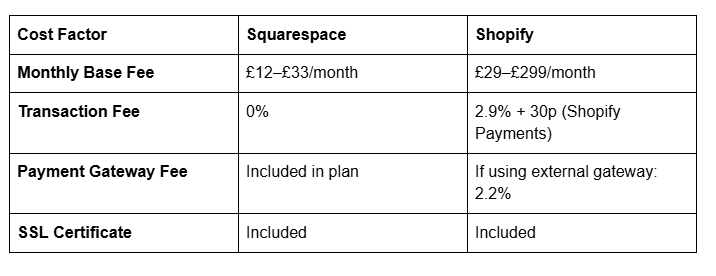
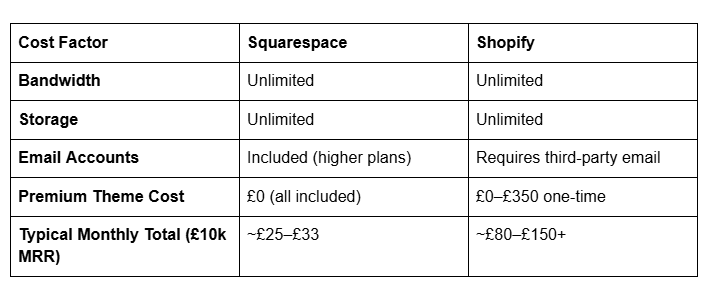
Pricing Comparison Table
Squarespace's All-In-One Model
Squarespace charges a monthly subscription that includes hosting, SSL, unlimited bandwidth, storage, and basic e-commerce. There are no transaction fees. For a £10,000 monthly revenue cosmetics brand, you'll pay roughly £25–£33 per month—a negligible cost.
The catch: upgrading to premium apps (email marketing integration, advanced analytics) adds cost. Advanced Commerce Plans (£27/month) unlock subscription products and advanced discounting.
Shopify's Tiered Model
Shopify's base tiers (Basic £29, Shopify £79, Advanced £299) are attractive, but transaction fees sting. At Shopify Payments, each sale costs 2.9% + 30p. A £10,000 monthly revenue business pays roughly £300 in transaction fees alone. Add payment processing, premium apps (SEO, email marketing, inventory), and the monthly cost quickly reaches £100–£200+.
For high-margin businesses (typical cosmetics margins: 60–75%), these fees are bearable. For lower-margin operations, they pinch.
The Pricing Verdict
Squarespace wins for cost-conscious brands. The all-in-one model eliminates surprise fees. Shopify's transaction fees and premium apps make it pricier, though high-volume sellers find the investment justified by enhanced features.
Ease of Use & Learning Curve
Platform complexity determines how quickly you can launch and iterate.
Squarespace's Gentleness
Squarespace is designed for non-technical founders. The interface is visually intuitive—drag-and-drop sections, WYSIWYG editing, straightforward navigation. Setting up a product page, configuring payments, or adjusting colours requires minutes, not hours.
The tradeoff: less power for those who want it. You're constrained by what Squarespace allows; workarounds feel clunky.
Shopify's Learning Curve
Shopify has a steeper initial learning curve. Dashboard navigation is logical once familiar, but the sheer number of settings, apps, and options can overwhelm beginners. Setting up products with variants, configuring fulfillment, and managing inventory is more granular—which is powerful, but requires effort.
The payoff: once familiar, Shopify's flexibility is addictive. You can build almost anything.
The Ease-of-Use Verdict
Squarespace for non-technical founders launching quickly; Shopify for those willing to learn for long-term power
Customisation & Extensibility
As your brand grows, customisation becomes critical.
Squarespace's Limitations
Squarespace's design tools are excellent for brand-level customisation (fonts, colours, layouts), but code-level customisation is restricted. You can inject custom CSS and JavaScript, but deep modifications require workarounds. The ecosystem of third-party apps is smaller than Shopify's, limiting advanced functionality.
Shopify's Extensibility
Shopify is built for customisation. The app ecosystem is vast: thousands of apps for email marketing, loyalty programmes, inventory management, and beyond. If a feature doesn't exist natively, an app likely bridges the gap. Developers can modify themes directly, build custom apps, and integrate with external systems seamlessly.
The Customisation Verdict
Shopify is extensible; Squarespace is elegant. Choose Shopify if customisation drives your roadmap.
Frequently Asked Questions
-
Transferring existing content (products, posts, customers) from Squarespace to Shopify is possible but manual. Products can be exported as CSV and re-imported; blog posts require manual migration. It's labour-intensive but feasible. Avoid repeated migrations by choosing carefully upfront.
-
Both support multi-currency and international shipping. Shopify has stronger multi-language support through apps; Squarespace requires more manual setup. For genuinely global brands, Shopify edges ahead.
-
Squarespace: No. Basic familiarity with web interfaces is sufficient. Shopify: Helpful but not required. Most setup is visual; code customisation is optional.
-
Both integrate with major platforms. Shopify has native Klaviyo integration and more app options; Squarespace requires manual setup or third-party apps. Shopify is easier for email-driven cosmetics marketing.
-
Shopify excels here. Native integrations with Facebook, Instagram, and TikTok Shop allow seamless multi-channel selling. Squarespace requires manual setup for each channel.
-
Both scale well. Squarespace automatically scales; Shopify's higher tiers (Shopify, Advanced plans) handle enterprise traffic. Neither should be a bottleneck for most cosmetics brands under £1M annual revenue.
-
Squarespace's design capabilities make it ideal for luxury positioning. The visual polish and minimalist aesthetic align with premium branding. Shopify is better for volume-focused, mass-market beauty.
-
Squarespace and Shopify both charge monthly with no long-term commitments. Cancel anytime (with proper data export). This flexibility favours uncertain founders.
Which Platform Is Right for Your Cosmetics Brand?
Choose Squarespace if:
You're launching a design-first, premium cosmetics brand where visual storytelling is central to your positioning.
You lack technical experience and want a platform you can manage independently without developers.
Your product line is relatively straightforward (single-variant products, no complex bundles or subscriptions).
You prioritise budget efficiency and want to minimise hidden fees and transaction charges.
You value out-of-the-box polish and want your site looking professional within days, not weeks.
Choose Shopify if:
Your cosmetics line includes numerous variants, bundles, subscriptions, or dynamic pricing models.
You plan aggressive growth and need multi-channel selling (Instagram Shop, TikTok, Amazon, marketplace integrations).
You're willing to invest in apps and development to unlock advanced features.
You want deep integration with email marketing (Klaviyo), loyalty programmes, and analytics platforms.
You anticipate hiring developers or agencies to customise and extend your platform over time.
You're building a brand that might eventually expand beyond cosmetics into adjacent categories.
The Bottom Line:
For most emerging cosmetics brands in 2026, Squarespace is the smarter choice. Its visual excellence, all-in-one pricing, and intuitive interface match the needs of design-conscious beauty entrepreneurs launching without technical support. You get to market faster, with lower costs, and with a website that genuinely reflects your brand's aesthetic.
However, if you're building an ambitious, feature-heavy operation with complex products and omnichannel ambitions, Shopify's power justifies its added complexity and cost.
The best platform is the one you'll actually use. Try Squarespace's 14-day free trial and Shopify's development store. Build sample pages, add products, and experience the interfaces firsthand. Your instinct will clarify which feels right.
Ready to Choose Your Platform?
The choice between Squarespace and Shopify shapes your brand's trajectory for years to come. But platform selection is just the starting point. The real work lies in building a compelling brand, designing product pages that convert, and executing a launch marketing strategy that reaches your ideal customers.
That's where Squareko comes in. We help cosmetics entrepreneurs navigate platform selection, brand positioning, conversion optimisation, and growth strategies tailored to your unique vision. Whether you're still deciding between platforms or ready to launch, our team provides the strategic clarity you need.
Get a personalised platform recommendation and launch strategy. Book a free 30-minute consultation with our team to evaluate your brand, discuss your growth ambitions, and receive a customised action plan for success.

From custom website design to SEO strategy, we help businesses launch a site that looks professional and performs better.

About the Author
I'm Walid Hasan, a Certified Squarespace Expert and Squarespace Circle Platinum Partner with over 12 years of hands-on experience designing and optimizing high-performing websites. Over the years, I've had the privilege of building more than 2,000 Squarespace websites for clients around the world, always focusing on clean design, strong user experience, and conversion-driven results.