How to Launch a DTC Skincare Brand on Squarespace: From Zero to First Sale
Introduction
The direct-to-consumer (DTC) skincare market has exploded. Brands like Glossier, Olaplex, and Drunk Elephant proved that consumers crave authentic, quality-focused skincare companies—and they'll bypass traditional retail to buy directly from founders who genuinely care. The opportunity is real, but so is the competition.
Launching a DTC skincare brand on Squarespaceis no longer a luxury reserved for well-funded startups. Today, any entrepreneur with a compelling product and a clear vision can build a professional, conversion-focused ecommerce store in days, not months. Squarespace eliminates the technical barriers whilst maintaining the aesthetic polish that luxury skincare customers expect. You don't need to hire developers, negotiate with retailers, or wait for shelf space. Your customers can find you online and place their first order within 24 hours of your launch.
In this guide, we'll walk through everything you need to know: from crafting your brand identity and setting up your Squarespace store, to optimizing product pages and launching your first marketing campaign. By the end, you'll have a roadmap to turn your skincare vision into a profitable business.
Key Takeaways
Squarespace is ideal for DTC skincare brands because it combines design flexibility, payment processing, and inventory management in one platform without requiring coding skills.
Your brand identity forms the foundation of customer trust and differentiation—invest time in your mission, values, and visual identity before building your store.
Product page strategy directly impacts conversions: include high-quality imagery, transparent ingredient lists, and genuine benefits rather than exaggerated claims.
Payment and shipping infrastructure must be seamless; choose reliable payment gateways and establish shipping zones early to avoid launch delays.
A pre-launch checklist ensures you've covered legal, operational, and marketing fundamentals before your first customer arrives.
First-sale marketing works best with a combination of email capture, organic social media, and micro-influencer partnerships rather than expensive paid ads alone.
Post-launch iteration is critical: track analytics, gather customer feedback, and optimise based on real behaviour and data.
Understanding the DTC Skincare Landscape
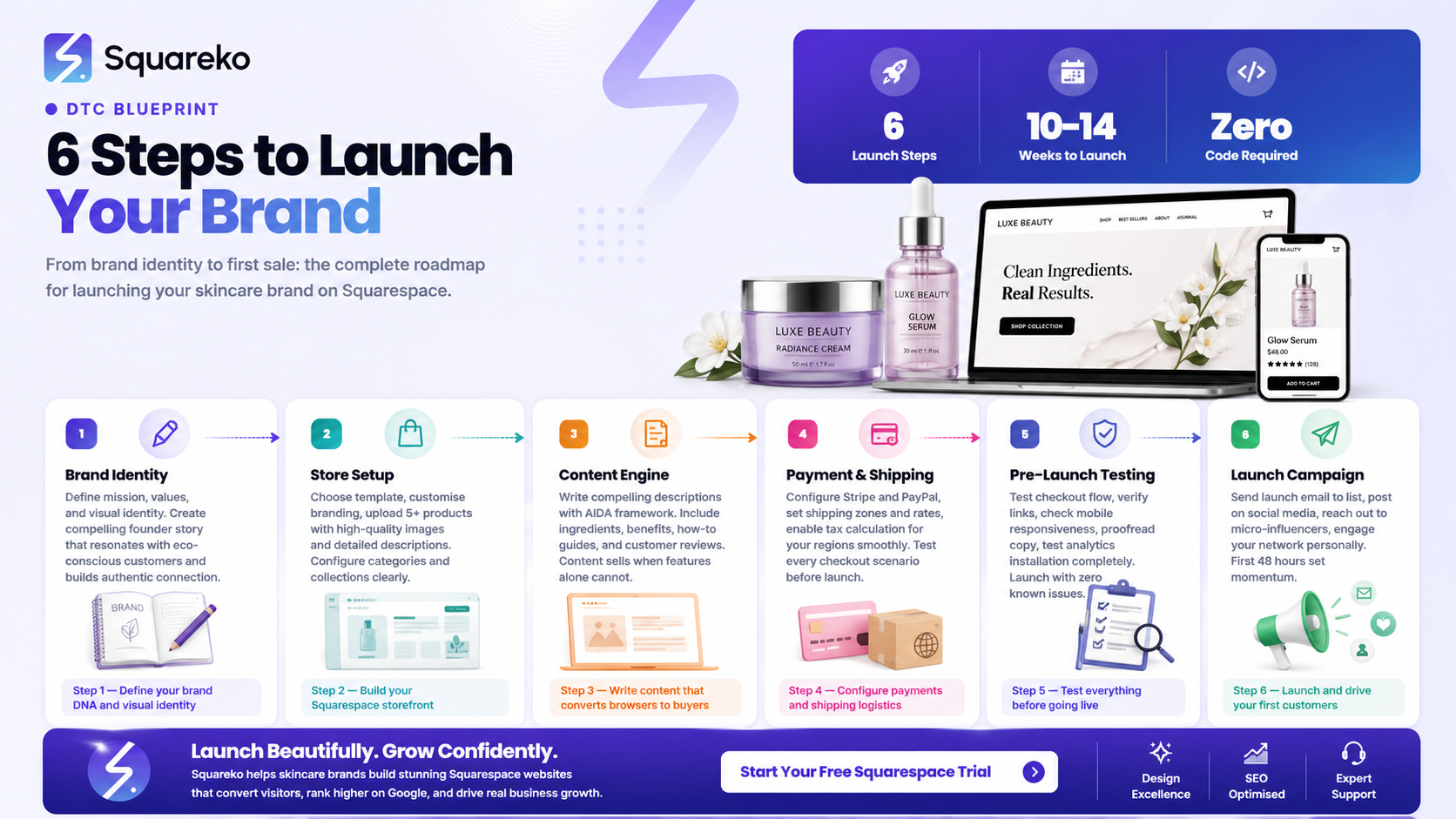
Before you build, understand where you're entering. The skincare industry generated £64 billion globally in 2023, and DTC brands now account for roughly 18% of that market. What's driving this shift?
Consumer expectations have changed. Today's skincare customers want transparency, authenticity, and a direct relationship with the brand. They expect detailed ingredient information, honest reviews, and a founder story—not celebrity endorsements or flashy misleading marketing. They're willing to pay premium prices if they trust the product is genuinely effective and ethically made.
The barrier to entry has lowered. With platforms like Squarespace, Shopify, and independent fulfillment partners, you no longer need massive capital to launch. You can test formulations with small batches, validate demand with a pre-order campaign, and scale only when you're confident in your product-market fit.
The path to profitability is faster. By owning the relationship with your customer and avoiding wholesale markups, you can operate healthily on lower volumes. Many DTC skincare brands turn profitable within their first 12–18 months—something nearly impossible in traditional retail distribution.
However, the landscape is also competitive. Customers are savvy. They read reviews, compare ingredients, and check for third-party certifications. Your brand must stand out not through hype, but through genuine product quality and authenticity.
Defining Your Skincare Brand Identity
Your brand identity is the foundation. Before you choose fonts or color palettes, clarify your brand purpose, target customer, and positioning.
Your Mission and Values
Why are you launching this skincare brand? Common authentic reasons include:
You solved a personal skincare problem and believe others face it too.
You're passionate about sustainable or ethical sourcing in beauty.
You've identified a gap in the market (e.g., affordable clinical-grade actives, skincare for sensitive skin types, or eco-conscious packaging).
You want to challenge misleading marketing practices in beauty.
Write a single sentence that captures your purpose: "I'm creating luxury, minimalist skincare for sensitive skin using only proven actives and zero irritants." This sentence should guide every decision you make—from product formulation to customer service tone.
Your values follow naturally. If sustainability drives you, you'll source eco-friendly packaging. If inclusivity matters, you'll ensure your product range serves different skin types and tones. If transparency is core, you'll publish your full ingredient sourcing and clinical trial results.
Know Your Customer
Who are you selling to? Define your ideal customer with specificity:
Age and gender: Does your brand serve women aged 25–35, men aged 30–45, parents seeking skincare for teenagers?
Skin concern: Acne, ageing, sensitivity, hyperpigmentation, rosacea?
Values: Do they prioritise clean beauty, luxury, sustainability, or clinical efficacy?
Shopping behaviour: Do they research extensively before buying, or impulse-purchase based on aesthetic appeal?
Spending power: Are they seeking affordable alternatives, or willing to pay £50–100 per product?
The more specific you are, the sharper your marketing and product positioning become. You're not building skincare for everyone — you're building for the person who reads skincare reviews on Reddit at 11 PM and checks ingredient databases obsessively.
Visual Identity
Once your purpose and customer are clear, develop your visual identity:
Logo and brand mark: Should feel premium but not unapproachable. A hand-drawn botanical element works for clean beauty; geometric minimalism works for clinical; bold typography works for rebellion-focused brands.
Colour palette: Choose 2–3 primary colours and 1–2 secondary colours. These should feel consistent across every touchpoint: your Squarespace store, social media, packaging, and email campaigns. Soft pastels feel luxe; deep jewel tones feel clinical; bright primaries feel playful.
Typography: Select one font for headlines (memorable, distinctive) and one for body text (highly readable). Consistency across your site builds brand recognition.
Photography and imagery style: This is critical for skincare. Your product photos must be consistent, well-lit, and realistic. Show ingredients, textures, and actual results (or before-and-after photos with full transparency). Inconsistent, stock-photo aesthetics undermine trust.
Tone of voice: How do you speak to customers? Warm and conversational? Clinical and educational? Witty and irreverent? Your email copy, product descriptions, and social media should all reflect the same voice.
Once you've defined your identity, create a simple one-page brand guidelines document. Reference it throughout the build process to ensure consistency.
Setting Up Your Squarespace Store
Squarespace is exceptionally user-friendly for skincare brands. Here's how to set it up correctly from the start.
1. Choose the Right Template
Squarespace offers templates specifically designed for ecommerce. Look for templates that:
Feature prominent product imagery (skincare sells on visuals).
Allow clear product categorisation .
Have a clean, distraction-free checkout process.
Integrate smoothly with your brand colours and typography.
Popular templates for beauty brands include Austen, Harper, and Lena. Preview each with your brand colours and logo before committing. You can change templates later, but it's easier to get it right from the start.
2. Set Up Your Domain
Your domain name is your permanent address online. Choose one that:
Reflects your brand name clearly.
Is easy to spell and remember.
Preferably includes your primary keyword (though it's not essential).
Is available as a .com, .co.uk, or .co extension (avoid obscure extensions for established brands).
Squarespace offers domain registration, hosting, and SSL security as one package. This simplifies management and ensures your site is secure (all modern ecommerce sites use HTTPS).
3. Customise the Homepage
Your homepage has roughly 3–5 seconds to communicate what you do and why customers should care. Structure it as follows:
Hero section (above the fold): A high-quality product photo or lifestyle image, paired with a single headline that captures your positioning. Example: Clinical skincare without the irritation. Proven actives. Zero fluff.
Value proposition (next section): 3–4 short sentences explaining what makes your brand different. Rather than generic claims, use specifics: "Our Retinol Night Serum combines 0.5% encapsulated retinol with hyaluronic acid and peptides—clinically tested to reduce fine lines by 23% in eight weeks. No irritation. No prescription required."
Product highlights section: Display your best-sellers or hero products with high-quality images, a brief description, and a clear Shop button.
Social proof section: Customer testimonials, review counts, or media mentions (add these after you've received reviews). This builds trust.
About section: A brief founder story and mission statement. Skincare customers care about who's behind the brand.
Email capture: A simple signup form offering a first-purchase discount. This builds your marketing list from day one.
Footer: Contact information, social media links, policies (returns, shipping, privacy), and secondary navigation.
4. Organise Your Collections
Squarespace calls product groups Collections. Organise yours by:
Skin type: Dry, oily, combination, sensitive.
Product category: Cleansers, serums, moisturisers, masks.
Concern: Anti-ageing, acne-prone, brightening.
Or a combination: Routine Kits, Bestsellers, New Arrivals.
Logic matters. A customer with sensitive skin should find their products in seconds.
5. Configure Site Settings
Before moving to products, configure:
Payment processing: Squarespace accepts major credit cards, PayPal, Apple Pay, and Google Pay out of the box. Enable all options. No configuration needed—Squarespace handles it.
Shipping settings: Define your zones (UK, EU, US, rest of world). Set rates based on order weight, fixed costs, or percentage-based. For skincare with liquid products, consider weight-based shipping; most carriers charge more for liquids.
Tax settings: If you're in the UK, enable VAT calculation. Squarespace calculates VAT automatically at checkout based on the customer's location.
Currency and locale: Set your primary currency (GBP, USD, EUR). Squarespace can automatically convert prices for international visitors or lock them to one currency.
Creating Winning Product Pages
Your product page is your salesperson. It must inform, persuade, and convert. Invest time here—weak product pages are the #1 reason DTC skincare sites fail to convert.
Product Page Structure
Product title: Should include the product name and key benefit or ingredient. Example: Retinol Night Serum: Clinically Proven Anti-Ageing for All Skin Types is better than Night Serum.
High-quality images: Use 4–6 images showing:
The product in bottle/jar, well-lit.
The texture and consistency (how it feels matters).
The product in use (hands, face, or lifestyle context).
The ingredient list (zoomed in and readable).
Packaging and design (back label, box).
Optional: before-and-after photos (if genuinely supported).
Avoid stock imagery. Real product shots build trust.
Price: Display clearly. If you're offering a launch discount, show the original price crossed out and the discounted price in bold.
Product description: This is where many brands fail. Avoid hype language. Instead, use this structure:
The problem: "Fine lines and loss of elasticity are natural signs of ageing, but they don't have to be inevitable."
The solution: "Our Retinol Night Serum combines three clinically proven actives: 0.5% retinol, 2% hyaluronic acid, and bakuchiol."
The benefits: "Regular use reduces fine lines by 23% in eight weeks, improves skin texture, and boosts hydration without irritation."
How to use: "Apply 2–3 drops to clean, dry skin before moisturiser. Start 2–3 times per week; gradually increase to nightly use as your skin adapts."
What to expect: "Retinisation is normal—you may experience mild redness or dryness in the first 2–3 weeks. This passes as your skin adjusts."
Who it's for: "Ideal for anyone seeking clinical anti-ageing results. If you're pregnant, breastfeeding, or using other retinoids, consult a dermatologist first."
Full ingredient list: Display every ingredient in INCI order (the international standard). Skincare enthusiasts read ingredient lists obsessively. If you hide them, you lose credibility.
Certifications or testing: If your product is dermatologist-tested, hypoallergenic, cruelty-free, or vegan, display these badges. If you've conducted third-party testing, mention it: "Third-party tested by an independent laboratory. Results available upon request."
Size options: If you offer multiple sizes, make this clear. Include how long each typically lasts: "15ml / approximately 30 days of nightly use."
Quantity and stock status: Allow customers to choose quantity. Show stock status clearly: "In stock (5 units remaining)" or "Available for pre-order—ships 15 March."
Customer reviews section: Squarespace integrates review apps like Trustpilot or Judge.me. Enable this. Social proof is powerful. Even three genuine 5-star reviews outperform no reviews.
Related products: Display 3–4 complementary products: "Customers also bought..." This increases average order value.
FAQs section: Add a collapsible FAQ on the product page answering common questions: "Is this suitable for oily skin?" "Can I use this with vitamin C?" "What's the shelf life?" This reduces support tickets and improves conversion.
Add to basket and payment buttons: Make these prominent and action-oriented. "Add to basket" is clear; "Shop now" is ambiguous. Ensure the button colour contrasts with the background.
Configuring Payment and Shipping
Seamless payments and shipping dramatically reduce cart abandonment.
Payment Gateway
Squarespace handles payment processing natively. Customers see a familiar checkout flow. However, you have choices:
Squarespace Payments: Simplest option. Accepts all major cards, PayPal, Apple Pay, Google Pay. Squarespace charges a 2.9% + 30p transaction fee (or 1.5% + 15p for annual plans). No setup needed.
Stripe: If you want more advanced features (recurring subscriptions, international payments, custom integration), connect your Squarespace store to Stripe. Fees are similar, but you gain more control.
PayPal: Add as a payment option to reach customers who prefer it. Many international customers prefer PayPal.
For skincare brands, enable all three. Let customers choose their preferred method.
Shipping Configuration
Skincare presents specific shipping challenges: products are fragile, liquids are weight-sensitive, and international shipping has restrictions.
Domestic shipping (UK): Offer standard (3–5 days) and express (next day) options. Typical costs:
Orders under 500g: £3–5 standard, £8–12 express.
Orders 500g–2kg: £5–8 standard, £12–18 express.
Weight-based shipping is fairest for skincare. Test your typical order weight and set rates accordingly.
International shipping: This is optional but highly recommended. EU and US markets are significant for skincare.
EU shipping: Consider a flat rate (e.g., £8 regardless of weight) or regional zones. Factor in VAT and customs.
US shipping: Rates vary by weight and service (USPS, FedEx, UPS). Budget £15–25 for standard, £30–50 for express.
Set up restricted countries (some carriers don't ship to all nations) and prohibited items (some regions restrict certain actives).
Carriers: Partner with Royal Mail, DPD, or Hermes for domestic shipping. For international, use services like Shippo, Parcelforce, or direct partnerships with carriers. Squarespace integrates with major carriers—you can print labels directly from the Squarespace dashboard.
Returns and exchanges: Define a clear policy: "We offer 30-day returns on unopened products for a full refund. Opened products can be exchanged for a different size or product." Display this prominently. Returns build trust.
Your Pre-Launch Checklist
Before you invite customers, verify everything:
Brand and Legal (1–2 weeks)
Trademark check: Verify your brand name isn't trademarked by another company (use the UK Intellectual Property Office database).
Product claims review: Ensure product descriptions comply with advertising standards. Avoid claims like "cures acne" or "erases wrinkles" (only proven benefits allowed). When in doubt, consult a cosmetics compliance specialist.
Ingredients and sourcing: Confirm suppliers, batch numbers, and ingredient certifications.
Insurance: Obtain product liability insurance (typically £300–800 annually for small skincare brands).
Privacy and terms: Draft a Privacy Policy (required by law), Terms of Service, Return Policy, and Shipping Policy. Use a template generator if needed.
Store Setup (2–3 weeks)
Domain secured: Domain registered and SSL certificate active (Squarespace handles this).
Squarespace template customised: Colours, fonts, logo, and imagery consistent.
5+ products live: Minimum viable product range. Avoid launching with one SKU.
Shipping configured: Domestic and (optionally) international rates set.
Payment methods enabled: Credit cards, PayPal, Apple Pay active.
Email capture live: Homepage email signup form configured.
Social media links: Instagram, TikTok, Pinterest linked from footer.
Favicon and logo: Upload brand assets to the site header.
Content and SEO (1–2 weeks)
Meta titles and descriptions: Written for homepage and top 3–5 product pages.
Product descriptions complete: Every product has detailed, benefit-focused copy.
FAQs published: At least 6–8 FAQs covering common questions.
About page written: Founder story and brand mission included.
Homepage copy polished: Clear value proposition, no spelling errors.
Robots.txt and sitemap: Submitted to Google Search Console.
Testing (3–5 days before launch)
Checkout flow tested: Complete a test order from the homepage to confirmation email. Verify payment processes, order confirmation is sent, and shipping options appear correctly.
Mobile responsiveness checked: View the site on iPhone and Android. Ensure images load, text is readable, and checkout works on mobile.
Links tested: Click every link (navigation, product links, social media links, CTA buttons). Verify none are broken.
Page speed checked: Use Google PageSpeed Insights. Aim for a score above 70 on mobile.
Spelling and grammar: Proofread every page, product description, and email.
Analytics installed: Google Analytics 4 connected to track visitor behaviour and conversion.
Email software set up: Mailchimp, ConvertKit, or equivalent integrated for email capture and campaigns.
Operations (before launch week)
Inventory counted: Know your starting stock for each product.
Packaging finalised: Product boxes, tissue paper, thank-you cards ordered and ready.
Customer support plan: Define response times for emails. Assign responsibility (you, co-founder, VA).
Fulfillment plan: Will you pack orders yourself or use a fulfillment partner? Process documented.
First email campaign drafted: Welcome email, first product recommendation, or launch offer ready to send.
Marketing Your Launch
Your store is ready. Now, how do you get customers through the door?
Pre-Launch Phase (2–4 weeks before)
Build your email list: Before launch, aim for 100–500 email subscribers. How?
Post behind-the-scenes content on Instagram Stories. Link to an email signup form in your bio.
Create a simple landing page teasing the launch. Offer a discount code (e.g., "Get 20% off at launch—signup for your code").
Reach out to friends, family, and acquaintances. Personal emails often have high conversion.
Join skincare communities on Reddit (r/SkincareAddiction) and answer questions. If relevant, mention your upcoming launch in your profile.
Build momentum on social media: Post 2–3 times per week on Instagram and TikTok. Show:
Behind-the-scenes of product development.
Ingredient education ("Why hyaluronic acid matters").
Founder story and personal skincare journey.
Teases of launch day and any first-customer offers.
Reach out to micro-influencers: Identify skincare-focused influencers with 10,000–100,000 followers in your niche. Reach out personally: "I've been following your skincare content because you align with my values around clean beauty. I'm launching a DTC skincare line focused on [your positioning]. Would you be interested in a partnership or product review?" Offer free products. If they're genuinely interested (not just looking for freebies), they'll create authentic content.
Launch Week
Email your list: Send 2–3 emails in launch week:
Launch announcement: Subject line: "Skincare for [your customer's problem]—now live." Share your story, product benefits, and a launch offer (e.g., 20% off, free shipping).
Social proof: If you've received early reviews or influencer mentions, share them. Testimonials build trust.
Urgency offer:"Launch week only: 20% off all orders. Ends Sunday midnight." This encourages quick action.
Post on social media daily: Share product photos, customer unboxings, and FAQs. Engage in the comments. Respond to every question within 24 hours.
Reach out personally to your network: Message friends and family individually. "I've launched my skincare brand. Here's my store [link]. I'd love your feedback and support." Personal outreach converts at 10–20% (vs. 1–2% for email).
Engage in relevant communities: Answer skincare questions on Reddit. Provide genuine value—don't spam. If relevant, mention your new brand.
Post-Launch (weeks 2–8)
Analyse your data: Check Google Analytics and Squarespace analytics weekly:
Which traffic source converts best (organic, email, social, direct)?
Which products sell fastest?
What's your average order value?
Where are customers dropping off?
Use these insights to refocus your marketing.
Encourage reviews: Email customers 7–10 days after purchase: "How's your skincare journey with us? Please share your honest review—it helps us improve and helps other customers make confident decisions." Make leaving a review as simple as possible (one-click links).
Iterate on social media: Double down on content types that engage your audience. If TikTok videos perform better than Instagram Reels, focus there.
Consider paid advertising: Once you have 10+ positive reviews and a clear best-selling product, test small Facebook or Instagram ads. Start with a £5–10 daily budget targeting your ideal customer. Aim for a 3:1 return on ad spend (ROAS) to stay profitable.
Launch an email sequence: Build an automated welcome series for new email subscribers. Example:
Day 0: Welcome + 15% off first purchase.
Day 3: "Why [your hero product]" education email.
Day 7: Founder story and brand mission.
Day 10: Skincare routine guide featuring your products.
Day 14: Social proof (customer reviews).
Gather feedback: Send a simple survey to customers: "What brought you to our brand? What could we improve? What product would you love next?" Use responses to inform future products and messaging.
Frequently Asked Questions
-
No. You can launch with made-to-order products (customers order, you produce and ship after). This reduces risk and capital requirements. However, made-to-order requires clear communication: set customer expectations for turnaround time (e.g., "Ships within 5–7 business days"). Alternatively, many founders produce 50–100 units of each product for launch, then reorder based on sales velocity.
-
Squarespace costs £15–33 per month. Your actual startup costs depend on:
Product development: £500–5,000 (formulation, lab testing, batch production).
Branding: £200–2,000 (logo, packaging design).
Initial inventory: £2,000–10,000 (100–500 units per product).
Packaging and shipping supplies: £500–2,000.
Marketing and ads: £500–2,000 for launch month.
Total minimum: £4,000–20,000. Most successful launches fall in the £8,000–15,000 range.
-
Work with a cosmetics compliance specialist or consult the Medicines and Healthcare products Regulatory Agency (MHRA) guidelines. Key rules:
Never claim your product "treats," "cures," or "prevents" a disease (that makes it a medicine, which requires regulatory approval).
Claims must be substantiated by testing or credible evidence.
Avoid exaggerated language ("erases wrinkles," "reverses ageing").
Use honest language: "reduces the appearance of fine lines," "visibly improves texture," "helps hydrate."
When in doubt, remove the claim.
-
Multiple products (3–5) are better for launch. A one-product brand feels incomplete and discourages repeat purchases. With 3–5 products, customers can build a routine and increase their basket size. Choose products that work well together: cleanser + serum + moisturiser is a classic foundation.
-
Skincare is personal. Some brands offer full returns on opened products (to reduce friction), whilst others only accept returns on sealed products (to prevent reselling issues). A common middle ground: "Opened products can be exchanged for a different size or product, but refunds are limited to unopened items." Be clear upfront. Transparency builds trust.
-
Most DTC skincare brands target profitability within 12–18 months. Your breakeven point depends on:
Gross margin: Skincare typically targets 70–75% gross margin (after COGS, shipping, payment fees).
Customer acquisition cost (CAC): Organic and email are low-cost; paid ads are expensive.
Repeat purchase rate: Skincare is repeat-purchase business. After your first 50 customers, many will return.
With careful spending and 30+ repeat customers per month, profitability is realistic by month 12.
-
Dropshipping is risky for skincare because:
Quality control: You can't guarantee product quality or freshness.
Brand trust: Customers expect you to own your supply chain. Dropshipping feels inauthentic.
Margins: Most dropship suppliers take 40–50% of the sale price, leaving thin margins.
It's better to partner with a private-label manufacturer (who makes formulations for multiple brands) or work with a contract manufacturer (who makes only your formulations). Both offer better margins and quality control.
Ready to Launch Your DTC Skincare Brand?
You now have a comprehensive roadmap: from defining your brand identity and setting up your Squarespace store, to configuring payments, writing compelling product pages, and marketing your launch. The path from zero to first sale is clearer than ever.
But clarity isn't execution. The real work happens when you apply these principles to your specific brand, product, and customer. That's where many entrepreneurs get stuck: balancing perfectionism with momentum, deciding between nice-to-have features and must-have fundamentals, troubleshooting problems that don't fit neatly into guides.
That's exactly why we created Squareko. We help DTC skincare entrepreneurs build, launch, and grow profitable brands on Squarespace. Whether you need help refining your brand positioning, optimising your product pages for conversion, or planning your first marketing campaign, our team is here to guide you.
Claim your free consultation with us today. Book a 30-minute call where we'll review your brand concept, identify your biggest opportunities, and create a personalised action plan for your launch. No fluff. Just practical, expert guidance.
Your first customer is waiting. Let's find them together.

From custom website design to SEO strategy, we help businesses launch a site that looks professional and performs better.

About the Author
Walid | Founder, Squareko
I'm Walid Hasan, a Certified Squarespace Expert and Squarespace Circle Platinum Partner with over 12 years of hands-on experience designing and optimizing high-performing websites. Over the years, I've had the privilege of building more than 2,000 Squarespace websites for clients around the world, always focusing on clean design, strong user experience, and conversion-driven results.