Squarespace SEO for Nutritionists and Dietitians: Rank in 2026
Introduction
Visibility in search is survival for nutrition professionals in 2026. A prospective client searches "IBS nutritionist London," "sports dietitian Manchester," or "how to find a registered nutritionist," and your website either appears on page one or it doesn't. Seventy percent of nutrition practice inquiries start with a Google search. Yet many nutrition professionals invest in beautiful Squarespace websites and wonder why they're not visible in search. The answer is rarely about Squarespace itself—it's about SEO strategy, keyword selection, E-E-A-T signals, and understanding how Google evaluates nutrition websites in a high-scrutiny, high-YMYL space. Nutrition is Your Money Your Life territory: false claims, unsubstantiated diets, and unqualified practitioners can harm health. Google's ranking algorithms reflect this scrutiny. This guide covers Squarespace SEO strategy specific to nutrition professionals, with emphasis on YMYL compliance, E-E-A-T signals, and the shift to AI-driven search in 2026.
Key Takeaways
Nutrition is extreme YMYL: Google applies heightened scrutiny to nutrition websites. False claims, unsubstantiated advice, or unqualified practitioners are penalised. Professional registration (HCPC, ANutr, RNutr) is your strongest E-E-A-T signal.
Keyword strategy differs by client type and geography: Commercial keywords ("book nutritionist consultation") have different intent than informational ("how does nutrition affect hormones") or local ("dietitian near me"). Target all three in your content strategy.
E-E-A-T is paramount in nutrition: Expertise (qualifications), Authoritativeness (professional body membership, citations, credentials), Trustworthiness (registration status, professional insurance, compliance). Google measures E-E-A-T in rankings.
Local SEO is critical for nutrition practices: Most nutrition clients search for local practitioners. Google My Business optimisation, local keyword targeting, and location-specific content are essential.
Content strategy ranks better than backlinks alone: Regular, evidence-based blog content on nutrition topics positions you as an authority. Google rewards fresh, relevant nutrition content.
AI and semantic search are changing how Google evaluates nutrition: In 2026, Google's AI-driven systems evaluate the semantic meaning and credibility of nutrition information, not just keyword matching. This benefits qualified, registered practitioners.
Why Nutrition is Extreme YMYL and What Google Rewards
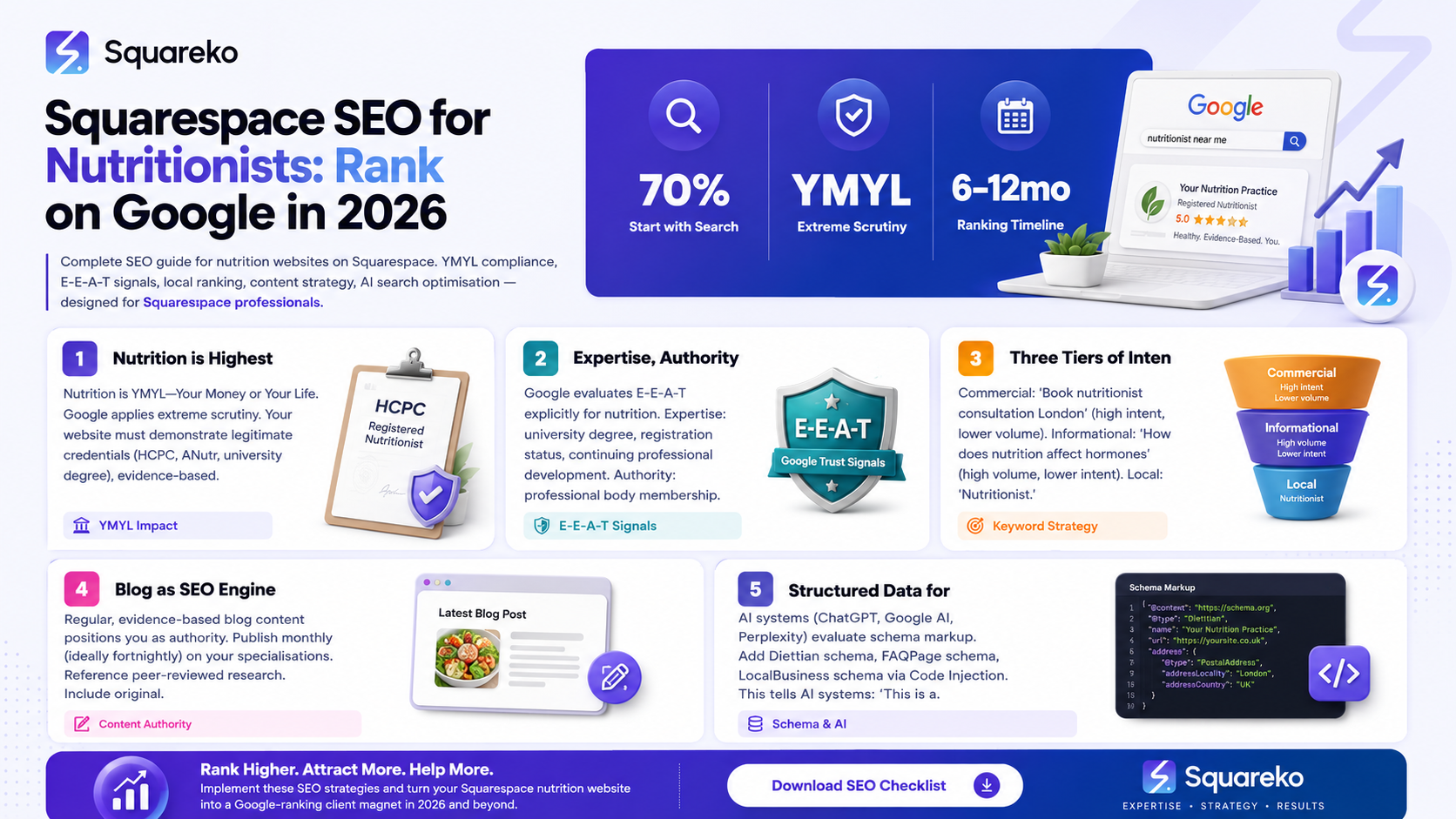
Your Money Your Life (YMYL) is a Google classification for content that could significantly affect a person's health, financial stability, safety, or life decisions. Nutrition is at the extreme end of YMYL: false nutritional advice can harm health, delay medical treatment, or contribute to serious conditions like eating disorders or malnutrition.
Because of this, Google applies extraordinary scrutiny to nutrition websites. A nutrition website ranking #1 must demonstrate:
Legitimate credentials: HCPC registration (for dietitians), ANutr/RNutr registration (for nutritionists), relevant university degree.
Compliance with health claims regulations: No unsubstantiated claims like "cure IBS" or "detox your body."
Evidence-based content: Nutrition information sourced from peer-reviewed research, not pseudoscience.
Professional accountability: Professional body membership, professional indemnity insurance, clear professional boundaries.
Google's automated systems and human reviewers penalise websites that fail these tests. Common penalties include:
Low quality raters flag the site: Google's Search Quality Raters (people who manually evaluate search results) identify non-compliant or low-credibility nutrition websites.
Poor ranking despite high traffic: A non-compliant or low-credibility nutrition website may get clicks but won't rank well.
Manual action penalties: In extreme cases (dangerous health claims, fraud), Google applies manual penalties, removing the site from search.
In contrast, registered, qualified, compliant nutrition professionals are rewarded in rankings. Your HCPC registration, ANutr/RNutr status, and professional credentials are signals Google explicitly looks for in nutrition YMYL results.
Understanding the Nutrition Keyword Landscape
Nutrition clients search in three distinct ways. Target all three in your SEO strategy:
Commercial Intent Keywords ("I want to buy a nutrition consultation"):
"Book nutritionist consultation London"
"Registered dietitian appointment"
"IBS nutritionist near me"
"Sports nutritionist for endurance athletes"
"Private nutrition consultant"
These keywords have high commercial intent and often lower search volume but higher conversion. Clients searching these terms are ready to pay.
Informational Intent Keywords ("I want to understand something about nutrition"):
"How does nutrition affect hormones"
"What does a registered dietitian do"
"Best foods for managing PCOS"
"How to reduce IBS symptoms naturally"
"Nutrition for sports performance"
These keywords have high search volume but lower commercial intent. They're ideal for blog content. By ranking for these, you establish authority and capture readers at the awareness stage of the client journey.
Local Keywords ("I want a practitioner in my area"):
"Nutritionist Manchester"
"Registered dietitian Liverpool"
"IBS specialist London"
"Sports nutritionist Birmingham"
Local keywords are essential. Most nutrition clients search for local practitioners. If you're based in London, ranking for "IBS nutritionist London" is more valuable than ranking for the global "IBS nutritionist."
Semantic Variations: Google now understands synonyms and semantic variations. "Registered nutritionist," "nutrition professional," "dietary consultant," and "nutrition specialist" are semantically similar. Your content should naturally include these variations, but don't force them unnaturally.
Long-Tail Keywords: "Nutritionist for PCOS and postpartum weight loss" is long-tail. These have lower search volume but higher specificity and intent. They're easier to rank for and convert better because they address specific client needs.
E-E-A-T for Nutrition Professionals: Expertise, Authority, Trust
Google's Search Quality Rater Guidelines explicitly evaluate E-E-A-T for every website, but especially for YMYL content like nutrition. Understanding how Google measures E-E-A-T helps you optimise your site to rank.
Expertise: This is your qualifications and knowledge. Google measures:
University degree in nutrition or related field: MSc Nutrition, BSc Dietetics, etc. Name the university prominently (e.g., "MSc Applied Clinical Nutrition, University of Westminster"). Generic "nutrition qualification" is weaker.
Professional registration: HCPC (for dietitians), ANutr/RNutr (for nutritionists), CNHC (if applicable). Registered status is the strongest expertise signal.
Continuing education and current knowledge: Mention recent training or CPD. "Completed advanced training in the low-FODMAP approach (BANT, 2024)" shows current knowledge.
On Squarespace, place expertise signals on
Your homepage (above the fold): Brief credential display.
Your About page (dedicated section): Full credential details.
Service pages: Expertise specific to each service (e.g., "Sports Nutrition for Endurance Athletes: I hold a diploma in Sports Nutrition from ISSN and specialise in fuelling for long-distance running").
Authoritativeness: This is your standing in the nutrition field. Google measures:
Professional body membership: BDA, BANT, CNHC, Association for Nutrition. Display logos and membership status.
Citations and references: Blog posts and content citing peer-reviewed research signal authority. Avoid generic health claims; back them up with research.
Media coverage or recognition: If you've been quoted in reputable publications or featured on professional platforms, mention this.
Peer recognition: Testimonials from clients (especially other healthcare professionals) signal authority.
On Squarespace:
Display professional body logos and membership information prominently.
In blog posts, link to peer-reviewed research. Example: "Evidence from the Journal of the American Dietetic Association shows that..." with a link to the study.
Create a Resources or Media page listing publications that have featured your work.
Trustworthiness: This is whether users and Google believe you're reliable and safe. Google measures:
Professional indemnity insurance: Displays insurance coverage publicly (e.g., "Insured with [Provider] for £6 million professional indemnity cover").
Transparent professional boundaries: Clear statements about when you recommend medical referral. "If I identify signs that medical investigation is needed, I recommend you speak with your GP."
Compliance with professional standards and regulations: Adherence to BDA, ANutr, GDPR, health claims regulations.
Client reviews and testimonials: Detailed, specific testimonials build trust more than generic praise.
HTTPS and secure website: Your Squarespace site is automatically HTTPS; this is table stakes.
Clear contact information and professional address: Transparency about how to reach you signals trustworthiness.
On Squarespace:
Display professional boundaries and medical referral policy prominently (About page, booking page, service pages).
Display professional indemnity insurance details in the footer or About section.
Feature detailed client testimonials with age, health challenge, and specific results.
Ensure your Privacy Policy and data protection practices are visible and clear.
Squarespace SEO Settings and Technical Foundation
Squarespace provides strong technical SEO foundations, but you must configure settings correctly:
SEO Title and Meta Description: In Squarespace, click on any page, then SEO → Page Title and Meta Description. Optimise for your target keyword:
Page Title (appears in search results and browser tab): 50-60 characters. Include your target keyword. Example: "IBS Nutritionist London | Evidence-Based Nutrition Support" (58 chars).
Meta Description (appears in search results below the title): 150-160 characters. Include target keyword and a compelling summary. Example: "Specialising in digestive health and IBS management. Registered nutritionist in London offering personalised, evidence-based nutrition plans. Book a free consultation." (158 chars).
Heading Structure: Use proper heading hierarchy. Squarespace allows H1, H2, H3. Every page should have one H1 (the page title). Use H2 for main sections, H3 for subsections. This helps Google understand page structure and your target keywords.
Image Alt Text: Every image should have alt text describing the image and including relevant keywords naturally. Example alt text: "Jane Smith, registered nutritionist in London, in her clinic consultation room." This helps Google understand images and improves accessibility.
Site Structure and Navigation: Squarespace automatically generates a sitemap.xml. Ensure your navigation is logical
Homepage
About (your credentials and expertise)
Services (broken down by condition or client type)
Blog (fresh content and authority building)
Contact/Booking
A clear structure helps Google crawl and understand your site.
Mobile Optimisation: Squarespace is mobile-responsive by default. Test your site on mobile devices (iPhone, Android) to ensure pages load fast and CTAs are easy to tap.
Page Speed: Page speed is a ranking factor. Squarespace sites are generally fast, but optimise:
Compress images before uploading (use tools like TinyPNG or ImageOptim).
Limit the number of embedded videos or use lazy loading for videos.
Test your site speed with Google PageSpeed Insights.
SSL/HTTPS: Squarespace provides HTTPS automatically. Ensure your domain uses the "https://" protocol (Settings → Domains).
On-Page Optimisation for Nutrition Websites
For each page targeting a specific keyword, optimise:
Primary Keyword Placement:
H1 (page title): Include your primary keyword. "IBS Management: Evidence-Based Nutrition Support for Digestive Health."
First 100 words: Your first paragraph should include your primary keyword naturally. "I specialise in helping people with IBS manage symptoms through personalised, evidence-based nutrition plans."
H2 sections: At least one H2 should include your keyword or a close variation. "How Nutrition Supports IBS Management."
Throughout the content: Include your keyword and semantic variations naturally. Don't over-optimise; keyword stuffing penalises you.
Link Structure:
Internal links: Link to relevant pages on your site using keyword-rich anchor text. Example: On your blog post about FODMAP, link to your "IBS Management" service page with anchor text "IBS nutrition support."
External links: Link to peer-reviewed research, professional organisations, and other authoritative sources. This signals you're evidence-based and builds trust.
Content Depth: Longer, more comprehensive content ranks better. Aim for 2,000+ words on core service pages and blog posts. Depth demonstrates expertise and gives Google more context to understand your content.
Content Freshness: Google prioritises fresh, recently updated content. Update your blog at least monthly. Update service pages annually. Squarespace automatically publishes update dates; use this signal—Google sees recent updates as a sign of active, maintained content.
Content Strategy: Authority Through Evidence
The most effective SEO strategy for nutrition professionals is content marketing. Regular, evidence-based blog content:
Attracts readers at the awareness stage of the client journey.
Positions you as an authority in your specialism.
Generates backlinks (other sites link to authoritative content).
Creates internal linking opportunities (linking blog posts to service pages).
Provides fresh, indexed content for Google to understand your expertise.
Blog Topic Strategy:
Condition-specific deep dives: If you specialise in IBS, create blog posts: "The Complete Guide to Low-FODMAP for IBS," "How Stress Affects IBS Symptoms," "Foods to Reintroduce After Elimination Diets."
Client frequently asked questions: "Can probiotics help with IBS?" "Is gluten the cause of my symptoms?" "How quickly will nutrition changes help my energy?" These match how clients actually search.
Evidence-based nutrition myth-busting: "Do detoxes work?" "Is fasting healthy?" "Are all fats bad?" Content debunking myths positions you as authoritative and evidence-based.
Seasonal and timely content: "Nutrition for managing holiday stress," "New Year nutrition goals that actually stick," "Nutrition for summer athletic performance."
Blog Content Guidance:
Reference peer-reviewed research: Every claim should be backed by research. Link to the study when possible. "Research published in the American Journal of Clinical Nutrition shows that increasing fibre intake can significantly improve IBS symptoms (Smith et al., 2023)."
Avoid unsubstantiated claims: Don't claim "detox your liver" or "cure IBS." Instead: "Evidence-based strategies that support digestive health and reduce IBS symptoms in many individuals."
Write for both clients and search engines: Use language clients understand, not overly technical jargon. But include keywords naturally. A post titled "The Complete Guide to Functional Nutrition for Perimenopause" targets both the specific client search ("perimenopause nutrition") and Google's understanding that you specialise in women's hormonal health.
Local SEO for Nutrition Practices
Most nutrition clients search for local practitioners. Local SEO is essential.
Google My Business: Create and optimise your Google Business Profile (formerly Google My Business):
Go to google.com/business.
Search for your practice name. If you don't have a listing, create one.
Fill in all information: business name, category ("Nutritionist" or "Dietitian"), location, phone, website, hours, services offered.
Add photos: professional headshot, your workspace, testimonials as image cards.
Regularly post updates (Google allows you to post news, offers, or reminders). Posts boost local visibility.
Encourage client reviews: Google reviews are a strong local ranking signal. Ask clients to leave reviews (link to your review page).
Local Keywords: Target keywords with your city or region:
"Nutritionist London," "Registered Dietitian Manchester," "IBS Specialist Birmingham."
Create location-specific service pages if you serve multiple areas: "Nutrition for PCOS in London," "Sports Nutrition Consultations in Leeds."
Local Citations: List your business on local directories:
BDA Directory (British Dietetic Association): If HCPC-registered, list on BDA's Find a Dietitian service.
Association for Nutrition directory: If ANutr/RNutr registered, list on their Find a Nutritionist service.
Local health directories and wellness platforms.
Address Schema: In Squarespace Code Injection, add schema markup for your business location:
{
  "@context": "https://schema.org",
  "@type": "LocalBusiness",
  "@id": "https://yoursite.com/#business",
  "name": "Your Name, Registered Nutritionist",
  "image": "https://yoursite.com/your-photo.jpg",
  "description": "Registered nutritionist specialising in [your specialism].",
  "address": {
    "@type": "PostalAddress",
    "streetAddress": "123 High Street",
    "addressLocality": "London",
    "postalCode": "SW1A 1AA",
    "addressCountry": "GB"
  },
  "telephone": "+44 20 1234 5678",
  "email": "hello@yoursite.com",
  "url": "https://yoursite.com",
  "priceRange": "££",
  "areaServed": "London",
  "knowsAbout": ["Nutrition", "IBS", "PCOS", "Sports Nutrition"]
}
This schema helps Google understand your location and services.
Schema Markup and Rich Snippets for Nutrition
Schema markup tells Google about your content in a structured format. For nutrition professionals:
Dietitian/ProfessionalService Schema: Tells Google you're a professional service provider:
{
  "@context": "https://schema.org",
  "@type": "Dietitian",
  "name": "Your Name",
  "image": "https://yoursite.com/photo.jpg",
  "description": "Registered nutritionist specialising in [specialism].",
  "url": "https://yoursite.com",
  "telephone": "+44 20 1234 5678",
  "email": "hello@yoursite.com",
  "knowsAbout": ["Nutrition", "Dietetics", "IBS", "PCOS"],
  "hasCredential": {
    "@type": "EducationalOccupationalCredential",
    "name": "MSc Nutrition",
    "credentialCategory": "degree",
    "recognizedBy": {
      "@type": "EducationalOrganization",
      "name": "University of Westminster"
    }
  },
  "memberOf": {
    "@type": "Organization",
    "name": "Association for Nutrition"
  }
}
FAQPage Schema: For your FAQ sections (increases chances of Google displaying FAQ snippets in search):
<!-- Please remove the commented script wrapper and add this schema inside a proper <script type="application/ld+json"> tag. -->
{
  "@context": "https://schema.org",
  "@type": "FAQPage",
  "mainEntity": [
    {
      "@type": "Question",
      "name": "What is FODMAP?",
      "acceptedAnswer": {
        "@type": "Answer",
        "text": "FODMAP stands for Fermentable Oligosaccharides, Disaccharides, Monosaccharides, And Polyols. These are short-chain carbohydrates that can trigger symptoms in people with IBS."
      }
    }
  ]
}
Add schema via Squarespace Code Injection (Settings → Advanced → Code Injection → Footer).
AI Search and Semantic Optimisation in 2026
Google's AI-driven search (including SGE—Search Generative Experience—and Gemini integration) is changing how nutrition information is evaluated and ranked. In 2026, Google's AI evaluates:
Semantic Meaning, Not Just Keywords: AI understands the semantic meaning of nutrition information, not just keyword matching. An AI evaluator can tell the difference between:
Evidence-based nutrition advice (from a qualified practitioner, referencing research).
Pseudoscience or unsubstantiated claims (even if keyword-optimised).
This benefits registered, qualified nutrition professionals and penalises low-credibility or misleading sites.
E-E-A-T is More Critical: AI-driven evaluation places even more emphasis on E-E-A-T signals. Your HCPC registration, ANutr/RNutr status, university degree, professional memberships—these become more valuable as Google's AI learns to recognise them as credibility signals.
Factuality and Evidence: AI systems check whether your nutrition claims are supported by evidence. Linking to peer-reviewed research, citing studies, and backing claims with evidence makes your content more "trustworthy" to Google's AI evaluators.
User Intent Understanding: AI understands user intent more deeply. A search for "how to manage IBS" might lead to educational content; "book IBS nutritionist consultation" will lead to practitioner pages. Optimise for intent, not just keywords.
Optimisation for AI Search:
Use clear, evidence-based language.
Reference peer-reviewed research directly.
Display credentials and registration status prominently.
Create comprehensive, authoritative content on your specialisms.
Ensure your website signals trust (HTTPS, professional design, clear contact info, testimonials, insurance disclosure).
Frequently Asked Questions
-
This depends on keyword difficulty and competition. Local keywords ("Nutritionist in [small city]") may rank within 2-3 months. More competitive keywords ("IBS nutritionist") may take 6-12 months. Ranking requires a combination of technical SEO, on-page optimisation, content depth, and backlinks. Consistent content publishing (monthly blog posts) accelerates ranking.
-
If you serve clients in a specific city or region, prioritise local ranking. Rank for "Nutritionist in London" before trying to rank nationally for "Nutritionist UK." Local keywords have less competition and higher commercial intent. As your practice grows and you potentially expand to multiple locations or remote clients, expand to broader geographic targeting.
-
At minimum, one blog post per month on topics relevant to your specialism. Ideally, fortnightly (twice monthly) if you have time. Each post should be 1,500+ words, evidence-based, and include internal links to service pages. Fresh content signals to Google that your site is active and maintained, which improves rankings.At minimum, one blog post per month on topics relevant to your specialism. Ideally, fortnightly (twice monthly) if you have time. Each post should be 1,500+ words, evidence-based, and include internal links to service pages. Fresh content signals to Google that your site is active and maintained, which improves rankings.
-
On-page SEO is optimisation within a specific page: title tags, meta descriptions, heading structure, content, internal links, keyword placement. Technical SEO is the foundation your site is built on: site speed, mobile responsiveness, HTTPS, crawlability, sitemap, structured data. Both are essential. Squarespace handles most technical SEO automatically; you manage on-page optimisation.
-
Both matter, but for nutrition professionals, content strategy is more important than aggressive backlink building. High-quality content earns backlinks naturally (other sites link to authoritative information). Focus on building authority through content, professional credentials display, and E-E-A-T signals. Backlinks will follow naturally as your authority grows. Avoid buying backlinks; this violates Google guidelines and can result in penalties.
-
Use Google Search Console (free) to see which keywords your site currently ranks for. Use Google Trends to see if a keyword has search interest. Use Ahrefs, SEMrush, or Moz Keyword Difficulty tools (paid) to assess competition. Focus on keywords with:
Reasonable search volume (ideally 50+ monthly searches).
Lower competition relative to your current authority.
Commercial or local intent (people ready to book).
For a new nutrition website, start with long-tail, specific keywords ("IBS Nutrition for Women in London") before targeting broader keywords ("Nutritionist").
-
AI tools can help with research and outline creation, but you must write final nutrition content yourself or work with a professional writer. Google penalises AI-generated content without human expertise, especially in YMYL. Your nutrition blog must reflect your professional expertise and be factually accurate. AI as a starting point is useful; AI as the finished product is risky.
-
Google Ads (paid search) and organic SEO are complementary. Ads give immediate visibility while you build organic ranking. Many nutrition practices run Google Ads for high-intent keywords ("book nutritionist") while simultaneously building organic ranking for informational keywords ("nutrition for IBS"). This dual approach maximises visibility. Start with organic SEO; add Ads once you have a clear conversion path.
Get Your Nutrition Website Ranking in 2026
You now understand the SEO landscape for nutrition professionals. But translating this knowledge into a ranking website requires strategic planning, content execution, and continuous optimisation. Many nutrition professionals understand SEO in theory but struggle with implementation: keyword research, content planning, technical setup, schema markup, and maintaining the discipline of monthly content publishing.
Squareko specialises in SEO strategy and execution for nutrition professionals on Squarespace. We'll help you:
Develop a keyword strategy targeting high-intent, location-based nutrition keywords.
Build technical SEO foundations and optimise Squarespace settings.
Create an authority-building content strategy aligned with your specialism.
Implement schema markup and rich snippets specific to nutrition professionals.
Build backlink opportunities through strategic content and professional visibility.
Monitor rankings and adjust strategy as search algorithms evolve in 2026.
Start your Squareko SEO strategy for nutrition. We'll conduct a keyword audit, assess your current SEO foundation, and build a 12-month SEO plan that positions you as an authority in your nutrition niche and drives consistent client bookings from organic search.

From custom website design to SEO strategy, we help businesses launch a site that looks professional and performs better.

About the Author
Walid is the founder of Squareko,
I'm Walid Hasan, a Certified Squarespace Expert and Squarespace Circle Platinum Partner with over 12 years of hands-on experience designing and optimizing high-performing websites. Over the years, I've had the privilege of building more than 2,000 Squarespace websites for clients around the world, always focusing on clean design, strong user experience, and conversion-driven results.