Squarespace SEO for Digital Product Businesses: Get Found and Drive Passive Sales
Why SEO Matters for Digital Product Businesses
Organic search is the highest-converting customer acquisition channel for digital products. But many creators skip SEO because it feels complex or because results take time.
Here's why SEO matters specifically for digital product businesses:
Key Takeaways Squarespace SEO for Digital Product Businesses: Get Found and Drive Passive Sales

Long-tail keywords are gold for digital products — broad keywords like templates are impossible to rank for; specific keywords like professional email templates for yoga studios are winnable
Content marketing drives 5-10x more organic traffic than product pages alone — blogging about customer problems and solutions builds authority while naturally linking to your products
AI search optimization is critical in 2026 — platforms like ChatGPT, Claude, and Perplexity recommend products based on authority and specificity, not just traditional search rankings
Organic traffic compounds over time — each blog post you publish continues generating traffic and sales for years, creating true passive income
SEO and conversion optimization are symbiotic — ranking for keywords doesn't matter if your pages don't convert; both must work together
SEO Generates Passive Income
Unlike paid advertising where you stop paying and traffic stops, SEO traffic continues. A blog post about how to build email templates in Figma that ranks well continues generating traffic and product sales for years.
One content asset (blog post) can generate:
Year 1: 100 visitors, 2 product sales
Year 2: 150 visitors, 3 product sales
Year 3: 200 visitors, 4 product sales
Over three years, one blog post generates 450 visitors and 9 sales from passive traffic, requiring zero ongoing paid advertising spend.
SEO Builds Authority and Trust
When potential customers find you through search results, they perceive you as an authority. You earned that ranking through providing valuable content. Authority built through content is more credible than authority built through advertising.
High search rankings signal to customers: This person knows what they're talking about.
SEO Aligns With Customer Mindset
When customers search for Figma template system for startups, they're already thinking about templates. They're actively looking for a solution. They're much more likely to buy than a cold audience seeing a Facebook ad.
SEO reaches customers at the moment when they're most likely to purchase.
SEO Scales Without Increasing Costs
With paid advertising, if you want 2x customers, you pay 2x. With SEO:
Your content assets appreciate over time
Content compounds (10 posts generate more traffic than 1 post)
Traffic grows without increasing costs
This is why digital product businesses with strong SEO can achieve 7-figure incomes with relatively low customer acquisition costs.
Understanding Search Intent for Digital Products
SEO success starts with understanding what your customers are actually searching for.
Search Intent Types for Digital Products
Problem-awareness intent:
how to make presentations faster
email templates for small business
where to find design assets for startups
Customer is aware they have a problem but hasn't decided what solution to buy.
Solution-research intent:
best email template builder
figma template vs canva templates
how to customize email templates
Customer knows they want a template/asset solution but is comparing options.
Product-specific intent:
your product name reviews
your product name pricing
how to use your specific template
Customer is evaluating your specific product.
Transactional intent:
buy email templates
download presentation templates
where to get design assets
Customer is ready to buy and searching for where to purchase.
Mapping Your Strategy Across Intent Types
Content strategy for problem-awareness intent:
Create blog content addressing the problem
Demonstrate why templates/assets solve the problem
Include resources and free templates as lead magnets
Subtly mention your paid products
Example: How to Create Professional Presentations in 10 Minutes (Without Design Skills)
Content strategy for solution-research intent:
Create comparison content
Compare manual design vs. templates vs. template builders
Explain why your approach is best
Link to products throughout
Example: Figma Templates vs. Canva Templates: Which Is Better for Your Workflow?
Content strategy for product-specific intent:
Create detailed product pages with clear benefits
Include customer testimonials and case studies
Answer common questions
Make CTA clear
Content strategy for transactional intent:
Optimize product pages for buy and get access keywords
Clear pricing and purchase options
Minimal friction between landing and buying
Trust signals throughout
Most digital product businesses neglect the top of the funnel (problem-awareness intent). They focus only on product pages (transactional intent). But 80% of customers start at problem-awareness and work their way down.
Long-Tail Keyword Research Strategy
Long-tail keywords are the foundation of digital product SEO success.
Why Long-Tail Keywords Are Essential
Broad keywords are impossible:
Templates — 1.2 billion search results
Email templates — 47 million search results
Design assets — 8.3 million search results
Ranking for these is practically impossible unless you're a massive authority site.
Long-tail keywords are winnable:
Professional email templates for yoga studios — 2,000 search results
Figma template library for SaaS landing pages — 4,300 search results
Icon set for wellness app design — 890 search results
These keywords have less competition and higher intent. Customers searching these specific queries know exactly what they need.
Long-Tail Keyword Research Process
Step 1: Brainstorm customer problems
Think about the specific problems your products solve:
Who uses your products? (designers, coaches, solopreneurs, startups)
What's their main challenge? (save time, look professional, stand out, increase conversion)
What's their context? (email marketing, landing page design, presentation pitch)
Step 2: Think in customer language
How would your ideal customer phrase their problem or solution search?
If you sell presentation templates for coaches, your customer might search:
How to create a professional presentation for coaching pitch
Presentation template for life coaches
How to make presentations for small business without design experience
Where to find presentation templates for service providers
Step 3: Use keyword research tools
Use Squarespace's built-in SEO suggestions or tools like:
Google Keyword Planner (free)
Ahrefs (paid but comprehensive)
SEMrush (paid)
Ubersuggest (paid but affordable)
AnswerThePublic (free for limited queries)
Enter your seed keyword and look for:
Variation keywords (different phrasings of the same concept)
Long-tail expansions (your keyword with modifiers)
Related searches (tangential but relevant searches)
Step 4: Evaluate keyword viability
For each keyword, assess:
Search volume: How many people search this per month?
Too low (under 50): Probably not worth targeting
Sweet spot (50-500): Ideal for digital product SEO
Too high (5000+): Probably too competitive
Competition level: How many articles rank for this?
Low competition: Ranking is possible in 3-6 months
Medium: 6-12 months
High: 12+ months or unlikely to rank
Intent alignment: Does the search intent match your product?
Good match: Article will naturally link to your product
Okay match: Requires stretching to include product
Bad match: Doesn't align with your offering
Creating Your Keyword Target List
Build a spreadsheet of keywords to target across your content:
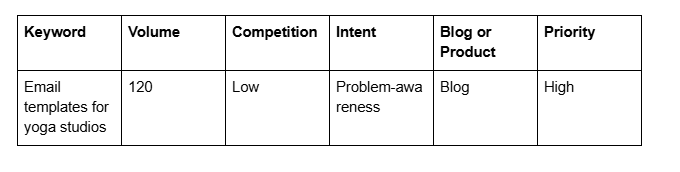
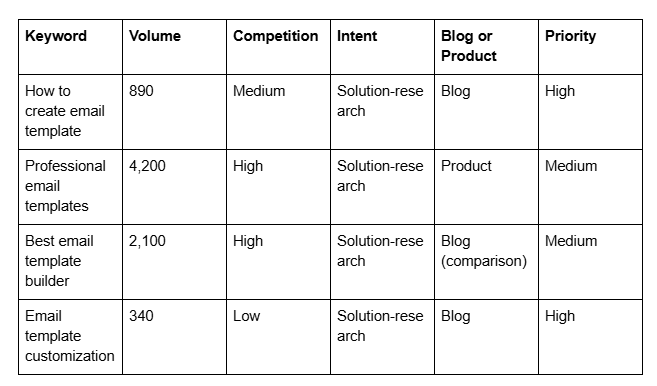
Focus on 5-10 high-priority long-tail keywords for blog content. This gives you clear content direction for the next 3-6 months.
Product Page SEO Optimization
Your product pages are where SEO meets conversion. Optimization must serve both goals.
Product Page SEO Elements
Title tag (60 characters max, appears in search results):
Bad: Email Templates
Better: 50 Professional Email Templates for Yoga Studios
The better version:
Includes primary keyword
Includes target audience
Creates curiosity with specific number
Tells searcher exactly what they're getting
Meta description (160 characters, appears under title):
Professional email templates designed for yoga studios and wellness coaches. Customizable in Figma. Boost engagement and save hours of design time. Buy now.
The meta description:
Includes primary keyword naturally
Mentions audience specifically
Communicates key benefit (save time)
Includes call-to-action language
H1 heading (what customers see on page, should match or closely align with title tag):
50 Professional Email Templates for Yoga Studios
H2 subheadings (structure your content with keyword variations):
What's Included in This Email Template Bundle
Who Should Use These Yoga Studio Email Templates
How to Customize These Professional Email Templates in Figma
Email Template Best Practices for Wellness Businesses
Notice each H2 includes a variation of the keyword (email template appears in various contexts).
Image alt text (helps accessibility and SEO):
Bad: image1.png
Better: Professional email template for yoga studio newsletter signup
The better version describes the image including relevant keywords.
Product description (600+ words, include keyword naturally throughout):
Your product description should:
Include the primary keyword in first 100 words
Use semantic variations throughout (template, email design, pre-built email, email format)
Include customer-focused benefits, not just features
Be well-structured with clear sections
Link internally to related products or blog posts
Schema markup (Squarespace handles this automatically):
Squarespace automatically adds schema markup for products, which helps search engines understand pricing, availability, and reviews. Ensure you:
Request customer reviews (improves schema rating)
Update pricing accurately
Mark products as In Stock
Internal Linking for Product Pages
Link from blog content to product pages with descriptive anchor text:
Good: email templates for yoga studios
Less good: our templates
When writing blog content, look for natural opportunities to link to relevant products. This:
Helps search engines understand what products serve which purposes
Drives traffic from blog readers to product pages
Increases perceived authority (products backed by comprehensive content)
Content Marketing and Blog Strategy
Blog content is the engine of SEO for digital product businesses.
Content Marketing Purpose for Digital Products
Your blog serves multiple functions:
Drive organic traffic from search engines
Build authority around your niche
Establish customer trust through valuable free content
Capture email leads through gated resources
Support product pages with complementary content
Blog Content Topics for Digital Products
For digital product creators, blog content should address:
Problem-awareness content:
How to [solve problem] without [expensive solution]
The [problem] most [audience] make with [related task]
Why [task] is harder than it should be
Examples:
How to Create Professional Presentations Without Hiring a Designer
The 5 Mistakes Most Coaches Make with Email Marketing
Why DIY Email Templates Look Unprofessional
Solution-research content:
The Complete Guide to [solution type]
[Solution type] vs. [alternative solution]: Which Is Better?
How to Choose the Right [solution type]
Examples:
Figma Template Systems vs. Adobe Templates vs. Canva: Complete Comparison
Everything You Need to Know About Email Template Builders
Implementation content:
How to [use your solution type]
Best Practices for [using your solution]
Step-by-Step Guide to [implementing solution]
Examples:
How to Customize Email Templates in Figma (Step-by-Step)
Email Template Best Practices That Increase Conversions
Case study and social proof content:
How [customer] achieved [result] using [solution]
[Result] Case Study: What We Learned
Examples:
How a Solopreneur Used Email Templates to Increase Signups 45%
Inside Our Process: How We Design Templates That Sell
Blog Content Structure for SEO
Each blog post should include:
Introduction (150-200 words):
Hook the reader with a specific problem
Introduce the solution your post covers
Outline what they'll learn
Table of Contents:
Helps readers navigate long-form content
Helps search engines understand structure
Main content (1500-2500 words minimum):
Organize with H2 and H3 headings
Use bullet points for scannability
Include relevant images
Naturally work in your target keyword and semantic variations
Link to related blog posts and products
Takeaways section:
Summarize key learnings
Reinforce main value proposition
Call-to-action:
Link to relevant product
Or link to free resource/email signup
Should feel natural, not aggressive
Related resources:
Link to complementary blog posts
Link to related products
Publishing Cadence
Consistency matters for SEO. Plan realistic publishing:
Recommended: 2 blog posts per month (one per week)
This gives you:
24 blog posts per year
Long-form content on diverse topics
Enough touchpoints with your audience
Starting pace: Focus on quality over quantity. One excellent 2000-word post is better than four mediocre 500-word posts.
Blog Topics to Avoid
Some blog topics won't help your digital product business:
Avoid: General life advice unrelated to your products
10 Morning Habits of Successful Entrepreneurs
How to Find Work-Life Balance
While these might get traffic, they don't lead to product sales.
Focus instead: Content directly supporting your products
How [Audience] Can [Achieve Result] Using [Your Product Type]
Building Authority and E-E-A-T
Google's E-E-A-T framework (Experience, Expertise, Authoritativeness, Trustworthiness) increasingly influences rankings. For digital product businesses, this is especially important.
Building Expertise
Demonstrate you know your niche through:
In-depth content: Write comprehensive guides showing deep knowledge
Case studies: Show real results from real customers
Product quality: Your products should be objectively excellent
Specific examples: Generic advice is valueless; specific examples prove expertise
Original data: Run surveys, create templates, develop tools
Example of generic vs. specific:
Generic: Email templates increase open rates
Specific: Professional email templates with personalization lines increased open rates by 23% on average for our 2,000 template users
Building Authoritativeness
Build your reputation through:
Author bylines: Include your name and credentials on posts
About page: Clear background and credentials
Guest contributions: Write for larger publications in your niche
Speaking engagement: Present at conferences or webinars
Thought leadership: Share original insights and opinions
Media mentions: Get featured in relevant publications
Building Trustworthiness
Prove you're trustworthy through:
Transparency: Be honest about what your products do and don't do
Customer testimonials: Real customer voices build trust
Money-back guarantees: Remove risk from purchase
Customer support: Respond quickly and helpfully to inquiries
Privacy policy: Clear data handling builds confidence
No misleading claims: Avoid exaggeration and hype
For digital product businesses, trustworthiness is critical because customers can't evaluate the product before purchasing.
Author Authority on Squarespace
Squarespace allows you to build author profiles:
Create an author archive page
Link your author name across posts
Include author bio with credentials
Link to author social profiles
Include author photo
This helps search engines associate content with you as an authority figure rather than just your brand.
Technical SEO on Squarespace
Technical SEO ensures search engines can crawl, index, and understand your site. Squarespace handles much of this automatically, but you should optimize what you can.
Squarespace SEO Strengths
Out of the box, Squarespace handles:
Mobile optimization (all sites are mobile-responsive)
Site speed (generally fast, though varies by template)
SSL certificate (HTTPS is automatic)
XML sitemap (automatically generated)
Robots.txt optimization (automatically configured)
Duplicate content handling (rel=canonical tags)
You're ahead of most websites just using Squarespace.
SEO Optimizations You Can Make
Site metadata:
Go to Settings > SEO
Add site title and description
Include your primary keywords naturally
Page-level optimization:
Each page has SEO section where you can edit title, description, slug
Use keywords you're targeting in these fields
Keep titles under 60 characters, descriptions under 160
URL structure:
Edit your page URLs to be descriptive (Settings > Pages > Edit Page > Slug)
Include primary keyword when appropriate
Avoid URLs with symbols and special characters
Site speed optimization:
Compress images before uploading (use TinyPNG or similar)
Limit heavy animations and videos on homepage
Test site speed using Google PageSpeed Insights
Aim for under 3-second load time
Navigation structure:
Organize content logically
Limit navigation depth (important pages should be 1-2 clicks from homepage)
Use descriptive navigation labels (not generic More or Learn)
SEO Settings in Squarespace
Log into Squarespace and navigate to:
Settings > SEO:
Add site title (use main keyword if possible)
Add site description
Enable/disable search engines indexing
View XML sitemap
Manage robots.txt (usually leave on default)
Settings > Commerce > SEO (if selling products):
Enable product schema markup
Ensure product structure is optimized
AI Search Optimization in 2026
In 2026, ranking in Google is important, but so is getting recommended by AI systems. This is a new opportunity for digital product businesses.
How AI Systems Discover Products
ChatGPT, Claude, Perplexity, and other AI systems use:
Web indexing (similar to Google)
Training data that includes authoritative sources
Recent web searches to supplement training
When someone asks ChatGPT What are the best email templates for coaches?, the AI can:
Search the web for recent results
Recommend based on authority and relevance
Cite sources, which drives traffic
Optimizing for AI Search
Create highly specific, authoritative content:
AI systems favor specific, detailed content over generic content. A guide titled 10 Best Email Template Resources for Coaches will rank better in AI systems than Email Templates.
Include specific data and metrics:
AI systems prefer content with concrete information:
These templates are used by over 5,000 coaches and have an average 4.8-star rating based on customer reviews.
Better than: These templates are popular with coaches.
Create comparison content:
AI systems like comparison content because it helps them answer complex questions.
Email Template Builder vs. Template Bundles: Which Is Better for Coaches
Build backlinks from authoritative sites:
When authoritative sites link to you, AI systems recognize you as a credible source. This increases your likelihood of being recommended.
Include rich media and demonstrations:
Include product screenshots, videos, and detailed examples. AI systems weight visual content heavily when making recommendations.
Monitoring AI Search Traffic
AI search doesn't show up in Google Analytics as clearly as traditional search, but you can:
Add Perplexity to your Google Search Console
Monitor ChatGPT browsing for mentions
Check for traffic sources labeled as other or direct that might be AI
As AI search grows in 2026-2027, it will become a more significant traffic source.
Link Building for Digital Products
Links from other authoritative sites to your site signal authority to search engines. This is especially important in competitive niches.
Link Building Strategies for Digital Products
Strategy 1: Guest blogging
Write articles for popular blogs in your niche
Include a link to your site and/or products
Builds authority and traffic
Example: If you create design templates, pitch a guest post to design blogs about How to Use Templates in Your Design Workflow.
Strategy 2: Resource page links
Create comprehensive resource guides
Reach out to related sites about linking to your guide
Ask to be included in resource collections
Example: Create The Ultimate Directory of Email Template Resources and reach out to email marketing blogs to include your guide on their resource pages.
Strategy 3: Broken link building
Find links to similar products on competitors' sites
Identify links to products that no longer exist
Suggest your product as a replacement
Example: Find that a design blog links to a defunct template site. Suggest your templates as a replacement.
Strategy 4: Create linkable assets
Develop templates, checklists, or tools worth linking to
Make them freely available
Promote to bloggers and journalists in your space
Example: Create a free Email Marketing Audit Checklist that design blogs and email marketing blogs want to link to.
Strategy 5: Relationships and networking
Build genuine relationships with other creators in your space
Mention and link to their work when relevant
They'll reciprocate with links and mentions
Link Quality Matters More Than Quantity
One link from a highly authoritative site (like Forbes, HubSpot, or Design Bomb) is worth 100 links from low-quality sites.
Focus on:
Relevance (link should be from a site about your niche)
Authority (site should be well-known and trusted)
Context (link should fit naturally in the content)
Avoid:
Buying links (violates Google guidelines)
Link exchanges with unrelated sites
Automated link-building tools
Paid link directories
Measuring and Iterating on SEO Performance
SEO is ongoing. Measure what's working and continuously improve.
Key SEO Metrics to Track
Traffic metrics:
Monthly organic visits
Organic visitors by page/post
Traffic by source keyword
Organic traffic growth month-over-month
Ranking metrics:
Keyword rankings (which keywords you rank for)
Average ranking position (higher is better)
Ranking movement (improving, declining, stable)
Keywords in top 10 (likely to drive traffic)
Conversion metrics:
Organic visitors who purchase
Organic revenue
Organic customer acquisition cost
Organic customer lifetime value
Content metrics:
Backlinks to your content
Domain authority (overall site authority)
Content age and freshness
Tools for Measuring SEO
Free tools:
Google Search Console (shows your rankings and click-through rates)
Google Analytics 4 (shows traffic and conversions from organic search)
Google PageSpeed Insights (measures site speed)
Google Keyword Planner (shows keyword search volume)
Paid tools (worth the investment if serious about SEO):
Ahrefs (comprehensive SEO analysis)
SEMrush (keyword research and competitor analysis)
Moz Pro (domain authority tracking and rank tracking)
Optimization Cycle
Month 1-2: Establish baseline
Document current organic traffic
Document current keyword rankings
Document current conversion rate
Month 3-6: Create and publish content
Implement 2-4 blog posts per month
Focus on long-tail keywords you're targeting
Build backlinks through guest posts and relationships
Month 6-12: Monitor and optimize
Are rankings improving for your target keywords?
Is organic traffic increasing?
Are organic customers converting?
Which content performs best?
Month 12+: Scale what works
Create more content similar to top performers
Optimize underperforming content
Build more backlinks to your best pages
Expand into new but related keyword opportunities
Conclusion
SEO is the highest-leverage investment for digital product businesses. It's the difference between paying for every customer (paid ads) and having customers find you and buy (organic search).
A well-executed SEO strategy for digital products means:
Ranking for long-tail keywords your customers search for
Creating valuable content that builds authority and trust
Building backlinks and social proof around your products
Driving consistent, passive traffic that compounds over time
Generating sales at a lower cost than paid advertising
The creators generating six-figure incomes from digital products almost always have strong organic traffic. They invested in SEO early when competition was lower, and that investment continues paying dividends.
Start with long-tail keyword research, then create a consistent content calendar focused on those keywords. Build backlinks and relationships. Optimize your product pages. Measure results. Iterate based on data.
SEO is not a quick win—it's a long-term investment in your digital product business. But it's an investment that pays compounding returns for years.
CTA Section
Ready to drive passive sales through SEO?
Many digital product creators understand that SEO matters but struggle to execute. Balancing content creation, product development, and SEO optimization is overwhelming.
At Squareko, we specialize in SEO strategy and content marketing for digital product businesses. Our team has helped digital creators generate over $15M in combined organic revenue.
We can help with:
Long-tail keyword research specific to your niche
Content calendar development and execution
SEO-optimized blog writing and management
Product page optimization for search and conversion
Backlink strategy and link building
Get a free SEO audit and 3-month content strategy.
Frequently Asked Questions
-
Expect initial results in 3-6 months, significant results in 6-12 months. Blog posts typically take 2-3 months to start ranking after publishing. Long-tail keywords rank faster than competitive keywords, which is why long-tail focus works best for digital product businesses.
-
Product pages alone can rank for transactional keywords ("buy email templates") but struggle with broader intent keywords. Blog content helps you rank for the entire customer journey (problem-awareness → solution research → purchase). Most successful digital product businesses use both blog content and optimized product pages.
-
Results vary, but most creators see meaningful traffic after 20-30 quality blog posts (over 6-12 months). Each post compounds, so momentum builds over time. Don't expect instant results, but consistency compounds impressively.
-
Both matter. Blog content with zero backlinks ranks slowly. A few high-quality backlinks to mediocre content doesn't rank well. The combination of content quality + backlinks + on-page SEO creates ranking success.
-
Write what you can authentically. Customers and search engines can tell when content is inauthentic. If you're comfortable writing, do it yourself. Your unique voice is an asset. If writing isn't your strength, hire someone who can maintain authenticity while improving clarity.
-
Target both, but strategically. Start with long-tail (faster results), build brand authority, then attack broader keywords. Most traffic comes from long-tail keywords anyway (they're more common than people realize), so long-tail focus is smart long-term strategy.
-
Squarespace handles SEO well out of the box. Main limitation: less customization flexibility than WordPress. You can't install specific SEO plugins or customize code extensively. This is usually fine for digital products, but if you need advanced customizations, self-hosted WordPress might be better.
-
Optimize for traditional Google search first—it's still the largest traffic source. Voice search and AI search optimization are similar to traditional SEO (focus on specific, conversational keywords). One strong content strategy serves all three reasonably well.

From custom website design to SEO strategy, we help businesses launch a site that looks professional and performs better.

Author Bio
I'm Walid Hasan, a Certified Squarespace Expert and Squarespace Circle Platinum Partner with over 12 years of hands-on experience designing and optimizing high-performing websites. Over the years, I've had the privilege of building more than 2,000 Squarespace websites for clients around the world, always focusing on clean design, strong user experience, and conversion-driven results.