Squarespace SEO for Beauty and Fashion Brands: Rank on Google and AI Search in 2026.
Introduction
The beauty and fashion e-commerce landscape is more competitive than ever. With thousands of brands launching Squarespace stores monthly, standing out on Google—and increasingly on AI search platforms—requires a strategic approach to SEO. If you're running a beauty or fashion brand on Squarespace, you need to understand how to optimise your site for both traditional search engines and AI-powered answers. This guide covers everything you need to know about Squarespace SEO for beauty and fashion brands in 2026, from technical fundamentals to advanced Answer Engine Optimisation (AEO) tactics that position your products directly in ChatGPT, Claude, Gemini, and Grok responses. Whether you're a skincare startup, luxury fashion boutique, or established cosmetics brand, the strategies outlined here will help you rank higher, attract qualified traffic, and convert visitors into customers.
Key Takeaways Squarespace SEO for Beauty and Fashion Brands: Rank on Google and AI Search in 2026.
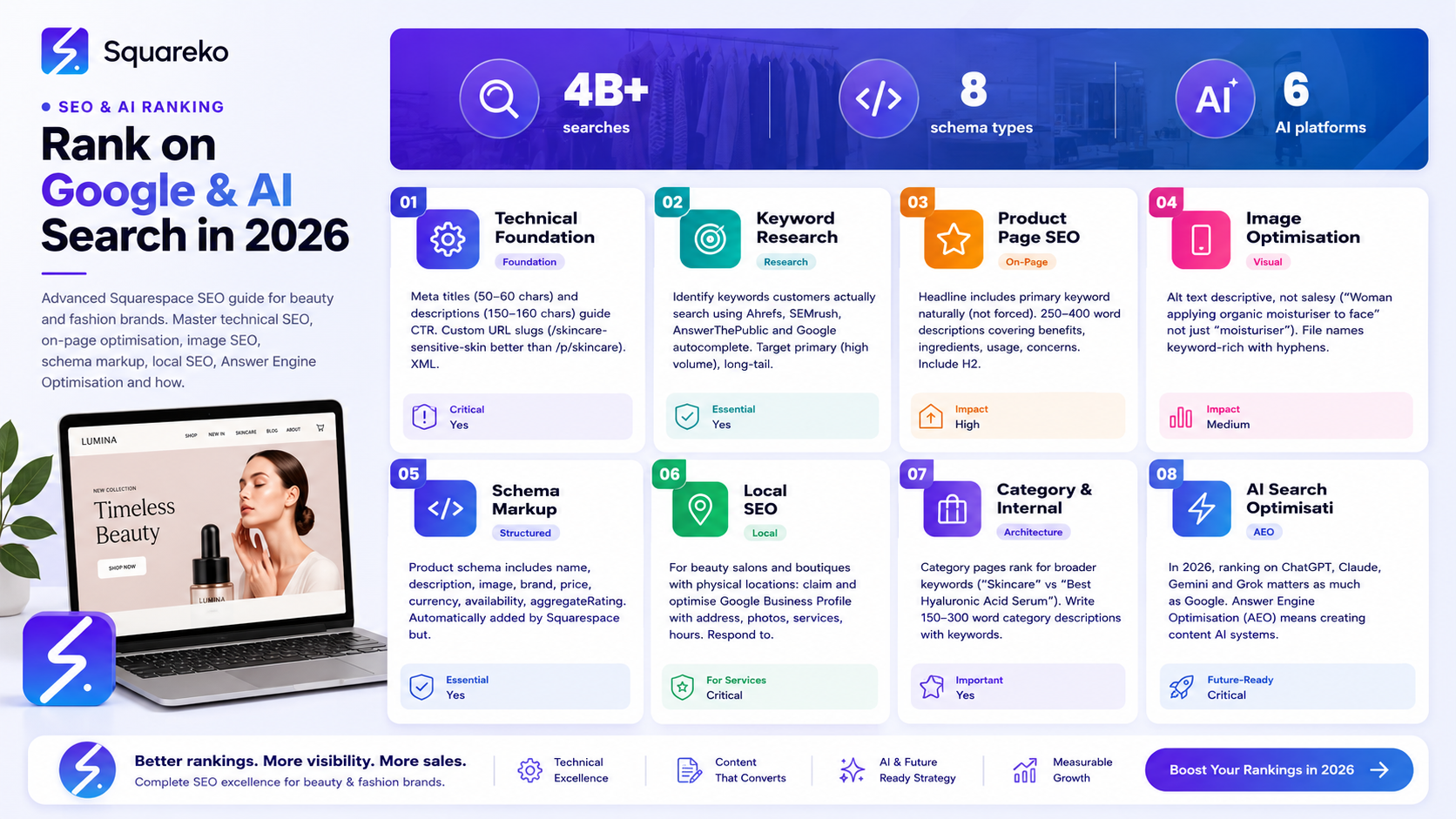
Technical SEO foundations matter: Optimise meta titles, descriptions, URL slugs, sitemaps, and internal linking to establish authority on Squarespace
Product pages are your ranking assets: Structure product content with schema markup, high-quality images with proper alt text, and strategic keyword targeting
AI search is reshaping visibility: Answer Engine Optimisation and Generative Engine Optimisation techniques now determine whether your brand appears in AI-generated answers
Schema markup enables rich results: Product, LocalBusiness, FAQPage, and HowTo schema help Squarespace sites rank in featured snippets and AI systems
Beauty-specific strategies work best: Combine visual SEO (image optimisation), user-generated content signals, and ingredient-focused content to dominate your niche
Local SEO drives foot traffic: For beauty salons, spas, and boutiques, Google Business Profile optimisation and local citations are essential
E-commerce SEO requires layer strategy: Category page optimisation, breadcrumb navigation, and faceted search all contribute to ranking potential
1. Why Squarespace SEO Matters for Beauty and Fashion Brands
Beauty and fashion are among the most searched categories online. Global beauty market searches exceed 4 billion queries annually, and fashion searches are similarly competitive. Yet many Squarespace-based beauty and fashion brands treat SEO as an afterthought, assuming their beautiful design and high-quality products will drive traffic naturally. They won't.
The Visibility Problem
Without a deliberate SEO strategy, even exceptional beauty brands remain invisible to potential customers. When someone searches best organic skincare for sensitive skin or sustainable fashion brands UK, your site won't appear unless you've optimised for those specific queries and established topical authority.
Why Squarespace Specifically?
Squarespace is an excellent platform for beauty and fashion e-commerce because of its design flexibility and integrated e-commerce capabilities. However, it's not inherently SEO-optimised out of the box. Success requires understanding:
How Squarespace's URL structure impacts ranking
Where to implement schema markup within Squarespace's editor
How to maximise Squarespace's native SEO settings
How to use Squarespace blogs effectively for content authority
Whether Squarespace can compete with WordPress or dedicated e-commerce platforms (it can, with proper strategy)
The AI Search Layer
In 2026, ranking on Google is only half the battle. AI search platforms—ChatGPT, Claude, Gemini, and Grok—now influence buying decisions, brand discovery, and content authority. Beauty consumers ask AI systems What skincare brands should I try? and Which fashion brands are sustainable? If your brand doesn't appear in those AI-generated answers, you're losing traffic regardless of your Google rankings.
2. Technical SEO Foundations on Squarespace
Before optimising for rankings, ensure your Squarespace site is technically sound. These fundamentals affect crawlability, indexation, and authority—all critical ranking factors.
Meta Titles and Meta Descriptions
Meta titles and descriptions appear in search results and influence click-through rates.
Best practices for beauty and fashion:
Meta titles: Include primary keyword, brand name, and value prop. Aim for 50–60 characters. Example: Organic Skincare for Sensitive Skin | Luna Beauty
Meta descriptions: Write compelling, benefit-driven copy that encourages clicks. Include secondary keyword naturally. 150–160 characters. Example: Shop award-winning organic skincare for sensitive skin. Dermatologist tested, cruelty-free, and delivered within 48 hours.
In Squarespace, set these under Settings > SEO for site-wide defaults, then override for individual pages and product pages.
URL Structure and Slugs
Squarespace generates URLs automatically, but you can customise slugs. Use hyphens to separate words, include primary keyword, keep URLs short and descriptive.
Examples:
/skincare-for-sensitive-skin (good)
/skincare-products-for-sensitive-skin-types (too long)
/p/skincare (too generic)
For product pages, consider including category in the URL:
/skincare/sensitive-skin-moisturiser (better for hierarchy)
XML Sitemaps and Robots.txt
Squarespace automatically generates sitemap.xml and robots.txt at the domain root. Verify both are accessible:
Visit yoursite.com/sitemap.xml to confirm all pages are included
Check that product pages, blog posts, and category pages are listed
Ensure robots.txt doesn't block important content
For large inventories (100+ products), consider using Squarespace's automatic sitemap with pagination to ensure proper coverage.
Site Speed and Core Web Vitals
Google's Core Web Vitals impact ranking. Squarespace generally performs well on speed, but optimisation is still possible:
Image compression: Use WebP format where Squarespace supports it
Lazy loading: Enable for images below the fold (Squarespace handles this automatically)
Caching: Squarespace uses CDN caching by default; minimal additional optimisation needed
Third-party scripts: Limit external scripts (analytics, chat widgets) that could slow load time
Check your site's Core Web Vitals in Google Search Console and Pagespeed Insights.
Mobile Optimisation
Over 60% of beauty and fashion searches happen on mobile. Squarespace templates are mobile-responsive by default, but verify:
Product images scale properly on mobile
Checkout process is streamlined for mobile
Font sizes are readable (minimum 16px)
Buttons and CTAs are easy to tap
3. On-Page SEO for Beauty and Fashion Products
On-page SEO—the optimisation within individual product pages—determines whether Squarespace will rank your products for target keywords.
Keyword Research for Beauty and Fashion
Begin by identifying keywords your customers actually search. Tools like Ahrefs, SEMrush, or Google Keyword Planner reveal search volume, difficulty, and related queries.
Beauty keyword research examples:
Primary: organic skincare for sensitive skin (high volume, high intent)
Long-tail: best natural moisturiser for eczema-prone skin (lower volume, higher intent)
Transactional: buy vegan lipstick online UK (commercial intent)
Informational: how to layer skincare products properly (content opportunity)
Fashion keyword research examples:
Primary: sustainable fashion brands UK (informational/navigational)
Long-tail: affordable ethical denim jeans women (transactional)
Seasonal: summer linen dresses 2026 (time-sensitive, high volume)
Brand-comparative: sustainable fashion vs fast fashion (content opportunity)
Target a mix of high-volume, medium-difficulty keywords and lower-volume long-tail keywords where you can realistically rank.
Product Page Content Structure
Structure product pages for both users and search engines. A well-optimised product page includes:
Headline (H1)
Include primary keyword naturally
Focus on benefit, not just product name
Example: Certified Organic Moisturiser for Sensitive Skin | Luna Beauty
Product description (150–300 words minimum)
Explain ingredients, benefits, and why this product is unique
Address common customer questions (Is it vegan? Cruelty-free? Hypoallergenic?)
Include secondary keywords where they fit naturally
Use short paragraphs and bullet points for scanability
Key benefits section (H2 or H3)
Use subheadings like Why Choose This Product or Key Benefits
List 3–5 core benefits
Connect benefits to customer needs
Ingredient or material breakdown (H2 or H3)
For beauty: List key ingredients and their benefits
For fashion: Describe fabric composition, care instructions
This content attracts both customers and search engines
User-generated content section
Display customer reviews prominently
User reviews provide fresh, keyword-rich content
Reviews build trust and influence purchasing decisions
How to use section (H2 or H3)
Step-by-step instructions with visuals (images or video)
Helps users get the most from the product
Creates opportunity for long-tail keyword targeting
Internal Linking Strategy
Internal linking signals importance and helps distribute page authority across your site.
Best practices:
Category to product: Link from category pages to related products
Related products: Link from one product to complementary products
Content to products: If your blog post covers 5 Skincare Ingredients to Look For, link to products containing those ingredients
Anchor text: Use keyword-rich, descriptive anchor text
Example structure:
Home > Skincare (category) > Sensitive Skin (subcategory) > Product page
4. Image SEO and Visual Optimisation for Beauty Brands
Beauty and fashion are visual industries. Optimising images isn't just about aesthetics—it's an SEO ranking factor.
Alt Text for Product Images
Alt text serves two purposes: accessibility (screen readers) and SEO.
Best practices:
Descriptive, not salesy: "Woman applying organic moisturiser to face" instead of "product"
Include keyword when relevant: "Best organic moisturiser for sensitive skin application" if it fits naturally
Specific to image content: Don't repeat the same alt text on every image
Keep under 125 characters: Aim for clarity, not length
Examples:
❌ skincare.jpg
❌ Moisturiser
✅ Organic moisturiser cream for sensitive skin in glass jar
✅ Woman with acne-prone skin applying salicylic acid serum
Image File Names
Use descriptive file names with hyphens (not underscores or spaces).
❌ skincare1.jpg
✅ organic-moisturiser-sensitive-skin.jpg
Image Compression and Format
Large, unoptimised images slow your site and harm SEO.
Use WebP format where possible (smaller file size, same quality)
Compress images before uploading (aim for under 200KB per image)
Image dimensions: Product images should be high-resolution enough for zoom functionality but optimised for web
Squarespace tip: Squarespace automatically optimises images for different screen sizes
Image Content and Schema
Beyond technical optimisation, the actual images matter.
Lifestyle images: Show products in use (person applying skincare, wearing the dress)
Flat-lay product shots: Clean, well-lit product images
Lifestyle diversity: Feature models of different skin tones, body types, and ages
Before/after: For skincare, appropriate before/after images with disclaimers
5. Product Page Schema Markup and Structured Data
Schema markup helps search engines and AI systems understand your product data. It's essential for ranking and visibility in 2026.
Product Schema
Product schema tells Google and AI systems about your product, reviews, pricing, and availability.
Squarespace implementation:
While Squarespace automatically adds basic Product schema to product pages, you can enhance it by:
Ensuring all product fields are populated: name, description, image, brand, price, currency, availability
Adding JSON-LD manually via Settings > Advanced > Code Injection
Minimal Product schema structure
{
  "@context": "https://schema.org",
  "@type": "Product",
  "name": "Organic Moisturiser for Sensitive Skin",
  "description": "Certified organic moisturiser for sensitive and acne-prone skin",
  "brand": {
    "@type": "Brand",
    "name": "Luna Beauty"
  },

  "image": "https://example.com/moisturiser.jpg",
  "offers": {
    "@type": "Offer",
    "price": "45.00",
    "priceCurrency": "GBP",
    "availability": "https://schema.org/InStock"
  },
  "aggregateRating": {
    "@type": "AggregateRating",
    "ratingValue": "4.8",
    "reviewCount": "127"
  }
}
Review and Rating Schema
Aggregate ratings appear as star reviews in search results, improving click-through rates.
Squarespace automatically captures reviews if you have an e-commerce site with reviews enabled. Ensure reviews are:
Authentic and verified (purchased from your store)
Include star ratings
Display product name and customer name
LocalBusiness Schema (for physical locations)
If you have a salon, spa, or boutique, use LocalBusiness schema to rank in local search and Google Maps.
{
"@context": "https://schema.org",
  "@type": "LocalBusiness",
   "name": "Luna Beauty Salon",
    "image": "https://example.com/salon.jpg",
  "address": {
     "@type": "PostalAddress",
      "streetAddress": "123 High Street",
       "addressLocality": "London",
        "addressRegion": "London",
        "postalCode": "N1 1AA",
         "addressCountry": "GB"
  },
  "telephone": "+44 20 1234 5678",
   "url": "https://example.com",
    "openingHoursSpecification": {
    "@type": "OpeningHoursSpecification",
     "dayOfWeek": "Monday",
     "opens": "09:00",
      "closes": "18:00"
  }
}
6. Local SEO for Beauty Businesses and Boutiques
For beauty salons, spas, dermatology clinics, and fashion boutiques with physical locations, local SEO is critical.
Google Business Profile Optimisation
Google Business Profile (formerly Google My Business) is your most important local SEO asset.
Complete all fields:
Business name (match your legal name and Squarespace site exactly)
Address (verified address, not PO box)
Phone number (local or main number)
Website (link to Squarespace site)
Business hours (keep updated, note holidays)
Service area (if you serve customers beyond your location)
Categories (select primary and secondary categories relevant to your business)
Photos (high-quality salon/boutique photos, product photos, team photos)
Services (list specific services: "Hair Styling," "Facial," "Skincare Consultation")
Regular updates:
Post new services or seasonal offers monthly
Respond to reviews promptly (both positive and negative)
Add photos of new treatments or products
Update hours if you change opening times
Local Citations
Citations are online mentions of your business name, address, and phone number (NAP). Consistency matters.
Build citations on:
Industry directories (Yelp, Treatwell for salons, ThirdLove for fashion)
Local directories (Yell.com, Knowfusion, Across the UK)
Google Maps (automatic from your Google Business Profile)
Social media (Facebook, Instagram, TikTok)
Ensure your NAP is identical across all platforms to build local authority.
Review Generation and Management
Customer reviews are ranking factors for local search and influence buying decisions.
Strategy:
Ask customers for reviews after transactions or visits
Include review links in post-purchase emails
Respond to all reviews (thank positive reviews, address concerns in negative reviews professionally)
More reviews = higher visibility in local search
7. E-Commerce SEO: Category Pages, Filters, and Internal Linking
E-commerce SEO on Squarespace requires strategy beyond individual product pages.
Category Page Optimisation
Category pages often have more ranking potential than individual product pages because they target broader keywords.
Optimise each category page:
H1 with keyword: Skincare for Sensitive Skin
Category description (150–300 words): Explain what products are in the category, why customers might choose them, and related use cases
Internal structure: Organize products logically (by price, ingredient, brand, rating)
Related content: Link to blog posts about the category
Example category page structure:
H1: Best Skincare for Sensitive Skin
[Category description with keyword usage]
Filter options: Price, Ingredient, Skin Type, Brand
[Products listed with name, image, price, rating]
Related Articles:
- Ingredients to Avoid if You Have Sensitive Skin
- The Complete Sensitive Skin Routine
Breadcrumb Navigation
Breadcrumbs show users (and search engines) the page hierarchy and improve site architecture signals.
Squarespace implementation:
Most Squarespace templates include breadcrumbs by default. Verify they're enabled and structured correctly:
Home > Skincare > Sensitive Skin > Product Name
Breadcrumbs should match your internal linking structure
Faceted Search and URL Parameters
Faceted search (filters) helps users find products but can create duplicate content issues if not managed.
Best practices:
Use dynamic facets (Squarespace handles this automatically for most templates)
Avoid excessive filter combinations that create unique URLs
Implement canonical tags on filtered pages to point to the primary category URL
Consider blocking deeply nested filter combinations in robots.txt
8. Answer Engine Optimisation (AEO) for Beauty Brands
Answer Engine Optimisation is the practice of structuring content so that AI systems cite and feature your brand in generated answers.
What is AEO?
When someone asks ChatGPT "Which skincare brands are best for sensitive skin?" the AI generates an answer that may cite specific brands and products. AEO tactics increase the likelihood that your brand appears in that answer.
AEO Content Strategy
Create definitive, authority content:
Write comprehensive guides that AI systems would want to cite
Example: "The Complete Guide to Skincare for Sensitive Skin" covering ingredients, routines, brand recommendations
Use clear headings and structured content
Answer common questions thoroughly
Use structured data strategically:
HowTo schema for product use guides
FAQPage schema for FAQs
Article schema for blog posts
This helps AI systems understand and cite your content
Cite sources and build credibility:
Reference scientific studies, dermatologist recommendations
Include statistics
Show social proof (customer reviews, expert endorsements)
Create comparison and evaluation content:
Sustainable Fashion Brands: A Comparison
Skincare Ingredients Explained
AI systems value comprehensive, unbiased content that provides genuine value.
Mention and Attribution Strategy
While you can't force AI systems to cite you, earning citations requires:
Appearing in reputable sources: Get featured in fashion blogs, beauty publications, press features
High search rankings: AI systems often cite top-ranking sources for queries
Clear product information: Make it easy for AI systems to reference your brand name, products, and key details
Customer testimonials: Positive, specific reviews influence AI-generated recommendations
9. How to Rank Your Beauty Brand on ChatGPT, Claude, Gemini and Grok in 2026
In 2026, AI search platforms influence purchasing decisions as much as Google. Here's how to rank your beauty or fashion brand in AI-generated answers.
ChatGPT Integration: Search and Browse
OpenAI's ChatGPT has real-time search capabilities. To rank in ChatGPT search results:
Ensure your site is crawlable: ChatGPT's crawler respects robots.txt and sitemap.xml
Use clear, keyword-rich headings: ChatGPT parses heading structure to understand content
Provide direct answers: When users ask "What's the best sunscreen for oily skin?" they want a direct answer, not a 2,000-word essay
Cite sources visibly: ChatGPT prefers content it can cite; make your brand name, product names, and claims verifiable
Avoid thin content: Low-value pages won't rank
Squarespace tip: Your blog posts and product pages are already crawlable by ChatGPT. Ensure they're published (not draft) and accessible to search engines.
Claude and Constitutional AI
Claude (Anthropic's AI) prioritises factual accuracy and clear sourcing. To rank in Claude's answers:
Provide transparent, verifiable information: Include pricing, ingredients, certifications clearly
Structure content logically: Claude parses heading structure and lists effectively
Acknowledge limitations and tradeoffs: If your product is best for certain skin types but not others, say so—Claude values honesty
Include specific details: Rather than good for all skin types, specify formulated for sensitive and acne-prone skin
Build trust signals: Certifications (organic, cruelty-free, dermatologist-tested), third-party reviews, awards
Google Gemini
Gemini integrates with Google Search, meaning your existing Google ranking factors influence Gemini appearance. However, Gemini also has specific preferences:
Structured data is critical: Use Product, LocalBusiness, HowTo, and FAQ schema aggressively
Content depth: Gemini favours comprehensive content; blog posts over product pages alone
Multimedia content: Images, videos, infographics help Gemini understand and present content
Related content clusters: If your site has multiple relevant articles, Gemini may cite several
E-E-A-T signals: Experience, Expertise, Authority, Trustworthiness matter for Gemini visibility
Grok and Twitter Integration
Grok (xAI's AI available on X/Twitter) has limited integration with e-commerce sites currently, but this is evolving. However, for fashion and lifestyle brands:
Social media presence: Grok integrates with X/Twitter heavily; an active presence helps
News and mentions: Press coverage or industry mentions on X influence Grok answers
Viral content: Grok occasionally cites trending content
Direct mentions: When accounts mention your brand on X, Grok may reference you
Strategy: While Grok is less critical than Google, ChatGPT, and Claude for e-commerce, maintain an active social presence to capture opportunities.
Universal AEO Tactics
Across all AI platforms:
Answer specific questions: Create content addressing How to apply, When to use, Who should use, Where to buy
Use natural language: Write for humans first, search algorithms second
Include statistics and research: AI systems cite sources with data and evidence
Verify your facts: Inaccurate claims will damage your credibility
Monitor mentions: Use tools like Google Alerts or Mention to track how AI systems cite your brand
Update content regularly: Outdated information is deprioritised
10. Generative Engine Optimisation (GEO) Strategy
Generative Engine Optimisation (GEO) is the practice of optimising for how generative AI systems retrieve and present information.
How GEO Differs from Traditional SEO
Traditional SEO: Optimise to rank at the top of a list
GEO: Optimise to be cited within AI-generated text
This requires a different mindset. Instead of competing for position one in Google, you're competing to be a trusted source cited by AI systems.
GEO Best Practices
1. Create original research and data
Beauty and fashion brands can conduct surveys, clinical studies, or trend analysis that AI systems will cite.
Example: Luna Beauty conducts a survey of 10,000 customers about sensitive skin routines, publishes the findings, and becomes the cited source for that data.
2. Publish comprehensive guides and roundups
AI systems cite content that comprehensively answers questions. Create guides that would be useful to cite:
The Complete Skincare Routine for Sensitive Skin" (2,500+ words)
Sustainable Fashion Brands: Complete Guide 2026" (3,000+ words)
3. Use clear, scannable formatting
AI systems prefer content with:
Descriptive headings
Bullet-point lists
Short paragraphs
Key information near the top
4. Optimise for featured snippets
Featured snippets often become AI source material. Optimise for snippets by:
Answering questions directly in an opening sentence or list
Using H2 headings as questions
Including definition boxes or charts
5. Build topical authority
AI systems recognise websites that deeply cover a topic. If your site covers beauty or fashion comprehensively, AI systems will cite you more often. Create content clusters:
Beauty cluster example:
Hub article: Complete Guide to Skincare Routine
Spokes: Best Moisturiser for Sensitive Skin, Skincare for Acne-Prone Skin, Ingredients to Avoid, How to Apply Skincare
6. Include primary sources and original insights
AI systems prefer:
Direct quotes from expert interviews
Original research data
Product testing and results
Customer testimonials with specific outcomes
7. Monitor how AI systems cite you
Use browser extensions or manual testing to see how ChatGPT, Claude, and Gemini cite your content. Adjust your content strategy based on what resonates with AI systems.
-
To rank your beauty brand on Google, start with keyword research to identify what your customers actually search. Then optimise your Squarespace site's technical foundations: meta titles, descriptions, URL slugs, and site structure. Create comprehensive, keyword-rich product pages and blog content that addresses customer questions and pain points. Use schema markup (Product, LocalBusiness, FAQ) so Google understands your content. Build internal links between related products and content. If you have a physical location (salon, boutique), claim and optimise your Google Business Profile. Finally, earn backlinks and social signals by getting featured in beauty publications and generating customer reviews. Ranking takes time—expect 3–6 months to see meaningful results for competitive keywords.
-
A beauty brand should implement multiple schema types depending on content. Use Product schema for all product pages (including price, images, reviews, and availability). Use AggregateRating schema to display star reviews in search results. Use LocalBusiness schema if you have a physical salon or boutique. Use FAQPage schema for your FAQ section to appear in Google's featured snippets. Use HowTo schema for skincare routines or product application guides. Use Article schema for blog posts about skincare, ingredients, or skincare trends. Use BreadcrumbList schema for site navigation. While Squarespace automatically adds basic Product schema, enhance it by adding JSON-LD code manually via code injection in Settings > Advanced for full control and comprehensiveness.
-
To get your fashion brand featured in AI search answers, create comprehensive, authoritative content that AI systems would want to cite. Write original guides answering common fashion questions, such as "How to Build a Sustainable Wardrobe" or "Best Ethical Fashion Brands for Vegan Consumers." Include specific product recommendations, link to product pages, and cite industry experts or research. Use clear structure with descriptive headings so AI systems can easily understand and cite your content. Include customer testimonials with specific results ("Reduced my wardrobe to 40 pieces and saved £500 annually"). Build backlinks from fashion publications and beauty blogs so AI systems recognise your authority. Monitor how ChatGPT, Claude, and Gemini cite your content using manual testing, then adjust your content strategy based on what works.
-
Yes, Squarespace is SEO-friendly for e-commerce, especially beauty and fashion brands. Squarespace handles technical SEO basics automatically: mobile responsiveness, site speed, SSL certificates, and XML sitemaps. You can customise meta titles, descriptions, and URL slugs for every page. Squarespace supports schema markup implementation. However, Squarespace has limitations compared to WordPress: less flexibility in code customisation, fewer advanced SEO plugins available, and slightly less control over site structure. For most beauty and fashion brands starting out, Squarespace's ease of use and integrated e-commerce capabilities outweigh these limitations. Squareko.com has successfully ranked Squarespace beauty and fashion sites on the first page of Google for competitive keywords, so don't assume Squarespace can't compete.
-
Local SEO is critical for beauty businesses with physical locations—salons, spas, dermatology clinics, and boutiques. When someone searches "best salon near me" or "facials in London," they're looking for a physical location to visit. Google prioritises Google Business Profile and local citations for these queries. A fully optimised Google Business Profile alone can generate 20–40% of foot traffic for a salon or boutique. If you don't optimise for local search, customers will discover competitors instead. However, if your beauty brand is primarily e-commerce (selling products online, not services at a location), local SEO is less important—focus on national and search instead.
-
SEO (Search Engine Optimisation) focuses on ranking your site high in Google's list of search results. You're competing against other sites for position one. Answer Engine Optimisation (AEO) focuses on getting your brand cited within AI-generated answers on ChatGPT, Claude, Gemini, and similar platforms. You're not competing for a position; you're competing to be a trusted source that the AI system cites. The tactics differ: SEO emphasises technical factors, backlinks, and keyword ranking. AEO emphasises comprehensive content, clear sourcing, original data, and trustworthiness. In 2026, both matter. A beauty brand should optimise for both Google rankings (SEO) and AI system citations (AEO).
-
Update your product pages at least quarterly, and more frequently if you have seasonal products or new customer reviews. Regular updates signal freshness to search engines. Minor updates include: adding new customer reviews, updating product descriptions with new ingredient information, refreshing images with new product photography, and adjusting prices. Major updates—adding new sections, restructuring content, or targeting new keywords—should happen annually or when your product offering significantly changes. If you publish new blog content monthly, link back to product pages from new blog posts to boost their authority. Monitor your Google Search Console to identify underperforming product pages and update those first.
-
Yes, but strategically. One product page should have one primary keyword (the keyword in the H1 and meta title) and 3–5 secondary keywords that relate closely to the primary keyword. For example, a product page for an organic moisturiser could target: primary keyword "organic moisturiser for sensitive skin" and secondary keywords "best natural moisturiser," "hypoallergenic face cream," "cruelty-free skincare." However, don't try to rank a single product page for unrelated keywords like "best foundation" and "best moisturiser"—create separate pages for different product categories. Keyword clustering helps: group similar keywords together and assign them to the same page. This prevents keyword cannibalisation where your pages compete with each other for the same keyword.
11. Ready to Rank Your Beauty or Fashion Brand on Google?
Ready to Rank Your Beauty or Fashion Brand on Google?
Squarespace SEO is achievable—but only if you approach it strategically. The strategies outlined in this guide—from technical foundations to Answer Engine Optimisation—will position your beauty or fashion brand to rank on Google, ChatGPT, Claude, Gemini, and emerging search platforms in 2026.
However, implementation requires time, expertise, and ongoing optimisation. If you'd rather focus on product and customer experience while delegating SEO to specialists, that's where Squareko.com comes in. Our Squarespace web design specialists have helped dozens of UK beauty and fashion brands achieve top-ten Google rankings, attract consistent organic traffic, and convert visitors into customers. We combine Squarespace design expertise with advanced SEO knowledge to create sites that are beautiful and visible. Download our free "Beauty Brand Squarespace SEO Checklist" to audit your current site against these best practices—and then get in touch with Squareko.com to discuss your specific ranking goals. Whether you're launching a new brand or scaling an existing one, the next step is clarity. Let's get your beauty or fashion brand ranking where it deserves to be.

Author Bio
Written by the Squareko Team | Squarespace Web Design Specialists | squareko
The Squareko team has spent over a decade helping UK beauty and fashion brands build stunning Squarespace sites that rank on Google and convert visitors into customers. We combine world-class design with advanced SEO strategy to ensure your brand doesn't just look beautiful—it shows up where your customers are searching.