Squarespace for Independent Fashion Designers: How to Compete with Big Brands
Introduction
The fashion industry feels dominated by multinational corporations with bottomless marketing budgets and manufacturing operations across continents. As an independent fashion designer, you might wonder if competing with big brands is even possible. The answer is yes—and you might actually have advantages they don't.
A Squarespace independent fashion designer doesn't need to match a major retailer's inventory size or advertising spend to build a profitable, loyal customer base. What you can do is what big brands struggle with: tell an authentic story, build genuine community, offer limited editions your customers won't find elsewhere, and maintain direct relationships with every person who buys your work.
This guide shows you how to position your indie fashion brand not as a smaller version of Nike or Zara, but as something fundamentally different and more valuable to the right audience.
Key Takeaways
Independent fashion brands compete on authenticity, founder stories, and limited editions—not on scale or marketing budgets
Squarespace provides all the tools indie designers need to build a professional online presence without technical expertise
Your competitive advantages include direct customer access, ethical transparency, community building, and meaningful storytelling
Strategic pricing, email marketing, and social proof can level the playing field against established brands
The fastest-growing fashion segment is conscious consumers seeking alternatives to fast fashion—and that's exactly where indie brands thrive
Why Independent Fashion Designers Can Win
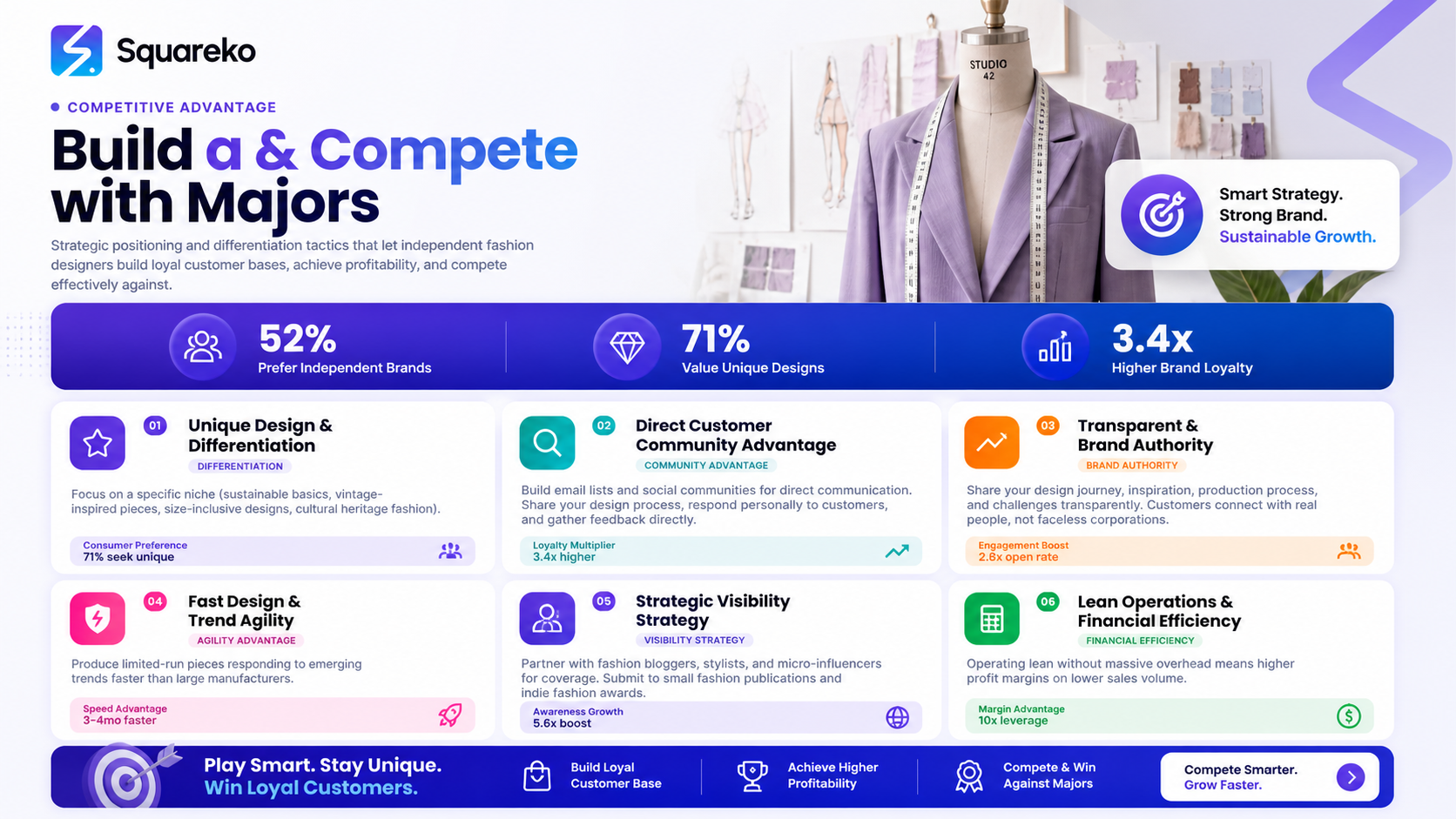
The misconception is that you're competing with big brands on their terms. You're not. When a customer chooses your indie label over a mainstream competitor, they're not choosing based on who has the biggest factory or longest supply chain. They're choosing because your brand means something—and they want to be part of that story. The global ethical fashion market grows at 5–10% annually, while fast fashion growth has stagnated. Consumers, especially Gen Z and millennials, actively seek alternatives. They want to know who made their clothes, why the designer started the brand, and what happens to unsold inventory. Big brands are built on opacity; yours can be built on transparency.
Research from McKinsey shows that 62% of consumers want brands to take a stance on social or political issues. Independent designers have an inherent advantage here—you already have a stance because you're building something you believe in. You don't need a committee approval process to express your values.
This isn't sentiment. It's market opportunity.
Understanding Your Actual Competition
Before crafting your competitive strategy, clarify who you're actually competing with. It's not Zara or H&M.
Your real competition is:
Other indie brands in your niche with similar aesthetics and price points
Direct-to-consumer established brands like Everlane or Reformation (though they started as indies)
Second-hand and rental platforms like Depop and Rent the Runway
Fast fashion for price-conscious customers
Mass-market players for volume, but only in specific categories
Your winning strategy focuses on the competition where your advantages matter: other indie brands and the growing conscious consumer segment. You win by being more authentic, more responsive, more personal, and more values-aligned than anyone else in your space.
You don't beat Zara at scale. You beat every other indie brand by being more you than they are.
Building Your Brand Story on Squarespace
Squarespace's design flexibility lets you tell that story beautifully. Rather than a generic "About" page listing facts, create a narrative arc: What frustrated you about existing fashion? What was the specific moment you decided to start designing? What's your design philosophy? How do you source materials?
Use Squarespace's rich media capabilities:
Video content: A 60–90 second founder story video on your homepage performs exceptionally well. This is your biggest advantage over faceless brands—people connect with you.
Photo essays: Behind-the-scenes shots of your design process, sourcing trips, or sample production matter far more than polished studio images.
Timeline features: Show your brand journey from idea to first collection to current success.
Customer testimonials: Integrate real customer stories and reviews directly into your product pages and homepage.
The goal isn't to look like a big brand. It's to look like something big brands can't be: intentional, personal, and real.
Your Competitive Advantages Checklist
Use this checklist to identify and emphasise the strengths that only indie brands have. Include these in your marketing, website copy, and customer communication:
Founder Story
✓ You have one; faceless corporations don't
✓ Explicitly tie your personal values, background, or journey to every product
✓ Use first-person language on your site and in emails
✓ Reference your story in product descriptions and social captions
Limited Editions
✓ Produce smaller batches (50–200 units per design)
✓ Use Squarespace's inventory management to track limited stock
✓ Create scarcity messaging: Only 47 of this design available
✓ Rotate collections seasonally or by theme to drive repeat visits
Direct Customer Access
✓ Reply personally to customer emails and Instagram messages
✓ Build an email list and communicate directly (not through ads)
✓ Collect feedback through Squarespace forms and use it to design your next collection
✓ Offer early access to new designs for email subscribers
Ethical Supply Chain
✓ Publish your material sourcing practices (even if imperfect)
✓ Name specific factories, suppliers, or artisans you work with
✓ Share the percentage of proceeds going to fair wages, sustainability, or charitable causes
✓ Be honest about where you still need to improve
Community Building
✓ Create a private Facebook group or Discord for your most loyal customers
✓ Ask customers to tag you in photos wearing your designs
✓ Celebrate customer stories alongside your own
✓ Respond publicly and meaningfully to comments and messages
These aren't minor nice-to-haves—they're your moat. They're what make your brand defensible against bigger competitors and attractive to conscious consumers.
Pricing Strategy That Reflects Your Value
Independent designers often underprice out of insecurity or pressure to compete on cost. This is a trap.You don't compete on price. You compete on value.
If you're producing smaller batches with ethically sourced materials and a founder's vision behind each piece, your pricing should reflect that. A $120 hand-dyed dress isn't competing with a $25 fast-fashion dress. They're not the same product.
Here's the pricing framework indie brands should use:
Cost-Plus Pricing (minimum baseline)
Calculate material + production + packaging + shipping + tax and overhead
Add 100–200% markup to cover your time, unsold inventory risk, and profit
This ensures you're not subsidising big brands with your labour
Value-Based Pricing (positioning strategy)
Research what comparable indie brands charge for similar quality and storytelling
Position yourself at the right point: premium indie, accessible indie, or luxury indie
Justify your price through your story, materials, and production scale
Use product descriptions and social proof to explain why your dress is worth £120
Psychology-Based Pricing
Price at £87, £127, £157—not £90, £130, £160
Bundle items at discount to increase average order value
Offer early-bird pricing (10% off) for new collection pre-orders
The customers who matter aren't price-shopping between you and Zara. They're choosing between you and 3–5 other indie brands they've shortlisted. Compete on story, quality, and values—not on being cheaper.
Creating a Community, Not Just Customers
Your biggest advantage over big brands is the ability to build a community around your work.
A community is a group of customers who feel invested in your brand's success and connected to each other. They're not just buyers; they're ambassadors, collaborators, and friends of the brand.
Squarespace supports several community-building strategies:
Email Communities
Segment your email list by purchase history (buyers, browsers, cart abandoners)
Send personalised recommendations based on what they've bought
Share monthly founder updates, behind-the-scenes content, and design insights
Invite subscribers to vote on new collection colours or silhouettes
Social Community Building
Repost customer photos with personal comments (not just a generic emoji)
Create a branded hashtag and regularly engage with posts using it
Go live on Instagram to answer questions about your design process
Collaborate with micro-influencers and other indie creators in complementary fields
Exclusive Access
Offer VIP email subscribers 24-hour early access to new collections
Create a Discord or private Facebook group for your most engaged customers
Host quarterly design chats or Q&As with video calls
Offer limited custom orders or bespoke services for your top supporters
User-Generated Content Campaigns
Launch a monthly challenge: Style my design your way with a hashtag
Select 3–5 customer photos and feature them on your homepage or email newsletter
Offer a discount code or free item to selected participants
Celebrate customers as collaborators, not just consumers
Communities drive repeat purchases. Customers who feel part of something are 2–3x more likely to buy again and 4x more likely to recommend you to friends.
Converting Browsers into Loyal Customers
Squarespace's tools help you move people through the customer journey more effectively than big brands:
First Impression (Landing Page)
Load your founder story or a compelling video immediately
Ensure your hero image or video communicates what makes you different
Include trust signals: customer testimonials, media mentions, or social proof (if you have it)
Clear navigation so browsers can quickly find what they want
Product Pages (Discovery)
Use detailed product descriptions that tell a story: "This hand-dyed linen shirt takes 6 hours to produce in our small studio in Manchester"
Include material composition and care instructions (big brands hide this; you highlight it)
Embed customer photos and reviews directly on the product page
Show the designer's inspiration behind the piece
Email Capture (Converting Browsers)
Use a popup offering 10% off a first purchase in exchange for email
Create a downloadable resource (sizing guide, styling tips) that requires email to access
Squarespace's email campaigns let you nurture these browsers with educational content, new collection announcements, and personal stories
Post-Purchase (Building Loyalty)
Include a handwritten thank-you note or a small gift with first orders
Send a follow-up email asking for feedback and offering a styling tip
Invite them to your email community or private Discord
Request a photo of them wearing/using the item and offer a small discount if they tag you on social media
Repeat Purchase (Retention)
Email your list 2–3 weeks before a new collection launches
Offer early access to email subscribers only
Send seasonal recommendations based on previous purchases
Celebrate customer anniversaries ("It's been a year since you bought your first piece")
Indie vs Big Brands: A Competitive Comparison
Understanding exactly where your advantages lie helps you position your brand effectively. Here's how independent fashion brands compare to established retailers:
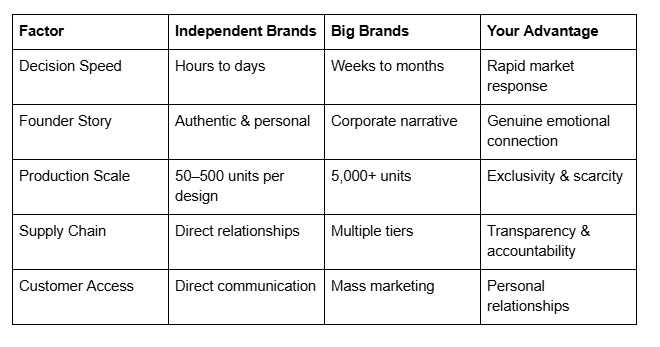
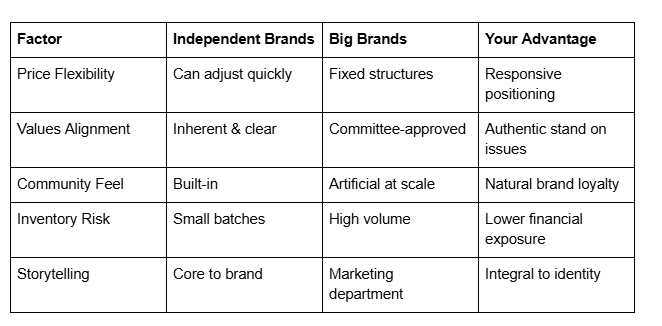
Your job isn't to match big brands at their game—it's to dominate the game where these advantages matter.
Scaling Without Losing Authenticity
Your indie advantage disappears the moment you feel like a scaled corporation. Here's how to grow without losing what makes you special:
Stay Small by Design
Keep collection sizes limited. If a design sells out, resist the temptation to restock it immediately.
Maintain the handmade or small-batch production process even as you grow.
Don't outsource your customer communication, at least in the early years.
Embrace Constraints
Limited inventory creates urgency and scarcity without dishonesty.
Seasonal collections force you to create fresh designs rather than indefinitely replicating old ones.
A smaller team means decisions are faster and more values-aligned.
Expand Horizontally, Not Vertically
Instead of mass-producing one design, create multiple complementary products (if you start with dresses, add bags or accessories made by you or trusted collaborators).
Partner with other indie brands rather than absorbing them.
Collaborate on limited-edition designs rather than owning everything.
FAQs
-
Yes, and you're already competing in the right space. Big retailers compete on volume, selection, and convenience. Independent brands compete on authenticity, values, and community. These aren't the same game. The consumer base actively seeking ethical, hand-crafted, or locally-made fashion grows every year. Your market isn't everyone; it's everyone who values what you value. That's a sustainable competitive advantage.
-
Three things. First, personalisation: a big brand's site is designed for anonymous transactions; your site is designed to build relationships. Second, storytelling: big brands sell products; indie brands sell stories, values, and identity. Third, responsiveness: you can update your site, respond to customer feedback, and pivot your messaging in days. Big brands need committee approvals. Your agility is an advantage; use it.
-
Start with email. Build a list and send personal, valuable content—not just sales pitches. Celebrate your customers publicly by reposting their photos with genuine comments. Create a private Discord or Facebook group for your most engaged customers where they can connect with you and each other. Ask for their input on design decisions. The community grows when customers feel genuinely heard and part of your brand's story.
-
No. If you're producing ethically and in smaller batches, your costs are different—often higher. Competing on price is a race to the bottom that indie brands lose. Instead, compete on value: justify your price through materials, craftsmanship, storytelling, and exclusivity. Your customers aren't shopping for the cheapest option; they're shopping for the right option.
-
Be specific and honest. Name your suppliers. Share photos from your production process. If you're not perfect (most indie brands aren't), say so and explain what you're working on. Vague claims about "ethical sourcing" hurt you because they sound like marketing. Detailed, slightly imperfect stories sound like truth. Customers respect honesty more than perfection.
-
Focus on earned media and community building instead of paid ads. Build your email list aggressively—email marketing delivers a 5000% ROI. Create consistent, value-adding social media content (style guides, behind-the-scenes, customer features). Collaborate with micro-influencers in complementary niches. Launch a referral programme that rewards your customers for recommending you. Your time is your greatest resource; spend it building relationships, not buying ads.
-
Test it. Launch at your target price and track conversion rates. If fewer than 1–2% of site visitors are buying, your price might be too high or your positioning isn't clear. If 5%+ are converting, you might be priced too low. Monitor your email list growth, social media engagement, and customer feedback. If people are complaining about price but praising quality, you're probably positioned correctly. Adjust gradually and track the impact.
Call to Action
Ready to build your competitive indie fashion brand? Squarespace gives you everything you need to tell your story, manage your inventory, build your email community, and sell directly to customers who value what you create.
Explore Squareko for templates, guides, and resources designed specifically for independent designers. We've helped hundreds of fashion entrepreneurs launch, scale, and compete with confidence.
Start your free trial today and see how Squarespace can be your competitive advantage.

From custom website design to SEO strategy, we help businesses launch a site that looks professional and performs better.

About the Author
I'm Walid Hasan, a Certified Squarespace Expert and Squarespace Circle Platinum Partner with over 12 years of hands-on experience designing and optimizing high-performing websites. Over the years, I've had the privilege of building more than 2,000 Squarespace websites for clients around the world, always focusing on clean design, strong user experience, and conversion-driven results.