Music Producer SEO on Squarespace: Get Found Online
Introduction
When someone searches for a music producer in your genre or city, will they find you? Or worse, will they ask an AI chatbot for recommendations and never see your website at all?
The music production landscape has shifted dramatically. It's no longer enough to have a killer portfolio or competitive beats prices. Your music producer website on Squarespace needs to rank on Google, show up in AI search results, and be discoverable through voice assistants and AI agents that now shape how listeners, artists, and studios find their next collaboration.
This guide covers everything you need to know about SEO for music producer websites on Squarespace—from the foundational setup most producers skip to the cutting-edge AI search strategies that will position you ahead of competitors in 2026 and beyond. Whether you sell beats, offer mixing and mastering services, or collaborate with emerging artists, this SEO framework applies to your business model.
Key Takeaways For Music Producer SEO on Squarespace
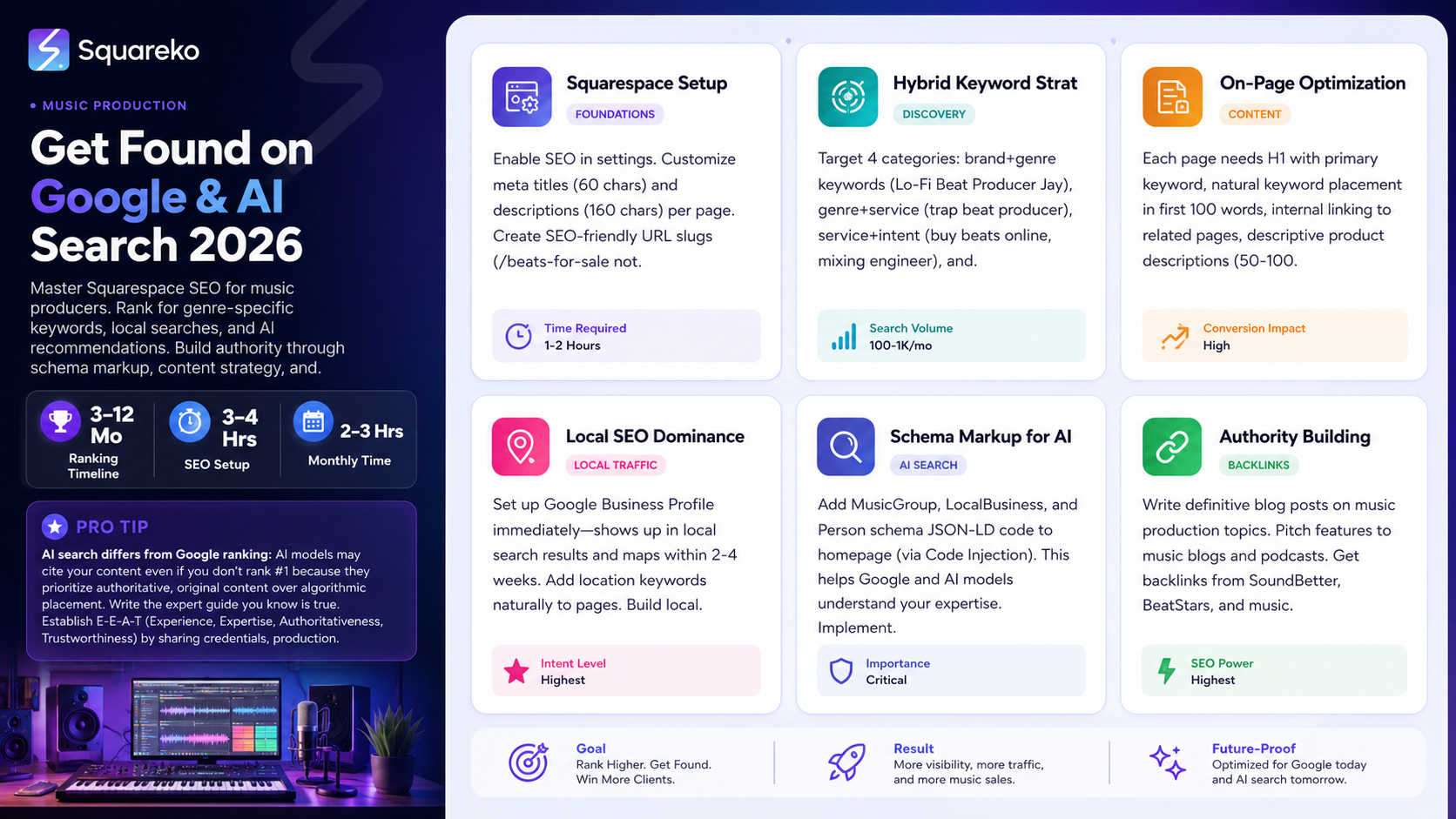
Squarespace SEO requires intentional setup: Enable all SEO features, customize URL slugs, write compelling meta descriptions, and use alt text on portfolio images to unlock organic visibility.
Music producers need hybrid keyword strategies: Combine genre-specific terms (trap beats, lo-fi production), service keywords (mixing engineer, beat seller), and location modifiers to capture intent at every funnel stage.
Local SEO is underutilized: Add your music producer business to Google Business Profile, optimize for music producer near me searches, and target studio partnerships to drive high-intent local traffic.
Structured data markup is essential for AI: Implement Music Group, Music Event, and Local Business schema so AI models understand your expertise and cite you when recommending music producers.
AI search requires different content: Write content that answers how musicians find producers, what qualifications matter, and how your production style fits specific genres—this is what AI agents reference when making recommendations.
1. Why SEO Is Different for Music Producers
Music production is not photography. It's not coaching. It's not e-commerce in the traditional sense, though some music producers do sell beats and samples. Understanding these differences is the first step toward an effective SEO strategy.
The Discovery Problem for Music Producers
Most musicians and artists don't search for music producer in isolation. They search for specifics:
Trap beat producer in Atlanta
Who produces lo-fi hip-hop beats
Best mixing engineer for indie rock
How to find a music producer that matches my style
Your SEO strategy must address all these intent layers. A photographer can rank for wedding photographer near me and capture 80% of relevant searches. Music producers must rank for dozens of micro-targeted queries because production style, genre expertise, and geographic availability all factor into decision-making.
Why Traditional B2B SEO Doesn't Work
Standard B2B SEO assumes businesses want leads from strangers who found them through search. Many music producers operate differently. You might prefer referrals, direct artist relationships, or selling beats through your own website.
However, even if you prefer working with trusted connections, SEO still matters. Here's why:
Authority building: High search rankings establish credibility. When an emerging artist Googles best lo-fi producers, seeing your name on page one validates your expertise.
Passive beat sales: If you sell beats online, organic search traffic compounds over time. One blog post about producing in your niche can drive consistent sales for years.
AI recommendations: As AI search grows, being ranked highly on Google means AI models have more data about your work, making you more likely to be recommended when people ask what music producers specialize in synth wave?
Studio partnerships: Studios and labels research producers before reaching out. Strong SEO visibility signals you're someone worth collaborating with.
The Music Producer SEO Advantage
Here's what works in your favor: Your niche is less saturated than general services. A plumber competes with thousands of local businesses for plumber near me. A music producer competing for lo-fi beat producer operates in a much smaller, more defensible market. This means the SEO effort required to rank is often lower, and the return on investment is often higher.
2. Squarespace SEO Foundations: What to Set Up First
Squarespace is a solid platform for music producers. It's visually designed for creatives, offers good portfolio functionality, and handles basic SEO well. However, most music producers leave significant SEO performance on the table by not configuring these foundational elements.
Enable and Configure Basic SEO Settings
Log into your Squarespace dashboard and navigate to Settings > SEO.
Site Title: This appears in browser tabs and search results. Keep it under 60 characters. Example: Jay Beats | Lo-Fi Hip-Hop Producer — Sold 2000+ Tracks
Site Description: 150–160 characters. This is your default meta description if you don't customize it per page. Example: Professional lo-fi hip-hop beat producer. Premium beats, production tutorials, and mixing services for indie artists and labels.
Logo URL: Upload a high-quality logo. Search engines use this in rich snippets and Knowledge Panels.
Social Accounts: Link all relevant social media profiles (YouTube, Instagram, SoundCloud, Spotify). This helps search engines understand your broader web presence.
Customize Page-Level SEO
For every important page on your site, set a custom meta title and description. Squarespace makes this easy:
Edit the page
Scroll to the bottom
Under SEO, customize the page title and description
Best practices for music producers:
Home page: Include your primary keyword naturally. Lo-Fi Beat Producer | Premium Beats & Production Services | [Your Name]
Portfolio/Beats page: High-Quality Beats for Sale | Lo-Fi, Trap, Synthwave | [Your Name]
Services page: Music Production Services | Mixing, Mastering & Beat Making
Blog: Each post should have a unique title and description that includes relevant keywords
Create SEO-Friendly URL Slugs
Squarespace auto-generates URLs based on page titles. These are often ugly and keyword-weak. Change them manually.
Instead of:
/about-me-and-my-studio
/portfolio-of-beats-and-productions
Use:
/about
/beats-for-sale
/music-production-services
/mixing-mastering
These are shorter, clearer, and include relevant keywords without keyword stuffing.
Master Alt Text for Portfolio Images
This is where many music producers lose ranking potential. Every beat artwork, album cover, or studio photo should have descriptive alt text.
Good alt text:
Describes what's in the image
Includes your genre and service type when relevant
Stays under 125 characters
Doesn't keyword stuff
Examples:
Lo-fi hip-hop beat artwork with vinyl record and coffee cup aesthetic
Trap beat artwork featuring dark neon colors and abstract geometric shapes
Professional mixing console during mastering session for indie pop track
Bad example: beat, lo-fi, producer, hip-hop, music, sound (keyword stuffing)
Mobile Optimization
Squarespace templates are mobile-responsive by default, which is good. However, verify that:
Your portfolio loads quickly on mobile (upload images under 100KB when possible)
Click-to-play audio players work smoothly
Your contact form is easy to fill on small screens
Navigation menu collapses properly
Google's PageSpeed Insights will flag slow pages.
3. Keyword Strategy for Music Producers
Most music producers use one of three keyword approaches: all of them are insufficient.
Approach 1: Target only their own name (Jay Beats) Approach 2: Target only their genre (lo-fi producer) Approach 3: Target only transactional keywords (buy beats online)
Successful music producers rank for keywords across all three categories, plus location-based variations.
The Four Keyword Categories for Music Producers
Category 1: Brand + Genre Keywords
These target people already aware of you or searching for your specific sound.
Jay Beats lo-fi
[Your Name] beat producer
[Your Name] mixing engineer
Why: These have high intent but low search volume. They're not primary traffic drivers but essential for protecting your brand.
Category 2: Genre + Service Keywords
These capture musicians looking for your style of production.
Lo-fi beat producer
Trap beat maker for sale
Synthwave producer
Indie rock mixing engineer
Mastering engineer specializing in electronic music
Why: These have moderate search volume and moderate intent. They're the backbone of your organic strategy.
Category 3: Service + Intent Keywords
These target people at different buying stages.
Informational: How to find a music producer, What does a mixing engineer do, Best practices for beat selling
Transactional: Buy beats online, Mixing and mastering services, Commission a song
Navigational: [Competitor Name] alternative, Music producer platform like BeatStars
Why: Informational keywords bring traffic that builds authority. Transactional keywords drive direct sales or service inquiries.
Category 4: Location + Service Keywords
Essential for local visibility and studio partnerships.
Music producer in [City]
Mixing engineer near me
Local beat producer [City]
Mastering services [Region]
Why: Local keywords have lower competition and higher intent for collaboration.
How to Build Your Keyword List
Use free tools:
Google Search Console (if you have an existing site): See what queries already bring you traffic.
Google Keyword Planner: Free, from Google itself. Shows search volume and competition.
Ubersuggest free version: Shows related keywords and search volume.
Answer the Public: Visualizes questions people ask about your niche.
For a music producer, start with these searches:
[Your genre] producer
[Your service] [your genre]
Music producer [your city]
How to find [your genre] producer
Best [your genre] music producer
Note search volumes. Target keywords with 100–1,000 monthly searches (low competition, real intent). Once you have rankings, expand to higher-volume keywords.
4. On-Page SEO for Your Key Pages
On-page SEO means optimizing the content, structure, and HTML elements of individual pages. For music producers, five pages deserve special attention.
Home Page SEO
Your homepage should establish what you do and build trust immediately.
Primary keyword placement:
H1 title: Professional Lo-Fi Hip-Hop Beat Producer & Mixing Engineer
First 100 words: Include your primary keyword and a value proposition
Meta description: Award-winning lo-fi producer. 2000+ beats sold. Custom production, mixing, and mastering for artists, labels, and studios worldwide.
Content structure:
Hero section with clear value prop
Brief bio (100 words) establishing credibility
Your services/offerings
Recent portfolio pieces
Social proof (client testimonials, press mentions)
Clear CTA to book a call or purchase beats
Portfolio/Beats Page SEO
This is your strongest page for ranking and conversion.
Keyword optimization:
H1: Professional Lo-Fi Beats for Sale | Download Now
H2s: Organize by genre or collection (Hip-Hop Beats, Lo-Fi Beats Under $50, Exclusive Untagged Beats)
Alt text on every beat cover: Lo-fi hip-hop beat with jazz samples and vinyl crackle, available for download
Content structure:
Intro paragraph explaining your beats (75 words)
Beat showcase (grid layout, Squarespace native)
Product descriptions (each beat: 50-100 words minimum)
Filtering/sorting (make it easy to browse by genre, mood, price)
FAQ about beat licensing (Can I monetize this beat on YouTube?)
Social proof (how many beats sold, listener testimonials)
Why detailed descriptions matter for SEO:
AI models scan beat descriptions when recommending lo-fi beats for hip-hop production
Detailed descriptions reduce bounce rate, signaling to Google this is valuable content
Unique descriptions (not stock language) rank better than generic professional beat text
Services Page SEO
If you offer mixing, mastering, production, or collaboration services, this page needs SEO optimization.
Keyword targets:
Music production services
Mixing engineer for [genre]
Mastering engineer [city]
Custom beat production
Structure:
Hero section with clear service offerings
Individual service sections (H2 for each):
Mixing Services
Mastering Services
Custom Beat Production
Artist Collaboration
Process walkthrough (builds trust and answers common questions)
Pricing (optional—some prefer to discuss in discovery call)
Testimonials from past clients
CTA to book a discovery call
Why this works for AI search: When AI models generate recommendations for who should mix my indie rock album, they cite content that explains your process, qualifications, and experience clearly.
Blog Posts (Supporting Authority)
Blog posts address informational keywords and build authority. Music producers should write 4–8 posts per year.
Effective blog topics for music producers:
How to Find the Right Music Producer for Your Project
Lo-Fi Beat Production Tutorial: 5 Essential Techniques
What's the Difference Between Mixing and Mastering?
How Much Should You Pay for Professional Beat Production?
DIY vs. Professional Mixing: Pros and Cons
On-page SEO for blog posts:
H1 with primary keyword
H2s for subheadings (naturally, not forced)
1,500–2,500 words (depth signals expertise)
Internal links to services and portfolio
Unique meta description under 160 characters
At least one resource (downloadable guide, template, or tool)
Contact Page SEO
Don't overlook this page.
H1: Get in Touch | Book a Mixing Session | Collaborate
Meta description: Contact Jay Beats for custom music production, mixing, and mastering inquiries. Fast response time, professional rates.
Clear form (name, email, project details)
Phone number (if you take calls)
Social links
For local music producers, add: Based in [City]. Available for studio sessions and remote collaborations.
5. Local SEO: Getting Found by Local Artists and Studios
Local SEO is overlooked in music production, but it's one of the highest-intent channels. Studios, music labels, and local artists actively search for producers in their area.
Set Up Google Business Profile
This is non-negotiable for local SEO.
Search for your business
If it exists, claim it. If not, create a new profile.
Fill in all information:
Business name
Category: Music Producer or Recording Studio
Phone number
Website
Business hours
Service area (if you work with remote clients, say so)
Photos (studio space, equipment, yourself)
Why this matters for SEO: Google Business Profile helps you show up in local search results and on Google Maps. When someone searches music producer near me in your city, your profile is often the first result.
Optimize for Near Me Keywords
Create content around local variations:
Music Producer in [City]
Mixing Engineer in [Region]
Beat Producer Near [Your Location]
Add these naturally to:
About page (e.g., Based in Los Angeles, serving artists and studios across Southern California)
Services page (mention your city/region)
A blog post titled Music Production Services in [Your City]: Why Local Expertise Matters
Build Local Backlinks and Citations
Search for:
Local music blogs or publications
City-based music directories
Local business listings (Yelp, Apple Maps)
Reach out to independent music blogs in your city and offer to write a guest post: 5 Music Producers Worth Knowing in [City] or similar.
Local Partnership Strategy
Studios and labels search for producers. Position yourself to be found:
Add your profile to studio recommendation lists (ask local studios if they refer producers)
Sponsor local open mics or music events (gets you local backlinks)
Join local music producer associations or collectives
6. Structured Data Markup for Music Websites
Structured data (schema markup) helps search engines understand your business better. It's essential for AI search visibility.
Why Schema Matters for Music Producers
When Google or an AI model encounters schema markup, they understand context without guessing. Instead of assuming you're some guy with music-related content, schema markup tells them: This is a music producer with 10+ years experience specializing in lo-fi production, based in Austin, with a 4.8-star rating from clients.
Three Schema Types You Need
1. Music Group Schema
Identifies you as a music-related entity.
{
  "@context": "https://schema.org",
  "@type": "MusicGroup",
  "name": "Jay Beats",
  "url": "https://yoursite.com",
  "description": "Professional lo-fi hip-hop beat producer and mixing engineer",
  "image": "https://yoursite.com/logo.png",
  "sameAs": [
    "https://instagram.com/jaybeats",
    "https://soundcloud.com/jaybeats",
    "https://youtube.com/jaybeats"
  ],
  "genre": ["Lo-Fi Hip-Hop", "Electronic"],
  "foundingDate": "2018",
  "location": {
    "@type": "Place",
    "address": {
      "@type": "PostalAddress",
      "addressLocality": "Austin",
      "addressRegion": "TX",
      "postalCode": "78701",
      "addressCountry": "US"
    }
  }
}
Where to add it: Squarespace doesn't have native schema support, so add this in Settings > Advanced > Code Injection under the Header. Or use the JSON-LD Helper extension.
2. LocalBusiness Schema
If you take on-site work or want to emphasize local presence:
{
  "@context": "https://schema.org",
  "@type": "LocalBusiness",
  "name": "Jay Beats Music Production",
  "description": "Professional music production, mixing, and mastering services",
  "image": "https://yoursite.com/studio.jpg",
  "telephone": "(555) 123-4567",
  "url": "https://yoursite.com",
  "address": {
    "@type": "PostalAddress",
    "streetAddress": "123 Music Lane",
    "addressLocality": "Austin",
    "addressRegion": "TX",
    "postalCode": "78701",
    "addressCountry": "US"
  },
  "priceRange": "$$",
  "openingHoursSpecification": {
    "@type": "OpeningHoursSpecification",
    "dayOfWeek": ["Monday", "Tuesday", "Wednesday", "Thursday", "Friday"],
    "opens": "09:00",
    "closes": "18:00"
  },
  "aggregateRating": {
    "@type": "AggregateRating",
    "ratingValue": "4.8",
    "reviewCount": "24"
  }
}
3. Person Schema (If You're the Brand)
{
  "@context": "https://schema.org",
  "@type": "Person",
  "name": "Jay [Last Name]",
  "jobTitle": "Music Producer & Mixing Engineer",
  "url": "https://yoursite.com",
  "image": "https://yoursite.com/headshot.jpg",
  "description": "Lo-Fi Hip-Hop producer with 10+ years experience. Specializing in beat production and mixing for indie artists.",
  "sameAs": [
    "https://instagram.com/jaybeats",
    "https://twitter.com/jaybeats"
  ],
  "knowsAbout": ["Music Production", "Lo-Fi Hip-Hop", "Mixing", "Mastering"]
}
How to Add Schema to Squarespace
Method 1: Code Injection (Easiest)
Go to Settings > Advanced > Code Injection
Paste JSON-LD schema in the Header section
Save
Method 2: HTML Block
Add a code block to your home page with the schema inside <script type="application/ld+json"> tags. Squarespace will process it.
7. How to Get Found on AI Search in 2026
This is where the landscape has fundamentally changed. Music producers can no longer rely solely on Google Search rankings. AI search—including ChatGPT, Claude, Google Gemini, and emerging AI agents—is reshaping discovery.
Why AI Search Matters for Music Producers
When someone asks ChatGPT, I need a lo-fi beat producer who specializes in sample-based production, the AI doesn't click through Google Search results. Instead, it searches its training data and cites sources.
If your website doesn't appear in that training data, you won't be recommended. And even if you rank #1 on Google, if your website doesn't answer the specific question the AI is addressing, you won't be cited.
Three AI Search Strategies
Strategy 1: Structured Content That AI Can Understand
AI models prioritize content that directly answers questions. Write content blocks that answer:
What qualifications should a music producer have?
How do you choose a producer for your genre?
What's the difference between beat producers and mixing engineers?
Structure these clearly:
Q: What qualifications should a music producer have?
A: A professional music producer should have:
- 3+ years of production experience
- Proficiency in at least one DAW (Ableton, Logic, FL Studio)
- Understanding of sound design, composition, and mixing
- Portfolio of released or collaborated music
- Communication skills to articulate a client's vision
AI models cite this clear format when answering similar questions.
Strategy 2: High-Quality, Citable Content
Create definitive guides on music production topics. Examples:
The Complete Guide to Lo-Fi Beat Production (2,000+ words)
Mixing vs. Mastering: A Producer's Breakdown
How to Get Your First Music Production Clients
These establish you as an authority. When AI models are trained or fine-tuned, they encounter your content frequently and cite it more often.
Strategy 3: Claim Your Author Authority (E-E-A-T)
E-E-A-T = Experience, Expertise, Authoritativeness, Trustworthiness.
In your content, establish:
Your production credits (artists you've worked with, songs released, streams)
Your formal music training (if applicable)
Your methodology and philosophy
Testimonials from clients and collaborators
Example bio:
Jay has produced over 500 lo-fi beats and released music on independent labels. His beats have been streamed 2M+ times on Spotify. He's collaborated with 50+ independent artists and holds a degree in Music Production from [University].
This signals trustworthiness to both Google and AI models.
Optimize for AI Agents and Voice Search
Music producers are increasingly discovered through AI agents that can access your website in real-time. This means:
Fast load times matter: Optimize images and remove unnecessary scripts. AI agents often have timeouts.
Clear, structured answers matter: If an AI agent visits your portfolio page, it should understand quickly: This is a lo-fi producer. These are recent projects. This is how to contact them.
Accessibility matters: AI agents often read your site like a screen reader. Use heading hierarchy, descriptive links, and alt text.
AI Search Doesn't Depend Solely on Google Ranking
Here's an important distinction: AI search rankings are semi-independent of Google rankings.
A page can rank poorly on Google but be cited frequently by AI models because:
AI training data includes more sources than Google's top 10 results
Some AI models are trained differently (Claude, Gemini, ChatGPT have different training approaches)
AI models favor original, authoritative content over clickbait, even if clickbait ranks higher
This means: Write the authoritative content you know is true. Don't optimize purely for Google's algorithm. Authoritative content naturally gets cited by AI.
8. Building Authority: Backlinks and Press for Music Producers
Backlinks—links from other websites to yours—remain one of Google's strongest ranking signals. For music producers, building backlinks requires a different strategy than other industries.
Why Backlinks Matter (Still)
A backlink is a vote of confidence. When a respected music blog links to your site, Google says: If this authority site recommends this music producer, they must be legitimate.
One high-quality backlink can move you up 5–10 ranking positions for competitive keywords.
Four Backlink Strategies for Music Producers
1. Music Blog Features and Interviews
Identify music blogs, production blogs, and artist blogs in your niche.
Search: [Your genre] music blog
Look for blogs with 10K+ monthly visitors
Check if they feature producers (look for Featured Producer sections)
Reach out with a media kit: I'm a lo-fi producer with 2M+ Spotify streams and would love to be featured in an interview about my production process.
Best case: They feature you and link to your site. This brings referral traffic and a high-authority backlink.
2. Music Producer Directory Listings
Submit your profile to reputable music producer directories:
Beat Stars (if you sell beats)
Local business directories (Yelp, Apple Maps)
Each listing that includes a link to your site is a backlink. Plus, these directories drive direct referral traffic.
3. Guest Posts and Collaborations
Write a guest post for a music education or production blog. Example topics:
5 Lo-Fi Production Techniques Every Beat Maker Should Know
How to Collaborate with Music Producers: A Guide for Artists
Guest posts almost always include a bio with a link to your site. Plus, you get exposure to a new audience.
4. Press Coverage and Music Magazine Features
If you release music or do noteworthy collaborations, pitch music journalists and podcasters:
I just released my beat collection on [Platform]. Would your audience be interested in a feature?
I collaborated with [Notable Artist]. Would you cover this?
Press coverage is high-authority. A mention in even a small music publication carries weight.
What NOT to Do (Backlink Mistakes)
Don't buy backlinks: This violates Google's guidelines and will harm your ranking.
Don't accept links from irrelevant sites: A link from a casino or payday loan site hurts more than it helps.
Don't do reciprocal linking: You link to me, I'll link to you is transparent and low-value.
Don't use link farms or automated services: These are spam and will get your site penalized.
Build links the right way: through actual relationships, quality content, and genuine partnerships.
9. Squarespace SEO Tools You Should Actually Use
Squarespace has built-in SEO features. Here's which ones matter.
Squarespace Native Tools
SEO Settings (Settings > SEO)
Add site title and description
Set preferred domain (www vs. non-www)
Request Google reindexing
Create XML sitemap (automatic)
This is where you customize meta titles and descriptions for each page.
Blog Tags
If you write blog posts, Squarespace creates tag pages automatically. These can rank for long-tail keywords. Use tags strategically:
One tag per post (avoid tag spam)
Use tags that are actual search keywords (Lo-Fi Production, Beat Making, Music Marketing)
Link to tag pages from your main blog page
Mobile Optimization
Squarespace makes this easy, but test it. Use Page Speed Insightto check mobile performance.
External Tools to Integrate
Google Search Console
This is essential. Free. Connect it to your Squarespace site:
Click Add Property
Follow Squarespace's integration steps (usually just verifying through DNS or HTML tag)
Google Search Console shows:
Which keywords drive traffic to your site
How many impressions you get (people see you in search results but don't click)
Which pages rank for which keywords
Errors Google found on your site
This data is invaluable. You'll see opportunities for pages to optimize.
Google Analytics
Tracks visitor behavior:
Which pages people spend time on
Bounce rate (people who arrive and leave immediately)
Conversion rate (people who submit a contact form or buy a beat)
Connect Google Analytics to your Squarespace site via Settings > Website > Analytics.
Screaming Frog (Free or Paid)
Crawls your website and identifies SEO issues:
Broken links
Duplicate meta descriptions
Missing alt text
Redirect chains
Use the free version to audit your site quarterly.
10. Monthly SEO Checklist for Music Producer Websites
SEO is ongoing. Dedicate 2–3 hours per month to these tasks.
Week 1: Content and Keywords
Check Google Search Console for new keyword opportunities
Identify 3 low-competition keywords to target (10–500 monthly searches)
Plan one blog post addressing an informational keyword
Update 3 existing pages with new keywords or refreshed content
Week 2: On-Page Optimization
Audit meta descriptions (are they compelling and under 160 characters?)
Check image alt text on your portfolio (update any that are missing or vague)
Review URL slugs (are they short, descriptive, and keyword-rich?)
Test your site on mobile with https://pagespeed.web.dev
Week 3: Backlinks and Authority
Identify 3 music blogs or publications that mention producers
Reach out to one blog for a feature or collaboration
Check your backlinks in Search Console (do you have any new linking domains?)
Respond to any press requests or interview opportunities
Week 4: Analytics and Reporting
Review Google Analytics for top-performing pages
Check Search Console for ranking changes (pages moving up or down)
Update your portfolio with any new releases or projects
Plan next month's keyword targets
Quarterly Tasks (Every 3 Months)
Full SEO audit using Screaming Frog
Review your backlink profile for spam or low-quality links
Update your Google Business Profile with new photos or information
Pitch 2–3 guest posts to music blogs or publications
Annual Tasks (Once Yearly)
Audit all pages for outdated information
Update your E-E-A-T bio with new credits or accomplishments
Review and update schema markup
Plan SEO strategy for the year ahead
Frequently Asked Questions
-
A: It depends on keyword competition. Targeting low-competition keywords (100–500 monthly searches in your niche), you can see ranking movement in 3–6 months. Competitive keywords may take 6–12 months. Google Business Profile can show local results in 2–4 weeks.
-
A: Both work. Squarespace is easier to use and less technical. WordPress offers more customization. For most music producers, Squarespace is sufficient. The difference is 5–10% SEO performance at most. Focus on content quality instead of platform switching.
-
A: Minimum 15–20 beats with unique descriptions of 50–100 words each. After that, focus on quality over quantity. A portfolio of 50 unique beats with excellent descriptions ranks better than 500 with generic text.
-
A: Both work. Squarespace gives you more control and is a single destination for all your information. BeatStars and Gumroad take a commission but handle payment processing. Some producers use both: premium beats on Squarespace, lower-price beats on BeatStars.
-
A: Currently, this is hard to measure. Google Search Console doesn't differentiate between traditional search and AI-powered results. Track: citation traffic (visits from ChatGPT, Claude, etc. in Analytics—they appear as referral sources), and monitor rankings for informational keywords you'd expect AI to cite.
-
A: Professionally and briefly. "Thanks for reaching out. If you experienced an issue with our service, please email directly so we can resolve it." Don't be defensive. One or two negative reviews don't hurt rankings if you have mostly positive ones.
Stop Hoping Algorithms Will Find You—Take Control of Your Visibility
You know the frustration. You've invested in studio time, premium plugins, and equipment. Your portfolio is solid. Your beats are professional. Yet potential clients keep finding other producers, and you're not sure why.
The truth is simple: Most music producers leave massive SEO opportunities on the table.
Right now, your competitors might be:
Ranking for music producer in [your city] while you're nowhere to be found
Showing up when AI agents recommend beat producers, while you're overlooked
Building authority through blog content and backlinks, while your website stays static
Optimizing their Squarespace for local discovery, while yours is invisible to local studios and artists
This isn't because they're better producers. Often, they're just better at making their websites work for them.
Here's what you can do starting this week:
Day 1–2: Set up Google Business Profile and verify your Google Search Console. (2 hours)
Day 3–4: Customize your meta titles and descriptions on your 5 most important pages. Add descriptive alt text to your portfolio. (2 hours)
Day 5: Identify 10 target keywords for your music production services. (1 hour)
Week 2: Write or update 3 key pages (home, portfolio, services) with keyword-rich content. (3–4 hours)
By the end of Week 2, you'll have fundamentals in place that 80% of music producers skip entirely.
But here's the reality: This requires ongoing effort. SEO isn't a one-time task. It's a monthly practice. Many music producers don't have time to stay on top of keyword research, content optimization, backlink outreach, and analytics review.
That's where we come in.
At Squareko, we specialize in Squarespace websites for creative professionals—especially music producers. We don't just build beautiful portfolios. We build websites that rank, convert, and grow your visibility on Google and AI search.
Here's what we can do for you:
Complete SEO audit of your current website, identifying quick wins and long-term opportunities
Squarespace setup and optimization with proper schema markup, structured data, and on-page SEO
Keyword strategy customized to your niche, from genre-specific terms to local discovery
Content creation for your portfolio, blog, and service pages—written to rank and convert
Monthly SEO management: Google Business Profile updates, backlink outreach, analytics review
We've helped music producers, beat makers, mixing engineers, and studios get found on Google—and increasingly, on AI search too.
Ready to stop competing on visibility and start dominating your niche?
Book a free 30-minute discovery call with us. We'll audit your current website, identify your biggest opportunities, and show you exactly how to get more clients finding you through search.

From custom website design to SEO strategy, we help businesses launch a site that looks professional and performs better.

About the Author
I'm Walid Hasan, a Certified Squarespace Expert and Squarespace Circle Platinum Partner with over 12 years of hands-on experience designing and optimizing high-performing websites. Over the years, I've had the privilege of building more than 2,000 Squarespace websites for clients around the world, always focusing on clean design, strong user experience, and conversion-driven results.