Local SEO for Therapists on Squarespace: Rank for City Keywords in 2026
Introduction
When someone searches therapist in London or anxiety counselling Manchester, they're making an immediate decision: they want a local therapist, not a national one. Local search is how therapy clients find you. A therapy practice without strong local SEO is invisible to the people most likely to book with you. This guide walks you through comprehensive local SEO for therapy practices on Squarespace, covering Google Business Profile setup (with privacy considerations for home-based practices), local keyword strategy, citation building on therapy-specific directories, and getting ranked in local search results and AI-powered recommendations. By the end, you'll have a complete local SEO strategy that drives therapy clients searching in your city.
Key Takeaways
Local SEO is non-negotiable for therapy practices; most therapy searches include location keywords ("therapist near me," "counselling in [city]")
Google Business Profile setup requires careful privacy considerations if you're home-based; use service area instead of home address
NAP consistency (Name, Address, Phone) across your website, Google Business, and citations is essential for local ranking
Local citations on therapy-specific directories (BACP Directory, Psychology Today, Counselling Directory) dramatically improve local authority
Client reviews for therapy practices are rare (confidentiality concerns); focus on building trust through other signals (credentials, supervision, professional affiliations)
Why Local SEO Matters for Therapy Practices
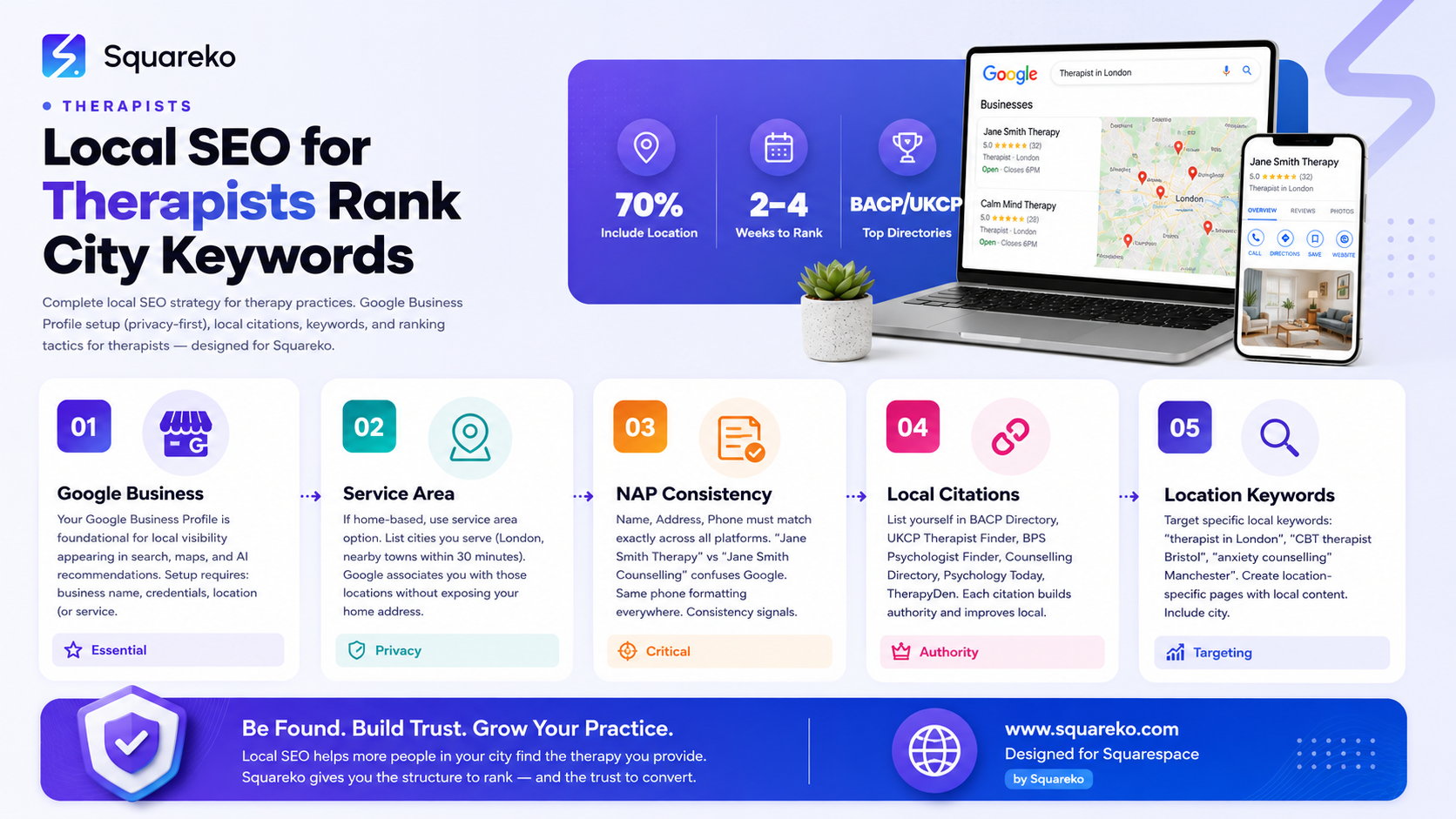
Local search has fundamentally changed how therapy clients find practitioners. Studies show that over 70% of therapy searches include location qualifiers: "therapist near me," "CBT counselling Bristol," "trauma therapist in Edinburgh." These are high-intent searches. The person searching has made the psychological leap—they've decided they need help, and they want someone local.
Local SEO for therapy is different from local SEO for other businesses (plumbers, restaurants, gyms). Therapy is intensely local. Most clients prefer to see a therapist within driving distance, often because they want anonymity (they don't want to see someone from their neighbourhood). This creates a crucial advantage: Google knows that therapy is location-specific, and it prioritizes local results for therapy searches.
However, local SEO for therapy also has unique challenges. Therapists running home-based practices often hesitate to display their home address publicly—for good reason. Privacy and safety matter. Google's Local Business system works around this with a "service area" option, which we'll cover in detail below.
The bottom line: if you're not doing local SEO, you're losing clients to competitors who are.
Google Business Profile Setup for Therapists (Privacy First)
Your Google Business Profile is the foundation of local search visibility. It appears directly in Google Search results, on Google Maps, and in AI-powered search recommendations (crucial in 2026). Setting it up correctly is non-negotiable.
Step 1: Create Your Google Business Profile
Go to google.com/business
Click Manage your business → Sign in with your Google account
Search for your business name or create a new listing
Select Therapist, Psychologist, Counselling Service, or similar
Add your business category
Fill in basic information (see below)
Step 2: The Privacy Question — Service Area vs. Address
Here's where therapy differs from other businesses. You have two options:
Option A: Display Your Office Address (If You Have One)
If you have a dedicated office or therapy room at a commercial location (not your home), display it. Google requires you to have a physical location you work from; displaying a commercial address builds trust.
Option B: Use Service Area Only (Home-Based Practices)
If you work from home, you can hide your home address and instead list a service area. Google allows this for specific business types, including therapy. When you use service area:
Clients won't see your exact home address
Google still knows you're in city and weights your results accordingly
You appear in local search results for city therapist
Clients contact you first; you can discuss session location (your home office, their home, online, etc.)
To set up service area:
In Google Business Profile, go to Business location
Select "Service area instead of address
Add cities/regions where you serve clients
Google will associate you with those locations for local search
Using service area is ethical and common. It protects your privacy while maintaining local visibility.
Step 3: Core Business Information
Fill in:
Name: Your full name or practice name
Phone: Your direct business number (professional line, not personal)
Website: Your Squarespace domain
Hours: Your availability
Categories: Psychologist, Therapist, Counsellor, Counselling Service (choose the most specific)
Step 4: Add Your Professional Photo and Credentials
Upload a professional headshot (same photo you use on your website). Google displays this prominently. A warm, professional photo builds trust.
In the About section, briefly describe your practice: I'm an accredited counsellor specializing in anxiety and depression. I offer person-centred therapy to adults. All sessions are confidential and tailored to your needs.
Keep it short—Google cuts it off, and clients see the full version on your website.
Step 5: Add Booking Link
If you use Squarespace Scheduling or an external booking system, add the booking link:
Go to Google Business Profile > Booking or Services
Add a Book button linking to your Squarespace Scheduling page
This allows clients to book directly from Google Business
Step 6: Verify Your Business
Google will ask you to verify your business. Options:
Postcard: Google mails you a code to enter (10-14 days)
Phone: Google calls you with a code instant, only in some regions
Email: For some business types
Choose the fastest option available. Verification is crucial; without it, your profile will have limited visibility.
Local Keyword Research for Therapists
Local keywords are geographic + therapeutic. You need to target both.
Primary Local Keywords
These are the searches you absolutely want to rank for:
Therapist in city — Therapist in London, Therapist in Manchester
Speciality therapist in city — CBT therapist in Bristol, Trauma counsellor in Edinburgh
Counselling near me — Very common, high-intent
Speciality counselling city — Anxiety counselling London, EMDR therapy Manchester
Secondary Local Keywords
Longer, more specific searches:
Therapist for issue in city — Therapist for panic attacks in Liverpool
Modality therapy city — Psychodynamic therapy Leeds, Acceptance and Commitment Therapy Bristol
Online therapist region — If you offer online services
"Issue counsellor city — Relationship issues counsellor Glasgow
How to Research Local Keywords
Google Autocomplete: Start typing "therapist in city" in Google Search. The autocomplete suggestions show what people are actually searching.
Google Search Console: See which local keywords bring you traffic (once you have traffic)
Competitor Research: Check what local keywords competitors are ranking for
Client Language: Ask clients: "What did you search for to find me?" Use their exact language
Targeting Local Keywords on Squarespace
Homepage: Naturally include your city keyword in the first 100 words and your H1: "Therapist in London specializing in anxiety and CBT"
Location Pages: Create dedicated pages for each city you serve: "Your Name - Therapist in City"
Services Pages: Include city keywords in service descriptions: "I offer CBT for anxiety in Manchester and surrounding areas"
Meta Descriptions: Each page should include city keyword: Accredited counsellor in Bristol offering therapy for depression and life transitions
Blog Content: Write about local mental health topics: Stress Management for London Professionals, Anxiety in Academic Settings: Help for Edinburgh Students
Building Local Citations on Therapy Directories
Citations are online mentions of your business (name, address, phone) on other websites. For therapy, citations on professional directories are crucial. They signal authority and improve local ranking.
Key Therapy Directories for UK and International Therapists
BACP (British Association for Counselling and Psychotherapy) Directory
Most prestigious for UK counsellors
Link: bacp.co.uk/therapist-search
Cost: Usually included with BACP membership
Essential if you're BACP accredited
UKCP (UK Council for Psychotherapy) Directory
Focus on psychotherapy registrants
Link: psychotherapy.org.uk
Cost: Included with UKCP registration
Essential if registered with UKCP
Psychology Today Directory
Widely used in US and increasingly UK
Link: psychologytoday.com
Cost: Paid profile (varies)
High traffic; builds SEO authority
Counselling Directory
UK-specific, non-accreditation-specific
Link: counselling-directory.org.uk
Cost: Paid listing (modest fee)
Good visibility for UK local search
TherapyDen
International, therapist-friendly
Cost: Paid
Growing platform with good SEO
NHS Talking Therapies Directories
If you're linked to NHS services
Reference only; not always editable
Healthgrades / DocFinder
Less therapy-specific, but mentioned by some clients
Citation Strategy
Audit: Check which directories you're already listed on (search "your name therapist")
Consistent NAP: On every directory, ensure Name, Address, Phone match exactly (including punctuation and abbreviations)
Prioritize Premium: Join BACP/UKCP directories if applicable; they carry the most weight
Complete Profiles: Each directory profile should have photo, bio, services, credentials, link to your website
Link Back: On your Squarespace website, link to your directory profiles (this creates reciprocal authority)
NAP Consistency
This is critical. Google compares your website information to directory listings. Any inconsistency confuses Google and hurts ranking.
Standard format for consistency:
Name: Your Full Name or Practice Name — consistent across all platforms
Address: If using service area, write Service Area: cities consistently; if displaying address, use full address with postcode
Phone: Same phone number everywhere, including formatting (spaces/dashes)
Local Schema Markup and Squarespace Configuration
Schema markup helps Google understand your business. For therapists, local schema is essential.
Adding LocalBusiness and Psychologist Schema to Squarespace
Squarespace doesn't automatically add local schema, but you can add it via Code Injection.
Go to Settings > Advanced > Code Injection > Header.
Paste this schema (customize for your practice):
{
  "@context": "https://schema.org",
  "@type": "Psychologist",
  "name": "Jane Smith",
  "description": "Accredited counsellor specializing in anxiety and depression",
  "telephone": "+44 20 XXXX XXXX",
  "email": "jane@example.com",
  "url": "https://yoursite.com",
  "areaServed": ["London", "Surrey", "Berkshire"],
  "priceRange": "£60",
  "knowsAbout": ["Anxiety", "Depression", "Life Transitions", "Relationship Issues"],
  "serviceType": ["Psychotherapy", "Counselling", "Cognitive Behavioural Therapy"],
  "hasCredential": {
    "@type": "EducationalOccupationalCredential",
    "credentialCategory": "BACP Accredited Counsellor"
  },
  "address": {
    "@type": "PostalAddress",
    "streetAddress": "[If applicable] 123 Therapy Street",
    "addressLocality": "London",
    "postalCode": "SW1 1AA",
    "addressCountry": "GB"
  }
}
Replace your details. If you're using service area (no physical address), omit the address field or use your city without street details.
Squarespace Location Pages
Create dedicated location pages for cities you serve:
Go to Pages > Add New Page
Create "/therapist-london/" (or similar)
Title: "Therapy in London |"
Content: Customize your introduction for that location. Include local keywords, local insights, local therapist scarcity/demand information.
Example structure:
H1: "Therapy for Anxiety in London | "
Intro: "Finding an experienced therapist in London can feel overwhelming. I'm a BACP-accredited counsellor based in [area of London], offering person-centred therapy for anxiety, depression, and life transitions."
Services: List services available in that location
How to Contact: "Ready to start? Book a free consultation" + booking link
Local insight: "London therapy can be expensive and hard to access. I offer affordable rates and accept referrals from within London and nearby counties."
Link location pages from your homepage and footer for maximum SEO benefit.
Ethical Review Strategy for Therapy Practices
Client reviews are powerful for local SEO. Google weighs review quantity, quality, and recency heavily in local ranking. However, therapy practices face a unique challenge: confidentiality. Many therapy clients feel uncomfortable being publicly associated with therapy.
Why Therapy Reviews Are Rare (And That's Okay)
A good therapy client wouldn't risk it. Therapy is confidential and stigmatized in many communities. Asking clients to post public reviews about their mental health treatment is ethically questionable, even if they're willing.
Ethical Review Strategy
Ask Strategically: Only ask clients who explicitly mention they'd be happy to refer others. Phrase it delicately: "If you've found our work together helpful and you're comfortable sharing, I'd appreciate a brief review on Google. You don't need to mention your issues—just comment on the experience."
Offer Anonymity: "You can use a first name + initial instead of your full name." Many review platforms allow this.
Keep It General: "Encourage reviews that mention experience ('friendly, professional'), not specific issues ("helped with my trauma"). Example: "Jane made me feel heard and safe. I'd recommend her to anyone looking for counselling." vs. "I came with PTSD and she fixed it."
Don't Pressure: If a client says no, accept it gracefully. Forced reviews are worse than no reviews.
Leverage Professional Referrals: Instead of client reviews, build relationships with GPs, other therapists, and mental health organizations. Professional referrals carry as much weight as client reviews (arguably more).
Alternative Trust Signals
Since reviews are limited, build authority through:
Credentials Display: Prominently display BACP, UKCP, BPS, or other accreditation logos on your website and Google Business Profile
Supervision Mention: "I receive regular supervision from Supervisor Name" signals ethical practice
Published Work: If you've written articles or given talks, mention it
Professional Affiliations: Display memberships in directories and professional bodies
Years of Experience: "15+ years working with anxiety in private practice"
Testimonials with Consent: Include anonymized client feedback: "Jane made me feel safe and understood. The techniques she taught me have genuinely helped my anxiety."
Frequently Asked Questions
-
For established therapists with consistent information across the web, 2-4 weeks. For new therapists with no citations or reviews, 3-6 months. Google rewards established, verified businesses. Speed depends on competition—highly competitive cities take longer. Building citations and consistent NAP across directories speeds up the process significantly.
-
No. Using service area is specifically designed for service-based businesses like therapy. Google has no penalty for service area; in fact, it's often more common and trusted for therapy. The key is that you must verify your Google Business Profile. Verification confirms you're a real therapist, even if your exact address isn't public.
-
Yes, but carefully. If you have actual offices in multiple cities, create a separate Google Business Profile for each. If you serve multiple cities from one location (or home-based), use one profile with a service area covering all cities. Don't create multiple profiles for the same practice; Google will penalize you for "duplicate listings."
-
Less important than for other businesses, but still valuable. Even 3-5 genuine reviews boost ranking and build trust. However, don't sacrifice ethics for reviews. A therapist with zero reviews but strong credentials and citations ranks better than one with fake reviews.
-
Most directories have a simple sign-up process on their websites. For BACP and UKCP, registration is part of membership. For others (Psychology Today, Counselling Directory, TherapyDen), you create a profile, verify your credentials, and pay a listing fee (usually £50-200/year). It's worth the investment; these directories carry significant SEO authority and drive client inquiries.
-
You can target them, but ranking will be difficult (high competition, vague) and potentially misleading (claiming to be "best" without objective evidence). Instead, target specific, honest keywords: "[Your Speciality] Therapist in London." These are easier to rank for and attract clients looking for exactly what you offer. "Best" claims without evidence can harm trust.
-
Offering both online and local is ideal. Your local services help you rank for "therapist in [city]"; online services expand your reach beyond location. On your website, make it clear: "I offer in-person sessions in [city] and online sessions to UK-based clients." This positions you as both local and geographically flexible.
-
You compete by emphasizing personal connection and specialization. Platforms are convenient but generic. You're a specialist: "BACP-accredited CBT therapist with 12 years' experience treating trauma." You're known: clients can see your face, credentials, and approach. You're human: you answer the phone, remember their story. Target specific keywords (trauma therapy, EMDR, specific modalities) rather than generic ones. Platforms rank for generic; you rank for specific.
Dominate Local Search for Your Therapy Practice
Local search is where your ideal clients are looking. Setting up your Google Business Profile, building citations, and targeting local keywords isn't optional if you want to grow your practice. The good news: local SEO for therapy practices is more straightforward than it seems, and the barrier to entry is low. Most therapists aren't doing it, which means your market is wide open.
If you're ready to dominate local search in your city and need expert guidance on local SEO strategy, Squareko can help. We audit therapy websites for local SEO, set up Google Business Profiles with privacy-first principles, and build citation strategies tailored to your location. Visit squareko to discuss your local SEO strategy and book a consultation. Let's get you ranking first in your city.

From custom website design to SEO strategy, we help businesses launch a site that looks professional and performs better.

About the Author
I'm Walid Hasan, a Certified Squarespace Expert and Squarespace Circle Platinum Partner with over 12 years of hands-on experience designing and optimizing high-performing websites. Over the years, I've had the privilege of building more than 2,000 Squarespace websites for clients around the world, always focusing on clean design, strong user experience, and conversion-driven results.