How to Write Interior Design Service Pages That Convert on Squarespace
Introduction:
Most interior designers describe their services like they're filing a tax return: "Full-service residential design. Kitchen and bath specialisation. Commercial projects considered."
Interior design service pages squarespace convert when they clarify what you actually do, prove you're the right person to do it, and invite someone to make a decision. Too many pages don't convert because they don't sell. They list. They describe features instead of benefits. They forget that prospects don't want a design service—they want a transformed space and the confidence that comes with it.
A high-converting interior design service page does three things simultaneously: it clarifies what you actually do, it proves you're the right person to do it, and it invites someone to make a decision. This guide shows you exactly how.
Key Takeaways
Interior design service pages fail when they describe services generically without articulating transformational value
The TRANSFORM Framework (Problem → Relationship → Approach → Narrative → Show → For You) converts browsers into enquiry-ready prospects
Before/after copy rewrites demonstrate how to shift from feature-focused to benefit-led language
Pricing transparency on service pages is a strategic choice, not a requirement—frame it according to your positioning
Service page templates for residential, commercial, and virtual design provide immediate implementation paths
FAQ schema markup increases click-through rates and builds trust with prospects who are comparing designers
Why Interior Design Service Pages Don't Convert
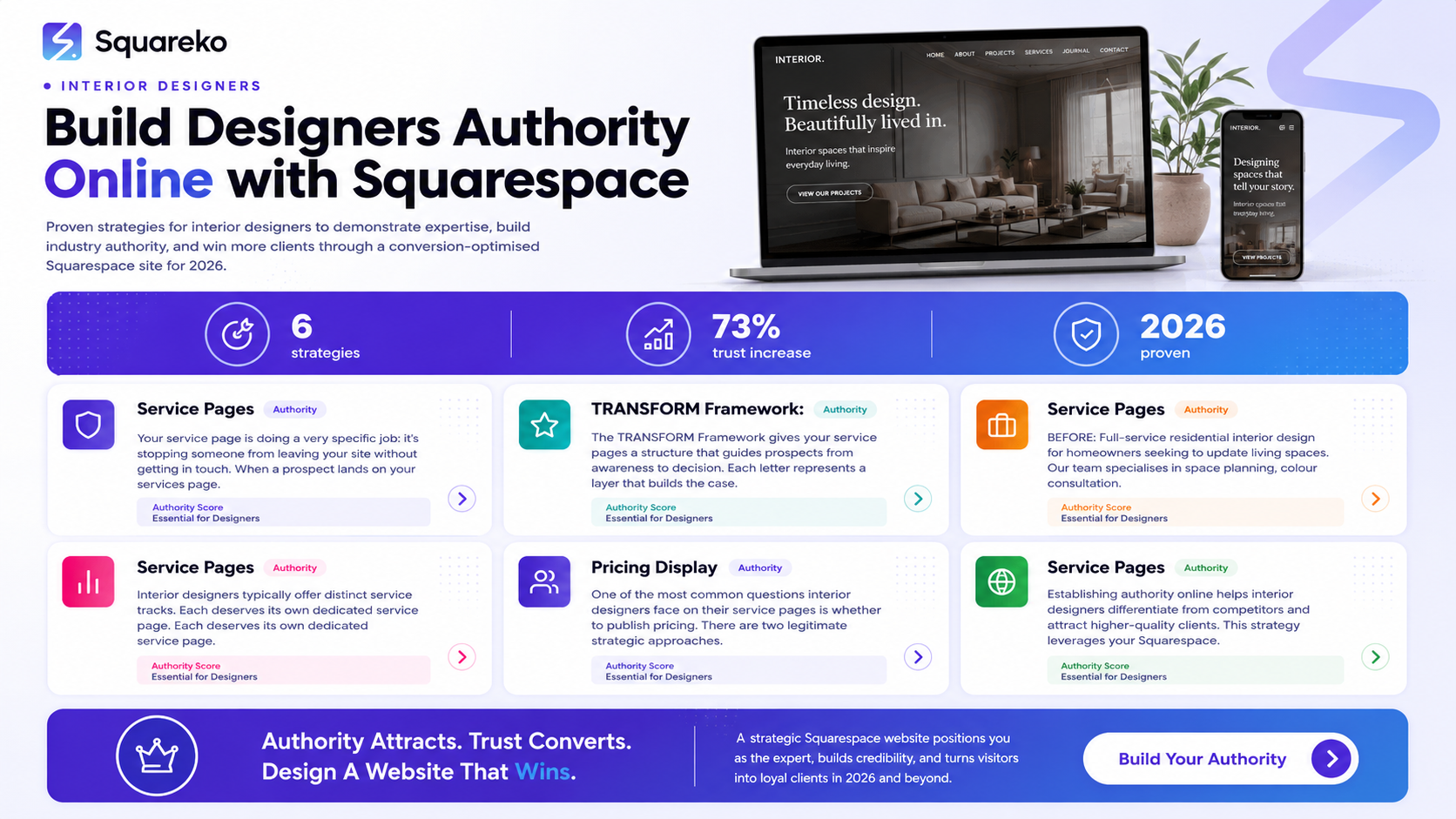
Your service page is doing a very specific job: it's stopping someone from leaving your site without getting in touch.
When a prospect lands on your services page, they're in a particular mental state. They've seen your portfolio. They think you might be good. Now they need to know three things:
Will you understand my specific problem?
Do I trust your process?
What happens if I say yes?
Most interior design service pages answer none of these questions. Instead, they list credentials, describe methodology in abstract terms, and assume a visitor will somehow understand why you are different from the next designer in their browser tabs.
The reason this happens is structure. Without a clear framework, designers write what feels safe: thorough descriptions of their service offerings. But thoroughness isn't persuasive. Relevance is.
The TRANSFORM Framework: A Proven Structure
The TRANSFORM Framework gives your service pages a structure that guides prospects from awareness to decision. Each letter represents a layer that builds the case for why someone should work with you.
T: The Problem (Current State)
Start by acknowledging the specific pain point your prospect is experiencing right now. Not generic poor design—the particular frustration they're sitting in.
A residential redesign prospect doesn't have "an outdated living room." They have a room that makes entertaining feel stressful. A kitchen renovation prospect doesn't want "updated cabinetry." They want a kitchen that finally makes cooking for their family feel manageable.
Name the problem specifically. Use language your prospect would use to describe their situation to a friend.
R: Relationship (Designer-Client Partnership)
Clarify the nature of your working relationship. How do you work with people, not for them?
Interior design is fundamentally collaborative. Your service page should position yourself as a guide who brings expertise and vision while prioritising the client's preferences, lifestyle, and budget. This is where you build the psychological contract that makes someone feel safe to say yes.
A: Approach (Design Process)
Describe your process in a way that reduces uncertainty. What's the first conversation like? How do you move from briefing to concepts? When does the client see options? How do you manage revisions and decisions?
Your approach is proof that you're structured and professional. It's also the section where you show that your process creates space for the client's input at critical moments.
N: Narrative (Emotional Transformation)
This is where most service pages are completely absent. The narrative is the story of what changes when someone works with you.
A kitchen renovation isn't really about new countertops. It's about a family gathering around a beautiful, functional space they love to cook in. A commercial hospitality project isn't really about colour palettes. It's about customers who walk in and immediately feel welcome, spending longer, ordering more, coming back.
The narrative is the why underneath the project. Name what actually changes in your client's life or business.
S: Show (Portfolio Evidence)
After you've set up the emotional context, show proof. Include before/after photography, testimonials from clients in similar situations, and case studies that demonstrate results.
The key difference: you're not just showing beautiful finished spaces. You're showing spaces that solved the specific problem you described in the opening section.
F: For You (Client Invitation)
End with a clear, specific call to action. Not "Get in touch." Try something like: "If this approach resonates with you, let's have a conversation about your space. Book a free 20-minute consultation call to discuss your brief, timeline, and budget."
This final section makes the decision small and specific. You're inviting them to a conversation, not to a vague "enquiry process."
Before and After: Three Service Page Rewrites
Rewrite 1: Residential Redesign Service
BEFORE:Full-service residential interior design for homeowners seeking to update living spaces. Our team specialises in space planning, colour consultation, and furniture selection. We work with high-quality suppliers and are experienced in project management. We serve the greater London area and beyond.
AFTER:Your home should make life easier, not harder. If your living spaces feel dysfunctional—rooms that don't flow, colour schemes that feel dated, or furniture that looks beautiful but doesn't work for your actual life—a residential redesign is where we start.
We design spaces that balance beauty with purpose. You live in your home every single day. It should work for you, not against you. We work closely with you through every decision, bringing professional expertise while always prioritising your preferences and lifestyle. Our process begins with understanding how you actually live—not how Instagram says you should.
From initial briefing to final styling, we manage every detail. You'll see options, approve directions, and feel confident in every choice. Most redesigns take 8-12 weeks from concept to completion.
See how we've transformed dated, awkward living rooms into spaces families actually want to spend time in. [View residential case studies]
Ready to redesign your space? Book a free 20-minute call to discuss your brief, timeline, and budget. We'll talk through your vision and explain exactly how we'd approach your project.
Rewrite 2: Kitchen Renovation Service
BEFORE:Kitchen renovation and design services. We specialise in kitchen layouts, cabinetry, worktops, and appliance integration. Our designers are experienced in managing complex kitchen projects and coordinating with tradespeople. Modern kitchens, traditional kitchens, and contemporary kitchen design available.
AFTER:A kitchen renovation is one of the most stressful decisions a homeowner makes. You're committing significant budget, disrupting daily life, and hoping the finished result will actually work.
We design kitchens that solve real problems. Maybe you've got a cramped galley that makes cooking frustrating. Maybe your current layout wastes space or makes meal prep chaotic. Maybe you have a big vision but aren't sure what's actually possible in your footprint.
Our kitchen renovation process starts with understanding how you cook, who uses the space, and what would actually make a difference. We translate that into a design that's functional first, beautiful second. We manage every detail—from layout and cabinetry through to appliance integration and finishes—so you never wonder what happens next.
From concept to handover, we work with trusted tradespeople and suppliers. You get a kitchen that's stunning and works brilliantly for the way you actually live.
See kitchen renovations we've completed for families like yours. [View kitchen case studies]
If a kitchen renovation is on your horizon, let's talk through your brief first. Book a free 20-minute consultation to discuss your space, budget, and timeline. No pressure—just a conversation.
Rewrite 3: Commercial Hospitality Design Service
BEFORE:Commercial interior design for hospitality venues. We provide full-service design for restaurants, bars, and hotels. Our services include space planning, branding integration, furniture specification, and project management. We have experience with budget-conscious and luxury projects.
AFTER:Your venue's design is the first thing your customers experience. It sets expectations, creates atmosphere, and influences how long they stay and what they spend.
We design hospitality spaces that work harder than they look. A restaurant design isn't just about aesthetics—it's about traffic flow, table configuration, sightlines from the bar, acoustic management, and staff efficiency. A hotel lobby needs to communicate welcome, security, and quality instantly. A boutique bar needs to feel like somewhere people want to be seen.
Our approach combines strategic design thinking with beautiful execution. We understand hospitality operations—we'll design a space that's stunning for your customers and manageable for your team.
We work through discovery sessions to understand your brand positioning, customer experience goals, and operational constraints. From there, we develop a design direction that enhances your positioning and supports your business model.
See how we've transformed vacant warehouses into destination venues, upgraded tired restaurants into thriving social spaces, and built hotel lobbies that drive positive first impressions. [View hospitality case studies]
If you're planning a new venue or refreshing an existing one, let's discuss how design can strengthen your positioning. Book a consultation to explore your brief and timeline.
Writing Service Pages for Different Project Types
Interior designers typically offer distinct service tracks. Each deserves its own dedicated service page, each following the TRANSFORM structure but tailored to the specific value proposition.
Residential Service Page Template
Structure:
Problem statement (the specific residential challenge)
How you work with homeowners (collaboration, communication, timeline expectations)
Your residential design process (number of phases, client touchpoints, duration)
The transformation (how a home should feel and function)
Case study evidence (2-3 residential projects showing before/after)
Call to action (book a consultation)
Key language: Focus on how your designs improve daily life, reduce stress, and reflect the client's personality. Use words like "manageable," "functional," "reflective," "purposeful," rather than "luxurious" or "high-end" unless that's genuinely your positioning.
Commercial/Hospitality Service Page Template
Structure:
Problem statement (the specific commercial challenge—customer experience, operational efficiency, brand positioning)
How you work with business owners (strategic approach, understanding their business model, managing complexity)
Your commercial design process (discovery, concept development, implementation, handover)
The transformation (how better design drives customer behaviour and business results)
Case study evidence (2-3 commercial projects showing impact)
Call to action (schedule a strategy call)
Key language: Focus on outcomes that matter to business owners: increased average spend, improved customer retention, more efficient staff operations, stronger brand positioning, competitive differentiation.
Virtual/Remote Design Service Page Template
Structure:
Problem statement (limitations of local designers, difficulty accessing specialist expertise, desire for remote flexibility)
How you work remotely (communication tools, deliverables, timeline, revision process)
Your virtual design process (initial consultation, mood boards, shopping lists, implementation support)
The transformation (professional design guidance without the overhead of in-person visits)
Project examples (virtual projects you've completed successfully)
Call to action (book a virtual consultation)
Key language: Emphasise accessibility, flexibility, and the same level of professional attention despite distance. Use phrases like "detailed shopping guidance," "mood board development," "implementation support," "remote colour consultation."
The Pricing Conversation: Transparency vs Exclusivity
One of the most common questions interior designers face on their service pages is whether to publish pricing.
There are two legitimate strategic approaches:
The Transparency Approach
Publishing your pricing (or pricing ranges) on your service page serves specific prospects and filters out others. Someone who sees "Starting at £3,500 for a residential redesign" immediately knows whether they're in your ballpark.
Advantages:
Filters out budget-mismatched prospects before they enquire
Builds trust through transparency
Positions you as confident in your value
Reduces mental friction for someone ready to book
Best for:
Package-based service offerings with clear pricing
Designers targeting a specific price point
Designers who've found price is rarely the decision-maker for their ideal clients
The Consultation-First Approach
Not publishing pricing creates the expectation that every project is custom and the investment depends on scope. You discuss budget during your initial conversation.
Advantages:
Allows flexibility for different budget levels
Positions projects as bespoke and individually scoped
Creates a conversation before pricing is established
Works well if your actual prices vary widely depending on scope
Best for:
Designers with highly variable project scopes
Designers targeting premium positioning where custom conversation is expected
Designers early in their career still establishing their pricing structure
The middle ground: Many designers publish a starting price and a range ("£3,500–£8,500 depending on project scope") with clear text inviting a conversation about your specific budget.
Whichever you choose, be consistent and clear. Don't make price a mystery if you're not using mystery as a strategic positioning tool.
Optimising Your Service Pages for Squarespace
Squarespace offers excellent features for interior design service pages. Here's how to maximise conversion:
Use image galleries strategically. Don't just show finished spaces. Use before/after galleries that visually demonstrate the transformation. Squarespace's image blocks support captions—use them to contextualise each before/after pair with a brief description of the challenge and solution.
Employ the layout blocks for clarity. Use Squarespace's text and image combinations to separate the TRANSFORM sections visually. Each section (Problem, Relationship, Approach, etc.) should feel distinct, making the page easy to scan and digest.
Add testimonials strategically. Include client testimonials within the service page, not just on a separate testimonials page. Place a testimonial after your service process section to confirm that real clients have experienced the process as smoothly as you've described.
Use internal linking. Link to your portfolio or case study pages from your service pages. Link to your about page when discussing your approach. This keeps prospects engaged and signals to Google that your site is well-organised.
Optimise for mobile. Most prospects will view your service page on mobile. Ensure your image galleries, testimonials, and calls to action are fully functional and compelling on small screens. Test your page on an actual phone before publishing.
Implement clear calls to action. Use Squarespace's button blocks liberally. Include calls to action after each major section, not just at the end. A prospect should never have to scroll far to find a way to get in touch.
Frequently Asked Questions
-
Focus on the specific transformation your service creates, not just the features you offer. Use the TRANSFORM Framework: start by naming the problem your prospect is experiencing, clarify your working relationship, describe your process clearly, tell the emotional story of what changes, show evidence from past projects, and end with a specific invitation to the next step. Interior designers who convert are designers who help prospects understand not just what you do, but what it will feel like to work with you and what their space will become.
-
Yes, and specifically. Don't make it abstract. Walk someone through exactly what happens: how many meetings, what they'll see at each stage, how decisions are made, how long it takes. Your process clarity reduces anxiety and increases conversion. People buy from designers they understand, and understanding your process is half of understanding whether you're right for them.
-
Between 1,200 and 2,000 words is typical, but length isn't the metric that matters. Completeness is. Your service page should be long enough to cover the TRANSFORM Framework thoroughly, include at least one detailed case study or before/after example, address common questions, and end with a clear call to action. Most pages that feel too short are too short because they're too generic, not because they're literally brief.
-
Include the problem (what was wrong or frustrating about the space), the solution (what you changed and why), the client experience (what was it like to work with you), and the outcome (how the client uses the space now, how they feel about it). Numbers and quotes are powerful: "Increased kitchen storage by 40%," or a testimonial saying "I actually enjoy cooking now." Visual evidence matters more than words, so choose beautiful photography that clearly shows the transformation.
-
This is a strategic choice, not a requirement. Publish pricing if you want to filter out budget-mismatched prospects early and build trust through transparency. Don't publish it if your projects are highly customised and you prefer to discuss budget during a consultation. If you choose transparency, be clear about what's included in your starting price and what additional budget might be needed for specific scope items.
-
Use your focus keyword (interior design service pages squarespace convert) in your page title, first heading, and at least once in the opening paragraph. Include semantic keywords naturally throughout: write interior design service page, interior design services description, interior designer copywriting, interior design service page SEO. Write for humans first, search engines second. Structure your content with clear headings, use internal links to related pages, and ensure your metadata is complete. Squarespace handles technical SEO well, so focus on content quality and keyword relevance.
Conclusion
Your interior design service page is your most powerful conversion tool. It's where interested prospects decide whether to take the next step—or close your tab and call someone else.
The difference between a service page that converts and one that doesn't isn't polish or length. It's clarity about what you actually change for clients and why that matters. Too many interior designers assume their prospects understand the value of design. They don't. Your service page needs to make that value visceral and specific.
Use the TRANSFORM Framework to structure your thinking. Start with the problem, build through relationship and process, anchor it emotionally, prove it with evidence, and close with a clear invitation. Tailor this structure to your specific service offerings—residential, commercial, virtual, or however you segment your work. And make deliberate choices about pricing transparency based on your actual positioning.
Your service page isn't a brochure. It's a conversation starter that turns browsers into prospects ready to book a consultation.
Ready to Strengthen Your Online Presence?
A high-converting service page is only the beginning. Squareko specialises in helping interior designers build Squarespace websites that look exceptional and actually close business. We understand interior design, we understand Squarespace, and we understand what converts browsers into clients.
If you'd like support building or optimising your interior design website, book a free consultation with Squareko. We'll review your current site, discuss your conversion goals, and recommend specific improvements tailored to your positioning and target market.
From custom website design to SEO strategy, we help businesses launch a site that looks professional and performs better.

About the Author
I'm Walid Hasan, a Certified Squarespace Expert and Squarespace Circle Platinum Partner with over 12 years of hands-on experience designing and optimizing high-performing websites. Over the years, I've had the privilege of building more than 2,000 Squarespace websites for clients around the world, always focusing on clean design, strong user experience, and conversion-driven results.