How Business Consultants Build Authority and Attract Premium Clients with Squarespace
Key Takeaways How Business Consultants Build Authority and Attract Premium Clients with Squarespace
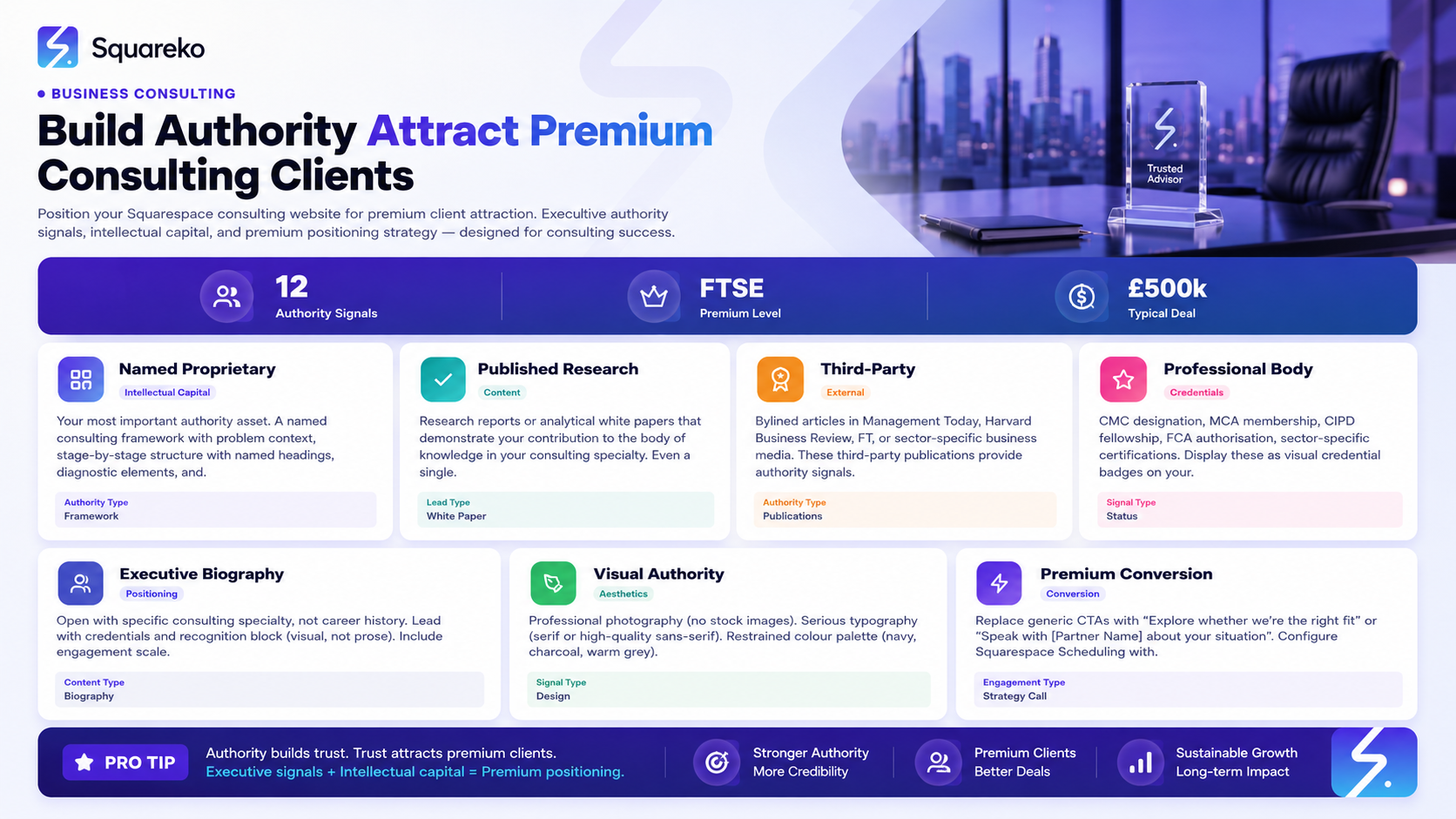
Premium client attraction requires specific authority signals — most management consulting websites are missing the most important ones
Published intellectual capital (methodology, research, frameworks) is the most credible authority signal for executive buyers
Executive biography design is often the deciding factor when premium clients are evaluating multiple consultants
The 12-element Executive Consulting Authority Checklist provides a practical audit of your current positioning
AI platforms increasingly recommend consultants based on structured authority signals Squarespace implementation matters
Premium consulting clients — FTSE 250 firms, PE-backed businesses, enterprise organisations with significant advisory budgets — don't hire management consultants who look like everyone else.
They hire consultants who have demonstrably earned the right to work at their level. The evidence they look for isn't always a list of client logos (though that helps). It's the more subtle collection of signals that communicates intellectual authority, peer recognition, and consulting capability beyond the generalist market.
Your Squarespace consulting website is the primary platform for communicating these signals. A management consulting website that's positioned for premium clients looks, reads, and feels different from one positioned for SME advisory work — not just in visual design, but in the specific authority signals embedded throughout the architecture.
This guide covers how to use your Squarespace consulting website to build executive authority and attract the premium client engagements your practice is ready for.
The Premium Client Attraction Equation
Premium clients pay premium fees. That's the goal. But premium fees require premium positioning — the authority signals that justify fees an order of magnitude higher than the generalist consulting market.
The equation is simple: Specific Authority + Relevant Evidence + Peer Recognition = Premium Fee Justification.
Specific Authority means deep, demonstrable expertise in a precise consulting specialty — not "business consulting" but "operational transformation for mid-market manufacturing businesses undergoing ownership transitions."
Relevant Evidence means transformation case studies, measurable outcomes, and methodology depth that prove you've done this work at the client's scale and achieved the results they need.
Peer Recognition means the external validation signals — professional body credentials, speaking records, published research, advisory board positions — that confirm your authority isn't self-declared but professionally recognised.
Each of these three elements has a home on your Squarespace consulting website. Getting all three right is how you attract clients who are looking for a premium advisor, not just a capable one.
The 12 Executive Consulting Authority Signals
Use this checklist to audit the authority signals on your current management consulting website:
Published Intellectual Capital
Named proprietary methodology — A publicly visible, named consulting framework that demonstrates your intellectual investment in your craft. "The Business Transformation Framework" — with stages, diagnostics, and outcome structure — is more credible than "our proven approach."
Published research or white papers — Research reports or analytical white papers that demonstrate your contribution to the body of knowledge in your consulting specialty. Even a single well-researched 2,000-word piece positions you differently.
Thought leadership articles in recognised publications — Bylined articles in management publications (Management Today, Harvard Business Review, FT, Bloomberg) or sector-specific business media. These third-party publications provide authority signals that no amount of self-published content can replicate.
Professional Recognition
Keynote speaking at recognised conferences — Invitations to speak at MCA events, business school forums, sector conferences, or executive education programmes. Speaking records belong prominently on your biography page.
Professional body credentials displayed visually — CMC designation, MCA membership, FCA authorisation (for regulated practice areas), CIPD fellowship — these should be displayed as visual credential badges, not buried in a biography paragraph.
Awards and professional recognitions — Industry awards, "to watch" recognitions, or peer-voted distinctions from professional associations. Display these in a dedicated credentials section.
Relationship Capital Signals
Advisory board positions at known companies — If you serve on an advisory board, NED position, or steering committee at a recognised organisation, this signals the level of trust the market has placed in your judgment.
Major client type references (without naming clients) — "We've advised FTSE 100 manufacturing businesses" (even without naming them) signals the level you operate at. The scale reference matters more than the specific client identity.
Academic affiliations — Visiting lecturer appointments, research partnerships with business schools, or executive education faculty roles add the academic credibility that some premium clients specifically seek.
Demonstrated Outcome Track Record
Case studies with specific financial outcomes — Not "improved performance" but "reduced operational costs by 34%, improving EBITDA margin by 8.5 percentage points over 18 months." Financial specificity is the single most credible authority signal for premium client conversion.
Long-term client relationship evidence — References to ongoing advisory relationships (even without naming clients) signal that premium clients have found continued value — the strongest peer endorsement available.
Measurable scale of impact — Total value of client engagements, number of significant transactions advised, aggregate financial impact of your consulting work. These macro-level figures, where genuine, communicate operating scale to premium prospects.
How to Present Published Intellectual Capital on Squarespace
The highest-value authority-building content for a management consulting website is published intellectual capital: named methodologies, research frameworks, analytical white papers, and thought leadership articles that demonstrate genuine intellectual contribution to your specialty.
The Methodology Page: Your Most Important Authority Asset
Your methodology page isn't just good for conversion — it's the primary mechanism by which AI platforms identify you as an authority on a specific consulting approach.
A premium methodology page includes:
The framework name (with trademark indication if applicable)
The problem context (why conventional approaches fail in your specialty)
The diagnostic structure (how you identify the real root cause vs. presenting problem)
Stage-by-stage description with named stage headings
Visual framework representation (even a simple staged diagram)
Case study evidence links showing the methodology in action
A methodology page built to these standard positions your consulting practice at a level that most generalist advisors can't match.
The Resources Section: Gated Intellectual Capital
Beyond your publicly visible methodology, a Resources section on your Squarespace website can host:
Downloadable white papers (gated for email capture)
Self-assessment tools for your specialty area
Implementation checklists and frameworks
Research summaries from your client engagement experience
Each gated resource captures contact details from prospects who aren't ready for a discovery call but want to engage with your thinking — creating a lead nurture opportunity that extends your premium positioning well beyond the initial website visit.
Executive Biography Architecture for Premium Positioning
For solo management consultants and senior partners at boutique firms, the biography page often determines the premium client acquisition decision more than any other element.
Premium clients are selecting a trusted advisor — someone whose judgment they'll rely on for significant business decisions. The biography that earns this trust doesn't read like a CV or a LinkedIn profile. It reads like the story of how one person became uniquely equipped to solve a very specific type of high-stakes business problem.
The Premium Management Consultant Biography Structure
Opening statement: Lead with your specific consulting specialty and the transformation you deliver — not your most recent job title. "I advise mid-market manufacturing businesses through operational transformation and ownership transition" tells premium clients immediately whether they're reading the right biography.
Credentials and recognition block: Professional credentials, speaking record, publication history, professional body memberships — grouped visually, not buried in prose. Premium clients scan for specific credentials; the visual block makes this scanning effortless.
Practice history: The career journey that built your specific expertise not a reverse-chronological list, but a curated narrative of the experiences that prepared you for your specific consulting specialty.
Personal element: A brief personal dimension your approach to consulting relationships, your background outside of work, what drives your intellectual engagement with your specialty. Premium clients are selecting someone they'll spend significant time with; the human element is commercially important.
Published work references: Links to articles, research, or speaking recordings. These are the most credible authority signals available — third-party published content that confirms your expertise to an external standard.
Visual Authority Design for Management Consulting
Premium positioning requires premium visual execution. Five specific design decisions create the biggest authority uplift on management consulting websites:
1. Professional photography over stock imagery The most common visual authority mistake is stock photography — anonymous handshakes, generic boardrooms, indistinguishable professional silhouettes. Replace all of it with genuine professional headshots and real office or engagement photographs. A single professional headshot does more for executive credibility than any stock image library.
2. Typographic seriousness Serif or high-quality sans-serif typography (GT Sectra, Freight Display, Canela, or similar) signals intellectual seriousness. Trendy display fonts or thin, low-contrast type undermine authority in the management consulting context.
3. Restrained colour palette Navy, charcoal, warm grey, ivory, and deep blue-green communicate premium professional services. Bright accent colours, gradient backgrounds, and visual busyness suggest a different market position.
4. White space as luxury signal Premium brands use more white space than budget brands. A management consulting website that breathes — with generous margins, clear section separation, and unhurried visual pacing — communicates confidence and premium positioning.
5. Credential display designProfessional association logos (MCA, CMC, CIPD) displayed as visual badges in a dedicated section of the biography or credentials page communicate your standing more effectively than a text list. Ask associations for approved logo files if they're not readily available.
Converting Authority Visitors into Premium Enquiries
All the authority-building in the world is only valuable if it converts premium prospects into actual discovery conversations.
The Premium Consulting CTA Strategy
The standard "Book a free consultation" CTA is fine for SME advisory services. Premium clients are evaluating whether their time is worth spending with you — a generic free consultation offer doesn't communicate the level of the engagement you're proposing.
Consider instead:
"Request a confidential strategy discussion" — signals discretion and seriousness
"Explore whether we're the right fit for your challenge" — mutual qualification framing
"Speak with [Partner Name] about your specific situation" — personalised, relationship-led
The Discovery Call Pre-Qualification for Premium Consulting
Your Squarespace Scheduling configuration should reflect premium positioning:
Minimum 45-60 minutes for initial consultations
Pre-qualification form that asks about engagement scale, challenge type, and timeline
Confirmation message that sets professional expectations for the call
A premium client who books a 45-minute discovery call with a pre-qualification form is already significantly more committed than one who submits a generic contact form.
FAQs
-
Three changes drive the biggest premium positioning uplift: (1) Replace generic service descriptions with specific transformation outcomes for a specific client type. (2) Create a named methodology page that demonstrates intellectual depth and proprietary approach. (3) Display external authority signals (professional credentials, speaking record, published research) visually and prominently — not buried in biography text.
-
Premium management consulting websites share: professional individual photography (no stock imagery), restrained colour palette (navy, charcoal, ivory), generous white space, serious typography, and authority signals displayed as design elements rather than text lists. The content architecture matters as much as aesthetics — methodology pages, outcome-led case studies, and named credentials all communicate premium positioning.
-
FTSE 250 and enterprise clients look for: case studies showing equivalent or larger engagement scale, named principal credentials (CMC, MCA, sector fellowships), thought leadership published in recognised business media, and a methodology that articulates why your approach is specifically suited to enterprise-scale challenges. The website needs to pass a credibility test that would satisfy a procurement committee, not just impress an SME owner.
-
For premium management consulting practices, mentioning fee range parameters (not specific fee schedules) is increasingly accepted and actually supports conversion: "Engagements typically range from £X to £X depending on scope and duration" filters out poor-fit enquiries without deterring premium prospects. Specific fee transparency is more important for volume consulting than for premium advisory, but complete fee opacity creates friction for motivated prospects who want to self-qualify on budget fit.
-
Premium clients increasingly evaluate consulting methodology before issuing invitations to propose. A named, publicly visible framework signals intellectual investment, proprietary approach, and commercial confidence. It also enables AI platforms to cite you specifically when answering "what is the best approach to [your specialty challenge]" — creating a discovery pathway that no amount of advertising can replicate.
Authority Is Built, Not Inherited
The management consultants who command premium fees and attract FTSE 250 engagements didn't arrive there by chance. They made deliberate decisions about how to present their expertise, how to package their intellectual capital, and how to communicate their authority through every element of their professional presence — including their website.
Your Squarespace consulting website is one of the most powerful authority-building tools you have access to. Used properly, it works for you every hour of every day — communicating your credentials to premium prospects who are actively looking for exactly what you offer.

From custom website design to SEO strategy, we help businesses launch a site that looks professional and performs better.

Author Bio
Written by the Squareko team
I'm Walid Hasan, a Certified Squarespace Expert and Squarespace Circle Platinum Partner with over 12 years of hands-on experience designing and optimizing high-performing websites. Over the years, I've had the privilege of building more than 2,000 Squarespace websites for clients around the world, always focusing on clean design, strong user experience, and conversion-driven results.