How to Write a Life Coach About Page That Books More Discovery Calls
Key Takeaways for Life Coach About Page That Books More Discovery Calls
A life coach about page is a trust document first and a biography second
Your personal story is relevant only insofar as it explains why you're the right person to help your specific clients
Credentials should be framed in terms of client benefit, not as a bare list of qualifications
The about page should end with a specific CTA — not just contact me but book a free discovery call
Testimonials on your about page can dramatically increase conversion rates
Most life coaches know their about page needs to do more than list their credentials. But knowing that in theory and knowing how to execute it in practice are very different things. The result is usually an about page that's either too short (a paragraph and a headshot), too long (a full autobiography), or structured like a resume rather than a trust-building document.
Here's the truth about a life coaching about page: it's not really about you. It's about your client's experience of you, and whether reading your story gives them the confidence that you are the right person to help them through theirs.
This guide gives you the exact framework for writing a life coach about page that does its job — builds genuine trust, communicates your unique value, and gives visitors the confidence to book a discovery call.
The Purpose of a Life Coach About Page
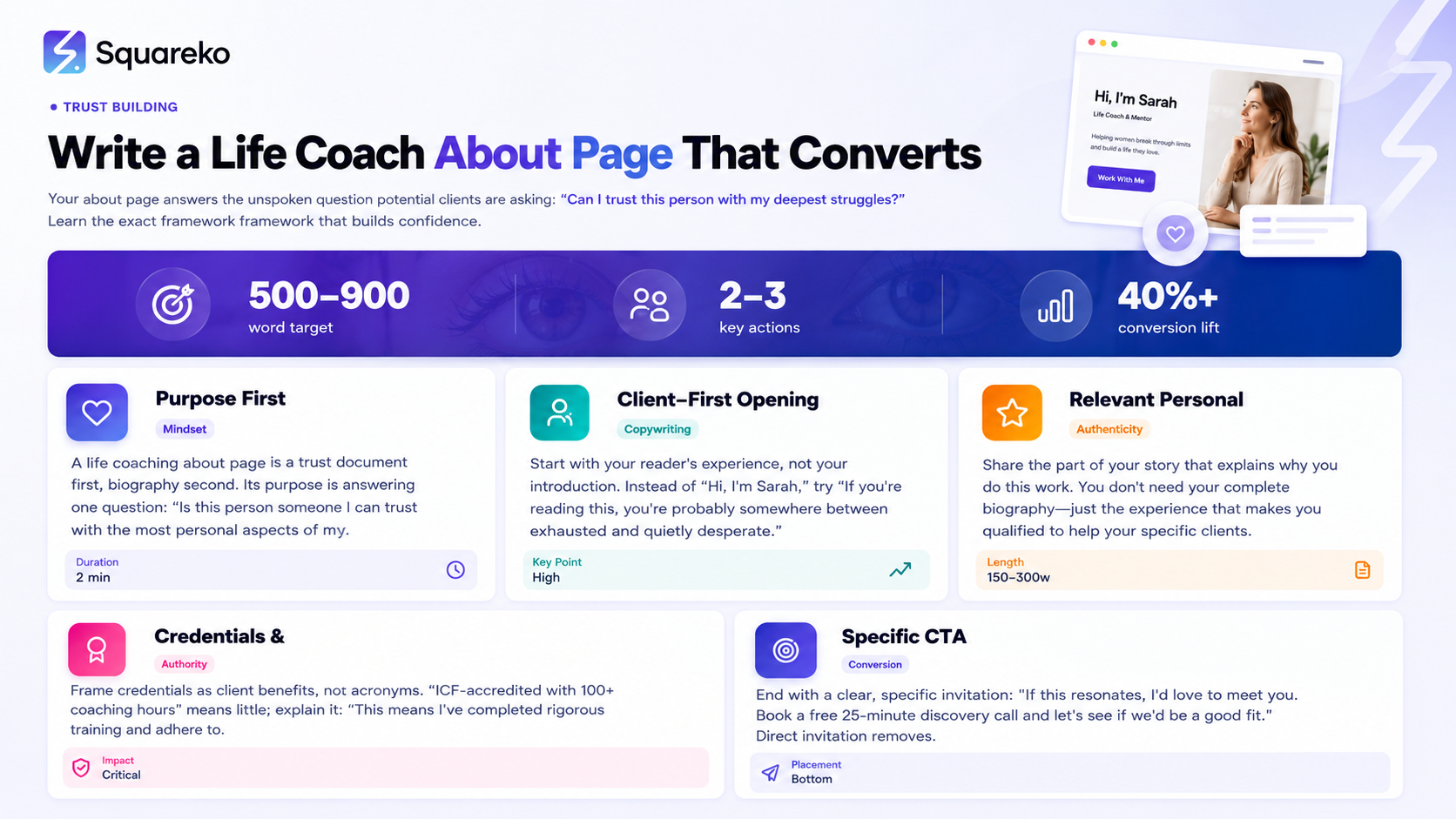
Before you write a word, get clear on the job your about page is doing. Its purpose is not to document your life history. It's not to list every certification and training you've ever completed. It's not to impress potential clients with your academic background.
The purpose of a life coaching about page is to answer one unspoken question: Is this person someone I can trust with the most personal aspects of my life?
That's a high bar. And it means your about page needs to do something that most professionals aren't trained to do: show up as a person, not just a provider.
What Potential Clients Are Actually Wondering
When a potential client reads your about page, they're running through a mental checklist — most of it unconscious:
Does this person understand what I'm going through?
Have they been through anything like this themselves, or are they just theoretically trained?
Do they seem warm and non-judgmental?
Are they credible? Do they have real training and experience?
Do I actually want to spend an hour a week with this person?
Your about page has to answer every one of those questions — without them having to ask a single one explicitly.
The Opening: Make It About Them First
Counter-intuitively, the most effective opening for a life coach about page isn't about you — it's about your client. Start with the person you help and what they're experiencing.
Weak opening (too common): Hi, I'm Sarah. I'm a certified life coach and I'm passionate about helping people live their best lives.
Strong opening: If you're reading this, you're probably somewhere between exhausted and quietly desperate. You know something has to change — you just can't quite see what, or how, or where to start. I know that feeling. And I know what comes next.
The second version immediately speaks to the experience of the person most likely to be reading your about page. It creates resonance before you've introduced yourself at all. From that resonance, trust follows.
Transition to Your Introduction
After the opening that speaks to the client, introduce yourself — briefly. Your name, what you do, and a single sentence about who specifically you help. I'm Sarah, a life coach for women navigating major life transitions — divorce, career change, loss, identity shifts.
Then the story begins.
Your Personal Story: What to Include and What to Leave Out
The personal story section of your about page is where most life coaches either undershoot (too vague, no real story) or overshoot (too much information, no clear connection to the client). Here's how to find the right balance.
The Relevant Part of Your Story
Your about page doesn't need your complete life history. It needs the part of your story that's directly relevant to why you do this work and why you're qualified (experientially, not just academically) to help your specific clients.
Ask yourself: what experience have I had that makes me uniquely suited to help the people I work with? That experience — not your entire biography — is the story your about page needs.
For a burnout recovery coach: the story of her own burnout, what she tried that didn't work, and what eventually shifted things. For a divorce recovery coach: her personal experience navigating divorce, how she found herself on the other side, and what she wished she'd had during the process.
You don't have to have personally experienced the exact situation your clients face. But you need something — lived experience, proximity to it, or a long professional history working with it — that makes your empathy real rather than theoretical.
What to Leave Out
Leave out the parts of your story that don't directly relate to the work you do with clients. Your childhood, your university experience, your previous career (unless directly relevant) — these can be mentioned briefly but should not dominate.
Also leave out: overly clinical language, jargon from your coaching training, and anything that makes you sound like a brochure rather than a person.
Length
The personal story section should be 150–300 words. Long enough to be real and resonant, short enough to stay purposeful.
Your Credentials and Training: Making Them Meaningful
Life coaching is an unregulated industry — which means credentials matter for trust, but they need to be explained, not just listed.
Don't Just List Acronyms
ICF-ACC, NLP Practitioner, certified in Positive Psychology means very little to a client who doesn't know what those acronyms stand for. Add a sentence of explanation for each significant credential:
I'm accredited by the International Coaching Federation (ICF) at Associate Certified Coach level — which means I've completed over 100 hours of coach-specific training and 100 hours of documented client coaching, and I adhere to ICF's ethical standards.
That sentence tells the client what the credential actually means and why it should matter to them.
Hours and Experience
If you have significant coaching hours or years of experience, state it specifically. I've worked with over 80 clients across three years of private coaching practice is more meaningful than extensive coaching experience.
Relevant Professional Background
If your previous career gives you relevant domain expertise — a therapist who became a mindset coach, a doctor who became a burnout recovery coach, a divorce attorney who became a divorce recovery coach — this is highly relevant and should be included. It adds a layer of credibility that pure coaching training cannot.
Your Coaching Philosophy and Approach
This section differentiates you from every other life coach who has the same ICF credential. Your philosophy is what you believe about human beings and what's possible for them. Your approach is how you work in practice.
Philosophy
What do you believe about why people get stuck? What's your view of how transformation actually happens? What's the role of the coach versus the client in that process?
Keep it personal and specific. I believe most people already know what they need — they've just spent years learning not to trust themselves. My job isn't to tell you what to do. It's to help you get quiet enough to hear what you already know.
That's a philosophy. It's distinct. It attracts some clients and repels others — both of which are the right outcome.
Approach
What does coaching with you actually look and feel like? Without going into a session-by-session breakdown, give the potential client a sense of the experience: I ask a lot of questions. I'm direct but not directive. I hold space for difficult emotions while also gently challenging the stories you've been telling yourself.
One paragraph on philosophy, one on approach — that's enough for an about page. The discovery call is where they experience it for real.
Testimonials on Your About Page
Most life coaches save all their testimonials for a dedicated testimonials page or for service pages. This is a mistake. The about page is the highest-trust-building page on your site — and social proof from clients who speak to that trust amplifies the message significantly.
The Right Kind of Testimonial for an About Page
About page testimonials should speak to the experience of working with you as a person, not just the results of the programme. The results were great — but more than that, [coach name] made me feel seen in a way I hadn't in years is perfect for an about page. It addresses the emotional trust question directly.
Place one or two short testimonials after your philosophy section or at the very end of the page before your CTA. They don't need to be long — 2–3 sentences that speak to who you are as a coach, not just what you deliver.
The CTA: What to Say at the End
Your about page should end with a clear, specific invitation to take the next step. Not contact me — that's vague and low-commitment. A specific invitation with context.
If you've read this far and something resonated — if you recognised yourself anywhere in what I've described — I'd love to meet you. Book a free 25-minute discovery call and let's see if we'd be a good fit. There's no obligation, and the call itself is usually useful regardless of what you decide.
This CTA does four things: it speaks to the person who's resonated with your story (filters in the right client), gives them the specific action (book a free call), specifies what will happen (25 minutes), and removes the barrier of fear (no obligation, the call itself is useful).
Place your booking button immediately below this paragraph — embedded scheduling or a link to your scheduling page. Don't make them search for it.
Don't Let a Weak About Page Cost You the Right Clients
Your coaching is real. Your experience is real. Your impact on clients is real. If your about page isn't communicating that — if it's not giving the right people the confidence to book a call — that's a fixable problem.
Squareko builds Squarespace life coaching websites where the about page is treated as the trust-building asset it actually is. Every page is structured to move the right visitors toward a discovery call — starting with your about page.
FAQs
-
Between 500–900 words is the sweet spot for most life coaches. Long enough to include a personal story, credentials, philosophy, and a CTA with room for testimonials. Short enough to stay focused and purposeful. Avoid the extremes: a three-paragraph about page feels thin for a trust-intensive service; a 2,000-word autobiography loses readers and dilutes impact.
-
If your personal experience directly relates to the clients you help, yes — and in fact it's often the most powerful trust signal you can offer. You don't need to share everything, and you don't need to make it dramatic. But genuine, relevant personal experience communicated with honesty and appropriate vulnerability converts far better than a purely professional narrative.
-
At least two: a professional headshot near the top of the page, and one or two more candid or lifestyle shots that show you in context — your workspace, in nature, or in a setting that reflects your coaching philosophy. Avoid a single stock-looking headshot with nothing else. Life coaching clients are choosing a relationship with a person, and multiple photos help build a sense of who you are.
-
You need both — but they should be integrated, not separate. A professional bio that lists credentials and experience without personal context feels cold. A personal story with no credentials feels like anyone could do this. The best about pages weave the two together: personal story that explains why you're drawn to this work, with credentials that confirm you've done the training to do it well.
-
Focus on your training, your personal experience with the themes you coach on, and your coaching philosophy. You don't need client testimonials to have a credible about page — but you should be transparent about where you are in your practice ("I'm in my first year of practice and working with a small number of clients as I build my experience") rather than implying a longer track record than you have. Authenticity at any stage is more compelling than overclaiming.
-
Second in the navigation (after Home) is standard for life coaching websites. "Home | About | Work With Me | Blog | Book a Call" is a common and effective navigation structure. Your about page is often the second or third page visitors check after landing on your homepage — giving it prominent navigation placement ensures it's easy to find.
-
First person, almost always. Third person ("Sarah Smith is a certified life coach who…") feels formal and creates distance — the opposite of what you need for a life coaching about page. First person ("I'm a certified life coach who…") is warmer, more direct, and feels like you're actually speaking to the reader. The only exception might be a short "official" bio for press or media purposes, separate from your main about page.
-
Yes — with adaptation. Your about page story, philosophy, and approach are core brand content that can be adapted for your LinkedIn profile, your coach directory listings, your email newsletter bio, and speaking introductions. The version on each platform should be adapted in length and tone for that platform, but the core story and message should be consistent across all of them.
From custom website design to SEO strategy, we help businesses launch a site that looks professional and performs better.

Author Bio
I'm Walid Hasan, a Certified Squarespace Expert and Squarespace Circle Platinum Partner with over 12 years of hands-on experience designing and optimizing high-performing websites. Over the years, I've had the privilege of building more than 2,000 Squarespace websites for clients around the world, always focusing on clean design, strong user experience, and conversion-driven results.