How to Grow a Cosmetics Brand to £100K Revenue with a Squarespace Website
Introduction
The cosmetics industry is booming. Beauty entrepreneurs are launching brands from bedrooms and building multi-six-figure businesses online. But here's the truth: reaching £100K in annual revenue requires far more than a beautiful website and hope.
Growing a cosmetics brand to £100K with a Squarespace website is achievable—and increasingly common. Whether you're formulating your own skincare line, curating beauty products, or building a personal brand as a beauty influencer, this guide shows you the exact roadmap to get there. We've worked with dozens of cosmetics founders at Squareko, and the brands that hit this milestone follow a predictable pattern: solid website foundations, strategic traffic generation, relentless conversion optimisation, and community-focused retention.
This post walks you through the complete strategy to grow your cosmetics brand to £100K revenue using Squarespace as your foundation.
Key Takeaways
A £100K cosmetics brand typically requires 500–2,000 monthly orders at an average order value (AOV) of £40–£80, depending on product mix
Website foundation matters most: fast loading, mobile optimization, professional product photography, and clear brand story convert 2–3x better than generic alternatives
Content marketing and email retention generate 30–40% of revenue for mature cosmetics brands; paid ads alone cannot sustain growth
Conversion rate optimization (moving from 1% to 2–3%) accelerates the path to £100K by 2–3 months
Most successful cosmetics brands phase growth: foundation (months 1–3), traction (months 4–9), scaling (months 10+)
Phase 1: Build Your £100K Foundation (Months 1–3)
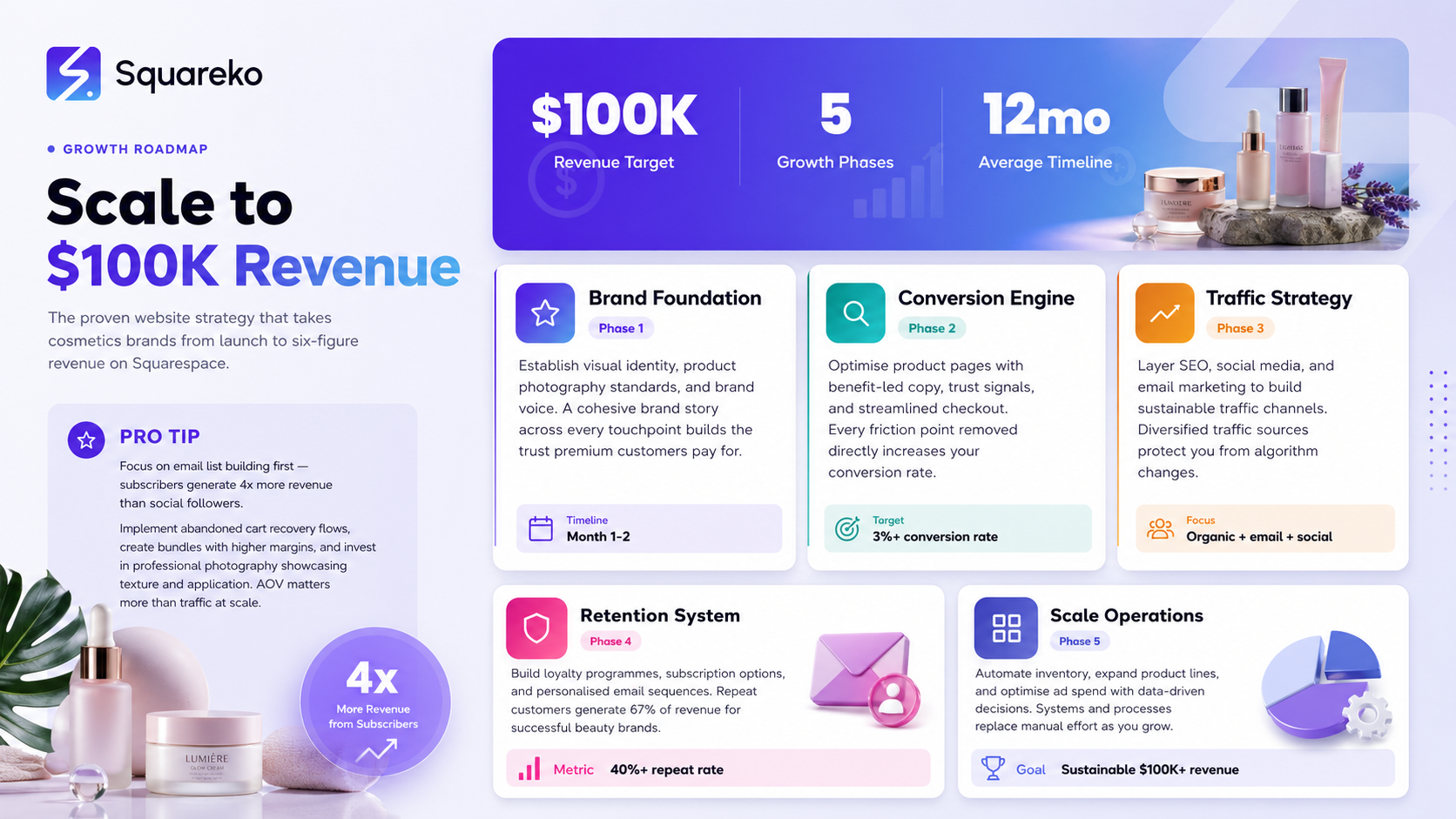
Before you spend a penny on ads, your Squarespace website must convert visitors into customers. This is where most cosmetics brands fail: they prioritise aesthetics over function.
Why Foundation Matters
A weak foundation means you're throwing money away on traffic. If your site converts at 0.5%, you need 200,000 visitors to hit £100K (at £40 AOV). But a properly optimised site converting at 2–3%? You need only 13,000–20,000 visitors. That's 10x cheaper to acquire.
Essential Foundation Elements for Cosmetics
Product Pages That Sell
Your product pages are your sales team. They must answer three questions instantly:
What problem does this solve?
Who is it for?
Why should I trust this?
Use high-quality product photography (top-down, lifestyle, close-up of texture). Include ingredient lists, benefits breakdowns, and customer reviews. Squarespace's product blocks allow comparison tables—use them. The brands hitting £100K always have product pages with 300+ words of benefit-driven copy, 5+ high-res images, and visible customer testimonials.
Brand Story That Connects
Beauty buyers don't just want products; they want to buy into a story. Your About page should tell the founder story: the problem you discovered, why you started, and your mission. Spend 2–3 weeks perfecting this. Cosmetics brands with compelling founder narratives see 15–20% higher conversion rates on average.
Social Proof Everywhere
Testimonials, reviews, and user-generated content are non-negotiable. Squarespace's review app integrates easily; use it from day one. Ask first customers for reviews within 3–5 days of purchase. By month 3, aim for 50+ reviews with a 4.5+ star rating.
Email Capture Strategy
Before you sell anything, build your email list. Use a exit-intent popup offering 15–20% off for email signup. By month 3, aim for 500+ email subscribers—this becomes your retention engine later.
Site Speed & Mobile Optimisation
Fast sites convert better. A 1-second delay reduces conversion by 7%. Use Squarespace's built-in performance tools. Compress images to under 200KB. Aim for a Lighthouse score of 80+. Test your checkout on mobile devices; 60%+ of cosmetics purchases happen on phones.
Phase 2: Generate Qualified Traffic (Months 4–9)
Now your website converts. Time to drive traffic. The most successful cosmetics brands use a three-channel approach: organic, paid, and community.
Channel 1: Content Marketing (Organic)
Cosmetics buyers search for solutions, not products. They Google "how to get glowing skin," "best skincare for sensitive skin," or "does retinol help acne?"
Create blog content around these search terms. Aim for 15–20 blog posts in your first year. Topics:
Skincare routines for different skin types
Ingredient deep-dives (hyaluronic acid, vitamin C, niacinamide)
Before-and-after guides
Myth-busting posts
Brand-specific guides to your bestsellers
Each post should be 1,500+ words, optimised for a target keyword, and link to relevant products. One well-ranking blog post can drive 200–500 monthly visitors without paid spend. By month 12, a library of 15 posts can generate 3,000–5,000 organic visitors monthly—with zero ad spend.
Use Squarespace's SEO tools: optimise meta titles, descriptions, and use your focus keywords naturally. Build internal links between posts and product pages.
Channel 2: Paid Advertising (Strategic)
Most cosmetics founders waste money on paid ads because they run them before their site is ready. You've fixed that. Now, paid ads amplify what's already working.
Facebook & Instagram Ads
These platforms excel for cosmetics because they're visual and demographic-targeted. Start with a small budget: £500/month. Test 5 audiences:
Website visitors (retargeting)
Similar audiences to customers
Beauty interest groups
Age 25–45, UK-based, high household income
Competitor follower lookalikes
Track which audience converts best. Reallocate budget to winners. By month 6–9, profitable ad spend can reach £2,000–£5,000/month.
Pinterest is under utilised for cosmetics. Users on Pinterest actively plan purchases 3–6 months ahead. Create 10–15 Pins linking to your blog content and product pages. Pinterest ads are cheaper than Instagram: expect 2–3x better ROI.
Channel 3: Community & Partnerships
The fastest path to £100K doesn't come from a single channel—it compounds through community.
Beauty Influencers: Partner with micro-influencers (10K–100K followers) in your niche. Offer 20–30% off or free products. A single post from the right influencer can drive 200–500 orders.
Affiliate Partnerships: Set up an affiliate program offering 10–15% commission. Beauty bloggers and YouTubers will promote your products in exchange.
Beauty Communities: Join Reddit's r/SkincareAddiction, r/MakeupAddiction. Answer questions authentically. Build trust before mentioning your brand. These communities drive loyal, repeat customers.
Phase 3: Master Conversion Optimisation (Months 4–9)
While you're driving traffic, optimise relentlessly. A 1% increase in conversion rate (say, 1% to 2%) doubles revenue without spending more on ads.
Analyse Your Baseline
Use Squarespace Analytics (or Google Analytics). Measure:
Site conversion rate (visitors to buyers)
Average order value (total revenue / orders)
Cart abandonment rate
Top traffic sources
Top products
By month 4, you should have 2–3 weeks of baseline data.
Optimisation Priorities
Priority 1: Reduce Friction in Checkout
Your checkout is a leaky bucket. If 10,000 visitors add products to cart but only 500 convert, you're losing £20K+ in revenue.
Enable guest checkout (no account required)
Offer multiple payment options: Debit, Credit, PayPal, Apple Pay
Show a trust badge (SSL, Money-Back Guarantee, Shipping Policy)
Display shipping costs before checkout (no surprises)
Squarespace handles most of this. Test your checkout end-to-end on iPhone and Android monthly.
Priority 2: Improve Product Pages
Your top 5 products generate 60%+ of revenue. Optimise them first:
A/B test product images (lifestyle vs. studio shots)
Test different descriptions (benefits vs. features)
Add customer testimonials specific to that product
Highlight stock levels
Include a Frequently Bought Together section
Most cosmetics sites miss this. After optimisation, these pages often see 15–25% conversion lifts.
Priority 3: Personalise the Experience
Returning customers spend 50% more than first-time buyers. Personalise their experience:
Show personalised product recommendations based on purchase history
Offer loyalty discounts
Create a customer VIP tier
Squarespace integrates with tools like Klaviyo to automate this.
Priority 4: Test Everything (But Smartly)
Run one test at a time. Change headlines, images, or copy for 2 weeks. Measure results. Keep what wins. Don't run dozens of tests simultaneously—you won't know what caused the improvement.
By month 9, a 1% baseline conversion rate should climb to 1.5–2%. That's thousands of pounds in recovered revenue.
Phase 4: Build Community & Retention (Months 6–12)
New customer acquisition costs money. Repeat customers spend more, refer friends, and defend your brand. Phase 4 is about building a community of loyal buyers.
Email Marketing as Your Retention Engine
Your email list is your most valuable asset. Here's the framework:
Welcome Sequence (3 emails, sent over 7 days)
Day 1: Thank you + exclusive 10% discount code
Day 3: Share your brand story + why customers love you
Day 7: Educational content (skincare routine, ingredient guide) + product recommendation
Abandoned Cart Sequence (2 emails, sent over 3 days)
Hour 1: "You left your bag behind" + gentle reminder + discount offer
Day 2: Urgency ("Only 3 left in stock") + social proof ("800+ customers loved this")
Post-Purchase Sequence (3 emails, sent over 30 days)
Day 1: Confirmation + shipping status
Day 7: How to use guide + photos + get the most from your purchase
Day 21: "How are you getting on?" + review request + 10% off next order
Monthly Engagement (2–3 emails/week)
New product launches
Educational tips (rotating skincare advice, ingredient spotlights)
Exclusive offers for email subscribers only
Seasonal campaigns
Most cosmetics brands see email revenue climb to 30–40% of total sales by month 12. That's passive, profitable revenue.
Build an Engaged Community
Beyond email, create community touchpoints:
Instagram Stories: Behind-the-scenes, founder tips, customer features
TikTok: Short skincare routines, product demos, trending sounds
Referral Program: Refer a friend, you both get 15% off
VIP Facebook Group: Exclusive tips, early product access, direct founder interaction
Phase 5: Scale to £100K (Months 10+)
By month 10, you've built a machine. You have:
A site converting at 1.5–2%
Organic traffic generating 2,000–4,000 monthly visitors
Paid ads delivering profitable ROAS (Return on Ad Spend)
Email generating 30–40% of revenue
Repeat customers comprising 30–40% of orders
A waiting list of micro-influencers wanting to work with you
Now it's time to scale profitably.
The Math to £100K
Let's work backwards:
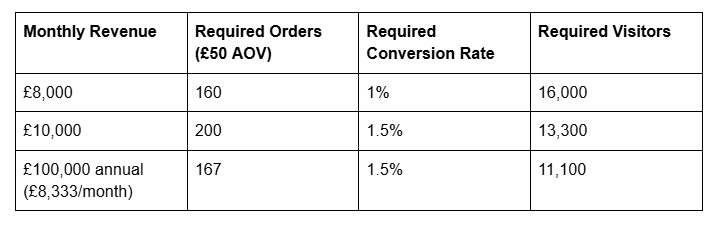
To hit £100K annual revenue:
You need roughly 11,000 monthly visitors at 1.5% conversion
Or 7,500 visitors at 2% conversion
By month 10, most successful brands are getting 40–50% of traffic from organic sources. That means you only need 5,500–5,600 paid visitors monthly—very achievable on £2,000–£4,000 ad spend.
The £100K Revenue Roadmap: Milestones & Timeline
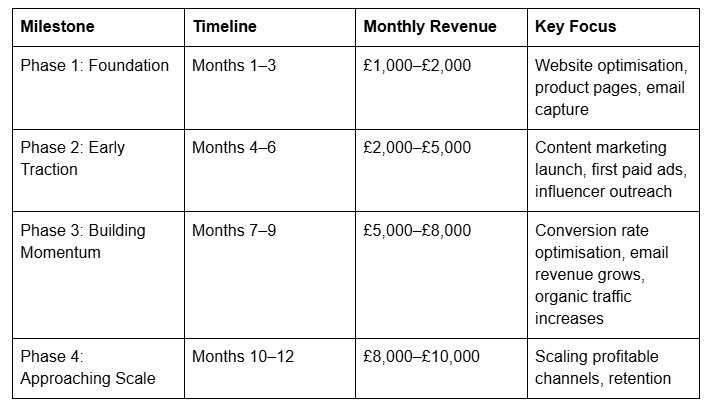
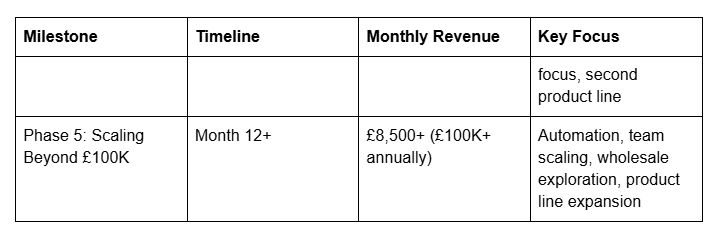
This timeline assumes:
Consistent effort (20–30 hours/week founder time)
Modest paid ad budget (£500–£2,500/month by month 6)
Quality products with strong customer satisfaction
Founder actively building community and relationships
What to Focus on in Month 10+
1. Scale Profitable Channels Only
By now, you know which channels work. Don't chase new shiny channels. Double down on what converts.
If organic is profitable (free), aim for 5,000+ monthly visitors. If Instagram ads deliver 2:1 ROAS, increase spend from £2,000 to £4,000.
2. Expand Your Product Line Strategically
One bestselling product limits your growth. By month 12, introduce 2–3 complementary products:
Skincare brand? Add a targeted treatment serum.
Makeup brand? Add a brush set.
Beauty brand? Add a bundle (starter kits always convert well).
Product line expansion typically increases AOV by 20–30% and creates cross-sell opportunities.
3. Consider Wholesale
Reaching £100K through DTC (direct-to-consumer) alone is entirely possible—but wholesale accelerates growth. Beauty retailers, boutiques, and gyms are always looking for indie brands.
Wholesale typically involves 50% discount off retail price. It's lower margin but fast volume. Many brands hit £100K at month 9–10 through a mix of DTC (60%) and wholesale (40%).
4. Automate Everything
By month 10, you should automate:
Email sequences (Klaviyo, Omnisend)
Social media posting (Buffer, Later)
Customer support (AI chatbots for FAQs)
Inventory management (Squarespace's built-in tools)
This frees you to focus on strategy and product development.
Critical Success Factors for Reaching £100K
The difference between brands that reach £100K and those that stall comes down to a few critical factors. First, commit to consistent effort—this isn't passive income. You'll need 20–30 hours weekly for the first 12 months. Second, quality matters more than quantity. One well-optimised product page with stellar reviews converts better than ten mediocre pages. Third, test relentlessly and make data-driven decisions; gut feelings rarely align with customer behaviour.
Finally, remember that £100K is not an endpoint—it's a milestone. The brands that hit this target in 10–12 months are positioned to scale to £500K, £1M, and beyond. The systems, community, and processes you build now determine how far you can grow.
Frequently Asked Questions
-
Yes. Squarespace is sufficient for brands up to £500K+ annual revenue. You'll eventually outgrow it for advanced analytics or integrations, but it's perfect for £0–£250K. Many successful cosmetics brands use Squarespace into their second year. Shopify becomes necessary only once you need serious inventory management, advanced reporting, or custom integrations.
-
Expect to invest £5,000–£15,000 before hitting profitability:
Squarespace hosting/domain: £200–£400/year
Product sourcing (if manufacturing): £2,000–£10,000
Initial marketing & ads: £2,000–£5,000
Email marketing tools: £100–£300/year
Photography & branding: £500–£2,000
If you're buying existing products to resell (dropshipping or white label), costs are much lower: £500–£2,000 total. But margins are also lower (30–40% vs. 60–80% for branded manufacturing).
-
Most cosmetics brands operate at £30–£80 AOV:
Budget skincare brands: £20–£40
Premium skincare: £50–£120
Makeup brands: £15–£45
Luxury beauty: £80–£200+
To hit £100K with an AOV of £50, you need 2,000 orders annually. That's roughly 167 orders/month or 5–6 orders per day. Very achievable with the strategy above.
-
Extremely important. Bad products kill brands fast. You need:
Effective formulations (test on real customers before launch)
Professional packaging (cheap packaging signals cheap product)
Clear ingredient lists (cosmetics buyers research ingredients deeply)
Compliance with UK Cosmetics Regulations (safety testing, labelling)
Never compromise on product quality to save costs. It destroys your reputation and makes growth impossible.
-
Both. Organic (blog, social, community) is slower but builds a moat—you own the audience. Paid ads are faster but stop the moment you stop spending.
The winning formula:
Months 1–6: 70% organic effort, 30% paid ads (small budget to test)
Months 7–12: 50% organic, 50% paid (scaling what works)
Month 12+: Balance based on profitability (if organic is 2:1 profitable, invest there)
-
Track these weekly:
Traffic by source: Organic vs. paid vs. social vs. email
Conversion rate: Visitors to buyers (target: 1–2%)
Average order value: Revenue per order
Customer acquisition cost (CAC): Total ad spend / new customers
Email list growth: New subscribers weekly
Repeat customer rate: % of orders from repeat customers (target: 30–40%)
Use these to make decisions. If a traffic source isn't converting, cut it. If email is underperforming, test new subject lines.
-
Most cosmetics brands are profitable by month 4–6 if:
Product margins are 50%+
You keep ad spend under £1,000/month initially
You prioritise organic growth
Some break even in month 2. Others take 9 months if they invest heavily in ads early. Profitability depends on margins, traffic sources, and your definition of "profitable" (after product costs only vs. after all expenses).
-
Lower risk, but lower margins (30–50% vs. 60–80%). You can reach £100K faster because upfront costs are minimal—but growth plateaus earlier because margins don't support scaling. Most successful indie brands manufacture eventually for better margins and brand control.
Ready to Build a £100K Cosmetics Brand Website?
Reaching £100K in annual revenue with a cosmetics brand on Squarespace is absolutely achievable. The brands that succeed follow a predictable roadmap: they build strong foundations, drive qualified traffic, obsess over conversion optimisation, and retain customers relentlessly.
The path isn't quick—expect 10–14 months from zero to £100K. But it's proven. Hundreds of cosmetics founders have followed this playbook and succeeded.
If you're ready to build your £100K cosmetics brand website, we can help. At Squareko, we specialise in helping beauty founders build high-converting Squarespace sites, from initial setup to scaling beyond £500K.

From custom website design to SEO strategy, we help businesses launch a site that looks professional and performs better.

About the Author
Walid | Founder, Squareko
I'm Walid Hasan, a Certified Squarespace Expert and Squarespace Circle Platinum Partner with over 12 years of hands-on experience designing and optimizing high-performing websites. Over the years, I've had the privilege of building more than 2,000 Squarespace websites for clients around the world, always focusing on clean design, strong user experience, and conversion-driven results.