How to Build an Operations Consulting Website on Squarespace That Wins Process Improvement Contracts
Key Takeaways How to Build an Operations Consulting Website on Squarespace That Wins Process Improvement Contracts
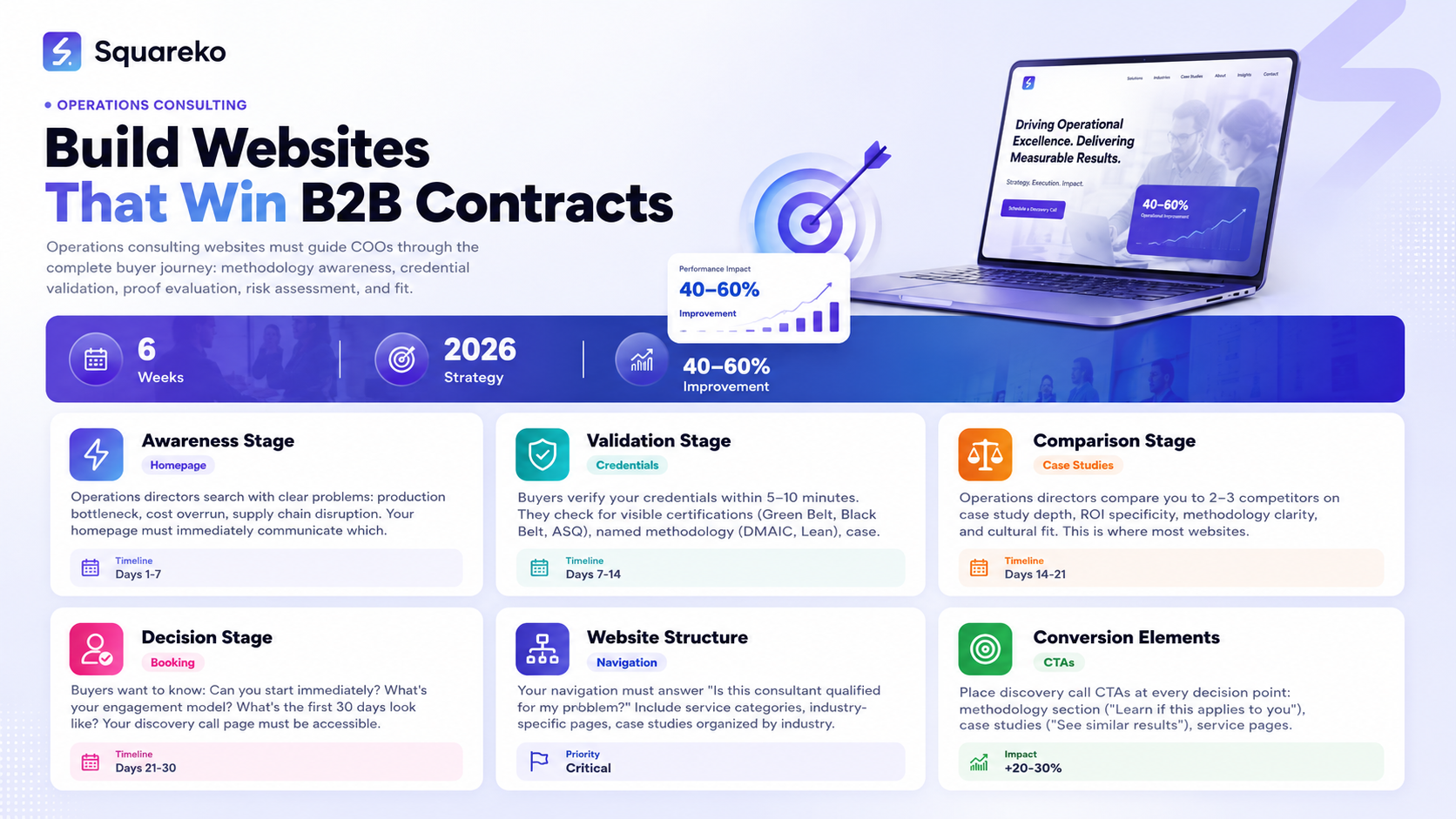
COO buyer journey spans 2-4 weeks: awareness of methodology → validation of credentials → comparison of case studies → discovery call booking. Your website must serve all four stages without forcing buyers through a single path
Lean/Six Sigma credentials are non-negotiable: Green Belt, Black Belt, ASQ, IASSC, and PMI certifications must be visually prominent and verified. Buyers will check certifications before booking calls
Before-and-after case studies must follow the PROCESS framework: Problem Context → Root Cause → Operational Solution → Execution → Savings Achieved → Sustained Results. Generic case studies lose deals
ROI metrics are the primary decision driver: Cost reduction %, cycle time improvement %, waste elimination %, OEE improvement, throughput increase. Without specific metrics, buyers assume you don't deliver measurable results
B2B discovery call architecture differs from B2B sales: You need multiple CTA pathways (methodology assessment, case study downloads, webinar registration, direct calendar booking), email nurture sequences, and exit-intent mechanisms, not cart abandonment emails
An operations consulting website isn't just a portfolio. It's a systematic sales tool designed to guide COOs and operations directors from "I have a problem" through to "I'm ready to book a discovery call." The buyer journey for operations consulting is fundamentally different from other service-based industries. Operations directors don't buy based on a consultant's charisma or impressive design portfolio. They buy based on systematic proof: methodology certifications (Green Belt, Black Belt, ASQ, IASSC, PMI), measurable ROI outcomes (cost reduction %, cycle time improvement %, waste elimination %), and case studies demonstrating operational discipline.
Building an operations consulting website on Squarespace requires understanding not only the platform's capabilities but also the procurement psychology of COO-level buyers. This guide walks through the complete website architecture needed to win process improvement contracts: the buyer journey map, systematic methodology presentation, ROI metrics display strategy, case study framework, and B2B discovery call conversion sequences.
Understanding the COO and Operations Director Buyer Journey
Stage 1: Awareness (Days 1-7)
An operations director becomes aware they have a problem. Common triggers: production bottleneck, cost overrun, quality issue, supply chain disruption, or cycle time creep. At this stage, they're searching for "process improvement consultant [city]," "Lean consultant [industry]," or "supply chain advisor." Your website's first job is to appear in search results and communicate immediately that you understand their specific challenge.
What they need to see: Clear service categories (Lean implementation, Six Sigma quality, supply chain optimization, operational transformation), your certification badges (Green Belt, Black Belt, ASQ), and a methodology summary. Your H1 and opening paragraphs must answer "Do you fix problems like mine?"
Website element: Service page headers with industry/function-specific CTAs. "Manufacturing operations bottleneck? Book a free assessment." "Supply chain cost overrun? Download our cost reduction checklist."
Stage 2: Validation (Days 7-14)
The operations director checks your credentials. Are you actually certified? Is your methodology legitimate? Do you have real case studies, or is this a generalist consultant? At this stage, they spend 5-10 minutes on your website looking for:
Visible Lean/Six Sigma certifications
Named methodology (DMAIC, PROCESS, Kaizen, 5S, VSM—not vague "efficiency improvement")
Case studies with specific ROI (not "improved efficiency" but "26% cycle time reduction in 18 weeks")
Professional testimonials from operations directors or manufacturing executives
Website element: Dedicated methodology page and credentials section. A "Featured Case Study" or "Results Showcase" that immediately communicates measurable outcomes.
Stage 3: Comparison (Days 14-21)
The operations director compares you to 2-3 other consultants. This is where most operations consulting websites fail. They're comparing case study depth, ROI specificity, methodology clarity, and cultural fit. At this stage, they might download multiple case study PDFs or whitepaper guides to compare.
Website element: Case study library organised by industry or service type. Email capture mechanism ("Download 5 Real Operations Consulting Case Studies" or "Free DMAIC Implementation Guide"). Downloadable methodology assets (Lean checklists, Six Sigma process maps, VSM templates).
Stage 4: Decision (Days 21-30)
The operations director decides to book a discovery call. At this stage, they want to know: Can you start immediately? What's the engagement model? What's the first 30 days look like? How much does it cost? (They may not ask price directly, but they're thinking about it.) They book a discovery call, often after hours or during a quick break, so your booking widget must be accessible 24/7.
Website element: Prominent discovery call CTA with Calendly or Acuity integration. A clear service overview page explaining engagement models (assessment, design, implementation, sustaining). Optional: FAQ section addressing common questions ("How long is a typical Lean engagement?" "What's your success rate?").
Psychological Drivers at Each Stage
Stage 1-2 (Awareness-Validation): TRUST and SPECIFICITY
Operations directors are sceptical of generic consultants
They want proof you understand their specific challenge (manufacturing, supply chain, finance operations, etc.)
Visible certifications and named methodology build trust quickly
Stage 3 (Comparison): PROOF and DEPTH
They compare case study quality and ROI specificity
They're looking for evidence of operational discipline and sustained results
Testimonials from operations leaders carry significant weight
Stage 4 (Decision): ACCESSIBILITY and CONFIDENCE
They want easy booking and clear communication about next steps
They're looking for confirmation that you're organized, professional, and accessible
Quick response time to inquiry matters enormously
Website Architecture for Operations Consulting
Header and Navigation
Your navigation must answer the question "Is this consultant qualified for my specific problem?" before visitors scroll. Structure your primary navigation around service categories and buyer problem statements, not generic consultant labels.
Bad: Home | Services | About | Contact Better: Home | Lean Implementation | Six Sigma Quality | Supply Chain | Operational Transformation | Case Studies | About |
Alternatively, use a dropdown structure:
Services (dropdown: Lean Implementation, Six Sigma Quality, Supply Chain Optimisation, Process Automation)
Industries (dropdown: Manufacturing, Financial Services, Healthcare, Retail)
Case Studies
Methodology (your named problem-solving framework)
Book a Call
Homepage Structure
Hero section (above the fold):
H1 and value proposition specific to operations (not "We improve efficiency" but "We reduce operational waste through systematic Lean and Six Sigma methodology")
Service category buttons (Lean, Six Sigma, Supply Chain, etc.)
Visible certification badges (Green Belt, Black Belt, ASQ, IASSC, PMI)
CTA: "Book a free 30-minute operational assessment" with calendar link
Section 1: Your Methodology (below the fold)
Named methodology (DMAIC, PROCESS, Kaizen, VSM framework, etc.)
Visual showing each phase or principle
Specific outcomes for each phase
Downloadable methodology guide (email capture)
Section 2: Featured Results
3-5 metrics tiles showing typical outcomes: "26% cost reduction," "40% cycle time improvement," "18% waste elimination"
Specify industry or context: "26% cost reduction in manufacturing supply chain," "40% lead time improvement in financial services"
Section 3: Featured Case Studies
2-3 detailed case study previews (Problem → Solution → Results)
Before-and-after imagery or metrics comparison
CTA: "View full case study" or "Download case study PDF"
Section 4: Services Overview
4-6 service cards (Lean Implementation, Six Sigma, Supply Chain, Operational Transformation, etc.)
Each card shows typical ROI for that service
"Learn more" CTA for each service
Section 5: Testimonials
3-4 testimonials from operations directors or manufacturing executives
Include company logo, name, title, and company
Focus on specificity and measurable outcomes
Optionally, embed video testimonial if available
Section 6: Authority/Thought Leadership (optional)
Latest blog post on operations consulting topic
Published research or white papers
Speaking engagements or media mentions
Purpose: demonstrate ongoing expertise and publishing capability
Section 7: Primary CTA
"Ready to improve your operations? Schedule a discovery consultation with our Lean and Six Sigma specialists"
Calendar link visible and accessible
Dedicated Service Pages
Each service (Lean, Six Sigma, Supply Chain, etc.) needs a dedicated page following this structure:
H1 and problem statement: "Lean Implementation for Manufacturing: Reduce Waste and Improve Throughput"
Service overview: What the service is, when it's appropriate, typical timeline
Methodology breakdown: DMAIC phases (or your named methodology) with specific operations outcomes at each phase
Typical ROI for this service: Cost reduction %, cycle time improvement %, throughput increase %, or relevant metrics
Case study or case study preview: "See how a manufacturing company reduced production lead time by 40% through our Lean implementation service"
Certifications required: This service requires Green Belt + Black Belt certification (builds trust)
Who this service is for: Manufacturing operations teams, supply chain teams, etc.
FAQ section: "How long does a Lean implementation take?" "What's involved in the Define phase?" "How do we measure improvement?"
CTA: Book discovery call specific to this service: "Schedule a free Lean assessment for your [manufacturing/supply chain/operations]"
Dedicated Methodology Page
A dedicated methodology page is essential for operations consulting. This page isn't about services; it's about education and authority.
H1: "Our Operational Improvement Methodology"
Introduction: Your philosophy and principles (systematic, data-driven, people-focused, etc.)
Methodology framework: DMAIC, PROCESS, Kaizen, 5S, VSM—whichever is your primary—with visual showing each phase
Each phase breakdown: What happens, how long it takes, typical outcomes
Certifications: Your Green Belt, Black Belt, ASQ, IASSC credentials. Optional: link to verification on issuing body's website
Thought leadership: Published research, case study summaries, framework diagrams
Downloadable assets: DMAIC checklist, Lean assessment template, VSM guide, etc. (email capture)
CTA: "Learn if our methodology is right for your challenge. Book a consultation"
Case Study Architecture
Each case study must follow a consistent structure. Use the PROCESS Framework:
Problem: What was the operational challenge? Industry context? Company size? Specific problem statement
Root Cause Analysis: What was causing the problem? Data and evidence from initial assessment
Operational Solution: Your methodology approach. Specific phases and timeline
Execution: How implementation happened. Team structure. Communication plan. Resistance management
Savings Achieved: Specific, quantified results. Cost reduction %, cycle time improvement %, waste elimination %, throughput increase %
Sustained Results: How results persisted after engagement ended. Control measures. Long-term metrics
Each case study should be 800-1,200 words with imagery (before-and-after process diagrams, production metrics charts, VSM comparison, etc.).
Systematic Methodology Presentation
Operations directors buy methodology, not consultants. Your website must communicate a systematic, repeatable, proven approach to solving operational problems. This means:
Name Your Methodology
Generic language loses deals. Instead of "Our improvement process," use:
DMAIC (Define, Measure, Analyse, Improve, Control)
PROCESS (Problem identification → Root cause → Operational solution → Cycle-time reduction → Execution → Sustained results)
Kaizen (continuous improvement)
5S methodology
VSM (Value Stream Mapping) framework
If you use multiple methodologies (Lean + Six Sigma + supply chain), clearly explain which is appropriate for which problem.
Create a Visual Methodology Diagram
Operations directors are visual thinkers. A simple diagram showing methodology phases with outcomes builds credibility instantly. Use Figma or Canva to create a methodology flowchart showing:
Each phase (DMAIC)
Activities within each phase
Typical timeline for each phase
Expected outcomes
Embed this on your methodology page and service pages.
Connect Methodology to Certifications
Operations directors understand Lean and Six Sigma certification levels:
Yellow Belt: Basic understanding, project support
Green Belt: Lead small to medium projects, 3-6 month timeline
Black Belt: Lead complex, multi-functional projects, 6-12 month timeline
Master Black Belt: Train other Black Belts, organizational strategy
Display your certifications prominently and explicitly tie them to the complexity of projects you lead.
Create Downloadable Methodology Guides
Build email capture by offering free methodology guides:
"The DMAIC Guide for Manufacturing Operations"
"5 Steps to Lean Supply Chain Optimization"
"How to Measure and Improve OEE (Overall Equipment Effectiveness)"
"Six Sigma for Quality Improvement: A Practical Guide"
Each guide should be 5-10 pages, include framework diagrams, and include a CTA at the end: "Download the full implementation checklist here" or "Ready to apply this to your operations? Book a consultation."
ROI Metrics and Results Display
This is non-negotiable: Your website must display specific ROI metrics, not vague claims of "improved efficiency."
Primary Metrics by Consulting Type
Lean Consultant:
Cost reduction (labour cost %, material cost %)
Cycle time improvement (order-to-cash, production lead time, delivery time)
Waste elimination (motion, waiting, processing, transport)
Throughput increase (units per hour, transactions per person)
Six Sigma Consultant:
Defect reduction % (parts per million, first-pass yield improvement)
Quality cost reduction (scrap %, rework %, warranty claims)
Process capability (Cpk, Sigma level improvement)
Customer satisfaction improvement
Supply Chain Consultant:
Landed cost reduction (cost per unit, cost as % of revenue)
Delivery time improvement (perfect order %, on-time delivery %)
Inventory optimisation (inventory turns, days inventory outstanding)
Procurement cost reduction (spend reduction %, supplier rationalisation)
Manufacturing Operations Consultant:
OEE (Overall Equipment Effectiveness) improvement (availability, performance, quality)
Production cost reduction (per unit, per hour)
Downtime reduction (unplanned downtime %, mean time to repair)
Throughput improvement (capacity utilisation %, production per shift)
Display Strategy
Use one or more of these tactics:
Metrics Tiles: Large, prominent tiles on your homepage showing 3-5 typical outcomes with specific numbers and context. "26% cost reduction in manufacturing supply chain" is better than "Cost reduction achieved."
Comparison Tables: Show before-and-after metrics side-by-side for typical engagements. Before: 15-day order-to-cash cycle. After: 9-day cycle. Result: 40% improvement.
Case Study Summaries: For each featured case study, prominently display the primary ROI outcome in a visual callout. "40% lead time reduction achieved in 18 weeks" with a visual metric badge.
Metrics Explainer Sections: Explain what each metric means and why it matters. "OEE measures equipment productivity across availability, performance, and quality. Average manufacturing OEE is 60%; we typically improve this to 80%+."
ROI Calculator (Optional): If your engagements are predictable (e.g., "Lean implementations save manufacturing companies typically 15-25% in production costs"), build a simple ROI calculator where visitors input their current costs and see potential savings.
Before-and-After Case Study Strategy
Case studies are the primary decision driver for B2B operations consulting. Your website must showcase them prominently, with specific attention to the before-and-after transformation.
Case Study Page Structure
Client profile: Industry, company size, operations complexity, primary challenge
The problem (before state): Specific operational metrics (current cost, lead time, defect rate, OEE, inventory level). Be specific: "Production lead time was 28 days, with 15 days of non-value-added queue time"
Root cause analysis: What was causing the problem? Data from initial assessment
Our solution: DMAIC/methodology approach. Specific phases and timeline. Tools used (VSM, process mapping, 5S, Kaizen workshop, etc.)
Implementation journey: Timeline of events. Week 1-2 (Define and measure), Week 3-8 (Analyse and improve), Week 9+ (Control and sustain)
The results (after state): Specific metrics with before-and-after comparison. Quantified business impact: "Production lead time reduced from 28 days to 17 days, a 39% improvement. At 500 units per month, this freed up 5,500 units of in-process inventory, reducing working capital by £180,000."
Sustained results: How results persisted 6-12 months after engagement ended
Client testimonial: Quote from operations director or manufacturing manager
Industry/function specificity: Clear statement of what industry and operational function this applies to
Visual Before-and-After Presentation
Use comparison sliders, side-by-side images, or timeline diagrams to show the transformation visually. Options:
Process diagram comparison: Before-and-after flowcharts showing simplified workflow
VSM comparison: Before Value Stream Map (with waste highlighted) vs. After VSM (streamlined)
Metrics comparison: Before metrics (current cost, lead time, defect rate) vs. After metrics, with % improvement callouts
Timeline diagram: Show month-by-month improvement progress
Case Study Library Organization
Organize case studies by one or more categories:
By industry: Manufacturing, Financial Services, Healthcare, Retail, Distribution By function: Production Operations, Supply Chain, Finance Operations, Human Resources By service type: Lean Implementation, Six Sigma Quality, Supply Chain Optimisation, Operational Transformation By outcome type: Cost Reduction, Lead Time Improvement, Quality Improvement, Capacity Improvement
Allow visitors to filter by category. A manufacturing operations director should be able to see only manufacturing-relevant case studies.
Anonymisation and Confidentiality
Most clients require anonymization. You can say "a mid-market manufacturing company" instead of the actual company name. If possible, use logos with permission ("With permission from [Company Name]"). If you can't use logos, emphasize the industry and company size: "A £50M manufacturing company" or "A 200-person distribution Centre."
Building an operations consulting website isn't about design aesthetics; it's about systematic conversion architecture.Squareko builds Squarespace websites for operations consultants that guide COO-level buyers through the complete buyer journey—from methodology discovery through case study evaluation to discovery call booking.
Lean/Six Sigma Credential Display
Credentials are trust anchors. Your website must display certifications prominently in at least three locations: header/navigation, dedicated credentials page, and service pages.
Certification Hierarchy
Operations directors understand certification levels. Display them in this order of credibility:
Six Sigma Certifications (most credible):
Black Belt (lead complex multi-functional projects)
Green Belt (lead small-to-medium projects, 3-6 months)
Yellow Belt (basic competency, project support)
Lean Certifications:
Lean Black Belt or Master Practitioner
Lean Green Belt
Lean Yellow Belt
ASQ (American Society for Quality) certifications
Other operations certifications:
PMP (Project Management Professional)
APICS CSCP (Certified Supply Chain Professional)
APICS CPIM (Certified in Production and Inventory Management)
IASSC (International Association for Six Sigma Certification)
Display Best Practices
Use logos where available: ASQ logo, Lean Institute logo, IASSC logo, PMI logo. Official logos add credibility
Display full credentials: Name, certification level, issuing organisation, year earned (optional)
Link to verification: If possible, link to the issuing organisation's certification verification tool (ASQ, IASSC, PMI all provide public verification)
Staff credentials: If you have a team, display each team member's credentials prominently
Continuing education: Mention that you maintain certifications through continuing education (Blue Circle certification, PMI-PMP renewal, etc.)
Credential Section Page
Create a dedicated "Credentials & Certifications" page that lists:
Your primary certifications with dates and issuing organisations
Your ongoing education and training
Links to verification tools
Team member certifications (if applicable)
Any published research or speaking engagements
Memberships in professional associations (ASQ, IOM, Lean Institute, etc.)
B2B Discovery Call Conversion Pages
Most operations consulting websites have a single "Contact" page. That's insufficient. You need multiple conversion pathways.
Discovery Call CTA Strategy
Place discovery call CTAs throughout your website at specific decision points:
After methodology section: "Want to know if this methodology is right for your operations? Book a free 30-minute assessment"
After service descriptions: Each service page should end with "Ready to start? Schedule a consultation with a [Green Belt/Black Belt] specialist"
After case studies: "See how we've delivered similar results for your industry. Book a discovery call"
Email capture assets: When visitors download methodology guides or case study PDFs, follow up with "Ready to discuss your specific challenge? Book a consultation"
Exit-intent popup (optional): When visitors are about to leave, show "Before you go: Get a free operational assessment.
Sticky footer CTA: Keep a visible CTA in the footer or sidebar: "Questions about our Lean/Six Sigma approach? Start a conversation "
Discovery Call Scheduling Page
Your discovery call page should:
Clearly explain what happens on the call: "30-minute conversation with a Black Belt consultant focused on understanding your operational challenge and outlining potential next steps. No obligation."
Offer service-specific booking options: "Book a Lean Assessment," "Book a Six Sigma Consultation," "Book a Supply Chain Review"
Provide clear calendar link: Use Calendly, Acuity, or HubSpot Meetings. Embed directly on your page
Follow-up email sequence: Confirm booking immediately, then send pre-call preparation guide ("Here's what to bring to your call"), then post-call summary and next steps
Timezone handling: If you're UK-based, specify time zone in scheduling widget
Email Nurture Sequence
Create an automated email sequence triggered by discovery call booking or methodology guide download:
Email 1 (Immediate): "Thanks for scheduling your consultation. Here's what to expect."
Confirm date/time
Introduce the consultant
Ask them to prepare: "Think about your biggest operational bottleneck" or "Have your current cycle time and cost data ready"
Email 2 (2 days before call): "Preparation guide for your operational assessment"
Outline specific questions you'll discuss
Optional: attach pre-call discovery questionnaire
Build anticipation for the call
Email 3 (after call, if they don't book): "Next steps: Free Lean readiness assessment"
Summaries key points from the call
Offer a small, no-cost deliverable (30-day Lean roadmap, VSM assessment, waste audit)
Keep them engaged if they're not ready to commit
Email 4 (1 week if no engagement): Valuable content
Link to relevant blog post or case study
Remind them you're available for questions
FAQs
-
A: Minimum 3-4 featured case studies on your homepage and case study library. Aim for 8-12 total case studies in your library, organized by industry or service type. More case studies build credibility, but quality matters more than quantity. A detailed, metrics-rich case study beats ten generic ones.
-
A: Display the metrics most relevant to your services. Lean consultants should feature cost reduction %, cycle time improvement %, and waste elimination %. Six Sigma consultants should feature defect reduction % and quality cost savings. Supply chain consultants should feature landed cost reduction % and delivery time improvement %. Always include specific numbers and context: "26% cost reduction in manufacturing supply chain," not just "Cost reduction achieved."
-
A: Focus on verifiable credentials (Green Belt, Black Belt, ASQ certifications—get them verified on issuing body websites), start with detailed case studies from early clients (even small engagements count), publish thought leadership (blog posts on DMAIC, Lean implementation, VSM, etc.), and offer free assessments or consultations to build initial client relationships.
-
A: Operations consulting is project-based and complex, so pricing varies significantly. Instead of listing prices, explain engagement models: "Lean assessments typically run 2-4 weeks and include initial analysis and recommendations. Implementation projects range from 3-12 months depending on scope." You can offer price ranges for specific, narrow services (e.g., "5S training £2,000-£4,000") if you have standardised offerings.
-
A: Most clients require anonymisation. Use industry and company size instead of names: "A mid-market manufacturing company" or "A 200-person distribution centre." You can sometimes use logos with explicit permission. Focus case studies on methodology and outcomes rather than client-specific details.
-
A: 800-1,200 words with imagery. This length allows you to tell the complete PROCESS story (Problem → Root Cause → Solution → Execution → Savings → Sustained) with enough detail to establish credibility without requiring excessive reading time from busy operations directors.
From custom website design to SEO strategy, we help businesses launch a site that looks professional and performs better.

Author Bio
Walid Hassan is the founder of Squareko
I'm Walid Hasan, a Certified Squarespace Expert and Squarespace Circle Platinum Partner with over 12 years of hands-on experience designing and optimizing high-performing websites. Over the years, I've had the privilege of building more than 2,000 Squarespace websites for clients around the world, always focusing on clean design, strong user experience, and conversion-driven results.