How to Build an Investor-Ready SaaS Website on Squarespace
How Investors Use Your Website
When an investor receives your cold email, warm introduction, or sees your company mentioned somewhere, their second action (after a quick Google) is almost always to visit your website. They're not looking for your pitch deck — they're forming a first impression before they agree to take a meeting.
That first impression matters. An investor who sees a well-built, clear, professional website is more likely to read your email carefully, more likely to agree to a call, and more likely to take you seriously as a founder. An investor who sees a cluttered, confusing, or incomplete website is — subconsciously or explicitly — forming judgments about your execution quality, your product clarity, and your standards.
This doesn't mean your website needs to be a standalone fundraising tool. It means your website needs to accurately represent the quality and ambition of the company you're building. The best investor-ready websites are simply excellent customer-facing websites that also communicate the signals investors look for.
Key Takeaways How to Build an Investor-Ready SaaS Website on Squarespace
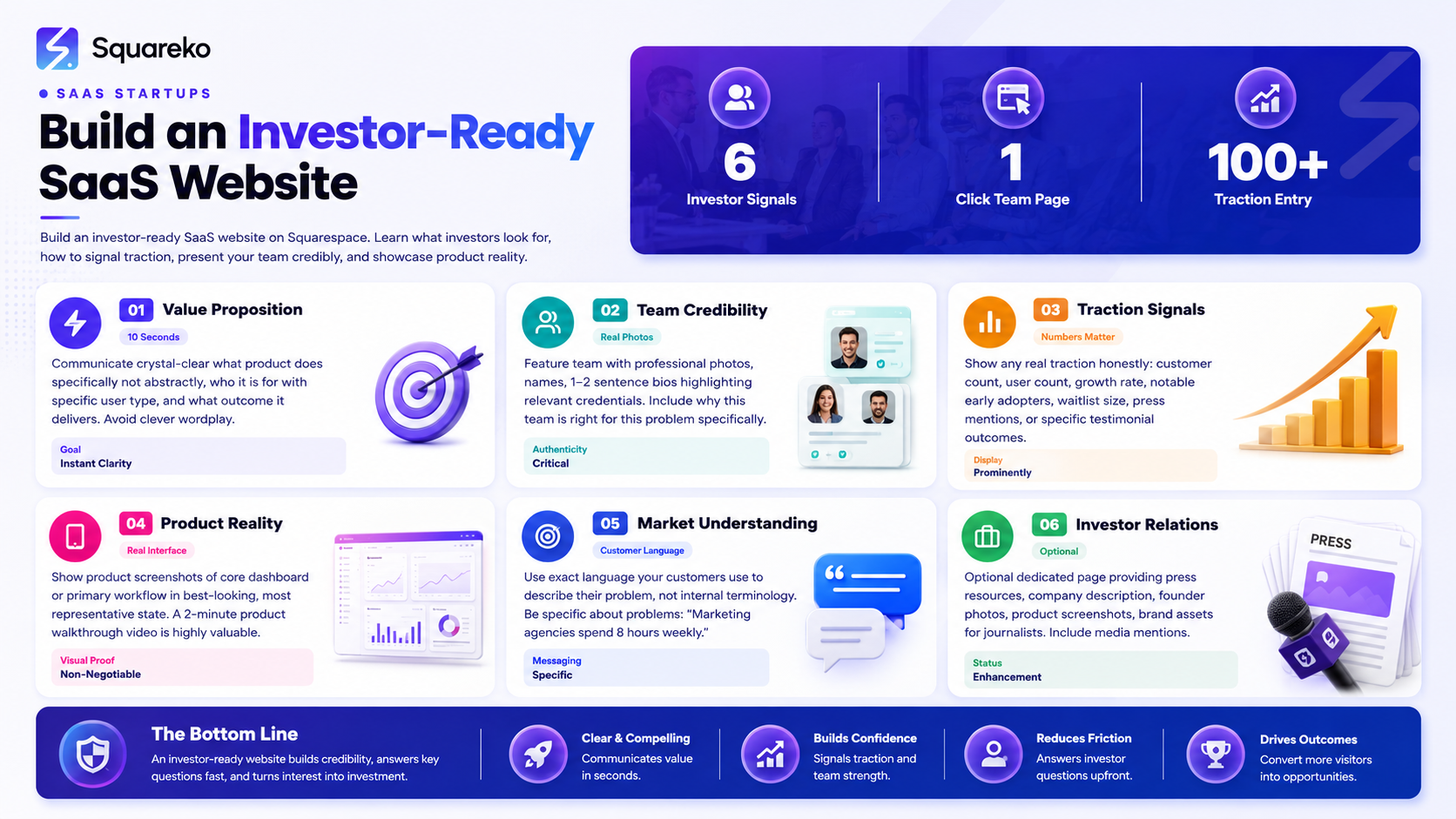
Investors assess execution quality through your website — a poorly built site signals poor judgment about what matters
The five things investors evaluate: value proposition clarity, team credibility, traction evidence, product reality, and market understanding
An investor-ready SaaS website doesn't look different from a great customer-facing website — it's the same thing built well
Squarespace's Fluid Engine is entirely capable of producing investor-grade web presence without custom development
Traction is the most powerful investor signal — find ways to show it clearly, even with limited data
The Five Investor Signals Your Website Must Send
1. Clear Value Proposition
Investors evaluate hundreds of companies. They have limited time to understand what each one does. If your website requires more than 10 seconds to communicate your core value proposition, you've already created friction.
Your website should communicate:
What the product does (specifically, not abstractly)
Who it's for (specific user type or industry)
What outcome it delivers (the measurable or tangible improvement)
This is the same clarity requirement as for customers — the difference is that investors are evaluating whether the market opportunity is real and whether this framing is sharp enough to compete.
2. Team Credibility
For early-stage SaaS companies especially, investors are often investing in the team as much as the product. Your website should make it easy for an investor to assess the founding team's credibility, relevant experience, and ability to execute.
3. Traction Evidence
Nothing speaks to an investor like evidence that real humans are using your product and finding value in it. Even early traction — 50 paying customers, 500 trial users, notable early adopters, or a significant waitlist — signals that the product solves a real problem.
4. Product Reality
Investors want to know the product exists and works. Screenshots, videos, or an interactive demo communicate this quickly. Abstract illustrations and vague benefit language raise questions about whether the product is actually built.
5. Market Understanding
Your website's messaging implicitly communicates whether you understand your market. Specific problem descriptions, specific customer language, and credible social proof from real users all signal market understanding. Generic marketing language signals you haven't talked to enough customers.
Homepage Design for Investor Credibility
An investor-ready homepage hits all five signals clearly, typically in this order:
Hero section: Crystal-clear value proposition. One sentence that a first-time reader can understand immediately. Avoid clever wordplay that forces the investor to interpret what you do.
Social proof bar: If you have notable customers, show logos. If you have usage numbers, show them. If you have press mentions, show publication names. Even small signals of validation matter.
Problem statement: A specific description of the problem your product addresses. If an investor recognizes the problem from their portfolio company experience or from their own life, you've created an aha moment.
Product showcase: Screenshots of the actual interface. This is non-optional for investor credibility — you must show the product exists and has a real interface.
Traction signals: Customer count, revenue indicators (even ranges), growth metrics, user testimonials. Placed mid-page where investors who are engaged will see them.
Team section: Name, photo, and 1-sentence credentials for each founder. Link to the full about page or team page. This should be on the homepage or a single click away.
In Squarespace's Fluid Engine, build these as distinct sections with intentional visual separation. The homepage for an investor should load fast and scan cleanly — avoid decorative elements that add visual complexity without conveying information.
The Team and About Page for Investors
For seed and pre-seed SaaS companies, the team page is often the most investor-relevant page on the site.
What Investors Look For in the Team Section
Relevant experience: Not just job titles — what have you done that makes you uniquely qualified to build this product? 10 years in enterprise software sales is more compelling than Former sales executive.
Complementary skills: A founding team with design, engineering, and commercial skills balanced appropriately is more fundable than a team of three engineers with no business development experience.
Authenticity: Real photos, real names, real LinkedIn links. Investors verify everything. A founder who is vague about their background on their own website raises red flags.
Why us: A brief statement about why this team is the right team for this problem. Not generic (we're passionate about innovation) but specific: We spent 6 years on the ops team at a logistics company watching this problem cost millions annually. We built this tool first for ourselves.
Building the Team Page in Squarespace
Use Squarespace's Fluid Engine to build a team section with: photo (professional, not stock), name, title, 2-3 sentence bio highlighting relevant credentials, LinkedIn link, and optionally other relevant social links.
For small founding teams (2-4 people), feature everyone with equal prominence. For larger teams, feature the founding team and key hires separately.
Showing Traction on Your Website
Traction is the most powerful signal you can send to an investor — and the most underutilized on early-stage SaaS websites. Founders often hide traction either because they're modest or because they don't think their numbers are impressive enough to share.
Almost any traction is worth showing if it's genuine:
Customer count: 100+ companies trust [product] — even 100 is meaningful for an early-stage SaaS.
User count: 2,500+ users signals that real people are using the product.
Growth rate: 3x growth in the last 6 months — relative growth is often more compelling than absolute numbers.
Notable early adopters: One recognizable customer logo is worth significant conversion.
Waitlist: Join 800+ companies on the waitlist — signals demand before you've launched.
Press mentions: As seen in [publication] logo bar — even a mention in a niche industry publication is worth showing.
Testimonial specificity: A testimonial with specific outcomes (reduced our reporting time by 80%) from a named person at a named company is compelling investor evidence.
In Squarespace, show traction through:
A statistics banner section (3-4 key numbers with context)
A client logo bar
Press mention logos
Featured testimonials with full attribution (name, title, company)
Product Clarity for Investors
Investors evaluate hundreds of decks with the same abstract claims: AI-powered, enterprise-grade, seamless workflow. These phrases are noise.
What cuts through: actual product screenshots and specific feature descriptions that make the product real.
Screenshots: Show the core dashboard or primary workflow. Make sure the interface looks clean and finished (or as close to finished as it is — being honest about being in development is better than showing mockups as if they're the product).
Demo video: A 2-minute product walkthrough video is highly valuable for investor-facing materials. If you have one, embed it on your homepage or a dedicated Product page.
Use case clarity: One or two specific use case descriptions — Here's how [company type] uses [product] to [specific outcome] — make the product value concrete and investor-legible.
Market Understanding Signals
Your messaging implicitly signals whether you understand your market. Investors with experience in your sector will immediately notice whether you're using language your actual customers use, or whether you're describing the market from the outside.
Customer language: Use the exact words your customers use to describe their problem. Not your internal language — the language from customer interviews, sales calls, and support tickets.
Specific problem statement: Marketing agencies spend an average of 8 hours per week creating client reports that clients don't read is market understanding. Businesses face challenges with reporting and communication is not.
Named competitive alternatives: If your customers compare you to a specific competitor, acknowledging that comparison on your website (in a vs page or comparison feature) signals you understand the competitive landscape. It also captures valuable search traffic.
An Investor Relations or Press Page
For SaaS companies actively fundraising or building public profile, an Investor Relations or Press page provides useful resources:
Press resources: Company description, founder photos, product screenshots, and brand assets for journalists and bloggers to use when covering you.
Media mentions: Curated list of notable press coverage with links.
For investors: A brief overview of your company, market, and traction, with a link to your deck (hosted privately, accessible via link) or a Request pitch deck form.
In Squarespace, this is a standard page build with an image gallery for brand assets, a text section for the company overview, and a contact form for media/investor inquiries.
Common Mistakes That Hurt Investor Confidence
Placeholder content: Lorem ipsum or Content coming soon anywhere on the site sends a signal about execution quality. Never launch a page that isn't complete.
Abstract product descriptions: We use AI to optimize business operations means nothing. Our AI automatically categorizes support tickets and routes them to the right team — reducing average response time from 4 hours to 23 minutes means something.
No social proof: Investors want to know the product works. Even a single specific testimonial from a named customer is better than none.
Team page with stock photos: Using stock photography for team members is immediately noticeable and damages authenticity. Real photos only.
No clear CTA: Your website should have a conversion goal even for investor visitors. Book a demo or Request a call gives investors an easy next step.
Claiming features that aren't built: Any claim you make on your website should reflect your actual product. Investors will request a demo — and if the demo doesn't match the website, you've lost credibility in the most damaging possible way.
Build Your Investor-Ready SaaS Website With Squareko
Squareko designs Squarespace websites for SaaS companies that communicate to both investors and users — built for credibility, clarity, and conversion.
FAQs
-
Yes. Investors use your website as a primary tool for first impressions before agreeing to a meeting. A well-built, clear website signals execution quality and strategic thinking. A poorly built or confusing website raises doubts. The website isn't the deciding factor in an investment decision, but it often determines whether investors engage at all.
-
Yes. Squarespace 7.1 with professional design (like Squareko delivers) produces a website that's visually competitive with any platform. The platform doesn't determine quality — the design, content, and strategy do. Many successful SaaS companies have raised significant funding with Squarespace marketing sites.
-
The homepage and the team/about page are the most important for investors. The homepage communicates value proposition, product reality, and traction. The team page communicates founder credibility and relevant experience. These two pages together form the core of an investor's first impression.
-
Any real traction is worth showing honestly: customer count (even 20-50 customers is real traction for pre-seed), waitlist size, trial user count, growth rate, press mentions, or a notable early adopter logo. Frame it appropriately — "50 companies in our beta" is honest and still shows validation. Avoid inflating numbers or misrepresenting your stage.
-
An investor relations or press page is useful for companies actively fundraising or building public profile. It centralizes resources (pitch deck request, press assets, media mentions) without cluttering your main customer-facing pages. For most early-stage startups, this is optional — a well-built customer-facing website serves investor audiences effectively without a dedicated investor page.
-
For early-stage SaaS, the team is often the primary investment signal — the product can pivot, but the team can't be replaced easily. A team page that clearly communicates relevant experience, complementary skills, and genuine motivation for building this specific product significantly influences whether investors take meetings. Be specific, authentic, and complete.
-
Show your core interface in its best-looking, most representative state. The primary dashboard or main workflow view is usually most compelling. Avoid empty state views, error screens, or overly complex views with too much data. Investors want to see that the product exists and has a real, professional interface — choose screenshots that demonstrate this clearly.
-
A product demo video is highly valuable but not required. If you have a clean 60-90 second walkthrough of your core workflow, embed it. If your product isn't yet at a stage where a video is presentable, skip it — a weak or clearly unfinished product demo does more harm than no video. Product screenshots are always sufficient for communicating product reality to investors.

From custom website design to SEO strategy, we help businesses launch a site that looks professional and performs better.

Author Bio
I'm Walid Hasan, a Certified Squarespace Expert and Squarespace Circle Platinum Partner with over 12 years of hands-on experience designing and optimizing high-performing websites. Over the years, I've had the privilege of building more than 2,000 Squarespace websites for clients around the world, always focusing on clean design, strong user experience, and conversion-driven results.